BYD(01211)

Search documents
小摩:预计比亚迪次季销量按季反弹 评级“增持”
Zhi Tong Cai Jing· 2026-03-06 09:07
Core Viewpoint - Morgan Stanley maintains a target price of HKD 110 for BYD (002594)(01211) with a rating of "Overweight" [1] Group 1: Product Developments - BYD has launched its second-generation blade battery and announced an expansion of its fast-charging network [1] - The company has introduced a total of 10 new pure electric and plug-in hybrid models across its brands, with deliveries expected to start in April or May [1] Group 2: Sales Forecast - BYD's sales are projected to rebound from approximately 700,000 units in the first quarter to between 1.1 million and 1.2 million units in the second quarter [1] Group 3: Market Focus - Investor attention is expected to shift towards the increase in store foot traffic around the Beijing Auto Show on April 24 [1]

小摩:预计比亚迪(01211)次季销量按季反弹 评级“增持”
智通财经网· 2026-03-06 09:01
Core Viewpoint - Morgan Stanley maintains a target price of HKD 110 for BYD (01211) with an "Overweight" rating, highlighting the company's recent product launches and expected sales growth [1] Group 1: Product Developments - BYD has launched its second-generation blade battery and announced an expansion of its fast-charging network [1] - The company has introduced a total of 10 new pure electric and plug-in hybrid models across its brands, with deliveries expected to start in April or May [1] Group 2: Sales Forecast - BYD's sales are projected to rebound from approximately 700,000 units in Q1 to between 1.1 million and 1.2 million units in Q2 [1] - Investor focus is anticipated to shift towards the increase in store traffic around the Beijing Auto Show on April 24 [1]
美银证券:比亚迪股份(01211)推第二代刀片电池 重申“买入”评级
智通财经网· 2026-03-06 09:01
智通财经APP获悉,美银证券发布研报称,比亚迪股份(01211)昨日(5日)举办2026年科技日,正式推出 第二代刀片电池及闪充技术。第二代刀片电池在常温下的充电时间缩短至5分钟及9分钟,而第一代刀片 电池则约需30分钟。在极寒天气下,充电时间少于12分钟。新一代电池在零下20度的容量保持率高于 85%。第二代刀片电池的能量密度较第一代刀片电池提升5%,因此可支持超过1,000公里的续航里程。 该行重申比亚迪"买入"评级及目标价122港元,因比亚迪海外业务贡献增加应有助其毛利率。 ...
美银证券:比亚迪股份推第二代刀片电池 重申“买入”评级
Zhi Tong Cai Jing· 2026-03-06 09:00
Group 1 - The core viewpoint of the article is that BYD has launched its second-generation blade battery and fast-charging technology, significantly improving charging times and energy density [1] Group 2 - The second-generation blade battery can be charged in 5 to 9 minutes at room temperature, compared to approximately 30 minutes for the first generation [1] - In extremely cold weather, the charging time is less than 12 minutes, with a capacity retention rate above 85% at -20 degrees Celsius [1] - The energy density of the second-generation blade battery is 5% higher than that of the first generation, enabling a range of over 1,000 kilometers [1] Group 3 - Bank of America Securities has reiterated a "buy" rating for BYD with a target price of HKD 122, citing increased contributions from overseas business that should help improve gross margins [1]
【联合发布】一周新车快讯(2026年2月28日-3月6日)
乘联分会· 2026-03-06 08:49
Core Viewpoint - The article provides an overview of new vehicle models set to be launched in 2026, detailing specifications, market segments, and pricing strategies for various manufacturers in the automotive industry. Group 1: New Vehicle Launches - Dongfeng Liuzhou's Fengxing Xinghai T5 is an A SUV set to launch on February 28, 2026, with a price range of 153,900 to 161,900 CNY and a pure electric range of 530 km [9]. - Xpeng Motors' X9, a C MPV, will be available from March 2, 2026, with prices ranging from 309,800 to 369,800 CNY and a maximum range of 750 km [17]. - GAC Aion's Aion i60, another A SUV, is scheduled for release on March 2, 2026, priced at 102,800 CNY, featuring a 1.5L range extender engine [25]. - SAIC Volkswagen's Volkswagen Teramont Pro, a C SUV, will launch on March 3, 2026, with a price of 344,900 CNY [33]. - Changan Automobile's Qiyuan A06, a C NB, will also be released on March 3, 2026, priced at 139,900 CNY [41]. Group 2: Specifications and Features - The Fengxing Xinghai T5 features a pure electric powertrain with a power output of 120 kW and torque of 240 N·m, with a battery capacity of 64.4 kWh [9]. - The Xpeng X9 offers multiple configurations with power outputs ranging from 235 kW to 370 kW, and a battery capacity of 94.8 kWh [17]. - The Aion i60 has a power output of 74 kW from its engine and 180 kW from its electric motor, with a battery capacity of 29.165 kWh [25]. - The Teramont Pro is equipped with a 2.0T engine producing 200 kW and 400 N·m of torque [33]. - The Qiyuan A06 features a 1.5L range extender engine with a power output of 72 kW and an electric motor output of 120 kW [41]. Group 3: Market Segmentation and Pricing - The article categorizes the new models into various segments, including A SUVs, C MPVs, and B SUVs, indicating a diverse market strategy [9][17][25][33][41]. - Pricing strategies vary significantly, with models like the Aion i60 positioned as more affordable options at 102,800 CNY, while luxury models like the BMW X5 are priced at 688,000 CNY [25][62]. - The introduction of multiple configurations for models like the Xpeng X9 allows for a broader appeal across different consumer segments [17].





花旗重申比亚迪买入评级,称其刀片电池充电速度全球领先
Bei Ke Cai Jing· 2026-03-06 08:39
Core Viewpoint - Citigroup reaffirms a "Buy" rating for BYD, highlighting the launch of its second-generation blade battery as a new global benchmark for mass production battery charging speed [1] Group 1 - BYD officially launched its second-generation blade battery on March 5, setting a new global standard for charging speed in mass production batteries [1] - Citigroup expects that BYD's inventory reduction in March, the rollout of new models from now until the second quarter, and the growth momentum in exports for March and April will act as catalysts for the company's performance [1] - The target price set by Citigroup for BYD is HKD 174 [1]

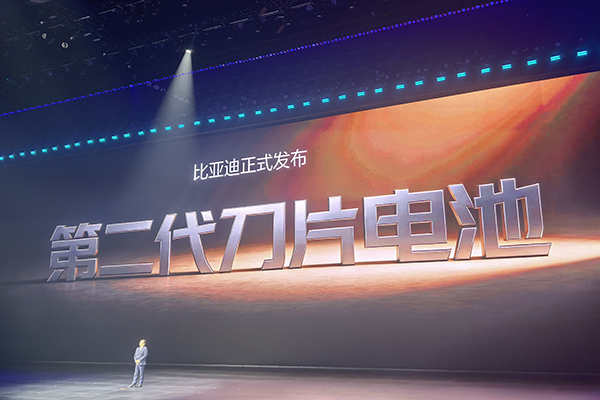
“5分钟充好,9分钟充饱”比亚迪闪充技术亮相 计划年底前建设2万座闪充站
Zhong Guo Jing Ji Wang· 2026-03-06 08:37
Core Viewpoint - BYD unveiled its "disruptive technology" during the "Waking of Insects" solar term, introducing the second-generation blade battery and flash charging technology, aiming to enhance its position in the electric vehicle market [1][3]. Group 1: Product Launch and Technology - On March 5, BYD held a launch event for its second-generation blade battery and flash charging technology, showcasing 10 models across its four brands equipped with this technology [3]. - The second-generation blade battery allows for "normal temperature charging in 5 minutes to 80%, and 9 minutes to full," and can charge in low temperatures with only a slight increase in time [3][9]. - The new battery technology has improved energy density by over 5% compared to the first generation, while also achieving a pure electric range of 1,036 kilometers for the Tengshi Z9GT model [11]. Group 2: Market Strategy and Sales Performance - BYD's sales have grown significantly, from over 700,000 units in 2021 to over 4.6 million units in 2023, placing it among the top five global automakers [5][6]. - Despite this growth, BYD faces challenges with declining domestic sales and increased competition, leading to a projected sales growth rate of only 7.73% in 2025 [6][8]. - The company plans to build 20,000 flash charging stations across China by the end of the year, enhancing its infrastructure to support the new technology [15][19]. Group 3: User Experience and Safety - The flash charging technology addresses user pain points such as slow charging speeds and range anxiety, which have been significant barriers to electric vehicle adoption [8][13]. - BYD has conducted extensive safety tests on the second-generation battery, demonstrating its safety under various conditions, including puncture tests and short-circuit tests [15]. - The new charging stations will feature a design that allows for easy user interaction and payment through the BYD flash charging app, promoting a seamless charging experience [17].
看完发布会,摩根大通更坚定看好比亚迪:不要纠结25年业绩,闪充有望颠覆行业!
Hua Er Jie Jian Wen· 2026-03-06 08:21
Core Viewpoint - Morgan Stanley maintains a positive outlook on BYD, highlighting that the combination of the second-generation blade battery and ultra-fast charging network positions BYD as a leader in the next phase of electric vehicle adoption [1][5] Group 1: Battery Technology - BYD's second-generation blade battery supports a maximum charging rate of 8C, allowing it to charge from 10% to 97% in just 9 minutes, setting a global record for mass-produced vehicles [2] - The new battery has an energy density of approximately 200Wh/kg, a 50% improvement over the first generation, and a theoretical cycle life of up to 4000 times, corresponding to about 15 years of vehicle use [2] - Safety tests exceed national standards, with no smoke or fire after 500 cycles of flash charging, and the thermal diffusion test conditions raised significantly [2] Group 2: Charging Infrastructure - BYD has established 4,239 ultra-fast charging stations and plans to expand to 20,000 by the end of 2026, ensuring that 90% of urban areas will have a charging station within 5 kilometers [5] - The charging stations are designed with a single-gun power of 1.5 megawatts and integrated energy storage systems to reduce grid impact [5] Group 3: Market Outlook - Morgan Stanley expects BYD's sales to rebound from approximately 700,000 units in Q1 2026 to between 1.1 million and 1.2 million units in Q2 2026, driven by the launch of 10 new models [5] - The year 2026 is anticipated to be a pivotal point for BYD's globalization strategy, with production capacity in Thailand, Indonesia, Brazil, and Hungary gradually increasing [5] - Morgan Stanley calculates a long-term reasonable stock price range for BYD between 94 and 121 HKD, with a target price of 110 HKD reflecting strong confidence in its future value [5]
花旗:比亚迪股份(01211)为量产电池充电速度树立全球标竿 重申“买入”评级
智通财经网· 2026-03-06 08:10
Core Viewpoint - Citigroup has reiterated a "Buy" rating for BYD Company Limited (01211) following the launch of its second-generation blade battery, which sets a new global benchmark for battery charging speed [1] Group 1: Product Development - BYD officially launched its second-generation blade battery, which is expected to lead the market in charging technology by at least one year [1] - The new battery technology is designed to perform strongly even in low-temperature environments, enhancing BYD's penetration into northern China and allowing it to capture market share from traditional fuel vehicles [1] Group 2: Market Strategy - The new strategy will unify BYD's electric vehicle battery and energy storage system battery businesses, creating a complementary relationship that is expected to enhance long-term operational leverage in battery production and potentially lower cost curves [1] - Citigroup anticipates that inventory reduction in March, the rollout of new models from now until the second quarter, and the month-on-month growth momentum in exports for March and April will serve as catalysts for BYD's performance [1] Group 3: Financial Outlook - Citigroup has set a target price of HKD 174 for BYD, reflecting confidence in the company's growth prospects [1] - The second-generation blade battery establishes new safety standards and limits for battery capacity degradation, which could further strengthen BYD's market position [1]
比加油还快!比亚迪发布第二代刀片电池:从10%充至97%仅需9分钟,极寒充电少于12分钟【附比亚迪企业分析】
Qian Zhan Wang· 2026-03-06 08:05
Core Insights - BYD has launched its second-generation blade battery, significantly improving charging efficiency, with the ability to charge from 10% to 70% in just 5 minutes and to 97% in 9 minutes, setting a new record for charging speed [2][3] - The second-generation blade battery features a 5% increase in energy density compared to the first generation, utilizing lithium iron phosphate with manganese and silicon-carbon anodes, and has optimized voltage platform and internal resistance [5] Charging Performance - In a controlled environment in Shenzhen, all tested models achieved charging from 10% to 70% in 5 minutes and from 10% to 97% in 9 minutes, comparable to refueling a gasoline vehicle [3][4] - The battery can also charge from 20% to 97% in 12 minutes in extreme cold conditions, demonstrating its reliability in low temperatures [4] Market Position and Sales - BYD has become a leading player in the global electric vehicle market, achieving sales of 1.8635 million electric vehicles in 2022, securing the title of the world's largest electric vehicle seller [9] - In 2025, BYD is projected to surpass Tesla in annual sales of pure electric vehicles, marking a significant milestone in the competitive landscape [11] Research and Development - BYD has consistently prioritized R&D, with 13 out of 14 years from 2011 to 2024 seeing R&D investments exceed net profits, and a 53% year-on-year increase in R&D spending in the first half of 2025, reaching 30.9 billion yuan [7][8] - The company is building a comprehensive battery ecosystem, covering upstream materials to recycling, and is advancing the development of semi-solid and all-solid-state batteries [7]