
AGRICULTURAL BANK OF CHINA(01288)

Search documents
农业银行(01288) - 2025 Q3 - 季度业绩
2025-10-30 08:30
Financial Performance - For Q3 2025, Agricultural Bank of China reported operating income of RMB 180,981 million, an increase of 4.30% year-on-year[7]. - The net profit attributable to shareholders for the same period was RMB 81,349 million, reflecting a growth of 3.66% compared to the previous year[7]. - The total operating income for the same period was RMB 550.77 billion, an increase of 1.87% year-on-year, while net interest income decreased by 2.40% to RMB 427.31 billion[17]. - For the nine months ended September 30, 2025, the group achieved a net profit of RMB 222.32 billion, representing a year-on-year growth of 3.28%[17]. - The bank reported a net profit of RMB 82.380 billion for the three months ending September 30, 2025, compared to RMB 78.768 billion in the same period of 2024, reflecting a growth of 3.9%[31]. - The bank's operating profit for the nine months ending September 30, 2025, was RMB 248.685 billion, up from RMB 241.308 billion in the same period of 2024[30]. - The bank's total comprehensive income for the nine months ending September 30, 2025, was RMB 206.532 billion, down from RMB 232.020 billion in the same period of 2024[31]. Assets and Liabilities - The total assets of the bank reached RMB 48,135,429 million, marking an increase of 11.33% from the end of the previous year[7]. - As of September 30, 2025, total assets reached RMB 48,135.43 billion, an increase of 11.33% compared to the end of the previous year[18]. - Total liabilities increased by 12.01% to RMB 44,960.22 billion compared to the end of the previous year[19]. - Total liabilities increased to RMB 44,960,218 million, up from RMB 40,140,862 million, reflecting a growth of approximately 12.5%[33]. - Customer loans and advances totaled RMB 26,987.57 billion, reflecting an increase of 8.36% from the end of the previous year[18]. - Customer loans and advances rose to RMB 26,019,737 million, compared to RMB 23,977,013 million in the previous year, marking an increase of about 8.7%[32]. - Customer deposits reached RMB 32,067.82 billion, an increase of 5.82% from the end of the previous year[19]. Shareholder Information - The total number of ordinary shareholders at the end of the reporting period was 539,787, with 520,726 being A-share shareholders[9]. - The top two shareholders, Central Huijin Investment Ltd. and the Ministry of Finance of the People's Republic of China, held 40.14% and 35.29% of shares respectively[9]. - The bank's equity attributable to shareholders was RMB 3,168,502 million, an increase of 2.51% from the previous year[7]. - The bank's total equity increased to RMB 3,175,211 million as of September 30, 2025, from RMB 3,097,273 million, representing an increase of approximately 2.5%[33]. - The bank has no restricted shares among its top shareholders, indicating a fully tradable share structure[10]. Dividends - The bank declared a final cash dividend of RMB 0.1255 per share for the fiscal year 2024, totaling RMB 43.923 billion[26]. - The board proposed an interim cash dividend of RMB 1.195 per 10 shares for the fiscal year 2025, amounting to RMB 41.823 billion, pending shareholder approval[26]. - The bank plans to distribute a cash dividend of RMB 4.12 per preferred share, totaling RMB 1.648 billion, for the fiscal year 2024-2025[26]. Capital and Financing - The capital adequacy ratio as of September 30, 2025, was 17.78%, with a Tier 1 capital adequacy ratio of 12.92%[23]. - The group issued RMB 600 billion in Tier 2 capital bonds in both July and September 2025[24]. - The group also issued RMB 500 billion in total loss-absorbing capacity non-capital bonds in August 2025[24]. - The bank issued debt securities amounting to RMB 3,450,107 million during the nine months ended September 30, 2025, compared to RMB 2,920,323 million in the same period of 2024, an increase of about 18.2%[36]. Cash Flow - The net cash flow from operating activities for the year-to-date period was RMB 2,034,128 million, showing an increase of 8.49%[7]. - Net cash from operating activities for the nine months ended September 30, 2025, was RMB 2,034,128 million, compared to RMB 1,874,980 million for the same period in 2024, an increase of about 8.5%[35]. - Cash and cash equivalents at the end of the period reached RMB 2,933,380 million, up from RMB 2,780,032 million, indicating an increase of approximately 5.5%[36]. - The bank's net cash used in investing activities for the nine months ended September 30, 2025, was RMB (1,208,002) million, an improvement from RMB (1,771,297) million in 2024[36]. - The bank's interest income from investment securities for the nine months ended September 30, 2025, was RMB (275,590) million, compared to RMB (267,368) million in 2024, indicating a slight increase of about 3.4%[35]. Non-Performing Loans - The non-performing loan balance was RMB 341.40 billion, with a non-performing loan ratio of 1.27%, a decrease of 0.03 percentage points from the end of the previous year[20].
港股通央企红利ETF天弘(159281)跌0.19%,成交额6765.17万元
Xin Lang Cai Jing· 2025-10-30 07:18
Core Points - Tianhong CSI Hong Kong Stock Connect Central State-Owned Enterprises Dividend ETF (159281) closed down 0.19% on October 30, with a trading volume of 67.65 million yuan [1] - The fund was established on August 20, 2025, with an annual management fee of 0.50% and a custody fee of 0.10% [1] - As of October 29, the fund's latest share count was 224 million shares, with a total size of 230 million yuan [1] - Over the past 20 trading days, the fund's cumulative trading amount reached 1.13 billion yuan, with an average daily trading amount of 56.48 million yuan [1] - The current fund manager is He Yuxuan, who has managed the fund since its inception, achieving a return of 2.56% during the tenure [1] Holdings Summary - The top holdings of Tianhong CSI Hong Kong Stock Connect Central State-Owned Enterprises Dividend ETF include: - COSCO Shipping Holdings (0.85% holding, 218,000 shares, market value of 2.9175 million yuan) [2] - Orient Overseas International (0.40% holding, 10,500 shares, market value of 1.3717 million yuan) [2] - China Foreign Transport (0.33% holding, 270,000 shares, market value of 1.1396 million yuan) [2] - China Petroleum & Chemical Corporation (0.32% holding, 162,000 shares, market value of 1.0973 million yuan) [2] - CITIC Bank (0.32% holding, 175,000 shares, market value of 1.1136 million yuan) [2] - CNOOC (0.29% holding, 58,000 shares, market value of 1.0041 million yuan) [2] - China Shenhua Energy (0.29% holding, 30,500 shares, market value of 982,600 yuan) [2] - China People's Insurance Group (0.29% holding, 164,000 shares, market value of 1.0107 million yuan) [2] - China Unicom (0.28% holding, 104,000 shares, market value of 952,800 yuan) [2] - Agricultural Bank of China (0.27% holding, 189,000 shares, market value of 933,900 yuan) [2]


多家银行调整积存金起投门槛
Jing Ji Wang· 2025-10-30 02:12
Core Viewpoint - The international gold price has been fluctuating at high levels, leading banks to adjust their precious metal business strategies, particularly by optimizing the minimum investment thresholds for gold accumulation products [1][2]. Group 1: Strategy Adjustments by Banks - Many banks have recently optimized the minimum investment thresholds for gold accumulation products in response to the current high volatility in gold prices and increased market risks [1][4]. - The Bank of Communications has introduced a floating mechanism for its gold accumulation plan, where the minimum investment amount will be adjusted according to real-time gold prices starting from October 27, 2025 [2][3]. - Other banks, including Agricultural Bank of China, have also announced similar adjustments to their gold accumulation products, moving towards a model that reflects real-time market conditions [2][4]. Group 2: Market Trends and Compliance - The floating mechanism linked to real-time gold prices helps avoid frequent manual adjustments and aligns with regulatory requirements, thus enhancing risk management and compliance [3][4]. - Several banks, including ICBC and Bank of China, have raised their minimum investment amounts for gold accumulation products in October, reflecting the need to ensure compliance and manage risks associated with rising gold prices [4][5]. - The increase in minimum investment thresholds is seen as a measure to curb speculative behavior among investors amid rising gold prices [4][6]. Group 3: Investor Education and Risk Management - Banks are also intensifying investor education by issuing risk warnings, advising clients to pay attention to market changes and manage their positions carefully [5][6]. - The combination of adjusting investment thresholds and providing risk warnings is aimed at enhancing risk control while ensuring compliance and protecting consumer rights [6].



村镇银行“归巢” 国有大行与区域银行齐发力
Bei Jing Shang Bao· 2025-10-30 00:34
Core Viewpoint - The ongoing "return to the nest" reform of village banks, led by main initiating banks, aims to address risks and optimize the financial layout in rural areas, ensuring that financial services remain rooted in local communities and meet the needs of rural residents [1][7][11]. Summary by Sections Village Bank Mergers and Acquisitions - On October 29, three village banks in Shandong were approved for dissolution, with their assets and operations taken over by Qingdao Rural Commercial Bank, marking a significant step in the "village to branch" reform [1][2]. - The day before, six village banks in Sichuan were also absorbed by Chengdu Rural Commercial Bank, indicating a broader trend of consolidation in the sector [2][3]. Background and Rationale - Village banks were established to serve "three rural issues," small and micro enterprises, and county-level economies, filling gaps left by traditional financial institutions. However, many have strayed from their original mission due to weak capital, governance issues, and inadequate risk control [7][11]. - The "village to branch" reform involves the absorption of village banks into their main initiating banks, eliminating their independent legal status and allowing for unified management and operations [7][11]. Strategic Implications - The main initiating banks can leverage their risk management frameworks and capital allocation mechanisms to reduce potential risks associated with village banks, enhancing their overall risk resilience [4][10]. - The consolidation allows main banks to deepen their penetration into rural financial markets by utilizing existing customer bases and branch networks of the absorbed village banks [4][10]. Future Outlook - The reform is expected to continue, with more village banks likely to be integrated into main initiating bank systems, as highlighted by recent regulatory approvals and ongoing discussions in the financial sector [11][12]. - The central government's emphasis on rural financial reform and the need for differentiated strategies for different institutions will be crucial for the success of these reforms [11][12].


11月起,银行存取款迎来新变化?3大趋势下,储户需要留意
Sou Hu Cai Jing· 2025-10-29 18:11
Core Points - The article discusses upcoming changes in banking regulations in China, effective from November 2025, which aim to simplify banking processes and enhance customer experience [3][4][5][6][10]. Group 1: Changes in Withdrawal Procedures - The optimization of the large withdrawal appointment system will allow customers to make appointments through various channels such as mobile banking apps, phone banking, and WeChat banking, rather than only in-person [4][5]. - The requirement to explain the purpose of cash withdrawals over 50,000 yuan will be simplified, with the new regulations indicating that this information will be optional [5][10]. - The daily withdrawal limit at ATMs will increase from 20,000 yuan to 30,000 yuan, enhancing convenience for customers [6][8]. Group 2: Credit Card and Fee Adjustments - Credit card functionalities will be upgraded, allowing for better integration with third-party payment wallets while maintaining cross-border transaction capabilities [8][9]. - The elimination of intercity withdrawal fees will provide significant savings for customers, with an estimated 6.7 billion yuan in fees collected in 2024 [10][12]. Group 3: Customer Feedback and Industry Response - Public sentiment regarding the new regulations is largely positive, with approximately 70% of online discussions reflecting approval for the changes [12][13]. - Banks are preparing for the implementation of these new regulations by updating systems and training staff to ensure smooth transitions [16][18].



农业银行唱响“农银养老之歌”
Xin Hua Wang· 2025-10-29 13:21
Core Viewpoint - Agricultural Bank of China is launching a series of activities themed around elderly care and financial services, aiming to enhance the quality of life for senior citizens and provide tailored financial solutions for their retirement needs [1][4][7]. Group 1: Elderly Care Financial Services - The bank is initiating the "Golden Years, Agricultural Affection" campaign, which includes ten major themed activities focused on retirement asset preservation and growth, as well as financing for enterprises [4][6]. - Agricultural Bank is committed to offering comprehensive financial services that integrate loans, bonds, funds, stocks, consulting, and leasing to support the elderly care industry [7]. Group 2: Community and Lifestyle Support - The bank collaborates with local governments and communities to enhance home-based elderly care services, including medical assistance, meal delivery, and cleaning services [11]. - Activities promoting traditional culture, such as calligraphy, tea ceremonies, and cultural attire, are organized to enrich the quality of life for seniors [12]. Group 3: Digital and Financial Security - The bank aims to assist seniors in embracing the digital age by providing training on using smartphones and online banking for everyday conveniences [17]. - It emphasizes the importance of financial security by raising awareness about risks such as telecom fraud and illegal fundraising [18].

主发起行密集收编,村镇银行“归巢”
Bei Jing Shang Bao· 2025-10-29 13:10
Core Viewpoint - The ongoing "return to the nest" reform of village banks, led by main initiating banks, aims to address risks and optimize the financial layout in rural areas, transitioning from scale expansion to quality improvement in financial services [1][8]. Summary by Sections Village Bank Dissolution and Integration - On October 29, three village banks in Shandong were approved for dissolution, with their assets and operations taken over by Qingdao Rural Commercial Bank [3][5]. - Similarly, six village banks in Sichuan were absorbed by Chengdu Rural Commercial Bank, marking a significant shift in the operational structure of these institutions [3][5]. Background and Purpose of Village Banks - Village banks were established to serve the "three rural issues" and small enterprises, filling gaps in financial services at the grassroots level [8][12]. - However, many have deviated from their original purpose due to weak capital, governance issues, and inadequate risk control, leading to a need for consolidation [8][12]. "Village to Branch" Reform Mechanism - The "village to branch" reform involves the absorption of village banks into their initiating banks, eliminating their independent legal status and consolidating operations [8][12]. - This process can occur through two main pathways: full acquisition of shares by the initiating bank or the integration of multiple village banks into a regional management branch [8][12]. Strategic Benefits of Consolidation - The consolidation allows initiating banks to leverage unified risk management frameworks and capital allocation mechanisms, enhancing the overall risk resilience of the absorbed village banks [6][11]. - It also facilitates the expansion of county-level financial services by utilizing existing customer bases and branch networks [6][11]. Future Outlook and Challenges - The reform is expected to continue, with more village banks likely to be integrated into main banks, as highlighted by recent regulatory approvals [12][13]. - However, there are concerns about potential drawbacks, such as longer decision-making processes and increased product homogeneity, which could hinder the unique advantages of village banks [12][13].

账户扩容、服务升级、产业赋能,银行业养老金融迈入“精耕时代”
2 1 Shi Ji Jing Ji Bao Dao· 2025-10-29 09:43
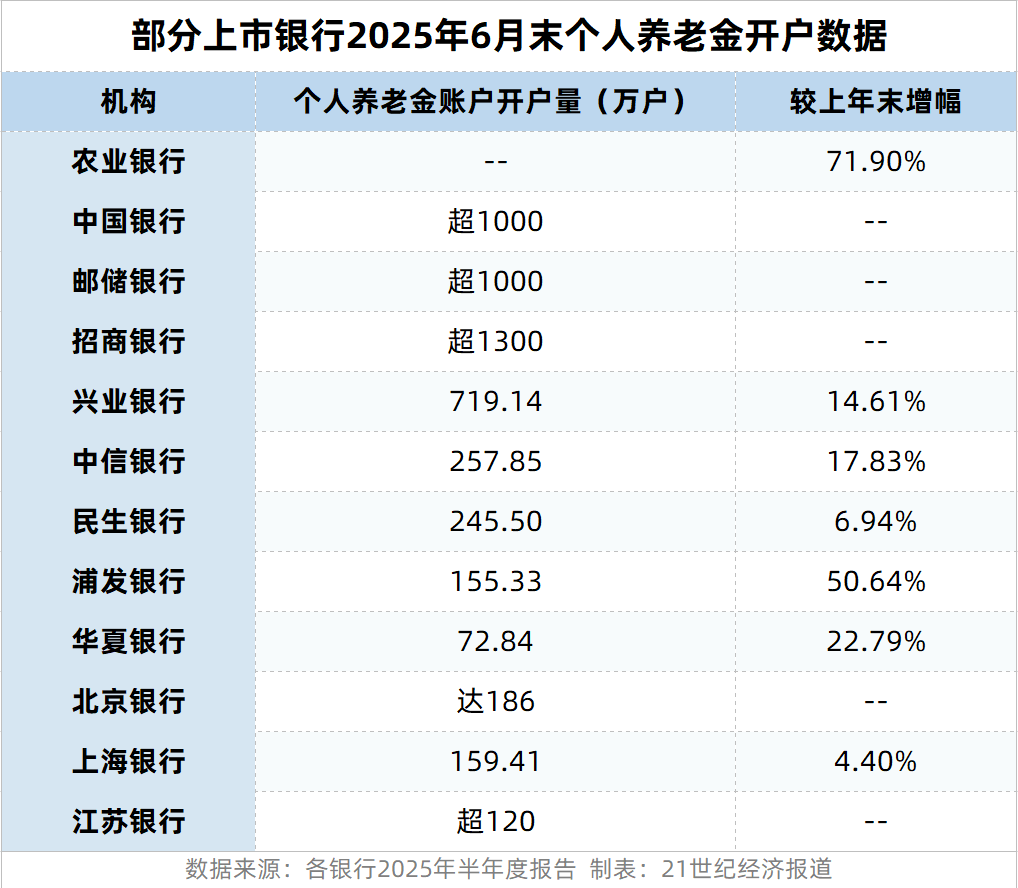
Core Insights - The article discusses the significant awakening of the "silver economy" in China, driven by the acceleration of the pension system and the elevation of pension services to a national strategic level [1][13] Group 1: Pension Financial Services - The competition in the pension financial sector is shifting from scale expansion to deep operation and value extraction, with personal pension accounts reaching over ten million for several banks [2][3] - Agricultural Bank of China saw a 71.9% increase in personal pension account openings compared to the previous year, while other banks like China Bank and Postal Savings Bank also reported significant growth [2][3] - The product supply for personal pensions is expanding, with banks offering a wider range of investment options to meet diverse customer needs [3][4] Group 2: Comprehensive Pension Services - Banks are moving towards a "one-stop" service model that integrates pension planning, wealth management, health management, and lifestyle services [5][6] - Several banks are targeting younger demographics to promote early pension planning, with initiatives aimed at educating and engaging younger clients [6] Group 3: Pension Service Financials - Banks are enhancing their service experiences through physical and digital adaptations, such as creating senior-friendly banking environments and improving online banking interfaces [7][8] - Initiatives like home service offerings and community engagement programs are being implemented to extend financial services to the elderly [8][9] Group 4: Pension Industry Financials - The pension industry financial sector is experiencing significant growth, with Agricultural Bank of China's pension industry loan balance reaching 21.6 billion yuan, a 94.6% increase from the previous year [10][11] - Innovative financial service models are emerging, such as loans linked to the usage rates of elderly care facilities, indicating a shift towards enhancing service quality in the sector [11][12] Group 5: Future Outlook - The banking sector is redefining its approach to the pension market, establishing dedicated departments and brands to enhance focus on pension financial services [13] - Digital transformation is seen as a key driver for the evolution of pension financial services, with technologies like AI and big data being leveraged to improve service delivery [13][14]
农银养老服务中心落地泰康之家琴园,青岛农行打造养老金融服务“暖心驿站”
Xin Lang Cai Jing· 2025-10-29 09:37
Core Insights - The event "Agricultural Bank Pension Happiness Launch - Qingdao Station" aimed to enhance the risk awareness of the elderly and promote financial consumer rights protection [1][2] - The establishment of the "Agricultural Bank Pension Service Center" signifies a collaborative effort to create a reliable financial service platform for the elderly [2] Group 1: Event Overview - The event was hosted by the Agricultural Bank of China Qingdao Branch and attended by over 100 elderly residents, emphasizing the importance of safeguarding their retirement funds [1] - Key figures from the Qingdao Financial Regulatory Bureau, Agricultural Bank, and Taikang Life expressed their commitment to improving elderly financial services through collaboration [1][2] Group 2: Educational Initiatives - The core educational segment focused on "Protecting Retirement Funds," utilizing real-life fraud cases to teach elderly attendees about fraud recognition and risk prevention [2] - A social security policy consultation area was set up to address concerns regarding pension qualification and social security cards, enhancing the understanding of social security among the elderly [2] Group 3: Cultural Engagement - The event featured engaging performances, including a comedic skit and songs, to create a lively atmosphere while reinforcing anti-fraud messages [3] - The Agricultural Bank is committed to expanding its pension financial service coverage and developing a high-quality pension financial service system [3]
农业银行总法律顾问赵廷军:数智时代需筑牢AI风险防控与法治保障双基石
Bei Jing Shang Bao· 2025-10-29 09:14
Core Viewpoint - The agricultural bank is addressing the challenges and opportunities presented by artificial intelligence in risk management and operational transformation within the banking sector [2][3]. Group 1: Risks and Challenges - The bank faces increasingly diverse risks, with artificial intelligence introducing new challenges related to data quality, model design, and algorithm effectiveness [2]. - The complexity of risk forms has increased, highlighting the importance of data security and personal information protection, as well as rising legal compliance risks due to cross-border data flow [2]. Group 2: Risk Management Strategies - The bank aims to enhance its risk prevention capabilities by improving the convenience and security of financial services, ensuring the protection of customer rights, especially for vulnerable groups [3]. - A robust risk control system is emphasized, focusing on technology empowerment, data quality enhancement, model management, and cybersecurity to safeguard customer information [3]. - The bank is committed to optimizing business processes and establishing a collaborative risk prevention community, including mechanisms for third-party cooperation and stress testing [3].