AGRICULTURAL BANK OF CHINA(01288)

Search documents
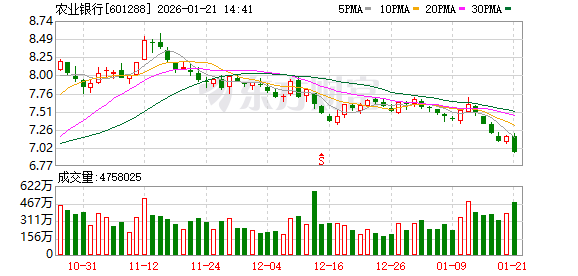
银行板块持续调整 农业银行跌近3%
Mei Ri Jing Ji Xin Wen· 2026-01-21 06:40
每经AI快讯,1月21日午后,银行板块持续调整,农业银行跌近3%,工商银行、中信银行、浦发银行、 重庆银行、邮储银行等跌幅靠前。 (文章来源:每日经济新闻) ...





今日沪指涨0.16% 电子行业涨幅最大
Zheng Quan Shi Bao Wang· 2026-01-21 05:20
Market Overview - The Shanghai Composite Index increased by 0.16% today, with a trading volume of 914.25 million shares and a total transaction value of 1,645.83 billion yuan, representing an 11.70% decrease compared to the previous trading day [1] Industry Performance - The electronics sector led the market with a gain of 1.99%, followed by non-ferrous metals at 1.50% and computers at 1.00% [1] - The coal, food and beverage, and banking sectors experienced the largest declines, with decreases of 1.61%, 1.14%, and 1.04% respectively [1] Detailed Industry Data - **Electronics**: - Change: +1.99% - Transaction Value: 3,505.53 billion yuan - Change from Previous Day: +6.05% - Leading Stock: Zhongrong Electric with a gain of 20.00% [1] - **Non-Ferrous Metals**: - Change: +1.50% - Transaction Value: 1,263.24 billion yuan - Change from Previous Day: +5.54% - Leading Stock: Zhaojin Gold with a gain of 10.02% [1] - **Computers**: - Change: +1.00% - Transaction Value: 1,132.04 billion yuan - Change from Previous Day: -9.94% - Leading Stock: *ST Lifan with a gain of 20.00% [1] - **Coal**: - Change: -1.61% - Transaction Value: 65.82 billion yuan - Change from Previous Day: -11.98% - Leading Stock: Dayou Energy with a decline of 7.90% [2] - **Food and Beverage**: - Change: -1.14% - Transaction Value: 191.49 billion yuan - Change from Previous Day: -10.06% - Leading Stock: Happy Home with a decline of 8.99% [2] - **Banking**: - Change: -1.04% - Transaction Value: 161.40 billion yuan - Change from Previous Day: -10.47% - Leading Stock: Agricultural Bank with a decline of 1.67% [2]
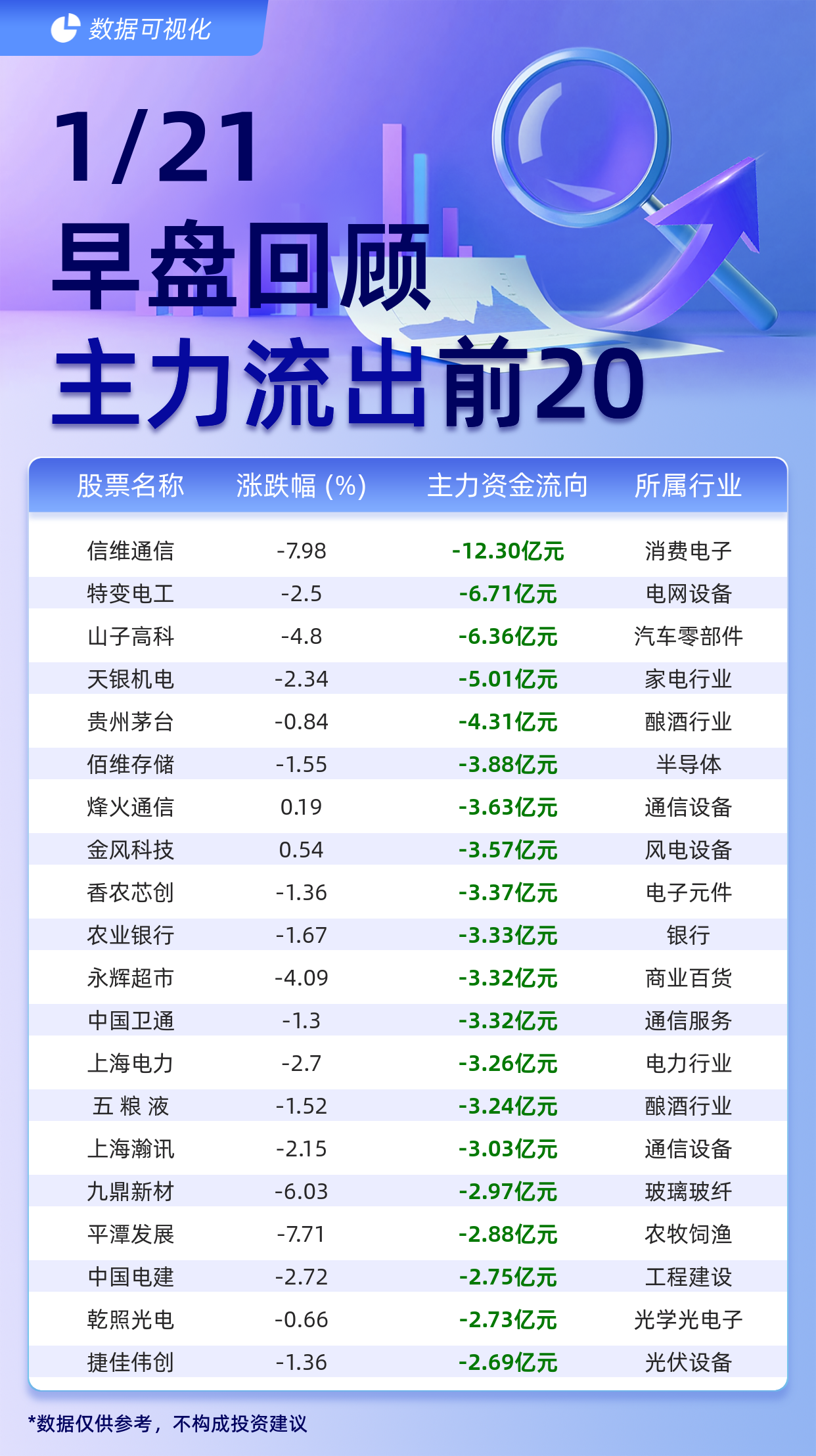
主力个股资金流出前20:信维通信流出12.30亿元、特变电工流出6.71亿元
Jin Rong Jie· 2026-01-21 04:04
Core Viewpoint - The data indicates significant outflows of capital from various stocks, with notable declines in share prices across multiple sectors, suggesting a bearish sentiment in the market. Group 1: Major Stocks with Capital Outflows - Xinyi Communication experienced a capital outflow of 1.23 billion, with a price drop of 7.98% [1][2] - Tebian Electric witnessed a capital outflow of 671 million, with a price decline of 2.5% [1][2] - Shanzi Gaoke had a capital outflow of 636 million, with a decrease of 4.8% [1][2] - Tianyin Electromechanical saw an outflow of 501 million, with a drop of 2.34% [1][2] - Kweichow Moutai experienced a capital outflow of 431 million, with a decline of 0.84% [1][2] Group 2: Additional Stocks with Notable Outflows - Baiwei Storage had a capital outflow of 388 million, with a price drop of 1.55% [1][2] - Fenghuo Communication saw an outflow of 363 million, with a slight increase of 0.19% [1][2] - Goldwind Technology experienced a capital outflow of 357 million, with a price increase of 0.54% [1][2] - Shannon Chip Creation had an outflow of 337 million, with a decline of 1.36% [1][2] - Agricultural Bank saw a capital outflow of 333 million, with a drop of 1.67% [1][2] Group 3: Further Stocks with Capital Outflows - China Satellite Communications experienced a capital outflow of 332 million, with a decline of 1.3% [3] - Shanghai Electric saw an outflow of 326 million, with a price drop of 2.7% [3] - Wuliangye experienced a capital outflow of 324 million, with a decline of 1.52% [3] - Shanghai Hanxun had an outflow of 303 million, with a drop of 2.15% [3] - Jiuding New Materials saw a capital outflow of 297 million, with a significant decline of 6.03% [3]



消费贷贴息新政“加速度”!怎么办?5家银行连夜发指引
Nan Fang Du Shi Bao· 2026-01-21 03:40
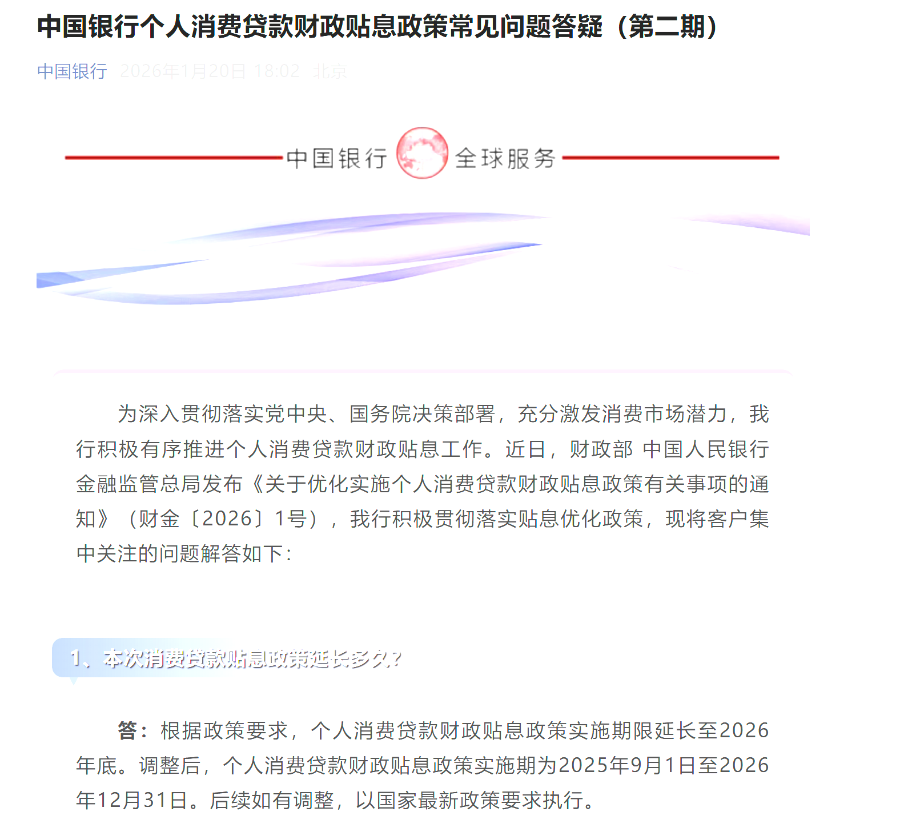
Core Viewpoint - The Ministry of Finance, the People's Bank of China, and the Financial Regulatory Administration jointly issued a notice to optimize the implementation of personal consumption loan interest subsidy policies, extending the policy duration, expanding the subsidy scope, and adjusting subsidy standards [2][4]. Policy Adjustments - The personal consumption loan interest subsidy policy now covers the period from September 1, 2025, to December 31, 2026, with a new specific implementation period for credit card bill installment subsidies from January 1, 2026, to December 31, 2026 [5]. - The previous restriction on key areas for consumption loans of 50,000 yuan and above has been lifted, allowing consumers to enjoy subsidies for all areas of personal consumption loans [7]. - The subsidy standards have been adjusted to unify the annual subsidy cap for each borrower at 3,000 yuan, with the subsidy shared between personal consumption loans and credit card installment loans [7]. Bank Responses - Major state-owned banks and representative joint-stock banks, including Bank of China, Agricultural Bank of China, Postal Savings Bank, and China Merchants Bank, have quickly responded by issuing detailed implementation guidelines and customer FAQs [2][5]. - Banks have emphasized the convenience of the application process, with various banks providing different channels for customers to apply for subsidies, such as mobile banking and customer service hotlines [8][10]. Implementation and Compliance - Existing customers who have already applied for subsidies will automatically benefit from the new policy without needing to re-sign agreements [9]. - Banks have committed to a "direct deduction" model for subsidy funds, ensuring that no additional fees are charged and that all processes are handled through official channels [10]. - Consumers are warned against fraudulent activities related to subsidy applications, with strict penalties for violations [10].

创新产品“贷”动乡村产业发展
Jin Rong Shi Bao· 2026-01-21 03:24
Core Insights - The Agricultural Bank of China (ABC) in Liuzhou, Guangxi, is implementing a new financial service model that focuses on "industry demand orientation and precise financial adaptation" to support local agriculture [1] - ABC has introduced specific loan products like "Jinju Loan" and "Jinju Trade Loan" to assist local farmers and e-commerce operators in preparing packaging materials and covering logistics costs, ensuring fresh citrus fruits reach consumers quickly [1] - The bank has committed to injecting 48 million yuan (approximately 6.7 million USD) into the local Jinju e-commerce industry by December 2025, supporting 41 producers and e-commerce operators [1] - In Luzhai County, the "Grain Farmer e-Loan" product was designed to meet the needs of large-scale grain producers, providing quick access to funds with a processing time of only three working days [1] - Over 5,200 grain producers in Luzhai have received more than 450 million yuan (approximately 63 million USD) in credit support, addressing their funding challenges for land rent, labor, machinery, and agricultural inputs [1] - ABC's financial services are transforming traditional agricultural production and operations in the region, injecting sustainable and active momentum into rural revitalization [1]
个人消费贷贴息政策“延期扩围”,大行股份行快速跟进,新入围地方银行:客户流失担忧消除
Xin Lang Cai Jing· 2026-01-21 02:48
Core Viewpoint - The newly revised consumer loan interest subsidy policy is expected to stimulate domestic consumption recovery by encouraging banks to increase consumer loan issuance [1][7]. Group 1: Policy Implementation - Major state-owned banks and joint-stock banks, including Agricultural Bank of China, Bank of China, and Postal Savings Bank, have promptly responded to the new consumer loan interest subsidy policy [1][7]. - Postal Savings Bank announced that from September 1, 2025, to December 31, 2026, personal consumption loans used for actual consumption will be eligible for interest subsidies, with credit card bill installments also included in the subsidy scope [2][8]. - The policy removes the previous restriction on single transactions of 50,000 yuan or more for eligible consumption transactions [2][8]. Group 2: Operational Procedures - China Merchants Bank outlined that customers must follow specific procedures to apply for the consumer loan interest subsidy, including signing a supplementary agreement during or after the loan issuance [3][9]. - The bank will calculate the subsidy amount based on the agreed-upon subsidy ratio and cap, directly deducting the subsidy from the interest charged to customers [3][9]. Group 3: Inclusion of More Financial Institutions - The latest policy expansion includes city commercial banks, foreign banks, and consumer finance institutions, which were previously excluded from the interest subsidy program [4][10]. - This expansion aims to enhance fairness and inclusivity in the financial system, encouraging local banks to actively participate in consumer loan issuance [4][10]. - Industry insiders expressed optimism about the inclusion of more consumer finance companies, indicating readiness to implement the policy effectively [5][11].

黄金投资带火银行“小众”业务
Zheng Quan Ri Bao· 2026-01-20 23:20
Core Insights - The demand for bank safe deposit boxes is surging due to the increasing interest in gold investments among residents, leading to a significant supply-demand imbalance in the market [1][4][5] - Many banks are experiencing a shortage of available safe deposit boxes, with waiting times for larger boxes extending up to 3 to 5 years [2][3][5] - The safe deposit box rental business, traditionally a niche service, is gaining mainstream attention as more customers seek to store physical gold and other valuables [3][4] Demand Factors - The rising trend of gold investment among residents has led to a marked increase in the demand for safe deposit boxes to store physical gold and precious metals [4][5] - Customers prefer physical gold over other investment products due to its perceived stability and security [4] Supply Factors - The supply of safe deposit boxes is constrained by the fixed capacity of bank facilities, making it difficult to expand the number of available boxes [5][6] - The rental process is slow, with many customers opting for long-term leases, which further limits the turnover of available boxes [5][6] Business Dynamics - The safe deposit box rental service is characterized by high initial investment and ongoing operational costs, which may deter banks from expanding this service [6][7] - Some banks have ceased offering safe deposit box services due to business adjustments and the high costs associated with maintaining security standards [6][7] Technological Advancements - The integration of digital and intelligent technologies is revitalizing the traditional safe deposit box business, enhancing security and customer experience [7][8] - Innovations such as biometric verification and automated safe deposit boxes are being introduced, allowing for more efficient and secure access [7][8]



大行回应!消费贷贴息政策升级,这些细节已明确
Di Yi Cai Jing· 2026-01-20 15:26
Core Viewpoint - The personal consumption loan interest subsidy policy is undergoing significant upgrades, with the implementation period extended to the end of 2026 and the inclusion of credit card installment payments in the subsidy scope [1][2]. Group 1: Policy Implementation Details - The new policy will be effective from January 1, 2026, and will cover personal consumption loans issued from September 1, 2025, to December 31, 2026, including credit card installment payments [2]. - Several major banks, including Agricultural Bank of China, Bank of China, and Postal Savings Bank, have confirmed their commitment to implementing the new policy and addressing common customer inquiries [1][2]. Group 2: Scope of Subsidy - The subsidy range has been expanded to include credit card installment payments, and previous restrictions on consumption categories have been lifted, allowing for broader eligibility [4][6]. - The previous limit of 50,000 yuan for single transactions has been removed, enabling consumers to benefit from subsidies regardless of the consumption category [4][6]. Group 3: Changes in Subsidy Amounts - The new policy eliminates the previous cap of 500 yuan on single transaction subsidies and the 1,000 yuan cumulative limit for loans under 50,000 yuan, while maintaining an annual cap of 3,000 yuan per borrower [6]. - The annual subsidy rate remains at 1% of the eligible loan amount, with a maximum of 50% of the loan contract interest rate applicable [6]. Group 4: Application Process for Subsidy - Customers can apply for the subsidy when signing loan contracts or credit card installment agreements, with banks required to verify transaction information for subsidy eligibility [7][8]. - If the system fails to recognize transactions, customers can provide proof of consumption for manual review and approval of the subsidy [7]. Group 5: Important Considerations - Banks emphasize that fraudulent activities or misrepresentation in loan applications will result in disqualification from receiving subsidies and potential legal consequences [10]. - Customers are advised that there are no fees associated with the subsidy application process, and banks will not engage third parties for processing [10].
信用卡账单分期纳入贴息!多家大行新政落地,这些红利可享
2 1 Shi Ji Jing Ji Bao Dao· 2026-01-20 15:06
Core Insights - The Chinese government is implementing a series of fiscal policies aimed at boosting domestic demand and promoting high-quality economic development, with a focus on six new policies, particularly two interest subsidy policies for the service sector and personal consumption loans [2][4]. Group 1: Policy Duration and Implementation - The personal consumption loan interest subsidy policy will be uniformly executed by Agricultural Bank of China, Bank of China, and Postal Savings Bank from September 1, 2025, to December 31, 2026 [5]. - The service sector loan interest subsidy policy, currently announced by Agricultural Bank of China, will also extend to December 31, 2026, with existing loans issued between March 16, 2025, and December 31, 2025, continuing under previous regulations [5]. Group 2: Optimized Subsidy Scope - The new policy includes credit card bill installment payments as part of the subsidy scope, effective from January 1, 2026, to December 31, 2026, with a subsidy rate of 1% per annum, capped at 50% of the agreed annualized interest rate [6]. - Adjustments in personal consumption loan subsidies include the removal of a 500 yuan cap on single transaction subsidies, elimination of a 1,000 yuan cap for cumulative transactions under 50,000 yuan, while maintaining a 3,000 yuan annual cap for all personal consumption loans [7]. - The service sector loan subsidy now includes three new categories: digital, green, and retail consumption, and increases the maximum subsidy per loan from 1 million yuan to 10 million yuan, significantly reducing financing costs for large loans [7]. Group 3: Important Considerations - Fraudulent activities to obtain funds will be legally addressed, with banks retaining the right to recover subsidies if fraudulent behavior is detected [8]. - Banks will not charge any fees for processing loans or subsidies and will not engage third parties for these services, emphasizing the prohibition of fraudulent practices [9]. - Overdue loans will not qualify for interest subsidies, and borrowers must settle all outstanding debts before being eligible for subsidies [9].

信用卡分期纳入贴息,多家国有大行火速公布细则
21世纪经济报道· 2026-01-20 14:43
Core Viewpoint - The article discusses the recent announcement by the Ministry of Finance regarding a package of policies aimed at stimulating domestic demand and promoting high-quality economic development, with a focus on two key interest subsidy policies for the service industry and personal consumption loans [1][4]. Group 1: Policy Duration - The personal consumption loan interest subsidy policy will be uniformly implemented by Agricultural Bank of China, Bank of China, and Postal Savings Bank from September 1, 2025, to December 31, 2026 [5]. - The service industry loan interest subsidy policy, currently announced only by Agricultural Bank, will also be effective until December 31, 2026, with existing loans issued between March 16, 2025, and December 31, 2025, continuing under previous regulations [5]. Group 2: Subsidy Scope Optimization - The inclusion of credit card business: Credit card bill installment plans are now part of the subsidy scope, applicable for new applications from January 1, 2026, to December 31, 2026, with a subsidy rate of 1% per annum, capped at 50% of the agreed annualized interest rate [6]. - Adjustments in personal consumption loan standards include the removal of a 500 yuan cap on single transaction subsidies, elimination of a 1,000 yuan cap for cumulative transactions under 50,000 yuan, while maintaining a 3,000 yuan annual cap for all personal consumption loans [6]. - For service industry loans, three new categories—digital, green, and retail—are added to the existing eight categories, and the maximum subsidy per loan is increased from 1 million yuan to 10 million yuan [6]. Group 3: Important Considerations - Fraudulent activities are strictly prohibited, and any misuse of funds will be legally addressed, with banks retaining the right to recover subsidies already granted [7]. - No fees will be charged during the loan and subsidy processes, and banks will not engage third parties for these services [7]. - Overdue loans will not qualify for subsidies, and borrowers must settle all outstanding principal and interest before being eligible for the subsidy [7]. Group 4: Inquiry Channels - Customers can check subsidy details through bank SMS, mobile banking apps, physical branches, or customer service hotlines, with specific business details to be confirmed through official channels [8].