
财政金融促内需政策

Search documents
【财金视野】“小激励”撬动消费新活力
Sou Hu Cai Jing· 2026-02-21 23:15
Core Viewpoint - The implementation of the prize invoice pilot program is effectively stimulating consumer spending and enhancing market vitality during the Spring Festival, signaling strong macroeconomic support for consumption [2][3]. Group 1: Program Implementation and Impact - The prize invoice pilot program is being conducted in 50 cities, with a total of 10 billion yuan allocated for prizes during the Spring Festival holiday alone [2]. - Consumers can participate in the lottery by obtaining invoices for purchases over 100 yuan in various sectors, including retail, dining, and tourism, which has led to increased consumer engagement and spending [3]. - The program has already shown positive results, with significant prize distributions reported in cities like Nanning and Taiyuan, where thousands of invoices have won cash prizes [2]. Group 2: Economic and Social Benefits - The initiative not only boosts consumption but also enhances compliance with tax regulations by encouraging consumers to request invoices and businesses to issue them, fostering a culture of lawful tax practices [3]. - The financial investment in the program acts as a subsidy for consumer spending, providing tangible benefits to consumers and stimulating demand in the market [3]. Group 3: Financial Management and Policy Coordination - There is a strong emphasis on optimizing the use of the 100 billion yuan investment to ensure effective outcomes, including the need for transparent fund management and performance evaluation [4]. - The pilot program is part of a broader strategy to enhance domestic consumption, supported by additional fiscal and financial policies aimed at stimulating consumer spending and investment [5]. - The combination of various policies, including loan interest subsidies for service industry operators and personal consumption loans, is designed to create a favorable environment for consumption growth [5].


宏观经济周报:经济结构优化接力赛-20260124
Guoxin Securities· 2026-01-24 14:46
Economic Performance - In 2025, China's GDP grew by 5.0% year-on-year, achieving the target of around 5%[1] - The GDP growth rate in Q4 2025 fell to 4.5%, marking a new low in recent years[1] - Monthly GDP growth rates for October to December were approximately 4.5%, 4.3%, and 4.7% respectively, indicating signs of recovery in December[1] Structural Changes - A notable shift occurred in the economic structure: the secondary industry (industrial and construction sectors) saw a decline, while the tertiary industry (services) experienced growth[1] - The acceleration of the service sector is expected to create more jobs and increase income, providing sustainable support for domestic demand[1] Policy Outlook for 2026 - The newly announced fiscal and financial policies focus on stimulating private investment, with four out of six specific policies aimed at supporting private investment[2] - The emphasis on private investment over government-led infrastructure projects signals a shift towards "investing in people" rather than "investing in things"[2] Risks and Challenges - The report highlights potential risks from overseas market volatility, which could introduce uncertainties into the economic outlook[2] - Domestic consumption remains weak, with significant declines in key indicators such as movie ticket sales (down 26.9%) and automobile sales (down 32.0%) compared to the previous year[21] Trade and External Factors - Port cargo throughput increased by 6.23% year-on-year, influenced by the timing of the Spring Festival[24] - Geopolitical risks are rising, potentially affecting global trade dynamics and pricing systems[25]
财政金融促内需一揽子政策发布
Xin Lang Cai Jing· 2026-01-20 19:55
Group 1 - The core viewpoint of the article is the introduction of a comprehensive set of fiscal and financial policies aimed at stimulating market vitality, expanding domestic demand, and promoting stable economic development through targeted measures [1][2] Group 2 - The Ministry of Finance has announced five policy documents to support the development of small and micro enterprises, including a loan interest subsidy policy that provides a 1.5% annual subsidy on eligible fixed asset loans for small and micro private enterprises, with a maximum subsidy loan scale of 50 million yuan per entity [1] - The policy covers 14 key industrial chains and emerging fields, including new energy vehicles, industrial mother machines, and artificial intelligence [1] Group 3 - The personal consumption loan subsidy policy aims to support financial innovation in consumer finance, expanding the coverage of personal consumption loan subsidies and enhancing the accessibility of these policies [2] - The policy includes a 1% annual subsidy for credit card installment payments and removes previous limits on the amount of subsidy per transaction and cumulative subsidy limits for borrowers [2] Group 4 - A special guarantee plan for private investment has been established with a total quota of 500 billion yuan, to be implemented over two years, supporting eligible small and micro enterprises in their production and consumption activities [2] - The plan aims to guide financial resources to support private investment by increasing risk-sharing ratios, lowering guarantee fees, and enhancing credit guarantee limits [2]
财政部等部门出台财政金融促内需一揽子政策
Shang Hai Zheng Quan Bao· 2026-01-20 18:53
Group 1 - The optimization of the financial subsidy policy for equipment update loans has expanded the support scope to include fixed asset loans related to equipment update projects and new technology innovation loans starting from 2026 [1] - The policy support for small and micro enterprises' loan interest subsidies is clarified to cover fixed asset loans issued by banks from January 1, 2026, and new policy financial tools used by small and micro enterprises [1] - The interest subsidy is set at 1.5% of the total loan amount, with a maximum loan limit of 50 million yuan and a subsidy period of up to 2 years, focusing on 14 key industrial chains including new energy vehicles and medical equipment [1] Group 2 - A special guarantee plan with a scale of 500 billion yuan has been established through the National Financing Guarantee Fund, aimed at providing guarantees for eligible small and micro enterprises' private investment loans [2] - The new guarantee plan supports not only medium-term loans for scene expansion and upgrades but also loans for factory renovations and operational turnover, with enhanced policies on risk ratios and compensation limits [2] - The budget for the fiscal expenditures required for these policies has been adequately arranged for 2026, allowing local and handling institutions to actively engage in business [2]
信用卡账单分期纳入贴息!多家大行新政落地,这些红利可享
2 1 Shi Ji Jing Ji Bao Dao· 2026-01-20 15:06
Core Insights - The Chinese government is implementing a series of fiscal policies aimed at boosting domestic demand and promoting high-quality economic development, with a focus on six new policies, particularly two interest subsidy policies for the service sector and personal consumption loans [2][4]. Group 1: Policy Duration and Implementation - The personal consumption loan interest subsidy policy will be uniformly executed by Agricultural Bank of China, Bank of China, and Postal Savings Bank from September 1, 2025, to December 31, 2026 [5]. - The service sector loan interest subsidy policy, currently announced by Agricultural Bank of China, will also extend to December 31, 2026, with existing loans issued between March 16, 2025, and December 31, 2025, continuing under previous regulations [5]. Group 2: Optimized Subsidy Scope - The new policy includes credit card bill installment payments as part of the subsidy scope, effective from January 1, 2026, to December 31, 2026, with a subsidy rate of 1% per annum, capped at 50% of the agreed annualized interest rate [6]. - Adjustments in personal consumption loan subsidies include the removal of a 500 yuan cap on single transaction subsidies, elimination of a 1,000 yuan cap for cumulative transactions under 50,000 yuan, while maintaining a 3,000 yuan annual cap for all personal consumption loans [7]. - The service sector loan subsidy now includes three new categories: digital, green, and retail consumption, and increases the maximum subsidy per loan from 1 million yuan to 10 million yuan, significantly reducing financing costs for large loans [7]. Group 3: Important Considerations - Fraudulent activities to obtain funds will be legally addressed, with banks retaining the right to recover subsidies if fraudulent behavior is detected [8]. - Banks will not charge any fees for processing loans or subsidies and will not engage third parties for these services, emphasizing the prohibition of fraudulent practices [9]. - Overdue loans will not qualify for interest subsidies, and borrowers must settle all outstanding debts before being eligible for subsidies [9].



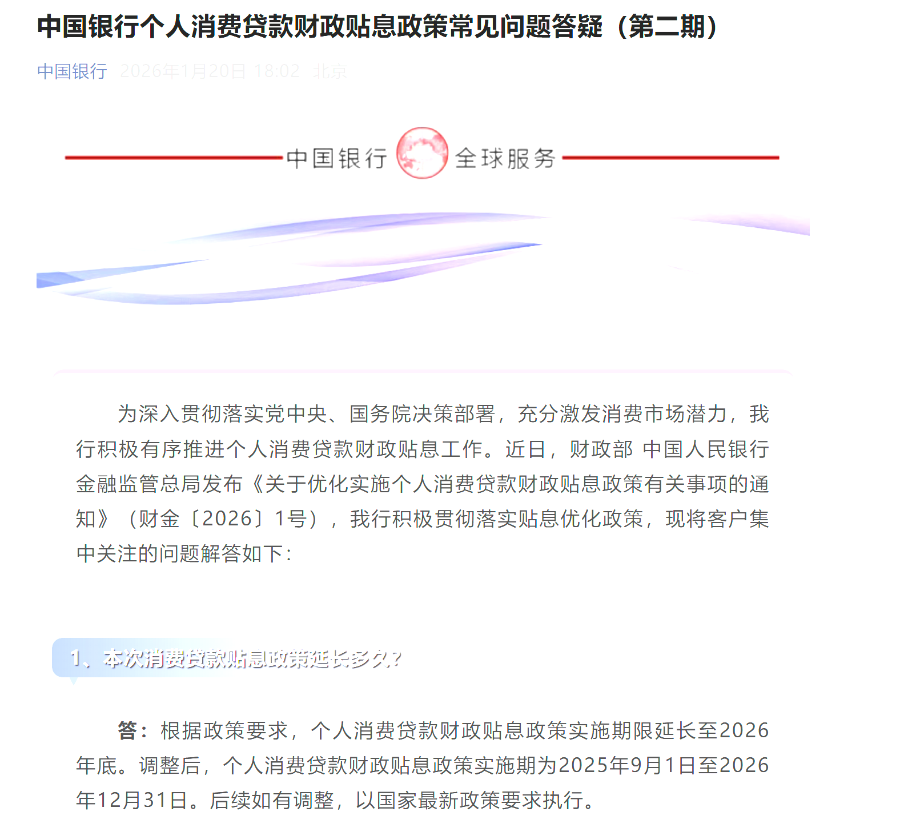
信用卡分期纳入贴息,多家国有大行火速公布细则
2 1 Shi Ji Jing Ji Bao Dao· 2026-01-20 14:44
Core Viewpoint - The Chinese government is implementing a series of fiscal policies aimed at boosting domestic demand and promoting high-quality economic development, with a focus on optimizing interest subsidy policies for the service industry and personal consumption loans [1][3]. Group 1: Policy Implementation - The personal consumption loan interest subsidy policy will be uniformly executed by Agricultural Bank, Bank of China, and Postal Savings Bank from September 1, 2025, to December 31, 2026 [4]. - The service industry loan interest subsidy policy, currently announced by Agricultural Bank, will also extend to December 31, 2026, with existing loans issued between March 16, 2025, and December 31, 2025, continuing under previous regulations [4]. Group 2: Subsidy Scope Optimization - Credit card bill installment payments have been added to the subsidy scope, with the subsidy applicable for new transactions from January 1, 2026, to December 31, 2026, subject to bank verification [5]. - The personal consumption loan subsidy standards have been adjusted by removing the previous limits on single transaction amounts and cumulative amounts for smaller loans, while maintaining an annual cap of 3,000 yuan for all personal consumption loans [6]. - The service industry loan subsidy has expanded to include three new sectors: digital, green, and retail, with the maximum subsidy amount for new loans increased from 1 million yuan to 10 million yuan [6]. Group 3: Important Considerations - Fraudulent activities to obtain subsidies will be strictly penalized, with banks retaining the right to recover subsidies if fraud is detected [7]. - No fees will be charged for processing loans or subsidies, and banks will not engage third parties for these services [7]. - Overdue loans will not qualify for interest subsidies, and borrowers must return all outstanding principal and interest before becoming eligible [7]. Group 4: Inquiry Channels - Customers can check subsidy details through bank SMS, mobile banking apps, physical branches, or customer service hotlines [8].
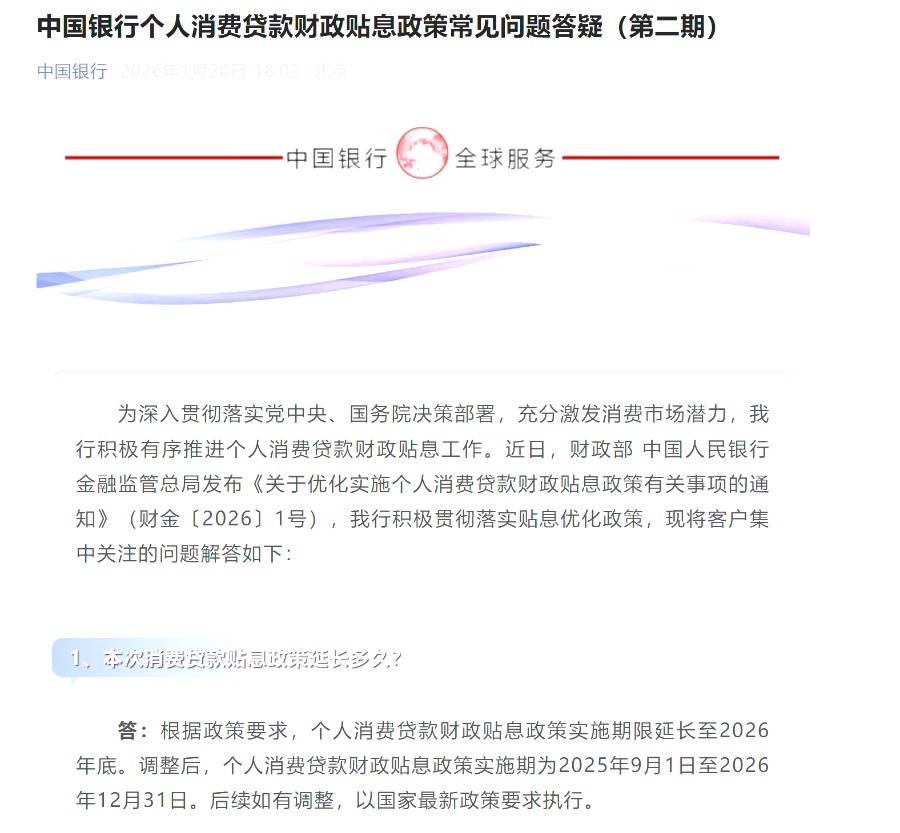
财政部详解今年积极财政政策重点安排
Xin Lang Cai Jing· 2026-01-20 12:46
Group 1 - The effectiveness of the 2025 fiscal policy includes increased counter-cyclical adjustments, with a deficit rate set at around 4%, and new government debt of 11.86 trillion yuan, which is a significant increase compared to previous years [1] - The focus on boosting consumption involved issuing long-term special bonds totaling 1.3 trillion yuan, with 300 billion yuan allocated for consumer subsidies, leading to a sales increase of approximately 2.6 trillion yuan in related goods [2] - Strengthening social welfare included a 667.4 billion yuan employment subsidy, increased healthcare funding, and a rise in pension standards, with total financial support for social welfare reaching about 4.9 trillion yuan [3][4] Group 2 - The 2026 fiscal policy will continue to implement a more proactive approach, focusing on increasing total fiscal expenditure while ensuring sustainability and optimizing expenditure structure [6][7] - Four key policies to stimulate private investment include lowering financing costs through interest subsidies and expanding the scope of support for small and medium-sized enterprises [8][9] - The export tax rebate policy will see adjustments, with the cancellation of rebates for certain products starting April 1, 2026, to promote resource efficiency and environmental sustainability [10] Group 3 - The comprehensive policy to promote domestic demand includes a goal to expand domestic consumption and investment, with a focus on simplifying processes and ensuring targeted support for key sectors [11][12] - Six specific policies have been introduced, including interest subsidies for loans to small and medium-sized enterprises and enhancements to consumer loan support [12][13] - The agricultural insurance sector has seen significant growth, with premium subsidies leading to a scale exceeding 155 billion yuan, providing risk coverage for over 1.25 billion households [23][24] Group 4 - The optimization of personal consumption loan subsidies has increased the maximum subsidy amount and extended the policy's duration to the end of 2026, broadening the range of eligible institutions [25][26][27] - The focus on fostering new economic drivers includes increased funding for technology and innovation, with a 10% rise in central government technology spending [15][16][17] - The fiscal measures aim to facilitate the construction of a unified national market, with ongoing reforms in fiscal and tax systems to enhance efficiency and fairness [18][19][20]