NCI(01336)

Search documents
A股,放量上攻!多股尾盘直线涨停!
Xin Lang Cai Jing· 2025-12-17 09:55
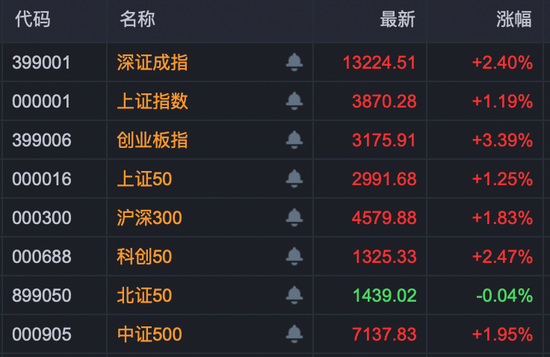
炒股就看金麒麟分析师研报,权威,专业,及时,全面,助您挖掘潜力主题机会! 今日(12月17日)午后,A股放量大幅上攻,创业板指大涨3.39%,创近2个月来最大单日涨幅,深证成 指、科创50也均涨逾2%,上证指数、沪深300、上证50等亦涨超1%,市场成交温和放大至1.83亿元。 万和证券认为,市场将震荡上行,"反内卷"政策有效推动市场竞争持续优化,扩内需、保民生等政策落 地带来供需关系的改善,建议关注消费行业的投资机会。此外,高技术制造业继续位于扩张区间,且明 显高于制造业总体水平,行业支撑作用持续显现,建议关注受益于政策和业绩驱动的集成电路、商业航 天板块。 市场热点方面,大金融午后集体异动拉升成为市场上涨主要动力。券商股在13:30左右开始放量,板块 指数约40分钟就由绿盘转为大涨近3%。华泰证券盘中一度冲击涨停,股价创2015年6月以来10年半新高 (复权,下同),收盘涨幅收窄至6.09%;兴业证券、广发证券等涨幅居前。 同一时段,保险板块指数也放量拉升,一度涨近4%,创历史新高。板块内所有个股上涨,中国太保、 新华保险逼近历史最高点,中国人寿、中国平安创年内新高。 银行板块指数午后也一度涨逾1%,多元 ...



港股大金融股午后拉升,中国人寿(02628.HK)涨超4%,新华保险(01336.HK)、中信证券(06030.HK)涨超3%,中国太保(02601.H...
Jin Rong Jie· 2025-12-17 06:25
本文源自:金融界AI电报 港股大金融股午后拉升,中国人寿(02628.HK)涨超4%,新华保险(01336.HK)、中信证券(06030.HK)涨超 3%,中国太保(02601.HK)、中国太平(00966.HK)、招商证券(06099.HK)、农业银行(01288.HK)涨超 2%。 ...


内险股午后涨幅扩大 长端利率呈企稳回升态势 有望带动上市险企估值修复
Zhi Tong Cai Jing· 2025-12-17 06:05
中信建投(601066)发布研报称,此前在长端利率趋势下行背景下,由于保险资金整体配置结构中约 75%-80%为固收类资产,市场对上市险企未来长期投资收益的预期较为悲观,也直接对寿险板块估值带 来压制,但近期长端利率呈企稳回升态势,目前10年国债收益率已处于1.8%以上,有望带动上市险企 估值修复。 内险股午后涨幅扩大,截至发稿,中国人寿(601628)(02628)涨4.31%,报28.56港元;中国太保 (601601)(02601)涨3.21%,报35.98港元;新华保险(601336)(01336)涨2.99%,报51.6港元;中国平 安(601318)(02318)涨1.88%,报65.1港元。 国金证券指出,明年大量定存到期,分红险对于低风险偏好、有长期财富保值增值诉求的资金来说具有 吸引力,且在反内卷和分红险转型背景下大公司的市占率将继续提升,预计开门红新单保费和NBV将 实现双位数增长。当前保险估值低位,配置性价比非常高,维持积极推荐。重点推荐开门红预期较好, 以及业务质地较好的头部险企。 ...



港股异动 | 内险股午后涨幅扩大 长端利率呈企稳回升态势 有望带动上市险企估值修复
智通财经网· 2025-12-17 06:00
国金证券指出,明年大量定存到期,分红险对于低风险偏好、有长期财富保值增值诉求的资金来说具有 吸引力,且在反内卷和分红险转型背景下大公司的市占率将继续提升,预计开门红新单保费和NBV将 实现双位数增长。当前保险估值低位,配置性价比非常高,维持积极推荐。重点推荐开门红预期较好, 以及业务质地较好的头部险企。 智通财经APP获悉,内险股午后涨幅扩大,截至发稿,中国人寿(02628)涨4.31%,报28.56港元;中国太 保(02601)涨3.21%,报35.98港元;新华保险(01336)涨2.99%,报51.6港元;中国平安(02318)涨1.88%, 报65.1港元。 中信建投发布研报称,此前在长端利率趋势下行背景下,由于保险资金整体配置结构中约75%-80%为固 收类资产,市场对上市险企未来长期投资收益的预期较为悲观,也直接对寿险板块估值带来压制,但近 期长端利率呈企稳回升态势,目前10年国债收益率已处于1.8%以上,有望带动上市险企估值修复。 ...

大理金融监管分局同意新华保险大理中心支公司变更营业场所
Jin Tou Wang· 2025-12-17 04:06
2025年12月16日,大理金融监管分局发布批复称,《新华人寿保险股份有限公司云南分公司关于新华人 寿保险股份有限公司大理中心支公司变更营业场所的请示》(新保云字〔2025〕98号)及相关说明解释材 料收悉。经审核,现批复如下: 二、新华人寿保险股份有限公司云南分公司应按照有关规定及时办理变更及许可证换领事宜。 一、同意新华人寿保险股份有限公司大理中心支公司将营业场所变更为:云南省大理白族自治州大理市 经济开发区满江街道大理创新工业园区漾濞路176号-2号(一楼)及176号-3号(三楼)。 ...
新华保险20251216
2025-12-17 02:27
Summary of Xinhua Insurance Conference Call Company Overview - **Company**: Xinhua Insurance - **Date**: December 16, 2025 Key Points Industry and Market Environment - Xinhua Insurance operates in a low-interest-rate environment with market uncertainties, focusing on stabilizing core earnings and controlling risks [2][3] - The company aims to achieve long-term stable excess returns in the equity market while actively seeking trading opportunities to enhance fixed income returns [2] Investment Strategy - The company will adjust its allocation to interest rate bonds based on factors such as the central rate of funds and asset maturity, increasing allocation during high rates and reducing it during low rates [2][5] - As of Q3 2025, Xinhua's equity holdings accounted for 21%, with domestic equities at 14% and foreign equities at 5%, showing slight growth due to structural adjustments [2][9] - The company has approximately 30 billion RMB in OCI-related stocks, focusing on high-dividend stocks with a yield of 4% or more [2][13] Duration Management - Xinhua has gradually reduced its duration gap, currently at an ideal state with asset duration around 10 years and liability duration between 13-14 years [2][6] - The company aims to maintain this duration gap without allowing it to widen, coordinating both asset and liability sides [6][8] Financial Performance and Projections - The investment performance in Q4 2025 is expected to align with company forecasts, despite challenges from low interest rates and market uncertainties [3][4] - The company anticipates a stable dividend policy, maintaining a payout ratio around 30%, contingent on operational performance and market conditions [20] Regulatory and Risk Factors - Xinhua is preparing to comply with the regulatory requirement for 30% of new premiums to enter the market, although specific guidelines are still awaited [10] - The recent adjustment of stock risk factors is not expected to significantly impact the company's solvency or stock allocation [11] Real Estate and Asset Exposure - The company holds over 20 billion RMB in real estate assets, with no current risk events reported regarding Vanke-related assets [16] - Xinhua has a dedicated team monitoring real estate dynamics, ensuring that asset repayments remain normal [16] Future Outlook - The company is cautious about the 2026 market outlook, recognizing potential pressures on profits and investment returns due to economic conditions and policy factors [19] - Xinhua plans to pursue steady and sustainable growth rather than aggressive expansion in 2026, with a focus on maintaining a healthy business plan [23] Product Development and Strategy - Xinhua is exploring the development of new health insurance products with dividend mechanisms to enhance customer appeal and meet regulatory guidelines [29][31] - The company aims to strengthen its bancassurance channel, collaborating with nearly 60 banks to enhance product competitiveness and customer engagement [30][32] Conclusion - Xinhua Insurance is strategically positioned to navigate the current low-interest-rate environment while focusing on risk management, investment performance, and product innovation to sustain growth and profitability in the coming years [2][3][19]
保险行业2026年年度投资策略:分红险重塑产品竞争力,新银保重构渠道新格局
Xin Lang Cai Jing· 2025-12-16 14:04
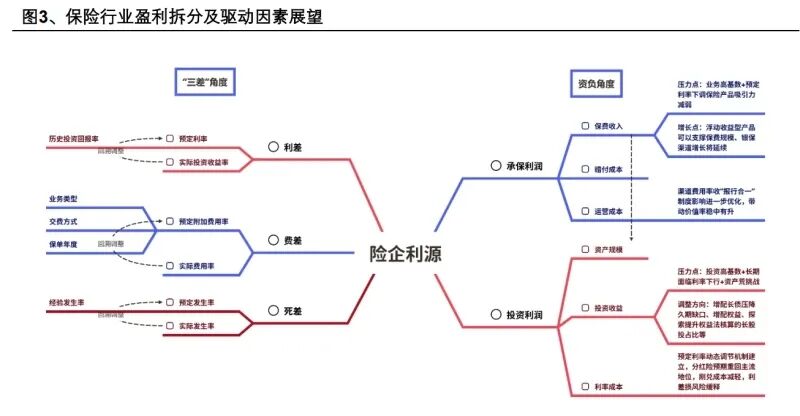
Overall Review - The insurance sector has experienced an overall increase, with A-shares and H-shares showing differentiated performance [1][7] - The fundamental performance indicates high value growth, with investment driving continued net profit growth [1][7] Financial Performance - For Q1-Q3 2025, the net profit growth year-on-year shows significant increases: China Life +60.5%, New China Life +58.9%, China Pacific Insurance +50.5%, PICC +28.9%, Taikang +19.3%, and Ping An +11.5% [2][9] - In Q3 2025 alone, the net profit growth year-on-year is led by China Life +91.5%, China Pacific Insurance +91.4%, and New China Life +88.2% [2][9] - The net asset changes from the beginning of the year show China Life +22.8%, PICC +16.9%, and China Pacific Insurance +12.3%, while Taikang saw a decline of -2.5% [2][9] Investment Logic - Insurance company profits are derived from underwriting profits and investment profits, with underwriting profits influenced by premium income and operational costs [3][10] - The investment profit is primarily affected by investment yield and liability cost rate, with the former being more variable due to market conditions [3][10] - The improvement in underwriting profits is driven by better product structures, channel efficiency, and cost control [3][10] Historical Stock Selection Logic - The stock selection logic for insurance companies has evolved through four phases over the past decade, with a focus on value growth from 2015-2019, short-term catalysts from 2020-2023, and a systemic revaluation of value in 2024 [5][13][14] - Since 2025, the systemic revaluation of value has continued, with H-shares of New China Life, PICC, and China Life leading the market [5][14] Future Outlook - The macroeconomic and capital market environment is expected to transition from a downward economic cycle with improving capital market conditions to a favorable economic cycle with a recovering capital market [6][15] - The focus will remain on net profit as a key indicator, with the importance of liability indicators represented by NBV expected to increase [6][15]

新华保险(601336.SH):前11月累计保费收入1888.50亿元 同比增长16%
Ge Long Hui· 2025-12-16 12:33
Core Viewpoint - Xinhua Insurance reported a cumulative original insurance premium income of RMB 188.50 billion from January 1, 2025, to November 30, 2025, representing a year-on-year growth of 16% [1] Group 1 - The cumulative original insurance premium income for Xinhua Life Insurance Co., Ltd. is RMB 188.50 billion [1] - The year-on-year growth rate of the insurance premium income is 16% [1]
保险板块12月16日跌1.08%,新华保险领跌,主力资金净流出6.35亿元
Zheng Xing Xing Ye Ri Bao· 2025-12-16 09:06
以上内容为证券之星据公开信息整理,由AI算法生成(网信算备310104345710301240019号),不构成投资建议。 从资金流向上来看,当日保险板块主力资金净流出6.35亿元,游资资金净流入1.79亿元,散户资金净流 入4.56亿元。保险板块个股资金流向见下表: 证券之星消息,12月16日保险板块较上一交易日下跌1.08%,新华保险领跌。当日上证指数报收于 3824.81,下跌1.11%。深证成指报收于12914.67,下跌1.51%。保险板块个股涨跌见下表: ...

工信部公布首批L3级智驾准入许可车型 东航11月旅客周转量同比增超10%
Xin Lang Cai Jing· 2025-12-15 23:08
Group 1: Automotive Industry - The Ministry of Industry and Information Technology has officially granted the first batch of L3-level conditional autonomous driving vehicle permits in China, marking a significant step towards commercial application of L3 autonomous driving [1] - Two electric vehicle models have been approved for pilot testing in designated areas of Beijing and Chongqing, with one model capable of autonomous driving at speeds up to 50 km/h and the other up to 80 km/h [1] Group 2: Aviation Industry - China Eastern Airlines reported a 6.51% year-on-year increase in passenger capacity input for November, with passenger turnover rising by 10.35% and a seat occupancy rate of 87.37%, up by 3.04 percentage points [7] - China Southern Airlines also saw an 8.68% increase in passenger capacity input for November, with a 10.42% rise in passenger turnover and a seat occupancy rate of 86.29%, up by 1.36 percentage points [8] Group 3: Coal and Mining Industry - China Shenhua reported coal sales of 389.5 million tons for the first 11 months, a decrease of 7.7% year-on-year, with November sales at 37 million tons, down by 3.6% [6] Group 4: Construction and Engineering Industry - China Metallurgical Group signed new contracts worth RMB 958.13 billion in the first 11 months, a decrease of 8.6% year-on-year, while overseas contracts amounted to RMB 75 billion, an increase of 0.4% [6] Group 5: Insurance Industry - Xinhua Insurance reported a cumulative original insurance premium income of RMB 188.85 billion for the first 11 months, reflecting a year-on-year growth of 16% [9] Group 6: Real Estate Industry - Hopson Development Group reported a total contract sales amount of approximately RMB 14.27 billion for the first 11 months, a decrease of 8.91% year-on-year [10] - Agile Group's pre-sale amount for November was RMB 511 million, down by 21.4% year-on-year [11]