L3级有条件自动驾驶汽车

Search documents
揭晓!2025中国汽车十大新闻!
Bei Jing Ri Bao Ke Hu Duan· 2025-12-29 04:17
Group 1 - The core theme of 2025 in the automotive industry is "anti-involution and strong regulation," with significant policy support and market response to boost automotive consumption [2][4] - The Ministry of Industry and Information Technology and other departments have intensified enforcement against issues like false evaluations and unfair competition, promoting a shift from price competition to value competition [4] - The "old-for-new" vehicle replacement program has led to over 11.2 million applications, accounting for about one-third of total sales, with new energy vehicles making up approximately 60% of this figure [6] Group 2 - The first batch of L3-level conditional autonomous driving vehicles has received approval for road testing in designated areas, marking a significant step towards commercialization [8] - The establishment of China Changan Automobile Group as the third state-owned automotive enterprise reflects the government's push for electric vehicle development and aims to enhance global competitiveness [10][11] - The "Energy-saving and New Energy Vehicle Technology Roadmap 3.0" outlines a vision for the automotive industry to achieve peak carbon emissions by 2040, with over 80% penetration of new energy vehicles [13] Group 3 - The "Automotive Industry Steady Growth Work Plan (2025-2026)" aims for total vehicle sales of approximately 32.3 million in 2025, with new energy vehicle sales targeted at 15.5 million [14] - China's automotive exports have reached 6.34 million units in the first 11 months of 2025, with a year-on-year growth of 18.7%, and are expected to exceed 7 million units by year-end [16] - Major automotive companies have committed to reducing payment terms to within 60 days, addressing long-standing issues of delayed payments to suppliers [18][19] Group 4 - New national standards for electric vehicle batteries, set to be implemented in July 2026, aim to enhance safety and quality, marking a significant upgrade in regulatory standards [21] - The Ministry of Commerce and other departments have introduced stricter regulations on used car exports to ensure compliance and promote healthy market development [23]



【忠阳车评】“准入许可”不等于大规模量产
Jing Ji Ri Bao· 2025-12-26 22:55
Core Viewpoint - The issuance of the first L3-level autonomous driving vehicle license plates in Beijing marks a significant milestone in China's autonomous driving industry, transitioning from technology validation to mass production applications [2][3]. Group 1: Regulatory Developments - The Ministry of Industry and Information Technology has officially granted conditional access permits for the first L3-level autonomous driving models, allowing specific electric vehicles from Changan Automobile and BAIC Group to operate on designated highways in Beijing and Chongqing [2][3]. - The L3-level autonomous driving is a critical transition from "driving assistance" to "autonomous driving," allowing the system to perform driving tasks under certain conditions without continuous driver monitoring [3]. Group 2: Market Dynamics - In the first three quarters of the year, the sales of new passenger cars equipped with L2-level driving assistance features increased by 21.2%, achieving a penetration rate of 64% [3]. - The trial implementation of L3-level autonomous driving vehicles is expected to enhance consumer experience and drive improvements in traffic management, insurance claims, liability recognition, and regulatory frameworks [3][4]. Group 3: Safety and Regulation - The permits for the two models come with strict limitations on operational scenarios, road types, urban areas, and speed limits, emphasizing a cautious regulatory approach to ensure safety [4][5]. - There is a distinction between "road test licenses" issued by local authorities and "product access permits" issued by national departments, with the latter being significantly more challenging to obtain [5]. Group 4: Future Outlook - The true commercialization of L3-level autonomous driving requires not only technological breakthroughs but also supportive policies, industry ecosystems, and infrastructure [5]. - The current pilot approach of "small-scale initiation with conditional implementation" indicates that widespread mass production of autonomous vehicles is still a long way off, despite the symbolic significance of the recent developments [5].

全国首块L3级自动驾驶专用号牌落地——从技术验证加速迈向量产应用
Xin Hua Wang· 2025-12-24 07:43
Core Insights - The first L3 conditional autonomous driving license "渝AD0001Z" has been issued in Chongqing, granted to Changan Automobile, marking a significant step towards the commercialization of autonomous vehicles in China [1][4] - The L3 level, defined as "conditional automation," allows vehicles to perform all dynamic driving tasks under specific conditions, although the driver must remain attentive and ready to take control when prompted by the system [1][2] Industry Developments - The Ministry of Industry and Information Technology has conditionally approved two automotive companies to submit applications for L3 autonomous driving vehicles, indicating a shift from technology validation to mass production applications in China's autonomous driving industry [1][2] - The automotive industry is increasingly focusing on smart technology, with China and the U.S. leading in intelligent driving, while Europe is making significant efforts to catch up [2] Regulatory Framework - The approval for the two models is not a blanket release; it includes specific regulations regarding operational scenarios, road types, urban areas, and speed limits [2][3] - The Changan SC7000AAARBEV model can operate in congested traffic at a maximum speed of 50 km/h on designated roads in Chongqing, while the Extreme Fox BJ7001A61NBEV model can achieve L3 automation at speeds up to 80 km/h on certain highways in Beijing [3] Operational Aspects - The two models are not available for private users but will be operated by affiliated ride-hailing service companies, which helps mitigate uncertainties during the initial rollout of L3 autonomous driving [3] - As the pilot programs progress and the industry gains a better understanding of safety risks, restrictions on these vehicles are expected to be relaxed, allowing for broader public access to autonomous driving technology [3][4] Government Support - The issuance of autonomous vehicle licenses reflects the government's commitment to fostering innovation while ensuring safety through prudent regulation [4] - This initiative is expected to stimulate technological innovation and upgrades within the automotive sector, aligning with the overall strategy of "institutional primacy, pilot breakthroughs, and gradual promotion" [4]
首块L3级自动驾驶专用号牌落地——从技术验证加速迈向量产
Jing Ji Ri Bao· 2025-12-24 06:11
Core Insights - The first L3 conditional autonomous driving license "渝AD0001Z" has been issued in Chongqing, granted to Changan Automobile, marking a significant step towards the commercialization of autonomous vehicles in China [1][4] - The L3 level, defined as "conditional automation," allows vehicles to perform all dynamic driving tasks under specific conditions, although the driver must remain attentive and ready to take control when prompted [1][2] Group 1: Industry Developments - The Ministry of Industry and Information Technology has conditionally approved two automotive companies to submit applications for L3 autonomous vehicle products, indicating a shift from technology validation to mass production applications in China's autonomous driving industry [1][2] - The approval of L3 autonomous vehicles is seen as a critical step towards industrialization, with pilot programs aimed at validating technology and establishing a foundation for large-scale applications [2][3] Group 2: Regulatory Framework - The licenses for the two models are not a blanket approval; they come with specific restrictions regarding operational scenarios, road types, urban areas, and speed limits [2][3] - The Changan SC7000AAARBEV model can operate in congested traffic at a maximum speed of 50 km/h on designated roads in Chongqing, while the Extreme Fox BJ7001A61NBEV model can achieve L3 automation at speeds up to 80 km/h on certain highways in Beijing [3] Group 3: Operational Aspects - The two models will not be available for private users initially; instead, they will be operated by affiliated ride-hailing service companies to manage the deployment of L3 autonomous driving [3] - The operational management aims to reduce uncertainties associated with the initial rollout of L3 autonomous driving, allowing consumers to experience the technology through ride-hailing services [3] Group 4: Government Support and Future Outlook - The issuance of autonomous vehicle licenses reflects the government's commitment to fostering innovation while ensuring safety through prudent regulation [4] - The ongoing pilot programs for smart connected vehicles are expected to inject strong momentum into technological innovation and upgrades within the automotive sector in China [4]
首块L3级自动驾驶专用号牌落地 从技术验证加速迈向量产应用
Jing Ji Ri Bao· 2025-12-23 22:34
Core Insights - The first L3 conditional autonomous driving license "渝AD0001Z" has been issued in Chongqing, granted to Changan Automobile, marking a significant step towards the commercialization of autonomous vehicles in China [1][4] - The L3 level, defined as "conditional automation," allows vehicles to perform all dynamic driving tasks under specific conditions, although the driver must remain attentive and ready to take control when prompted [1][2] Group 1: Industry Developments - The Ministry of Industry and Information Technology has conditionally approved two automotive companies to submit applications for L3 autonomous vehicle products, indicating a shift from technology validation to mass production applications in China's autonomous driving industry [1][2] - The approval of L3 autonomous vehicles is seen as a critical step towards industrialization, with pilot programs aimed at validating technology and establishing a foundation for large-scale applications [2][3] Group 2: Regulatory Framework - The licenses for the two models are not a blanket approval; they come with specific regulations regarding operational scenarios, road types, urban areas, and speed limits [2][3] - The Changan SC7000AAARBEV model can operate in congested traffic at a maximum speed of 50 km/h on designated roads in Chongqing, while the Extreme Fox BJ7001A61NBEV model can achieve L3 automation at speeds up to 80 km/h on certain highways in Beijing [3] Group 3: Operational Aspects - The two models will not be available for private users initially; instead, they will be operated by affiliated ride-hailing service companies to manage the deployment of L3 autonomous driving [3] - The operational management aims to reduce uncertainties associated with the initial rollout of L3 autonomous driving, allowing consumers to experience the technology through ride-hailing services [3] Group 4: Government Support and Future Outlook - The approval of autonomous vehicle products reflects the government's commitment to fostering innovation while ensuring safety through prudent regulation [4] - The ongoing pilot programs for smart connected vehicles are expected to inject strong momentum into technological innovation and upgrades within the automotive industry in China [4]
一周热榜精选:失业升通胀降重塑美联储前景?日本加息终于落地!
Jin Shi Shu Ju· 2025-12-19 15:01
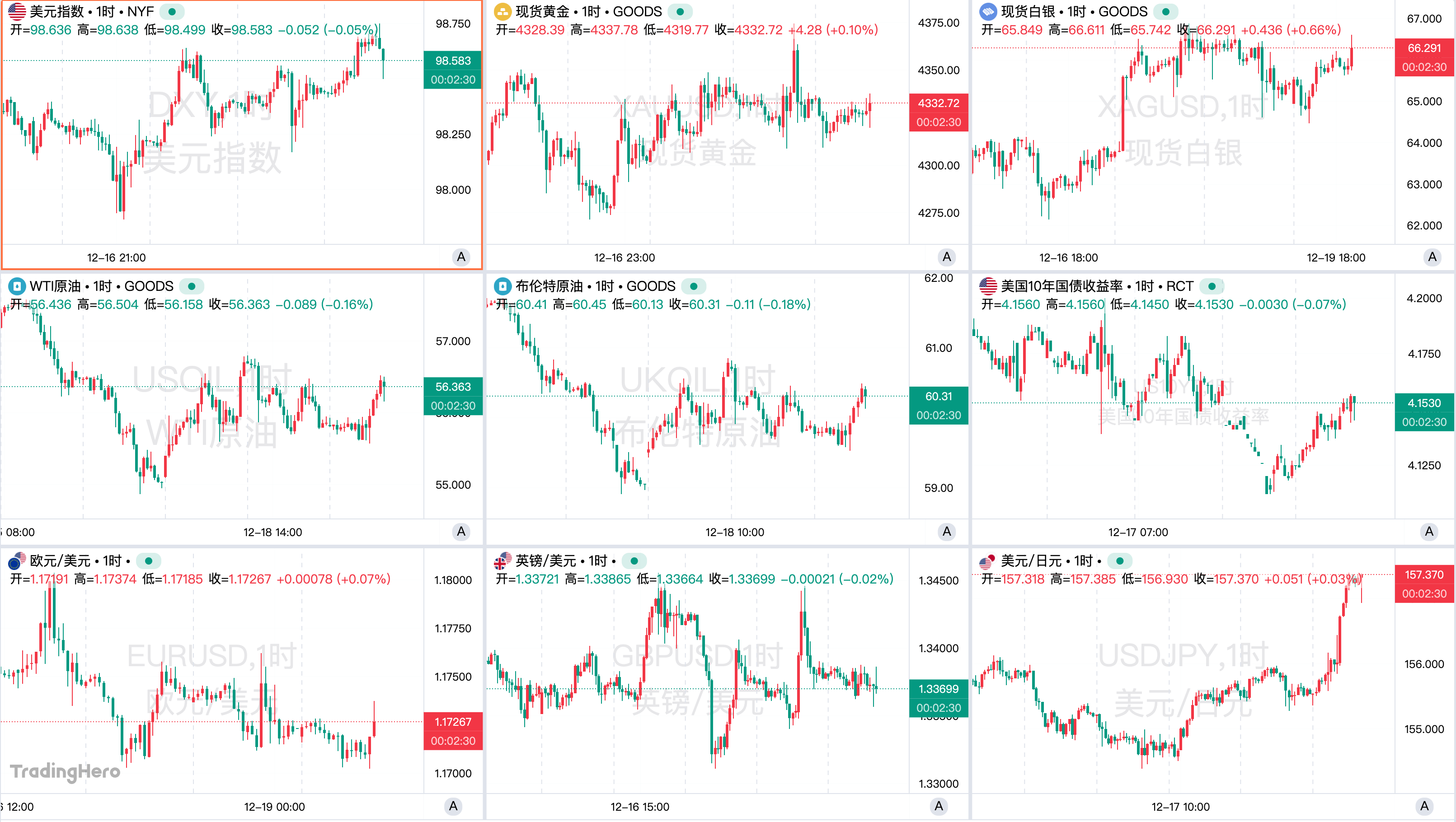
Market Overview - The US dollar index experienced a decline followed by a rebound, initially dropping below the 98 mark due to mixed non-farm data and fluctuating inflation expectations, but later recovered as US Treasury yields stabilized [1] - Gold prices maintained a high volatility pattern, attempting to breach the $4,350 to $4,370 range but failing to hold, indicating profit-taking at high levels [1] - Silver outperformed gold, reaching historical highs and showing a nearly 130% increase this year, although volatility increased significantly at these levels [1] - International oil prices continued a downward trend, influenced by concerns over oversupply and potential peace agreements in the Russia-Ukraine conflict, with prices hitting a four-year low before a slight rebound [1] US Stock Market - The US stock market showed significant divergence and increased volatility, initially pressured by technology stocks but rebounding mid-week due to individual stock performance and improved risk appetite [2] - Despite a collective rise in major indices on Thursday due to favorable inflation data, the overall trend for the week remained one of consolidation with structural market characteristics evident [2] Investment Bank Insights - Goldman Sachs predicts gold prices will soar to $4,900 per ounce by December 2026, while also expressing a bearish outlook on oil prices and favoring copper as the preferred industrial metal [5] - ANZ Bank suggests that in a bullish scenario, gold prices could exceed $5,000 per ounce by 2026, while Standard Chartered anticipates new highs for gold prices in the same year [5] - Morgan Stanley expects a slowdown in gold price increases next year, with silver lagging behind [5] Economic Data and Federal Reserve Outlook - Recent US economic data revealed a stronger-than-expected non-farm payroll increase, but the unemployment rate rose to 4.6%, the highest since September 2021, indicating a cooling labor market [6] - The November CPI data was below expectations, with overall CPI at 2.7% and core CPI at 2.6%, the lowest since March 2021, leading to increased market expectations for a rate cut by the Federal Reserve in January [6] - Federal Reserve officials displayed differing views on monetary policy, with some advocating for aggressive rate cuts while others suggested a more cautious approach [7] International Central Bank Actions - The Bank of Japan raised its benchmark interest rate from 0.5% to 0.75%, marking the first increase in 11 months and the highest level in 30 years, indicating a shift towards tightening monetary policy [9] - The Bank of England lowered its key interest rate from 4% to 3.75%, the lowest in nearly three years, amidst internal policy disagreements [11][12] - The European Central Bank maintained its deposit rate at 2%, while raising inflation and economic growth forecasts for the coming years [12] Corporate Developments - Warner Bros. Discovery's board rejected a hostile takeover bid from Paramount, citing concerns over the financing structure and risks associated with the proposal, while supporting a merger agreement with Netflix [24]
亚太股市全线拉升,黄金跳水!发生了什么?
Zheng Quan Shi Bao· 2025-12-19 04:43
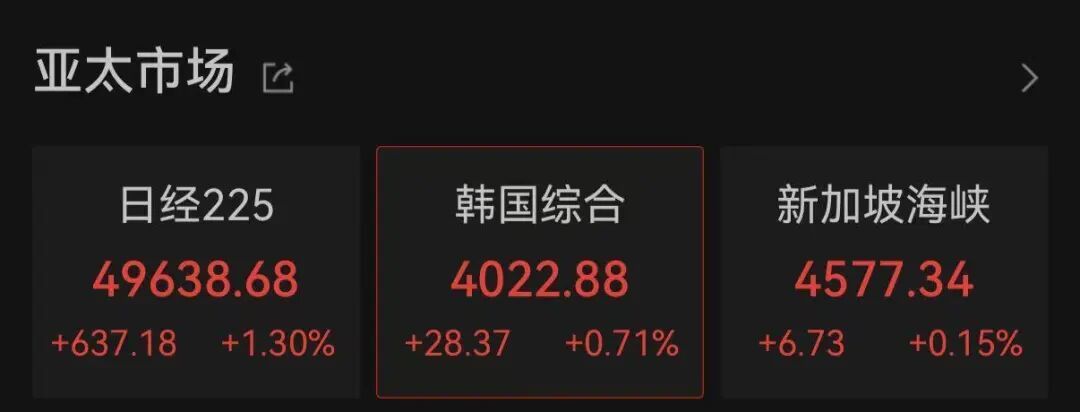
Market Overview - The A-share market experienced a slight rise, with the Shanghai Composite Index and the Shanghai 50 Index increasing for the third consecutive day, while the Shenzhen Component Index, ChiNext Index, and Sci-Tech Innovation 50 also opened strong [1] - Over 4,400 stocks rose, and trading volume remained stable [1] - The Japanese central bank raised its policy interest rate from 0.5% to 0.75%, the highest level in 30 years [1] - The Asia-Pacific stock markets showed positive performance, with the Nikkei 225 Index rising over 1% and the Korean Composite Index increasing by more than 0.7% [1] Nuclear Fusion Sector - The nuclear fusion concept stocks surged, with the sector index initially rising over 3%, reaching a historical high [5] - Trump Media & Technology Group agreed to merge with TAE Technologies in a deal valued at over $6 billion, expected to close by mid-2026 [7] - The merger aims to integrate capital channels and nuclear fusion technology to support the growth of the artificial intelligence industry [7] - A 50 MW commercial nuclear fusion power plant is set to begin construction next year, with plans for additional plants to achieve a total power supply capacity of 350 to 500 MW [7] - The global nuclear fusion market is projected to approach $500 billion by 2030, equivalent to approximately 3.5 trillion yuan [8] - The commercialization path for nuclear fusion technology is becoming clearer, with expectations for accelerated capital expenditure during the 14th Five-Year Plan period [8] Autonomous Driving Sector - The automotive industry saw a broad rally, particularly in the autonomous driving sector, which rose over 2% [9] - Zhejiang Shibao hit its daily limit for the fourth consecutive day, reaching a new annual high, while Huati Technology also achieved a daily limit for the second day [11] - The Ministry of Industry and Information Technology announced the first batch of L3 conditional autonomous driving vehicle approvals, with Changan Automobile and BAIC Arcfox being the first companies to receive permits [11] - This approval indicates a shift from mere technological demonstrations to regulatory compliance and operational deployment in designated areas [11]

首批L3车型获准上路,自动驾驶“拐点”来了?丨财经早察
2 1 Shi Ji Jing Ji Bao Dao· 2025-12-17 12:44
Core Insights - The first batch of L3 conditional autonomous vehicles in China has received operational permits, marking a significant milestone in the country's autonomous driving era [1] Group 1: Definition and Implications of L3 - L3 level represents conditional automation where the system can fully take over driving tasks in specific scenarios, allowing the driver to temporarily disengage [2] - A key revolutionary aspect of L3 is the shift in responsibility from the driver to the vehicle manufacturer in case of accidents caused by system failures, as per regulations effective in 2025 [2] Group 2: Companies Involved - The first two companies to receive L3 permits are Changan Automobile and BAIC's Arcfox, with Changan focusing on congested scenarios and BAIC targeting high-speed efficient travel [3] - Both companies' vehicles will initially be operated by specific service entities rather than being sold directly to consumers, reflecting a cautious approach by regulatory authorities [3] Group 3: Market Opportunities - The launch of L3 vehicles provides a first-mover advantage for Changan and BAIC, with other manufacturers like BYD, NIO, and GAC likely to accelerate their efforts to obtain similar permits [4] - Transitioning from L2 to L3 involves significant hardware advancements, benefiting core components such as intelligent driving domain controllers and automotive-grade chips [4] - The shift in responsibility will necessitate the development of new insurance products, accident assessment processes, data security regulations, and maintenance systems [4]
首批L3车型获准上路,自动驾驶“拐点”来了?
2 1 Shi Ji Jing Ji Bao Dao· 2025-12-17 12:36
Group 1 - The first batch of L3 conditional autonomous vehicles in China has received operational permits, marking a significant milestone in the country's autonomous driving era [1][3] - L3 level automation allows the system to take over driving tasks in specific scenarios, enabling drivers to temporarily disengage from their responsibilities, with the caveat that they must be ready to take control in complex situations [2][3] - The shift in liability from the driver to the vehicle manufacturer in the event of an accident due to system failure is a revolutionary aspect of L3, establishing a legal foundation for "machine drivers" [2][3] Group 2 - The first two companies to receive L3 permits are Changan Automobile and BAIC's Arcfox, with Changan focusing on congested scenarios and BAIC targeting high-speed efficient travel [3][4] - The initial deployment of these vehicles is limited to specific routes and operated by designated companies rather than individual consumers, reflecting a cautious approach by regulatory authorities [3][4] - The launch of L3 vehicles is expected to accelerate advancements in core hardware, such as intelligent driving domain controllers and automotive-grade chips, as well as the development of new ecosystems and service models in the automotive industry [4]
L3级自动驾驶汽车上路,释放什么信号?这两个字至关重要
Ke Ji Ri Bao· 2025-12-17 03:04
Core Viewpoint - The approval of two L3 level conditional autonomous driving vehicles by the Ministry of Industry and Information Technology marks a significant step in promoting the innovation and application of intelligent connected vehicle technology in China [1][3]. Group 1: Regulatory Framework - The classification of driving automation in China ranges from L0 to L5, with L3 representing conditional automation, indicating that autonomous vehicles are now entering the market in product form [1]. - The regulatory approach emphasizes a "small cut start, conditional implementation" strategy to ensure safety in the deployment of autonomous driving technology [3]. - A dual-track mechanism for "product access + road passage" has been established, involving collaboration among various departments to create a clear safety baseline for autonomous driving applications [3][4]. Group 2: Evaluation Process - The approval process for the vehicles involved a systematic safety assessment, ensuring that the models met strict criteria regarding enterprise capability, product safety, and testing validation [4]. - Initial trials will be conducted in lower-risk environments such as highways and fast roads to validate the technology's maturity and management effectiveness before expanding the application scope [4]. Group 3: Industry Implications - The approval of L3 autonomous driving products sends a positive signal to the industry, indicating that innovations meeting regulatory standards can enter the market [6]. - The ongoing opening of the application channel for related trials will encourage collaboration among vehicle manufacturers, component suppliers, software developers, and data service providers, promoting a shift from isolated technological breakthroughs to systemic capability enhancement [6]. - With clear safety boundaries and responsibilities, innovation in autonomous driving can thrive, ensuring that users feel secure and confident in the technology [6].