
ICBC(01398)

Search documents
工行青海分行绿金润泽生态 深耕产业四地
Jin Rong Shi Bao· 2025-12-25 04:18
Core Viewpoint - The Industrial and Commercial Bank of China (ICBC) Qinghai Branch is strategically focusing on green finance as a key development pillar, aligning with the province's goal of building an ecological civilization and promoting low-carbon development during the 14th Five-Year Plan period [1] Group 1: Green Finance Development - The balance of green loans increased from 25.2 billion to 43.3 billion, a growth rate of 72%, with the proportion of green loans in total loans rising from 29% to 38% [2] - Loans for the "Four Lands" industry rose from 23.9 billion to 41.1 billion, also reflecting a 72% growth [2] - The bank has actively supported major clean energy projects, providing approximately 18.3 billion in loans for hydropower, 2.3 billion for wind power, and 8 billion for solar power projects, significantly boosting the installed capacity of wind, solar, and hydropower in Qinghai [2] Group 2: Financial Innovation and Low-Carbon Transition - The bank is implementing carbon accounts as a core strategy for the dual carbon goals, facilitating the conversion of carbon sink resources into financial resources [3] - Innovative products include the first "Agricultural Transformation + Sustainable Link" loan in the province and preferential loans linked to carbon accounts, with total credit issuance reaching 84 million [3] - A differentiated pricing mechanism based on carbon emission performance has been introduced, effectively reducing financing costs for green transition enterprises [3] Group 3: Social Responsibility and Ecological Protection - The bank integrates economic and social responsibilities, actively participating in ecological protection and restoration efforts [4] - Strategic cooperation with the Sanjiangyuan Ecological Protection Foundation has led to the establishment of the "ICBC Yellow River Upper Reaches Economic Ecological Public Welfare Forest Project," with over 430 acres of afforestation completed from 2022 to 2024 [4] - The bank has launched the "Beautiful Qinghai: Sanjiangyuan" precious metal products to enhance cultural promotion and environmental awareness, merging public welfare and financial value [4]
播金种银三十年:一家国有大行在川的乡村振兴实践
Xin Lang Cai Jing· 2025-12-25 02:53
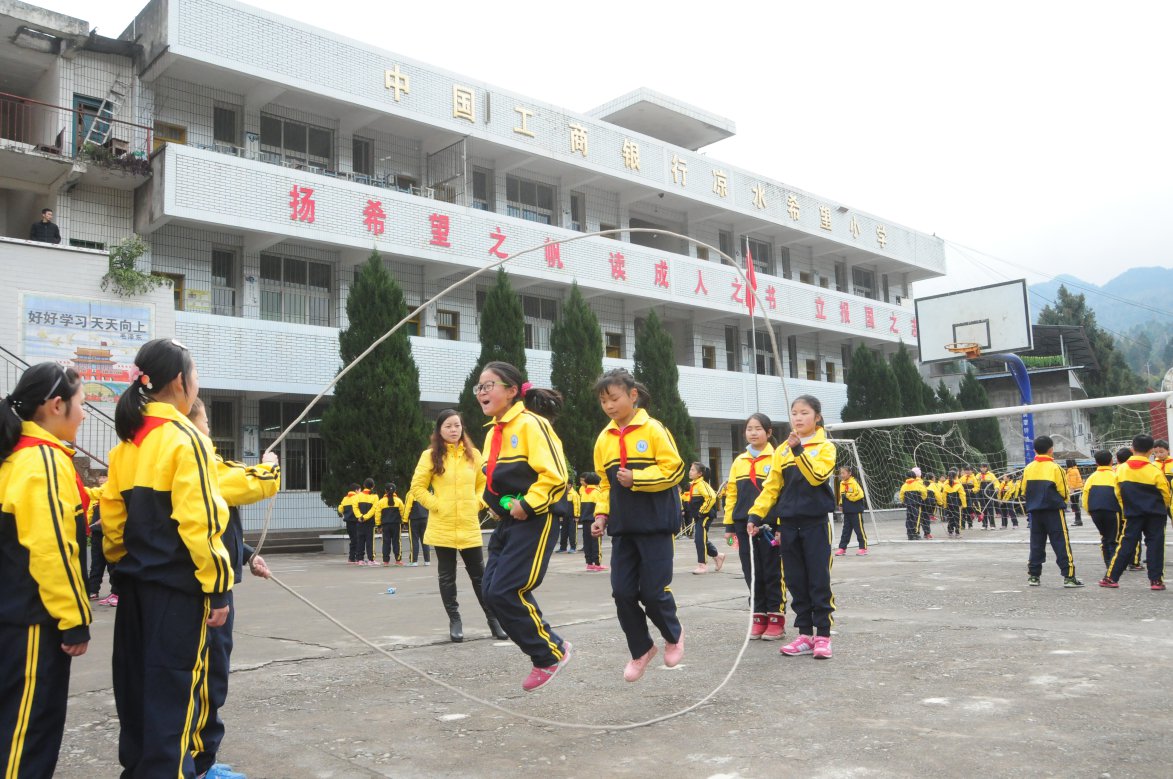
Core Viewpoint - The Industrial and Commercial Bank of China (ICBC) has played a significant role in poverty alleviation and rural revitalization in Sichuan Province over the past 30 years, investing over 9 billion yuan and providing more than 20 billion yuan in loans to support local development initiatives [1][7]. Group 1: Initial Support and Infrastructure Development - In the early stages of assistance, ICBC focused on basic needs, investing in essential areas such as education and healthcare to strengthen the foundation for development [2][3]. - ICBC's initiatives included the construction of schools and healthcare facilities, such as the Liangshui Hope Primary School and the support for the relocation of the Wanyuan City Central Hospital, significantly improving local educational and medical resources [2][3]. Group 2: Comprehensive Support and Poverty Alleviation - ICBC implemented a multi-faceted support strategy in areas like infrastructure, education, healthcare, and financial services, leading to the successful poverty alleviation of over 2,600 residents in Tikeluo Village [5][7]. - The bank's efforts have resulted in the establishment of a robust safety net in education, healthcare, and infrastructure, fulfilling its social responsibilities as a state-owned enterprise [7]. Group 3: Transition to Sustainable Development - As the assistance progressed, ICBC shifted its focus from mere donations to fostering sustainable economic growth through initiatives like the "Borrow Sheep, Return Sheep" program, which has helped nearly 700 impoverished households increase their annual income [8][9]. - The bank has also invested over 13 million yuan in the Tongjiang silver ear industry, facilitating the development of a complete support system that enhances local economic resilience [9][12]. Group 4: Market Integration and Consumption Support - ICBC has worked to connect local production with market demand, launching initiatives such as the "Qinghua Pepper Weather Index Insurance" and "Whole Village Credit" to support local farmers and enhance production capabilities [13][15]. - The bank has actively promoted consumption assistance through various campaigns, purchasing over 370 million yuan worth of agricultural products from poverty-stricken areas, thereby boosting local sales [15][17]. Group 5: Long-term Impact and Future Directions - Over three decades, ICBC has evolved from a resource provider to a catalyst for institutional innovation and local economic development, aiming to create a self-sustaining growth model for rural areas [17]. - The bank's comprehensive approach to poverty alleviation and rural revitalization serves as a replicable model for similar initiatives across the country, with a commitment to continue supporting local communities [17].

中国工商银行积极优化股权服务 赋能新质生产力发展
Zhong Guo Xin Wen Wang· 2025-12-25 02:44
Group 1 - The core viewpoint of the articles emphasizes the acceleration of building a financial powerhouse in China, focusing on the development of direct financing through equity and bonds, as highlighted in the 20th Central Committee's Fourth Plenary Session and the Central Economic Work Conference [1][2] - Industrial and Commercial Bank of China (ICBC) successfully hosted a roadshow for technology innovation enterprises, promoting nearly 20 profitable companies in strategic emerging industries such as integrated circuits, new materials, and biomedicine, attracting around 30 national-level funds and institutional investors [1] - The roadshow provided a comprehensive service from "showcasing to docking to landing," aiming to support the cultivation and growth of strategic emerging industries and future industries, thereby injecting financial momentum into the development of new productive forces [1] Group 2 - ICBC is leveraging its group advantages to provide high-quality development services for strategic emerging industries and future industries, introducing a comprehensive service product for private equity funds that covers all stages from establishment to exit [2] - The bank has established a customer management system for private equity funds, optimizing equity services and has served over 10,000 private equity funds and management institutions, benefiting more than 30,000 invested enterprises [2] - ICBC is committed to implementing the spirit of the 20th Central Committee's Fourth Plenary Session and the Central Economic Work Conference, continuously improving its diversified equity financing service system to enhance the service quality for technology innovation enterprises [2]
智通港股通资金流向统计(T+2)|12月25日
智通财经网· 2025-12-24 23:35
Core Insights - Tencent Holdings (00700), Alibaba-W (09988), and Hong Kong Exchanges (00388) led the market in net inflows, with amounts of 1.115 billion, 1.055 billion, and 309 million respectively [1] - China Mobile (00941), Luoyang Molybdenum (03993), and CICC (03908) experienced the highest net outflows, with amounts of -1.053 billion, -184 million, and -181 million respectively [1] - In terms of net inflow ratios, China Telecom Services (00552), Yihua Tong (02402), and Sunshine Insurance (06963) topped the list with ratios of 167.31%, 126.18%, and 118.17% respectively [1] Net Inflow Rankings - Tencent Holdings (00700) had a net inflow of 1.115 billion, representing a 13.09% increase, closing at 614.500 [2] - Alibaba-W (09988) saw a net inflow of 1.055 billion, with a 12.23% increase, closing at 146.400 [2] - Hong Kong Exchanges (00388) recorded a net inflow of 309 million, with a 24.77% increase, closing at 407.000 [2] Net Outflow Rankings - China Mobile (00941) faced a net outflow of -1.053 billion, a decrease of -54.21%, closing at 83.700 [2] - Luoyang Molybdenum (03993) had a net outflow of -184 million, down by -29.82%, closing at 19.100 [2] - CICC (03908) experienced a net outflow of -181 million, a decrease of -30.22%, closing at 20.540 [2] Net Inflow Ratio Rankings - China Telecom Services (00552) achieved a net inflow ratio of 167.31%, with a net inflow of 26.5926 million, closing at 4.520 [3] - Yihua Tong (02402) had a net inflow ratio of 126.18%, with a net inflow of 26.5481 million, closing at 23.980 [3] - Sunshine Insurance (06963) recorded a net inflow ratio of 118.17%, with a net inflow of 31.5558 million, closing at 3.940 [3]

智通ADR统计 | 12月25日
智通财经网· 2025-12-24 22:22
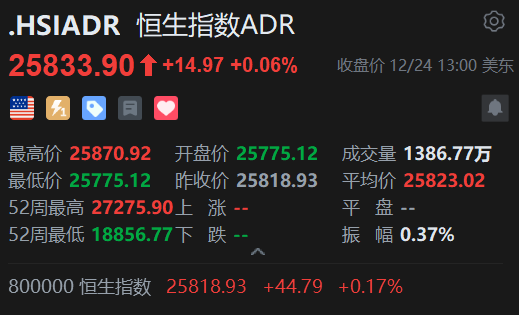
Market Overview - The Hang Seng Index (HSI) closed at 25,833.90, up by 14.97 points or 0.06% [1] - The index reached a high of 25,870.92 and a low of 25,775.12 during the trading session, with a trading volume of 13.8677 million [1] - The 52-week high for the index is 27,275.90, while the 52-week low is 18,856.77, indicating a fluctuation of 0.37% [1] Major Blue-Chip Stocks Performance - HSBC Holdings closed at 123.759 HKD, down 0.03% from the Hong Kong close [2] - Tencent Holdings closed at 602.001 HKD, down 0.17% from the Hong Kong close [2] - Alibaba Group (W) saw a decrease of 1.200 HKD, closing at 146.000 HKD, a drop of 0.82% [3] - China Construction Bank decreased by 0.050 HKD, closing at 7.560 HKD, a decline of 0.66% [3] - Xiaomi Group (W) increased slightly by 0.020 HKD, closing at 39.220 HKD, a rise of 0.05% [3] ADR Performance - Tencent's ADR closed at 602.001, down by 0.999 HKD or 0.17% compared to its Hong Kong stock price [3] - Alibaba's ADR closed at 145.796, down by 0.204 HKD or 0.14% compared to its Hong Kong stock price [3] - HSBC's ADR closed at 123.759, down by 0.041 HKD or 0.03% compared to its Hong Kong stock price [3] - AIA Group's ADR closed at 83.298, up by 0.048 HKD or 0.06% compared to its Hong Kong stock price [3]


今日金价一夜异动:24日调整后,全国珠宝店黄金最新零售价更新
Sou Hu Cai Jing· 2025-12-24 19:39
Core Insights - The gold price has surged dramatically, reaching 1403 yuan per gram, reflecting a significant increase in consumer interest and urgency to purchase gold jewelry as the holiday season approaches [1][3][14] Price Variations - On December 24, 2025, major jewelry brands like Chow Tai Fook and Lao Feng Xiang listed their gold prices at around 1403 yuan per gram, while other brands like Cai Bai offered prices between 1342 and 1345 yuan, showing a price difference of nearly 60 yuan per gram for the same gold quality [3][5] - The price of investment gold bars varies significantly, with brand names like Chow Tai Fook pricing their gold bars at 1230 yuan per gram, while banks like ICBC offer prices as low as 990 to 1014 yuan per gram, which is closer to the raw material price [6][8] Market Dynamics - The gold market is experiencing a split, with high retail prices for jewelry supported by brand value, while investment gold prices reflect a more competitive landscape with significant price differences based on the sales channel [8][10] - In the Shenzhen Shui Bei market, the base price for gold is around 1165 yuan per gram, with additional costs for craftsmanship, indicating that consumers can access gold at much lower prices than retail [10] Consumer Behavior - For consumers purchasing gold for personal milestones, brand stores remain the preferred choice due to their reputation and after-sales service, while those focused on investment should consider bank offerings for lower costs [11][13] - Younger consumers interested in unique designs are turning to alternative channels like Shui Bei for lower-priced options, understanding that these purchases are more about personal enjoyment than investment [13][14] Market Sentiment - The current gold price surge is driven by both panic buying and investment strategies, reflecting a broader sentiment of uncertainty and the desire for tangible assets during volatile times [14]





港股通12月24日成交活跃股名单





Zheng Quan Shi Bao Wang· 2025-12-24 15:32
Core Viewpoint - The Hang Seng Index rose by 0.17% on December 24, with southbound capital recording a total transaction amount of HKD 457.99 billion, resulting in a net sell of HKD 11.75 billion [1] Group 1: Southbound Capital Transactions - Southbound capital transactions included a total of HKD 169.12 billion for the Shenzhen Stock Connect, with a net sell of HKD 6.24 billion, and HKD 288.87 billion for the Shanghai Stock Connect, with a net sell of HKD 5.52 billion [1] - The most active stock for southbound capital was SMIC, with a total transaction amount of HKD 46.18 billion and a net buy of HKD 4.91 billion, closing up by 3.12% [1][2] - Other notable stocks included Alibaba and Tencent, with transaction amounts of HKD 30.19 billion and HKD 16.71 billion, respectively, both experiencing net sells of HKD 2.88 billion and HKD 6.11 billion [1][2] Group 2: Individual Stock Performance - The stocks with the highest net buy amounts included Agricultural Bank with HKD 1.75 billion and Hua Hong Semiconductor with HKD 1.06 billion [1] - China Mobile had the highest net sell amount at HKD 7.11 billion, closing down by 0.06% [1][2] - The stock with the longest consecutive net buy days was CSPC Pharmaceutical, with a total net buy of HKD 2.12 billion over three days [2]
国有大行火速响应信用修复新政
21世纪经济报道· 2025-12-24 14:10
Core Viewpoint - The article discusses the implementation of a new credit repair policy by the People's Bank of China, which allows for automatic credit repair for individuals with overdue debts, significantly lowering the barriers and costs associated with credit repair [1][3]. Group 1: Policy Overview - The new policy, effective from December 22, 2025, allows for the automatic removal of certain overdue information from credit reports without the need for individual applications, marking a shift towards a dual focus on both punishment and repair in the credit system [1][3]. - The policy covers various types of personal loans, including mortgages, consumer loans, and credit cards, and applies to all financial institutions connected to the central bank's credit system [6][3]. Group 2: Eligibility and Conditions - To qualify for the credit repair, overdue information must meet three criteria: it must have occurred between January 1, 2020, and December 31, 2025; the overdue amount must not exceed 10,000 RMB; and the debt must be fully repaid by March 31, 2026 [6][3]. - The automatic repair process is designed to be seamless, with the central bank's credit system identifying eligible overdue information without requiring any action from the individual [3][7]. Group 3: Implementation by Financial Institutions - Major banks, including Industrial and Commercial Bank of China, Agricultural Bank of China, and others, have quickly adapted to the new policy by enhancing their service channels and ensuring accurate data management to facilitate the policy's implementation [9][10]. - Banks have established various channels for customers to inquire about their credit status and have emphasized the importance of confirming repayment amounts to ensure eligibility for the credit repair [11][10]. Group 4: Balancing Rights and Risk Management - The new policy aims to balance individual rights protection with financial risk management, encouraging overdue borrowers to repay their debts while helping banks recover non-performing assets [14][15]. - The policy is expected to stimulate demand for personal loans, including consumer and mortgage loans, by releasing previously constrained financing needs, thus revitalizing the credit market [15][16].



深圳房抵经营贷利率低至2.35%,资金空转等风险需关注
Nan Fang Du Shi Bao· 2025-12-24 13:43
Core Viewpoint - The personal housing mortgage business loan market in Shenzhen is experiencing a resurgence of low interest rates, with the minimum rate dropping to 2.35%, which is 65 basis points lower than the current one-year LPR of 3% [2][3]. Group 1: Interest Rates and Loan Conditions - The minimum interest rate for personal housing mortgage business loans has reached 2.35% across multiple banks in Shenzhen, including Zhuhai Huaren Bank, Zhejiang Commercial Bank, and CITIC Bank [2]. - Different banks have established varying thresholds for loan amounts, loan-to-value ratios, and eligibility criteria, leading to a competitive landscape [3][4]. - The maximum loan amount varies significantly among banks, with CITIC Bank and China Merchants Bank offering up to 30 million yuan, while Zhejiang Commercial Bank and Industrial and Commercial Bank of China have a cap of 20 million yuan [3][4]. Group 2: Risk Factors and Regulatory Concerns - Experts have raised concerns about potential risks associated with low interest rates, including the risk of fund misallocation and regulatory loopholes that could allow funds to flow into the real estate market [4][6]. - The banking sector faces increased pressure on profitability due to declining interest rates, which could impact asset quality and operational stability, particularly for smaller banks [6]. - Regulatory measures have been introduced to guide the industry towards standardized development, emphasizing the need for compliance and risk management [6][7]. Group 3: Economic Implications - The reduction in personal housing mortgage business loan rates is seen as a necessary response to current economic conditions, aimed at supporting small and micro enterprises and stabilizing economic growth [5]. - Lower interest rates are expected to stimulate credit demand, enhance loan willingness among enterprises, and promote the rational flow and optimization of funds [5]. - Banks are encouraged to innovate and develop more financial products tailored to small and micro enterprises to enhance their market share and service capabilities [5].



高亚林,被“双开”!
Zhong Guo Ji Jin Bao· 2025-12-24 13:21
中国基金报记者 晨曦 又有国有大行干部被处理! 丧失理想信念、背弃初心使命,搞迷信活动;违反中央八项规定精神,接受可能影响公正执行公务的宴 请,收受可能影响公正执行公务的礼品、礼金; 【导读】中国工商银行大连市分行原专家高亚林被开除党籍和公职 (原标题:高亚林,被"双开"!) 12月24日,中央纪委国家监委官网通报:中国工商银行大连市分行原专家高亚林被开除党籍和公职。 日前,中央纪委国家监委驻中国工商银行纪检监察组、大连市监委对中国工商银行大连市分行原专家高 亚林严重违纪违法问题进行了立案审查调查。 经查,高亚林存在以下问题: 今年以来,工商银行反腐工作持续深入,多名干部被查,包括:甘肃分行党委委员、副行长吕红晓,安 徽省分行原党委副书记、副行长梁延国,中国工商银行(澳门)股份有限公司原董事长姜壹盛,云南分 行原党委书记、行长许海,浙江分行原党委书记、行长沈荣勤,河南省分行原党委书记、行长许杰等。 今年9月,工商银行在巡视整改进展情况通报中表示,将落实坚决打好反腐败斗争攻坚战、持久战、总 体战部署,强化重点领域整治,严查风险背后的腐败问题,一体推进"三不腐"。深入开展"纪检监察工 作规范化法治化正规化建设年" ...