ICBC(01398)

Search documents
工商银行取得通信呼叫任务处理方法专利
Sou Hu Cai Jing· 2026-03-06 02:28
Group 1 - The core point of the article is that the Industrial and Commercial Bank of China (ICBC) has obtained a patent for a method, device, and electronic equipment related to "communication call task processing" with the announcement number CN115237638B, applied for on August 2022 [1] - ICBC was established in 1985 and is located in Beijing, primarily engaged in monetary financial services [1] - The registered capital of ICBC is approximately 35.64 billion RMB [1] Group 2 - According to data analysis from Tianyancha, ICBC has invested in 28 companies and participated in 12,176 bidding projects [1] - The bank holds 970 trademark information entries and 5,000 patent information entries [1] - Additionally, ICBC possesses 79 administrative licenses [1]

3000亿特别国债注资大行,有何影响
第一财经· 2026-03-06 01:32
Core Viewpoint - The Chinese government plans to issue 300 billion yuan in special bonds to support the capital replenishment of state-owned banks, following a previous issuance of 500 billion yuan in 2025, indicating ongoing financial support for these institutions [3]. Group 1: Capital Injection Plans - The second round of capital injection for state-owned banks is anticipated, with the 300 billion yuan scale aligning with market expectations [3]. - This capital injection aims to alleviate the pressure on banks due to narrowing net interest margins and slowing profit growth, thereby enhancing their capital adequacy and risk resistance [3][4]. - According to CICC's estimates, the 300 billion yuan capital could leverage approximately 4 trillion yuan in asset expansion, significantly supporting the real economy and mitigating financial risks [3]. Group 2: Targeted Banks and Capital Requirements - The Industrial and Agricultural Banks are the primary focus for the second round of capital injections, with four out of six major state-owned banks having already completed a total of 520 billion yuan in capital injections [4]. - All six major state-owned banks are classified as systemically important, with the Industrial Bank facing a higher capital adequacy requirement of 2% following its recent upgrade [4]. - The minimum core Tier 1 capital adequacy ratios required for these banks are 9.5% for the Industrial Bank, 9% for the Agricultural, Construction, and China Banks, and 8.5% for the Communications Bank [4]. Group 3: Financial Performance and Capital Adequacy - As of the end of Q3 2025, the Industrial and Agricultural Banks had total assets of 52.81 trillion yuan and 48.14 trillion yuan, respectively, reflecting growth rates of 8.18% and 11.33% since the beginning of the year [5]. - The core Tier 1 capital adequacy ratios for the Industrial and Agricultural Banks were 13.57% and 11.16%, showing a decline from the previous year's figures [5]. - The capital injection is expected to improve the core Tier 1 capital adequacy ratios of the two banks by an average of 0.6 percentage points, which is lower than the 1.0 percentage point increase observed in the first round of injections [5].



工商银行广州分行“乐购新春”系列活动激活新春消费活力
Xin Lang Cai Jing· 2026-03-05 12:27
Group 1 - The core idea of the article is the promotion of consumer spending through various financial activities and partnerships with local merchants during the Spring Festival season [1][2] - The bank has launched a series of promotional activities such as "Love Buy New Year Dinner," "Love Buy Citywalk," and "Love Buy Merchants Circle" to cater to the diverse consumption needs of citizens [1][2] - The promotional activities are designed to enhance the overall consumer experience by integrating financial services with local cultural events and attractions [1][2] Group 2 - The bank has strategically targeted popular shopping districts and local merchants, successfully attracting over 100,000 visitors to physical stores during the promotional period [2][4] - Key partner merchants experienced a 36% year-on-year increase in transaction volume, a 17% increase in transaction count, and a 16% increase in average transaction value during the Spring Festival [2][4] - The initiative aims to create a win-win situation for cardholders, merchants, and the overall market by boosting consumer confidence and activating potential demand [2][4] Group 3 - The bank has effectively utilized both online and offline channels for promotion, including social media, in-branch advertising, and public transport displays to maximize outreach [4][6] - The "Happy Shopping Spring" series of activities has established a financial ecosystem that benefits both consumers and merchants, enhancing the overall shopping experience [4][6] - Future plans include further integration of payment ecosystems with consumer scenarios to inject long-term momentum into the regional consumption market [4][6]
王其峰会见工商银行客人
Xin Lang Cai Jing· 2026-03-05 12:17
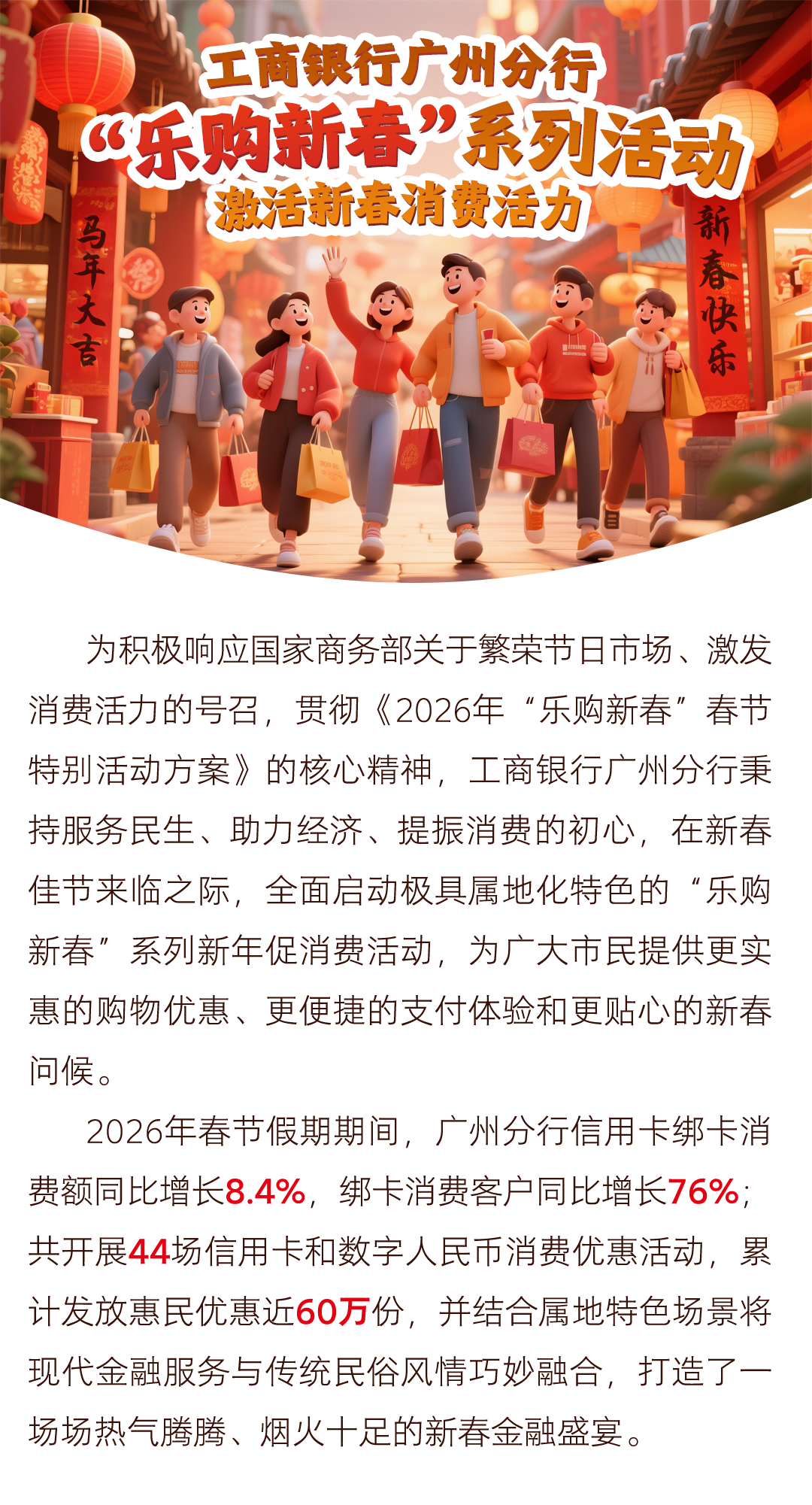
Core Viewpoint - The meeting between Shandong Highway Group and Industrial and Commercial Bank of China (ICBC) aims to strengthen their cooperation in financial services, focusing on project financing, cross-border financial services, and financial innovation to support high-quality economic development in Shandong Province [3][6]. Group 1 - Shandong Highway Group's Chairman Wang Qifeng welcomed ICBC's delegation and expressed gratitude for the bank's long-term financial support [3][6]. - Wang emphasized the importance of ICBC as a key financial partner, highlighting the deep cooperation foundation and fruitful results achieved [3][6]. - The meeting serves as an opportunity to deepen collaboration in major project financing and other financial services, aiming for resource sharing and mutual benefits [3][6]. Group 2 - ICBC's branch manager Li Feng expressed appreciation for Shandong Highway Group's trust and support, reaffirming the bank's commitment to being a significant partner [3][6]. - Li stated that ICBC will focus on the development needs of Shandong Highway Group, optimizing financial services and expanding the scope and depth of cooperation [3][6]. - The goal is to empower the group's high-quality development through high-quality financial services [3][6].
3000亿特别国债,即将启动
21世纪经济报道· 2026-03-05 10:21
Group 1 - The core point of the article is the announcement of a new round of capital injection for state-owned commercial banks in China, with a plan to issue 300 billion yuan in special government bonds to support capital replenishment [1] - The first round of capital injection in 2025 involved 500 billion yuan for four major banks, and the current focus is on Industrial and Agricultural Banks, which are expected to receive priority in this round of funding [1][2] - As of the end of Q3 2025, the core Tier 1 capital adequacy ratios for Industrial Bank and Agricultural Bank were 13.57% and 11.16%, respectively, both meeting regulatory requirements despite year-on-year declines [1] Group 2 - The need for continuous capital replenishment for state-controlled large banks arises from the pressure on net interest margins and profitability, limiting their ability to accumulate internal capital [2] - The issuance of special government bonds is part of a strategic deployment to enhance the stability of large commercial banks and their role in supporting the real economy [3]


5000亿后又有3000亿!今年拟发特别国债注资国有大行
第一财经· 2026-03-05 03:58
Core Viewpoint - The Chinese government plans to issue 300 billion yuan in special bonds to support the capital replenishment of state-owned commercial banks, following a previous issuance of 500 billion yuan in 2025 for four major banks [3][4]. Group 1: Capital Replenishment Plans - The second batch of capital replenishment for state-owned banks is underway, with the first batch having successfully injected 500 billion yuan into four major banks, including China Bank, Postal Savings Bank, Transportation Bank, and Construction Bank, totaling 520 billion yuan [3][4]. - The issuance of special bonds is aimed at enhancing the asset allocation capacity and service capabilities of these banks to support the real economy and ensure sustainable development [4][5]. Group 2: Regulatory and Market Context - The six major state-owned banks are classified as systemically important banks, facing higher capital adequacy requirements. The government’s move to inject capital is seen as a proactive measure to alleviate pressures from narrowing net interest margins and slowing profits [4][5]. - The capital adequacy ratios required for these banks are set at 9.5% for Industrial and Commercial Bank of China, 9% for Agricultural Bank of China, China Bank, and Construction Bank, and 8.5% for Transportation Bank [5][6]. Group 3: Current Capital Adequacy Status - As of the end of Q3 2025, the core Tier 1 capital adequacy ratios for Industrial and Commercial Bank of China and Agricultural Bank of China were 13.57% and 11.16%, respectively, showing a decline from the end of 2024 [6].



工商银行:动真碰硬抓好整改整治
Jin Rong Shi Bao· 2026-03-05 01:56
Core Viewpoint - The China Industrial and Commercial Bank (ICBC) is focusing on implementing a correct performance view as part of its party-building efforts, emphasizing the importance of education and adherence to the directives from the central government [1][2]. Group 1 - The recent meeting of ICBC's Party Committee aimed to deepen the understanding of Xi Jinping's important speeches regarding the establishment and practice of a correct performance view [1]. - The meeting highlighted that this educational initiative is a significant deployment by the central leadership and a key task for party building this year [1]. - The bank is committed to enhancing the political, ideological, and action awareness necessary for effective learning and education [1]. Group 2 - The meeting emphasized a focus on practical and straightforward approaches, aligning with the overarching requirements of serving the public, making scientific decisions, and ensuring effective execution [2]. - It was stressed that the bank should integrate learning with problem identification and rectification, emphasizing a problem-oriented approach [2]. - The importance of long-term institutional building alongside immediate corrective actions was highlighted, aiming to foster an environment where employees are motivated and capable of achieving results [2].
金价高位博弈,银行贵金属业务风控从“静态提门槛”到“动态限额度”
第一财经· 2026-03-04 13:15
Core Viewpoint - The article discusses the shift of commercial banks in China from static risk management to dynamic risk management in their precious metals business due to increased gold price volatility and speculative trading behavior among investors [3][5][11]. Group 1: Dynamic Risk Management Implementation - China Construction Bank announced the implementation of dynamic trading limits for its "Jianxing Gold" business starting March 4, 2026, in response to rising physical gold purchase volumes [5][10]. - This dynamic limit will be adjusted daily based on market conditions, allowing for more flexibility compared to previous static risk management methods [5][9]. - Other banks, such as Agricultural Bank of China and Zhejiang Commercial Bank, have also begun exploring dynamic control mechanisms to better manage risks associated with fluctuating gold prices [3][10]. Group 2: Market Volatility and Speculative Behavior - The gold market has experienced significant volatility, with prices fluctuating dramatically, such as a rise from approximately $5100 to $5419 per ounce within a few days [12]. - Many new investors, often lacking a deep understanding of gold trading, have entered the market, leading to increased speculative trading and subsequent losses [11][14]. - The article highlights individual cases of investors who faced substantial losses due to short-term trading strategies, which were not aligned with the intended long-term investment nature of gold accumulation products [13][14]. Group 3: Adjustments in Risk Management Standards - Banks are raising the risk tolerance levels for investors engaging in precious metals trading, with some banks requiring a minimum risk assessment rating of C3 (balanced) or higher [15][16]. - There is a trend towards tightening the rules for precious metals agency business, with many banks suspending new trades or limiting purchases [15][16]. - The article notes that banks are increasingly integrating compliance and risk management, emphasizing the importance of investor suitability and regular risk warnings [16].

工商银行上海市分行:聚焦养老金融 护航银发生活
Sou Hu Cai Jing· 2026-03-04 07:40
Core Viewpoint - The development of pension finance is both a political responsibility for state-owned banks and an important mission to serve the public, with a focus on creating a comprehensive pension financial service system for the elderly in Shanghai [1][4]. Group 1: Service Infrastructure - ICBC Shanghai Branch has implemented age-friendly modifications in its flagship branch, including accessible facilities such as wheelchair ramps, low-position ATMs, and various assistive devices, ensuring a seamless experience for elderly customers [1]. - The bank has established a systematic and standardized approach to pension finance, creating a three-tiered network of pension financial service points, with 300 flagship features, accounting for 63% of its total branches [2]. Group 2: Digital Services - The bank has enhanced digital services for the elderly by integrating financial services into daily life through initiatives like personal pension account services on the "Shangyin" app and a dedicated section for elderly services in mobile banking [2]. - Over 200 million customers have been reached through online features designed for the elderly, bridging the digital divide [2]. Group 3: Social Security and Financial Support - ICBC Shanghai Branch maintains a leading position in social security services, with the highest balance and growth in social security deposits, and a market share of 20% in financial social security cards [3]. - The bank supports the high-quality development of the pension industry by financing large health and wellness projects and small to medium-sized pension enterprises, introducing innovative loan products to address financing challenges [3]. Group 4: Future Commitment - The bank is committed to continuously improving its pension financial services, enhancing product offerings, and elevating service experiences to support families in their later years and contribute to addressing the challenges of an aging population [4].
2026年2月社融前瞻:预计社融增速8.1%
GF SECURITIES· 2026-03-04 07:26
Investment Rating - The industry investment rating is "Buy" [5]. Core Viewpoints - The report forecasts a social financing growth rate of 8.1% for February 2026, with a total social financing increment of 2.1 trillion CNY, which is a year-on-year decrease of 0.1 trillion CNY [4][7]. - It is expected that the total outstanding social financing will reach 451.1 trillion CNY by the end of February, reflecting a year-on-year growth rate of 8.1% and a month-on-month decline of 0.07 percentage points [4][7]. - The report highlights that credit growth is anticipated to be lower year-on-year due to the impact of the Spring Festival, with corporate credit demand expected to remain flat and retail loans likely to decrease year-on-year [4][7]. Summary by Sections Social Financing Estimates - The estimated social financing stock for February 2026 is 451.1 trillion CNY, up from 449.1 trillion CNY in January 2026 and 417.3 trillion CNY in February 2025, showing a month-on-month increase of 2.0% and a year-on-year increase of 33.8% [7]. - The report predicts a decrease in new RMB loans for February 2026, estimating an increment of 0.5 trillion CNY, which is a year-on-year decrease of 0.1 trillion CNY [4][7]. Credit and Bond Financing - The report anticipates a decrease in government and credit bond net financing for February, with government bonds expected to net finance 1.4 trillion CNY, down 0.3 trillion CNY year-on-year [4][7]. - The report also notes that the demand for bank bills is expected to remain strong, with a decrease of 1,000 billion CNY in discounted bank acceptance bills, reflecting a year-on-year decrease of 2,000 billion CNY [4][7]. Monetary Growth - The report emphasizes the importance of M2 growth, which is expected to remain high at around 9.0% in February, supported by strong government bond financing and improved corporate cash flow [4][7]. - M1 growth is projected to rise to approximately 5.1%, influenced by a low base effect and the reduced impact of deposit migration [4][7].