
PSBC(01658)

Search documents
超燃!“十四五”时期,这些成就续写新传奇
21世纪经济报道· 2025-10-01 09:07
Core Viewpoint - The article highlights the significant achievements and advancements made in various sectors during China's "14th Five-Year Plan" period, emphasizing the continuous growth of the real economy and the importance of innovation and infrastructure development. Group 1: Economic Growth and Innovation - In 2024, China's total R&D investment is expected to exceed 3.6 trillion yuan, representing a 48% increase compared to 2020 [3] - The number of high-tech enterprises in China is projected to surpass 50,000, an increase of 83% from 2020 [3] - The private sector has grown to over 58 million enterprises during the "14th Five-Year Plan" period, with private enterprises accounting for over 92% of national high-tech enterprises [4][6] Group 2: Financial Support for Key Sectors - Postal Savings Bank has supported over 100,000 technology-based enterprises, with a technology loan balance exceeding 930 billion yuan by June 2025 [3] - The bank's loans to private enterprises reached 2.64 trillion yuan, representing a significant portion of its total loan portfolio [6] - The bank has also increased its medium- and long-term loans to the manufacturing sector by 8.53% compared to the previous year [8] Group 3: Infrastructure and Agricultural Development - By the end of 2024, China's high-speed rail operating mileage is expected to reach 48,000 kilometers, with 5G base stations totaling 459,377 [7] - Grain production in China has reached 1.4 trillion yuan, marking a significant increase of 740 billion yuan since 2020 [9] - The bank has supported rural revitalization efforts, with agricultural loan balances reaching 2.44 trillion yuan, a leading position among state-owned banks [10] Group 4: Employment and Social Welfare - The annual increase in urban employment has stabilized at 12 million during the "14th Five-Year Plan" period [11] - The national basic pension insurance coverage has reached over 95% [12] - Postal Savings Bank has opened over 10 million personal pension accounts, with a deposit scale growth of 28.85% compared to the previous year [13]



2025年前三季度A股股权承销排行榜
Wind万得· 2025-10-01 03:18
Core Insights - The Chinese A-share equity financing market remains active in the first three quarters of 2025, characterized by significant structural differentiation and driven by both policy and innovation [2] - Total fundraising events reached 215, with a total amount of 8540.44 billion yuan, marking a year-on-year increase of 414.42% [5][8] Financing Overview - In the first three quarters of 2025, there were 215 financing events, an increase of 35 events compared to the previous year, with total equity financing amounting to 8540.44 billion yuan [5][8] - The number of IPOs was 76, raising 759.74 billion yuan, a year-on-year increase of 66.67% [5][8] - The number of private placements was 109, raising 7322.62 billion yuan, a year-on-year increase of 670.69% [5][8] - Excluding policy factors, the actual equity financing scale was 3340.44 billion yuan, a year-on-year increase of 101.21% [5][8] Financing Methods Distribution - IPOs accounted for 8.90% of the total fundraising, while private placements dominated with 85.74% [8][11] - Convertible bonds represented 5.36% of the total fundraising [8][11] Industry Distribution of Financing Entities - The banking sector led with a fundraising amount of 5200 billion yuan, followed by public utilities at 488.03 billion yuan and semiconductors at 392.86 billion yuan [12][47] Regional Distribution of Financing Entities - Beijing ranked first in fundraising with 4249.62 billion yuan, followed by Shanghai with 1600.54 billion yuan and Guangdong with 762.82 billion yuan [16][19] IPO Trends - The number of IPOs increased to 76, with a total fundraising of 759.74 billion yuan, a 66.67% increase year-on-year [22][29] - The Shanghai and Shenzhen main boards led in fundraising, accounting for 57.31% of the total [25][28] Top IPOs - The highest fundraising IPO was Huadian New Energy, raising 181.71 billion yuan, followed by Zhongce Rubber and Tianyouwei [36][37] Private Placement Trends - The number of private placements was 109, with a total amount of 7322.62 billion yuan, significantly influenced by the special government bond capital replenishment plan [39][42] - State-owned enterprises dominated private placements, accounting for 86.39% of the total [43][46] Top Underwriters - CITIC Securities led the underwriting amount with 1864.47 billion yuan, followed by Bank of China and Guotai Junan [58][59] - In terms of the number of underwritings, CITIC Securities also ranked first with 48 cases [60][61] Convertible Bonds - The leading underwriter for convertible bonds was Huatai Securities, with an underwriting amount of 98.50 billion yuan [79][80]





金融监管总局披露9月第三批罚单,一个月合计罚超3亿
Xin Lang Cai Jing· 2025-10-01 01:33
Core Viewpoint - The National Financial Regulatory Administration has issued a new batch of fines totaling over 39 million yuan, primarily targeting violations related to internet loan businesses by Postal Savings Bank and Citic Baixin Bank [1][2]. Group 1: Regulatory Actions - In September, the National Financial Regulatory Administration has issued a total of three batches of fines, affecting over 20 institutions or individuals, with a cumulative penalty amount exceeding 300 million yuan [1]. - Postal Savings Bank was fined 27.92 million yuan for various violations, including mismanagement of loan and internet loan businesses [1]. - Citic Baixin Bank was fined 11.2 million yuan for imprudent management of internet loan businesses and non-compliance in regulatory data reporting [2]. Group 2: Institutional Responses - Postal Savings Bank has acknowledged the regulatory findings and is committed to rectifying the issues, emphasizing compliance and high-quality development in its operations [1]. - Citic Baixin Bank has also expressed its commitment to implementing corrective measures and enhancing risk management and compliance practices [2]. Group 3: Broader Context - The fines issued in September reflect a range of issues, including traditional banking risks and emerging concerns such as data security and internet loan management [3]. - Over 30 individuals have faced penalties since September, indicating a trend towards accountability and thorough regulatory oversight [4].

合计近4000万元!邮储银行、百信银行收千万级罚单
Zhong Guo Zheng Quan Bao· 2025-09-30 15:45
Group 1 - Postal Savings Bank was fined a total of 27.9167 million yuan for imprudent management of related loan businesses, internet loan businesses, performance assessments, and cooperative businesses [1][2][3] - Baixin Bank was fined a total of 11.2 million yuan for imprudent management of related internet loan businesses and non-compliance in regulatory data reporting [1][3] - The penalties were part of a broader increase in regulatory scrutiny within the banking sector, with multiple fines issued in September alone [8][9] Group 2 - Baixin Bank, established in 2017, is a joint venture between CITIC Bank and Baidu, with CITIC Bank holding a 65.7% stake [6] - As of June 30, Baixin Bank reported total assets of 119.516 billion yuan, a year-on-year increase of 1.9%, and achieved a net profit of 0.472 billion yuan, reflecting a 1.66% increase [6] - The recent penalties mark the first for Baixin Bank under its new chairman, who was appointed on August 25, 2023 [6]
邮储银行回应2791万元罚单:已按监管要求有序推动整改,坚持依法合规经营
Zhong Zheng Wang· 2025-09-30 12:12
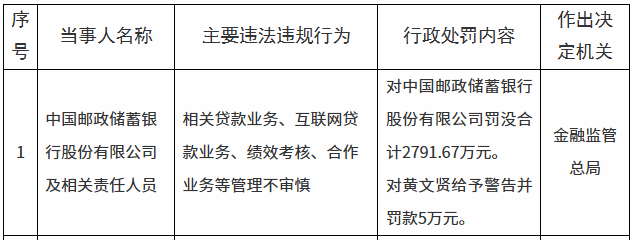
Core Viewpoint - Postal Savings Bank of China was fined approximately 27.92 million yuan due to management issues related to loan businesses and performance assessments, highlighting regulatory scrutiny in the banking sector [1] Regulatory Actions - The financial regulatory authority disclosed that Postal Savings Bank faced penalties for imprudent management in various areas including loan operations and internet lending [1] - A related individual was also warned and fined 50,000 yuan as part of the enforcement actions [1] Company Response - Postal Savings Bank acknowledged the regulatory findings and emphasized its commitment to compliance and high-quality development [1] - The bank plans to implement corrective measures in response to the regulatory feedback, focusing on improving governance and internal control systems [1] - The bank aims to enhance its service to the real economy and provide quality financial services to customers [1]
互联网贷款不审慎、消保不规范等,三家银行共被罚近4500万元
2 1 Shi Ji Jing Ji Bao Dao· 2025-09-30 12:06
Group 1 - The National Financial Regulatory Administration imposed fines totaling nearly 40 million yuan on Postal Savings Bank and Baixin Bank due to issues related to internet loan operations [1][2] - Postal Savings Bank was fined 27.9167 million yuan for various violations including mismanagement of loan operations and internet loan business [1] - Baixin Bank was fined 11.2 million yuan for imprudent management of internet loans and non-compliance in regulatory data reporting [2] Group 2 - Postal Savings Bank acknowledged the regulatory findings and emphasized its commitment to compliance and high-quality development in response to the penalties [1] - Baixin Bank stated that the penalties stemmed from supervisory checks conducted in 2023, covering business activities from January 1, 2021, to June 30, 2023 [2] - Beijing Bank was fined 5.3 million yuan for multiple violations including inaccurate loan risk classification and inadequate provisions for financial investments [2]

又是两家大行收罚单,合计罚没近4000万元
Xin Lang Cai Jing· 2025-09-30 11:24
登录新浪财经APP 搜索【信披】查看更多考评等级 (来源:POS圈支付网) 邮储银行罚没2791万 | 序 | 当事人名称 | 主要违法违规行为 | 行政处罚内容 | 作出决 | | --- | --- | --- | --- | --- | | 릉 | | | | 定机关 | | 1 | | | 对中国邮政储蓄银行 | 金融监管 | | | 中国邮政储蓄银 | 相关贷款业务、互联网贷 | 股份有限公司罚没合 | | | | 行股份有限公司 | 款业务、绩效考核、合作 | 计2791.67万元。 | | | | 及相关责任人员 | 业务等管理不审慎 | 对黄文贤给予警告并 | 总局 | | | | | 罚款5万元。 | | 罚单显示,中国邮政储蓄银行的主要违法违规事实(案由)为:相关贷款业务、互联网贷款业务、绩效 考核、合作业务等管理不审慎。 同日,邮储银行在其官网发布了"关于行政处罚事项的临时信息披露报告",对此次处罚进行了回应,邮 储银行称,对于上述处罚涉及问题,本行已全面开展整改,同时严格对标监管要求,进一步加强合规风 险管控,持续推进高质量发展,提升金融服务水平。 中信百信银行罚没1120万 | | ...
监管披露多张罚单!五家银行合计被罚超4600万元
Bei Jing Shang Bao· 2025-09-30 11:23
Group 1 - The National Financial Regulatory Administration and its Beijing branch announced administrative penalties totaling 46.4267 million yuan for five banks [1] - Postal Savings Bank and Citic Baixin Bank were fined a combined total of 39.1167 million yuan, with Postal Savings Bank facing penalties of 27.9167 million yuan for various management violations [1] - Citic Baixin Bank was fined 11.2 million yuan for issues related to internet loan management and non-compliance in regulatory data reporting [1] Group 2 - Beijing Bank was fined 5.3 million yuan for multiple violations, including inaccurate loan risk classification and inadequate impairment provisions for financial investments [2] - Ping An Bank's Beijing branch was fined 2 million yuan for using improper means to attract deposits, with a related individual banned for life from the banking industry [2] - Industrial and Commercial Bank of China’s Beijing Mudanyuan branch received a warning and a fine of 10,000 yuan for damaging its financial license [2]


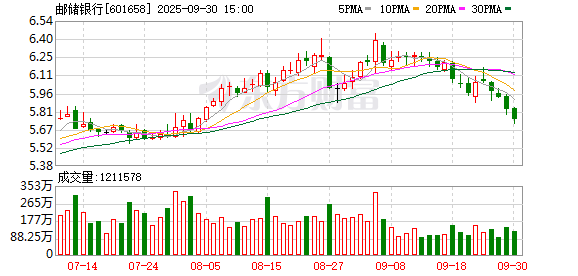
邮储银行股价连续4天下跌累计跌幅5.12%,南方基金旗下1只基金持14.88万股,浮亏损失4.61万元
Xin Lang Cai Jing· 2025-09-30 10:41
来源:新浪基金∞工作室 9月30日,邮储银行跌1.37%,截至发稿,报5.75元/股,成交6.97亿元,换手率0.18%,总市值6905.47亿 元。邮储银行股价已经连续4天下跌,区间累计跌幅5.12%。 资料显示,中国邮政储蓄银行股份有限公司位于中国北京市西城区金融大街3号,香港湾仔皇后大道东 248号大新金融中心40楼,成立日期2007年3月6日,上市日期2019年12月10日,公司主营业务涉及中国 邮政储蓄银行股份有限公司在中国提供银行及相关金融服务。该银行主要通过个人银行、企业银行及资 金业务运营。个人银行业务向个人客户提供多种产品及服务,包括人民币及外汇存储、贷款、银行卡及 中间业务产品及服务。企业银行业务为企业客户提供多样化金融产品及服务,包括企业贷款、贴现票 据、企业存款及中间业务产品及服务,如:结算、票据管理、现金管理、投资银行、托管及公司理财。资 金业务主要包括金融市场业务,如:市场交易、投资、同业融资及票据贴现。资金业务还包括资产管理。 主营业务收入构成为:个人银行业务69.57%,公司银行业务19.70%,资金业务10.65%,其他业务 0.07%。 从基金十大重仓股角度 数据显示,南方 ...
邮储银行积极支持江门地区“专精特新”及高新技术企业
Zhong Guo Fa Zhan Wang· 2025-09-30 10:35
Group 1 - China Postal Savings Bank is actively innovating financial service models in Jiangmen, Guangdong, to support local "specialized, refined, unique, and innovative" and high-tech enterprises through innovative products, rapid loan disbursement, and accompanying services [1] - The bank has introduced "Science and Technology Innovation Loans" based on intangible assets, breaking traditional collateral limitations, which allows for a more flexible financing structure for technology-driven companies [2] - The "Science and Technology Innovation Loans" are specifically aimed at supporting research and development investments and equipment upgrades for companies like Hongxing Aluminum, which expects an output value of 320 million yuan this year [2] Group 2 - The bank's rapid response is exemplified by the case of Guangdong Wanjiahong Stainless Steel Products Co., which received a 5 million yuan loan within 72 hours to address a short-term funding gap due to a surge in orders [3][4] - The "Cluster E-Loan" product utilizes industry-wide data to create risk control models, enabling standardized online loan services for entire industrial clusters, thus improving efficiency and reducing processing time [3][4] - The bank emphasizes a partnership model with local enterprises, providing customized, long-term services that adapt to the specific needs of companies like Lifen Electric, which has benefited from tailored financial solutions [6][7] Group 3 - The bank collaborates with government departments, guarantee institutions, and industrial parks to create a multi-party financial service mechanism, enhancing support for "specialized, refined, unique, and innovative" enterprises [7] - The bank's initiatives, such as using intellectual property pledges to solve financing difficulties for aluminum companies and providing rapid funding solutions for stainless steel enterprises, contribute significantly to the industrial revitalization efforts in Jiangmen [7]