PSBC(01658)

Search documents
银行零售信贷“缩表”,调整期持续?
券商中国· 2025-10-08 08:10
Core Viewpoint - Recent adjustments by some joint-stock banks to reduce credit card overdraft rates to "0" aim to increase volume by lowering costs [1] Group 1: Credit Card Loan Trends - Credit card loan balances are a key indicator of retail banking customer activity, with recent adjustments reflecting banks' efforts to compete for existing customers during a retail "cold season" [2] - Many listed banks have seen a further expansion of negative growth in credit card loan balances this year, alongside a decline in other retail loan categories such as consumer loans and mortgages [2][4] - Major state-owned banks like Bank of China and Postal Savings Bank reported declines in credit card loan balances of 13.88% and 5.67% respectively, while some joint-stock banks also experienced negative growth [3] Group 2: Overall Retail Lending Environment - The retail lending sector is undergoing an "adjustment period," with 17 out of 42 listed banks reporting a contraction in personal loan balances as of mid-2023 [4] - The contraction in personal housing mortgage loans has been a significant factor, with a reported negative growth of 1.6% in personal housing loan balances at the end of 2023, marking the first decline since 1997 [5][6] Group 3: Retail Loan Risk Assessment - Retail loan risks are on the rise, with the non-performing loan (NPL) ratio for retail loans increasing to 1.23% as of mid-2023, compared to a decrease in corporate loan NPL ratios [9] - Specific segments such as mortgage loans, consumer loans, and credit cards have seen their NPL ratios rise, indicating a challenging environment for retail lending [9][10] - The overall retail loan risk trend remains upward, with banks acknowledging the need for improved risk management practices in response to these challenges [10]






邮储银行(01658.HK)获平安资管增持836万股
Ge Long Hui A P P· 2025-10-08 00:10
Group 1 - The core point of the article is that Ping An Asset Management Co., Ltd. has increased its stake in Postal Savings Bank of China (01658.HK) by acquiring 8.36 million shares at an average price of HKD 5.4382 per share, resulting in a total investment of approximately HKD 45.4634 million [1] - After the acquisition, Ping An Asset Management's total shareholding in Postal Savings Bank has risen to 3,382,236,000 shares, increasing its ownership percentage from 16.99% to 17.03% [1]

监管重拳!三家银行被罚近4500万
凤凰网财经· 2025-10-07 13:27
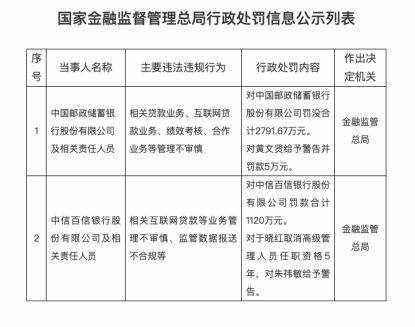
Core Viewpoint - The article discusses significant penalties imposed on Postal Savings Bank, Citic Baixin Bank, and Beijing Bank due to violations in their internet loan businesses and other financial practices, highlighting the regulatory scrutiny in the banking sector [2][4][6]. Group 1: Penalties and Violations - Postal Savings Bank was fined a total of 27.92 million yuan for issues related to internet loan management and other operational practices, with a related individual receiving a warning and a fine of 50,000 yuan [3][4]. - Citic Baixin Bank faced penalties totaling 11.2 million yuan for improper management of internet loans and non-compliance in regulatory data reporting, with one executive losing their senior management position for five years [3][5]. - Beijing Bank was fined 5.3 million yuan for multiple violations, including inaccurate loan risk classification and inadequate provisions for financial investments, with two responsible individuals receiving warnings and fines of 50,000 yuan each [6][7]. Group 2: Institutional Responses - Postal Savings Bank emphasized its commitment to compliance and improvement in governance and internal control systems following the penalties, aiming to enhance service quality for customers [4]. - Citic Baixin Bank acknowledged the penalties as a result of regulatory inspections and stated its focus on strengthening risk management and compliance measures moving forward [5]. - Both banks expressed intentions to adhere strictly to regulatory requirements and continue providing reliable financial services to their customers [4][5].


Ping An Asset Management Co., Ltd.增持邮储银行836万股 每股作价约5.44港元
Zhi Tong Cai Jing· 2025-10-06 11:40
香港联交所最新资料显示,9月30日,Ping An Asset Management Co.,Ltd.增持邮储银行(601658) (01658)836万股,每股作价5.4382港元,总金额约为4546.34万港元。增持后最新持股数目约为33.82亿 股,最新持股比例为17.03%。 ...
Ping An Asset Management Co., Ltd.增持邮储银行(01658)836万股 每股作价约5.44港元
智通财经网· 2025-10-06 11:35
智通财经APP获悉,香港联交所最新资料显示,9月30日,Ping An Asset Management Co., Ltd.增持邮储 银行(01658)836万股,每股作价5.4382港元,总金额约为4546.34万港元。增持后最新持股数目约为33.82 亿股,最新持股比例为17.03%。 ...
监管重拳!三家银行被罚近4500万
2 1 Shi Ji Jing Ji Bao Dao· 2025-10-06 09:04
Group 1 - The National Financial Regulatory Administration imposed fines totaling nearly 40 million yuan on Postal Savings Bank and Citic Baixin Bank due to issues related to internet loan operations [1][4] - Postal Savings Bank was fined 27.9167 million yuan for imprudent management of loan and internet loan businesses, along with a warning and a fine of 50,000 yuan for responsible person Huang Wenxian [4][5] - Citic Baixin Bank faced a total fine of 11.2 million yuan for imprudent management of internet loan operations and non-compliance in regulatory data reporting, with responsible person Yu Xiaohong's senior management qualification canceled for five years and a warning issued to Zhu Yimin [4][5] Group 2 - Beijing Bank was fined 5.3 million yuan by the Beijing Financial Regulatory Bureau for various violations, including inaccurate loan risk classification and inadequate provisions for financial investment business impairment [6][7] - Responsible persons Xu Kai and Wang Jin received warnings and fines of 50,000 yuan each due to the violations at Beijing Bank [6][7]
福建:为乡村振兴注入金融“活水”
Xin Hua Wang· 2025-10-06 08:42
Core Insights - Financial institutions in Fujian are innovating financial products to inject capital into rural revitalization, particularly focusing on specialty agricultural industries [1][2] Group 1: Financial Support for Agriculture - In Nanping City, a farmer received a loan of 450,000 yuan to expand his rice farming operations, highlighting the importance of financial support for agricultural growth [1] - In Longyan City, a farmer reported a 30% increase in grape yield compared to the previous year, facilitated by a 250,000 yuan loan from a local bank [1] Group 2: Innovative Financial Products - Financial institutions in Fujian have developed various loan products such as fishery management loans and specialty tea loans to address the challenges faced by farmers and fishermen due to lack of collateral [1] - In Changle District, local financial departments provide one-stop financial services, allowing aquaculture farmers to use their farming certificates as collateral for loans [2] Group 3: Comprehensive Financial Services - The establishment of a "sea community" service flagship store in Ningde City allows fishermen to complete loan applications and contracts directly at their work sites, improving efficiency [2] - As of the end of last year, the total output value of ten key rural specialty industries in Fujian exceeded 2.3 trillion yuan, demonstrating the significant economic impact of these initiatives [2]
邮储银行(01658) - 截至2025年9月30日股份发行人的证券变动月报表
2025-10-06 08:35
本月底法定/註冊股本總額: RMB 120,095,053,492 FF301 2. 股份分類 普通股 股份類別 A 於香港聯交所上市 (註1) 否 證券代號 (如上市) 601658 說明 A股(上海證券交易所) 法定/註冊股份數目 面值 法定/註冊股本 上月底結存 100,238,886,492 RMB 1 RMB 100,238,886,492 增加 / 減少 (-) 0 RMB 0 本月底結存 100,238,886,492 RMB 1 RMB 100,238,886,492 1. 股份分類 普通股 股份類別 H 於香港聯交所上市 (註1) 是 證券代號 (如上市) 01658 說明 H股 法定/註冊股份數目 面值 法定/註冊股本 上月底結存 19,856,167,000 RMB 1 RMB 19,856,167,000 增加 / 減少 (-) RMB 本月底結存 19,856,167,000 RMB 1 RMB 19,856,167,000 致:香港交易及結算所有限公司 截至月份: 2025年9月30日 狀態: 新提交 公司名稱: 中國郵政儲蓄銀行股份有限公司 呈交日期: 2025年10月6日 I. ...
寻找“受尊敬”企业系列报道之四:人力资本即核心竞争力,从薪酬榜单看企业长期主义
Jing Ji Guan Cha Bao· 2025-10-05 06:46
Core Insights - The article emphasizes that employee compensation is a crucial indicator of a company's sustainable development capability, reflecting corporate governance, strategic determination, and social responsibility [1][15] - The ongoing increase in employee compensation over three years indicates stable profitability and a reasonable cost allocation mechanism within companies, allowing them to maintain basic employee protections amid external fluctuations [1][15] Industry Overview - A total of 1,291 companies in the A-share market have experienced continuous employee compensation growth from 2022 to 2024, covering 32 industry categories, with a significant presence in the real economy [2] - The mechanical equipment industry leads with 166 companies (12.86%), followed by electronics (122 companies, 9.45%), electrical equipment (115 companies, 8.91%), pharmaceutical biology (113 companies, 8.75%), automotive (109 companies, 8.44%), and basic chemicals (106 companies, 8.21%) [2] - The financial sector, particularly banks and insurance groups, shows a strong trend in employee compensation growth, with 37 companies (2.86%) in banking and non-banking financial services [2] Top Companies by Employee Compensation - The top ten companies by total employee compensation are all from the financial sector, indicating a strong correlation between asset scale, profitability, and employee welfare [3] - Agricultural Bank ranks first with a total employee compensation of 87.803 billion yuan, followed by China Construction Bank (60.661 billion yuan) and Bank of China (58.554 billion yuan) [5][6][7] - These companies demonstrate a commitment to employee welfare through various strategies, including performance-based pay, investment in talent development, and alignment of compensation with business growth [5][6][7][8][9] Trends and Characteristics - The continuous growth in employee compensation is linked to the companies' long-term vision and is indicative of their ability to adapt to macroeconomic conditions and industry upgrades [15] - High industry concentration is observed, with the majority of the top ten companies being financial institutions, reflecting strategic considerations in human resource allocation [15] - The linkage between compensation growth and business transformation is evident, with many companies investing in technology innovation and digital transformation [15] - A trend towards market-oriented incentive mechanisms is noted, with more companies adopting performance-based compensation systems to attract and retain key talent [15]



超燃!“十四五”时期,这些成就续写新传奇
2 1 Shi Ji Jing Ji Bao Dao· 2025-10-01 09:16
Core Insights - The "14th Five-Year Plan" period has seen significant advancements in China's manufacturing transformation and upgrades, with a focus on strengthening the real economy and achieving notable accomplishments across various sectors [1][3][4]. R&D and Technology - By 2024, China's total R&D investment is expected to exceed 3.6 trillion yuan, representing a 48% increase compared to 2020 [3]. - The number of high-tech enterprises in China is projected to surpass 500,000 by 2024, marking an 83% increase since 2020 [3]. Private Sector Growth - The number of private enterprises in China has grown to over 58 million during the "14th Five-Year Plan" period, with private enterprises accounting for over 40% of national high-tech enterprises, an increase from the end of the "13th Five-Year Plan" [4]. Financial Support for Private Enterprises - Postal Savings Bank has provided diversified financial services to empower the high-quality development of private enterprises, with a loan balance of 2.64 trillion yuan for private enterprises as of June 2025 [5]. Infrastructure Development - By the end of 2024, China's high-speed rail operating mileage is expected to reach 48,000 kilometers, with 5G base stations totaling 4.598 million [7]. - The "14th Five-Year Plan" period has accelerated infrastructure development, with significant support from Postal Savings Bank for major projects [8]. Agricultural Production - In 2024, China's grain production is projected to reach 1.4 trillion yuan, an increase of 740 billion yuan compared to 2020, marking the 21st consecutive year of growth [10]. Rural Development and Financial Inclusion - Postal Savings Bank has actively supported rural revitalization, with an agricultural loan balance of 2.44 trillion yuan as of June 2025 [11]. - The participation rate in basic pension insurance has reached over 95%, benefiting 560 million people [13]. Social Welfare and Financial Services - The "14th Five-Year Plan" period has seen continuous improvement in the well-being of the population, with Postal Savings Bank opening over 10 million personal pension accounts, and the deposit scale increasing by 28.85% compared to the previous year [14]. Financial Services to the Real Economy - The quality and efficiency of financial services to the real economy have significantly improved, with annual growth rates for loans to technology-based SMEs, inclusive microloans, and green loans exceeding 20% [16].