PSBC(01658)

Search documents
多家银行官宣:2026年1月1日起,为数字人民币实名钱包余额计付利息
Bei Jing Shang Bao· 2025-12-31 05:25
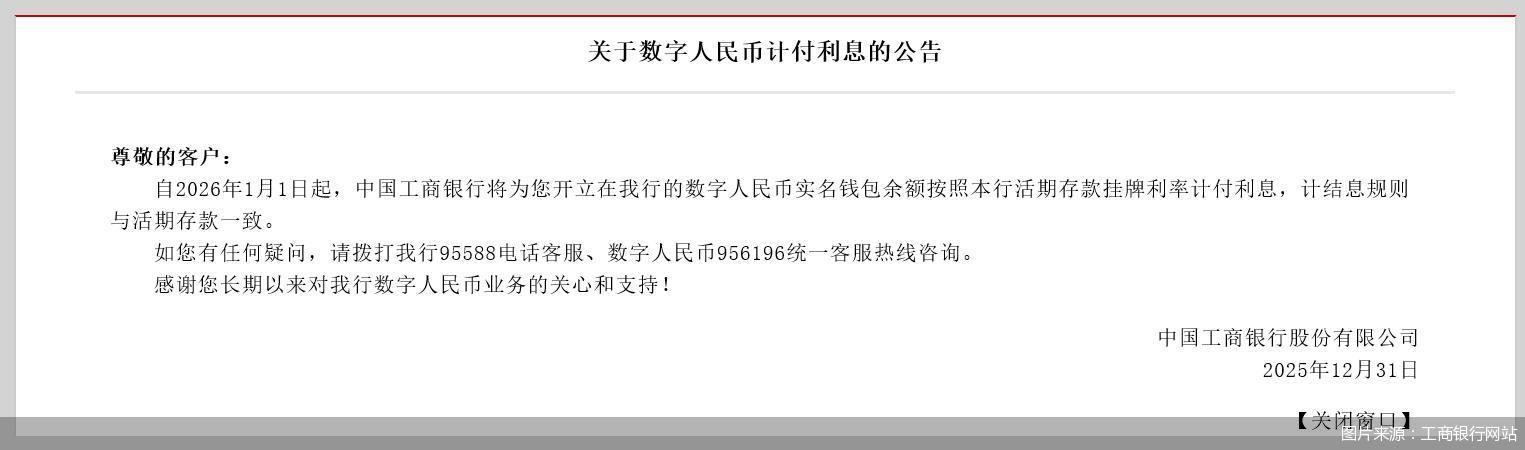
Core Viewpoint - Major Chinese banks including Industrial and Commercial Bank of China, Agricultural Bank of China, Postal Savings Bank of China, Bank of Communications, and China Construction Bank will start paying interest on digital RMB wallet balances at the same rate as current deposit rates from January 1, 2026, marking a significant transition in the digital currency landscape in China [1][4][5] Group 1: Bank Announcements - Industrial and Commercial Bank of China, Agricultural Bank of China, and Postal Savings Bank of China will apply interest to digital RMB wallet balances according to the current deposit rate, with interest calculation rules consistent with those for current deposits [4] - Bank of Communications will also apply the current deposit rate to digital RMB wallet balances, including various types of personal and corporate wallets, while balances in type four wallets will not earn interest [4] - China Construction Bank will revise its customer service agreement to reflect that digital RMB wallet balances will earn interest based on the current deposit rate starting January 1, 2026 [4] Group 2: Digital RMB Framework - The People's Bank of China has introduced a plan to enhance the management and service system for digital RMB, which will officially implement a new measurement framework and operational mechanism on January 1, 2026 [5] - This transition signifies a shift from the "digital cash era" to the "digital deposit currency era" after a decade of research and pilot programs [5]





中信银行少帅转战邮储,国有行股份行间高管流动折射何种变化
Nan Fang Du Shi Bao· 2025-12-31 04:36
Core Viewpoint - The recent appointment of Lu Wei as the president of Postal Savings Bank after his resignation from CITIC Bank highlights the increasing trend of executive mobility between state-owned and joint-stock banks in China, reflecting a shift towards breaking down institutional barriers and fostering financial innovation [2][9][12]. Group 1: Executive Changes - Lu Wei resigned from his positions at CITIC Bank, including president and executive director, due to work adjustments, and has been appointed as the president of Postal Savings Bank [3][5]. - Lu Wei has over 20 years of experience at CITIC Bank, having held various significant roles, including vice president and secretary of the board [3][4]. - Following Lu Wei's departure, CITIC Bank's chairman, Fang Heying, will temporarily assume the role of president [8]. Group 2: Industry Trends - The movement of executives between state-owned and joint-stock banks has become increasingly common, with several high-profile cases in recent years, indicating a trend towards more fluid talent mobility in the banking sector [9][10]. - Experts suggest that this trend is part of a broader strategy to enhance capital and talent flow, shift performance metrics from "loan scale" to "ecological value," and stimulate financial innovation [10][11]. - The transition of executives like Lu Wei poses challenges, as they must adapt their skills and experiences to different banking environments, particularly in rural contexts [11][12].


智通港股早知道 | 隔夜COMEX白银期货涨7.88% 两部门:2026年继续实施消费品以旧换新 支持汽车置换更新
智通财经网· 2025-12-31 01:40
Group 1: Consumer Subsidy Policy - The National Development and Reform Commission and the Ministry of Finance announced a subsidy policy for consumer electronics and appliances, effective from 2026, providing a 15% subsidy on the sales price for specific products [1][4] - Consumers can receive a subsidy of up to 1,500 yuan for each qualifying appliance, and up to 500 yuan for each qualifying digital product, with a limit of one subsidy per product category per consumer [1][4] - The policy also supports the replacement of vehicles, offering subsidies for consumers who trade in their cars for new energy vehicles or low-displacement fuel vehicles [4] Group 2: Market Performance - COMEX silver futures rose by 7.88%, while the Dow Jones Industrial Average fell by 0.2%, closing at 48,367.06 points [2] - The S&P 500 index decreased by 0.14%, and the Nasdaq Composite index dropped by 0.24% [2] - Major tech stocks showed mixed performance, with Intel and Meta both gaining over 1% [2] Group 3: Corporate Announcements - China Aircraft Leasing announced the purchase of 30 Airbus A320neo aircraft, with deliveries expected to occur in phases until 2033 [9] - China Aluminum International plans to acquire a 51% stake in Yunnan Yun Aluminum Logistics for approximately 264 million yuan [15] - Zijin Mining Group expects a net profit of approximately 51-52 billion yuan for 2025, representing a year-on-year increase of about 59%-62% [18]


“不赚钱也要抢单”低息经营贷背后的银行账本
Zhong Guo Zheng Quan Bao· 2025-12-30 21:11
Core Viewpoint - The personal operating loan interest rates have generally entered the "2" range, with some banks offering rates as low as 2.3%, driven by competition and a strategy of attracting customers through lower prices [1][4]. Group 1: Current Loan Rates - Many banks are now offering personal operating loan rates below 2.5%, with slight variations based on region and product type [1][2]. - For instance, the lowest rate for personal mortgage operating loans at one bank is 2.35%, with a loan term of 3 years and a credit limit of up to 30 million yuan [1]. - Another bank reports that the minimum rate for collateralized personal operating loans is 2.5%, while credit-based products start at 2.55% [2]. Group 2: Loan Approval Criteria - Borrowers must meet strict criteria, including having a local household registration and a minimum duration of social security payments [3]. - The collateral property must be within the local jurisdiction, not older than 35 years, and the borrower must have owned it for at least 3 months [3]. - Additionally, the borrowing entity must be a small or micro enterprise with a good credit record and normal operating cash flow [3]. Group 3: Market Dynamics and Risks - The current low interest rates are a result of multiple factors, including policy guidance, industry competition, and reduced funding costs for banks [4][5]. - While lower rates can stimulate demand and reduce interest expenses for borrowers, there are concerns about potential risks, such as narrowing interest margins and the possibility of unhealthy competition [4][5]. - Experts warn that aggressive pricing strategies could lead to a decline in banks' profitability and their ability to support the real economy effectively [4][5]. Group 4: Strategic Responses from Banks - Different banks have varying perspectives on the sustainability of low-interest operating loans, with some viewing it as a necessary strategy to gain market share despite thin margins [5][6]. - Larger banks may benefit from cross-selling additional services to clients attracted by low rates, while smaller banks face challenges in maintaining competitiveness without engaging in price wars [6][7]. - There is a call for financial institutions to adopt differentiated strategies and focus on enhancing product quality and service rather than solely competing on price [6][7].

“消失”的银行监事长
Shang Hai Zheng Quan Bao· 2025-12-30 19:26
Core Viewpoint - The bank supervisory board system, in operation for nearly 30 years, is approaching its end as banks begin to abolish this structure in favor of audit committees, following new regulations from the China Securities Regulatory Commission (CSRC) and the Financial Regulatory Bureau [2][3][4]. Regulatory Framework for Reform - The new Company Law, effective from July 2024, allows financial institutions to replace supervisory boards with audit committees, fundamentally changing the requirement for supervisory boards as mandatory entities [3][4]. - The Financial Regulatory Bureau has issued policies that support the transition, allowing financial institutions to choose between retaining supervisory boards or establishing audit committees to perform supervisory functions [3][4]. Differences in Implementation - There is a differentiation in the approach to abolishing supervisory boards between listed and non-listed banks, with listed banks required to eliminate supervisory boards by 2026, while non-listed banks have the option to retain them [4][5]. - Major state-owned banks have already initiated the process of abolishing supervisory boards, with the five largest banks voting to remove them in April 2025 [5]. Effectiveness and Challenges of Supervisory Boards - The supervisory board has been criticized for its lack of independence, professionalism, and efficiency, often leading to overlapping functions and ineffective oversight [6][7]. - The costs associated with maintaining a supervisory board are significant, with estimates suggesting that listed banks could save millions annually by abolishing this structure [7]. Transition Paths for Supervisory Board Members - Former supervisory board members may transition to roles within the audit committee, take on positions in other financial institutions, or retire from the industry [8]. - The governance mechanism is expected to become more efficient, with fewer decision-making layers and a more direct oversight structure through audit committees [8].



官宣!中信银行行长芦苇辞任
Zhong Guo Ji Jin Bao· 2025-12-30 16:11
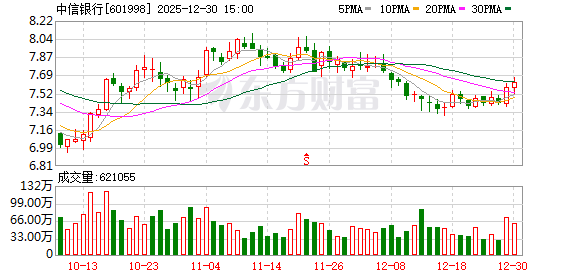
Group 1 - The president of CITIC Bank, Lu Wei, has resigned due to work adjustments and has been appointed as the president of Postal Savings Bank [2][4] - Lu Wei has served at CITIC Bank for 26 years, holding various key positions and contributing significantly to the bank's financial management, capital replenishment, and international development [2] - The board of CITIC Bank has appointed Fang Heying to assume the responsibilities of the president following Lu Wei's departure [2] Group 2 - Postal Savings Bank has announced the appointment of Lu Wei as its new president, pending approval from the National Financial Regulatory Administration [4] - The previous president of Postal Savings Bank, Liu Jianjun, has resigned due to reaching the statutory retirement age [4] - For the first three quarters of 2025, Postal Savings Bank reported revenue of 265.08 billion yuan, a year-on-year increase of 1.82%, and a net profit of 76.794 billion yuan, up 1.07% [4]
中信银行行长芦苇辞任,已获聘为邮储银行行长
Zhong Guo Ji Jin Bao· 2025-12-30 16:11
Group 1 - The president of CITIC Bank, Lu Wei, has resigned due to work adjustments and has been appointed as the president of Postal Savings Bank [2][3][4] - Lu Wei has served at CITIC Bank for 26 years, holding various key positions and contributing significantly to the bank's financial management, capital replenishment, and international development [3] - The board of CITIC Bank has appointed Fang Heying to assume the responsibilities of the president following Lu Wei's departure [3] Group 2 - Postal Savings Bank has announced the appointment of Lu Wei as its new president, pending approval from the National Financial Regulatory Administration [4] - Liu Jianjun, the former president of Postal Savings Bank, has resigned due to reaching the statutory retirement age [4] - For the first three quarters of 2025, Postal Savings Bank reported a revenue of 265.08 billion yuan, a year-on-year increase of 1.82%, and a net profit of 76.794 billion yuan, up 1.07% [5] - As of the end of the third quarter of 2025, Postal Savings Bank's total assets reached 18.61 trillion yuan, an increase of 8.9% from the previous year [5] - The non-performing loan ratio of Postal Savings Bank stands at 0.94%, the only major state-owned bank below 1%, although it has increased by 0.04 percentage points compared to the end of last year [5]

笃行向新程!在回望与展望中 奔赴“十五五”
2 1 Shi Ji Jing Ji Bao Dao· 2025-12-30 16:05
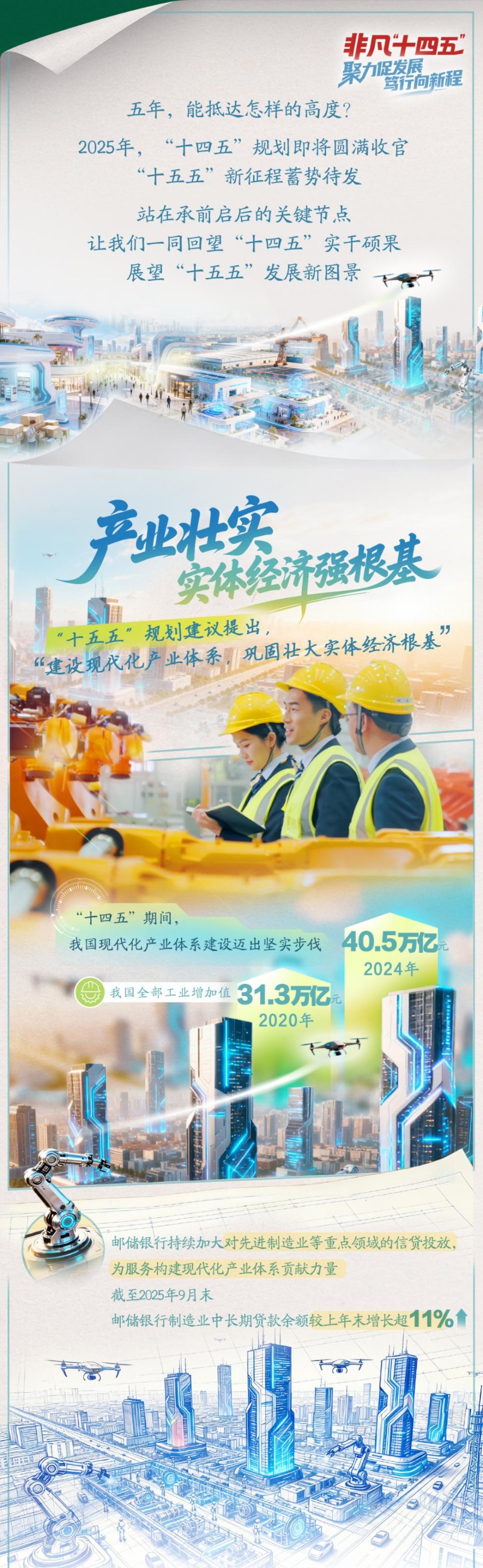
Group 1 - The "14th Five-Year Plan" has made significant progress in building a modern industrial system, with a focus on strengthening the real economy [2] - By the end of September 2025, the balance of medium- and long-term loans for the manufacturing sector from Postal Savings Bank has increased by over 11% compared to the previous year [2] - The comprehensive innovation capability of the country has steadily improved, ranking first in the national comprehensive innovation capability ranking by 2024 [3] Group 2 - The consumer market has seen both quantity and quality improvements during the "14th Five-Year Plan," with total retail sales of social consumer goods reaching 4,419.45 billion yuan by 2024 [4] - Postal Savings Bank continues to optimize financial supply to promote the upgrading of consumption [4] - The number of registered business entities in the country has been increasing, reflecting the vitality of business entities during the "14th Five-Year Plan" [5] Group 3 - The development of high-quality private and small and micro enterprises has been supported, with the balance of inclusive small and micro enterprise loans reaching 801.247 billion yuan by September 2025 [6] - Agricultural modernization has progressed steadily, with the comprehensive mechanization rate of crop farming reaching 41.3% by 2025 [7] - Postal Savings Bank has deepened its involvement in the agricultural sector, with the balance of agricultural loans reaching 1.41 trillion yuan by 2020 [7] Group 4 - The quality of life for citizens has improved significantly, with per capita disposable income reaching 6.74 billion yuan by 2024 [8] - Postal Savings Bank has extended its services to enhance the quality of financial services for the betterment of people's lives [8]
港股公告掘金 | 云顶新耀:原研产品耐赋康®的相关技术在中国受到专利ZL200980127272.5的保护,该专利目前处于有效状态
Zhi Tong Cai Jing· 2025-12-30 15:10
Major Events - Cloudtop New Horizon (01952) has its original product, Nanfukang®, protected by patent ZL200980127272.5 in China, which is currently valid [1] - Linkang Biotechnology Group (00690) has reached a strategic cooperation with Wenzhou Medical University National Engineering Research Center and the People's Government of Ouhai District, Wenzhou [1] - Auhua Pharmaceutical (00013) announced that the new drug application for Savolitinib for treating gastric cancer patients with MET amplification has been accepted and included in priority review in China [1] - Fosun Pharma (02196) has initiated Phase I clinical trials for its integrated diagnosis and treatment nuclear medicine project SRT-007 within China [1] - Postal Savings Bank of China (01658) has received approval from the National Financial Supervision Administration for the absorption and merger with Postal Huai Wanjia Bank [1] - MicroPort Cardiac Devices-B (02160) has officially published the one-year follow-up results of the early feasibility study for AltaValveTM [1] Operating Performance - New Fire Technology Holdings (01611) reported an annual loss attributable to shareholders of HKD 9.212 million, a shift from profit to loss year-on-year [1] - Xingqian Development (00640) reported an annual net profit of approximately HKD 122 million, an increase of 21.7% year-on-year [1] - Zijin Mining Group (02899) expects a net profit attributable to shareholders of approximately RMB 51-52 billion for the fiscal year 2025, representing a year-on-year increase of about 59%-62% [1] - Zijin Gold International (02259) issued a profit warning, expecting a net profit attributable to shareholders of approximately USD 1.5-1.6 billion for 2025, a year-on-year increase of about 212%-233% [1]
国有大行唯一直销银行吸收合并获批!独立法人直销银行仅剩一家
Sou Hu Cai Jing· 2025-12-30 14:44
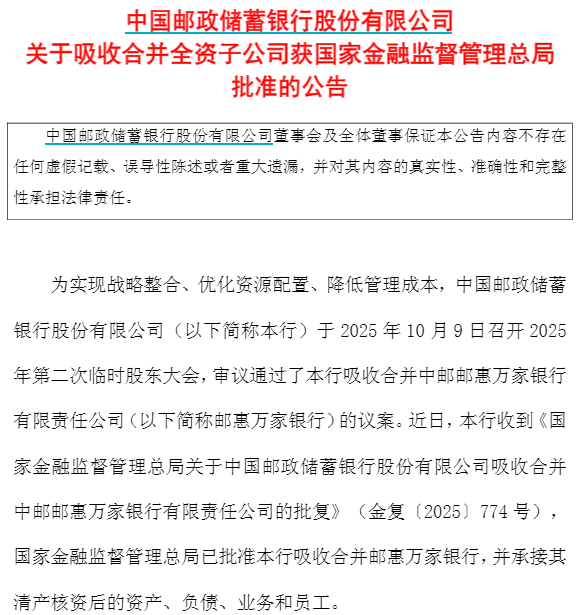
Group 1 - The core point of the news is that China Postal Savings Bank has received approval to absorb and merge its wholly-owned subsidiary, Postal Huinong Bank, which will leave only Citic Baixin Bank as the remaining independent legal direct bank in China [1][3]. - The merger is expected to optimize management and business structure, enhance digital transformation effectiveness, improve operational efficiency, and reduce management costs for China Postal Savings Bank [3]. - Postal Huinong Bank, established in 2022 with a registered capital of 5 billion yuan, was intended as a testing ground for the digital transformation of China Postal Savings Bank [3]. Group 2 - In 2024, Postal Huinong Bank reported a revenue of 243 million yuan and a net loss of 415 million yuan, with total assets of 12.828 billion yuan and total liabilities of 8.669 billion yuan by the end of 2024 [3]. - The non-performing loan ratio for Postal Huinong Bank was 6.66%, with a provision coverage ratio of 239.55% [3]. - The trend of merging or shutting down direct banking operations has been observed across multiple banks since 2017, with several banks like Ping An Bank and Shanghai Pudong Development Bank closing or integrating their direct banking channels [4]. Group 3 - Regulatory tightening is a significant reason for the decline in direct banking operations, with increased scrutiny on financial institutions to return to core operations and maintain risk isolation [4]. - The tightening of regulations regarding data security, personal information protection, and internet loans has limited the business models that direct banks previously relied on, making innovation more challenging [4]. - The once-prominent role of direct banks as a key tool for traditional banks to counter the impact of internet finance has diminished significantly [4].