PING AN OF CHINA(02318)

Search documents
智通ADR统计 | 10月8日
智通财经网· 2025-10-07 23:03
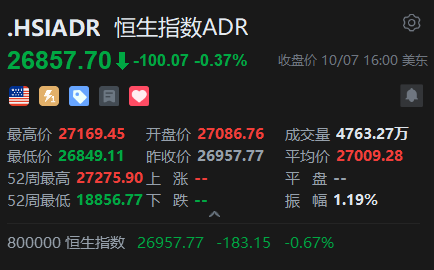
Market Overview - The Hang Seng Index (HSI) closed at 26,857.70, down by 100.07 points or 0.37% as of October 7, 16:00 Eastern Time [1] - The index reached a high of 27,169.45 and a low of 26,849.11 during the trading session, with a trading volume of 47.63 million [1] - The HSI's 52-week high is 27,275.90 and the low is 18,856.77, indicating a trading range of 1.19% [1] Blue-Chip Stocks Performance - Major blue-chip stocks mostly declined, with HSBC Holdings closing at HKD 110.069, down 0.75% from the Hong Kong market close [2] - Tencent Holdings closed at HKD 670.363, down 1.05% compared to the Hong Kong market close [2] Individual Stock Movements - Tencent Holdings (00700) saw a slight increase of 0.59% to HKD 677.500, but its ADR price was HKD 670.363, reflecting a decrease of 7.137 [3] - Alibaba Group (09988) decreased by 2.49% to HKD 180.500, with its ADR price at HKD 176.415, down by 4.085 [3] - HSBC Holdings (00005) increased by 0.91% to HKD 110.900, while its ADR price was HKD 110.069, down by 0.831 [3] - Other notable declines include Xiaomi Group (01810) down 2.09% to HKD 53.850 and JD.com (09618) down 2.14% to HKD 137.200 [3]






智通港股通资金流向统计(T+2)|10月7日
智通财经网· 2025-10-06 23:33
Group 1 - On September 26, the top three stocks with net inflows from southbound funds were Alibaba-W (09988) with 34.60 billion, Yingfu Fund (02800) with 14.02 billion, and Tencent Holdings (00700) with 11.06 billion [1][2] - The top three stocks with net outflows were China Mobile (00941) with -6.35 billion, China Telecom (00728) with -3.59 billion, and China Construction Bank (00939) with -3.38 billion [1][2] - In terms of net inflow ratio, GX Hengsheng Technology (02837) led with 462.02%, followed by Green Power Environmental (01330) with 156.44%, and Anjii Food (02648) with 127.61% [1][2] Group 2 - The top ten stocks with the highest net inflows included Xiaomi Group-W (01810) with 11.00 billion and Huahong Semiconductor (01347) with 8.23 billion [2] - The top ten stocks with the highest net outflows included China Petroleum & Chemical Corporation (00386) with -2.16 billion and Changfei Optical Fiber Cable (06869) with -1.53 billion [2] - The net outflow ratios for the top ten stocks included Tianjin Chuangye Environmental Protection (01065) at -123.57% and China Telecom (00728) at -113.73% [3][4]

越亚半导体冲刺港股:上半年营收8亿中国平安与东方富海是股东
Xin Lang Cai Jing· 2025-10-06 10:35
Core Viewpoint - Zhuhai Yueya Semiconductor Co., Ltd. has submitted its prospectus for an IPO on the Hong Kong Stock Exchange, aiming to raise approximately 1.224 billion yuan for expansion projects and working capital [3][4]. Financial Summary - The company plans to allocate 1.037 billion yuan for the AI-focused high-performance embedded packaging module expansion project, 107 million yuan for the R&D center project, and 80 million yuan for working capital [4]. - In the first half of 2023, Yueya Semiconductor reported a revenue of 811 million yuan [5]. - Projected revenues for 2022, 2023, and 2024 are 1.667 billion yuan, 1.7 billion yuan, and 1.796 billion yuan, respectively, with net profits of 415 million yuan, 188 million yuan, and 215 million yuan [4][5]. Shareholder Structure - The largest shareholder is AMITEC Company, holding 39.9452% of shares, followed by Xin Xin Chuan with 30.9106% [6][9]. - Other notable shareholders include Oriental Fortune Management and Zhuhai Huajin Lingrui, holding 2.221% and 2.7104% respectively [8][9]. Ownership Changes Post-IPO - After the IPO, AMITEC's shareholding will decrease to 33.9535%, while Xin Xin Chuan's will drop to 26.274% [10]. - The total number of shares post-IPO will be approximately 1.049 billion, with the public holding 15% [10].


独家内部流出!2025年“融资之王”名单确认,国资和巨头都在押注这几位!
Sou Hu Cai Jing· 2025-10-06 03:23
Group 1 - The list of companies with the highest financing in 2025 has been released, with State Grid New Energy leading at 36.5 billion RMB [1] - Other companies following include Ping An Life, Inner Mongolia Zhongguang Nuclear, Huaxing Optoelectronics, and Fusion Energy [1] - Capital is flowing into sectors such as energy, high-end manufacturing, and finance, indicating strong investment in these core areas [1] Group 2 - The substantial financing acts as a "strong heart tonic" for companies and reflects capital's firm commitment to key areas of industrial upgrading in China [2]
智通港股通资金流向统计(T+2)|10月6日
智通财经网· 2025-10-05 23:34
Key Points - On September 26, 2023, the top three stocks with net inflows from southbound funds were Alibaba-W (09988) with 34.60 billion, Yingfu Fund (02800) with 14.02 billion, and Tencent Holdings (00700) with 11.06 billion [1][2] - The top three stocks with net outflows were China Mobile (00941) with -6.35 billion, China Telecom (00728) with -3.59 billion, and China Construction Bank (00939) with -3.38 billion [1][2] - In terms of net inflow ratio, GX Hang Seng Technology (02837) led with 462.02%, followed by Green Power Environmental (01330) with 156.44%, and Anjuke Food (02648) with 127.61% [1][2] - The top three stocks with the highest net outflow ratios were Tianjin Chuangye Environmental Protection (01065) at -123.57%, China Telecom (00728) at -113.73%, and China Pacific Insurance (02328) at -110.28% [1][2] Net Inflow Rankings - The top ten stocks by net inflow included: - Alibaba-W (09988): 34.60 billion, 13.44% [2] - Yingfu Fund (02800): 14.02 billion, 9.22% [2] - Tencent Holdings (00700): 11.06 billion, 8.77% [2] - Xiaomi Group-W (01810): 11.00 billion, 4.71% [2] - Huahong Semiconductor (01347): 8.23 billion, 15.41% [2] - The top ten stocks by net outflow included: - China Mobile (00941): -6.35 billion, -61.43% [2] - China Telecom (00728): -3.59 billion, -113.73% [2] - China Construction Bank (00939): -3.38 billion, -18.39% [2] - China Pacific Insurance (02328): -2.86 billion, -110.28% [2] - China Petroleum & Chemical Corporation (00386): -2.16 billion, -51.00% [2] Net Inflow Ratio Rankings - The top three stocks by net inflow ratio were: - GX Hang Seng Technology (02837): 462.02%, 16.14 million [3] - Green Power Environmental (01330): 156.44%, 3.21 million [3] - Anjuke Food (02648): 127.61%, 1.14 million [3] - The top three stocks by net outflow ratio were: - Tianjin Chuangye Environmental Protection (01065): -123.57%, -2.42 million [3] - China Telecom (00728): -113.73%, -3.59 billion [3] - China Pacific Insurance (02328): -110.28%, -2.86 billion [3]


寻找“受尊敬”企业系列报道之四:人力资本即核心竞争力,从薪酬榜单看企业长期主义
Jing Ji Guan Cha Bao· 2025-10-05 06:46
Core Insights - The article emphasizes that employee compensation is a crucial indicator of a company's sustainable development capability, reflecting corporate governance, strategic determination, and social responsibility [1][15] - The ongoing increase in employee compensation over three years indicates stable profitability and a reasonable cost allocation mechanism within companies, allowing them to maintain basic employee protections amid external fluctuations [1][15] Industry Overview - A total of 1,291 companies in the A-share market have experienced continuous employee compensation growth from 2022 to 2024, covering 32 industry categories, with a significant presence in the real economy [2] - The mechanical equipment industry leads with 166 companies (12.86%), followed by electronics (122 companies, 9.45%), electrical equipment (115 companies, 8.91%), pharmaceutical biology (113 companies, 8.75%), automotive (109 companies, 8.44%), and basic chemicals (106 companies, 8.21%) [2] - The financial sector, particularly banks and insurance groups, shows a strong trend in employee compensation growth, with 37 companies (2.86%) in banking and non-banking financial services [2] Top Companies by Employee Compensation - The top ten companies by total employee compensation are all from the financial sector, indicating a strong correlation between asset scale, profitability, and employee welfare [3] - Agricultural Bank ranks first with a total employee compensation of 87.803 billion yuan, followed by China Construction Bank (60.661 billion yuan) and Bank of China (58.554 billion yuan) [5][6][7] - These companies demonstrate a commitment to employee welfare through various strategies, including performance-based pay, investment in talent development, and alignment of compensation with business growth [5][6][7][8][9] Trends and Characteristics - The continuous growth in employee compensation is linked to the companies' long-term vision and is indicative of their ability to adapt to macroeconomic conditions and industry upgrades [15] - High industry concentration is observed, with the majority of the top ten companies being financial institutions, reflecting strategic considerations in human resource allocation [15] - The linkage between compensation growth and business transformation is evident, with many companies investing in technology innovation and digital transformation [15] - A trend towards market-oriented incentive mechanisms is noted, with more companies adopting performance-based compensation systems to attract and retain key talent [15]


瑞银:内地分红型保险产品复苏 看好友邦保险及中国平安
Xin Lang Cai Jing· 2025-10-02 06:58
Core Viewpoint - The guidance issued by the National Financial Regulatory Administration on promoting high-quality development in health insurance is positive and significant for the industry [1] Group 1: Regulatory Developments - The regulatory framework allows insurance companies with good ratings to launch participating dividend-type long-term health insurance products [1] - Implementation details are not finalized, but a transitional solution is expected to involve a combination of dividend savings policies and critical illness riders [1] - The focus remains on the fundamental purpose of protection despite the introduction of dividend features [1] Group 2: Market Implications - The introduction of dividend-type critical illness insurance in mainland China is expected to have limited competitive impact on the insurance sales for mainland visitors in the Hong Kong market, which is developing steadily [1] - Key success factors for dividend health insurance include strong regulatory ratings, investment and distribution capabilities, a focus on protection products, and the establishment of a medical ecosystem [1] Group 3: Company Analysis - The company "Huai Bang China" is identified as a major beneficiary of these developments [1] - Among domestic listed insurance companies, China Ping An (02318) is relatively focused on protection products and possesses a comprehensive online and offline medical ecosystem, which may create synergies with health products like critical illness insurance [1]
瑞银:内地分红型保险产品复苏 看好友邦保险(01299)及中国平安
智通财经网· 2025-10-02 06:49
Core Viewpoint - UBS reports that the National Financial Regulatory Administration has issued guidelines to promote the high-quality development of health insurance, which is seen as positive and significant [1] Group 1: Regulatory Changes - The guidelines allow insurance companies with good regulatory ratings to launch participating dividend-type long-term health insurance products [1] - Implementation details are not finalized, but a transitional solution is expected to involve a combination of dividend savings policies and critical illness riders [1] - Despite the introduction of dividend features, regulators will continue to focus on the fundamental purpose of protection [1] Group 2: Market Comparison - The introduction of dividend-type critical illness insurance in mainland China is expected to have limited competitive impact on the Hong Kong market for insurance sales to mainland visitors [1] - Hong Kong's dividend products typically offer higher demonstration rates, around 6%-6.5%, compared to mainland rates of 2.9%-3.3% [1] - Hong Kong insurance products provide a broader range of global investment options, catering to the asset diversification needs of visitors [1] Group 3: Key Success Factors - Key success factors for dividend health insurance include strong regulatory ratings, investment and distribution capabilities, a focus on protection products, and the development of a medical ecosystem [1] - Friends Health China is viewed as a major beneficiary of these developments [1] - Among domestic listed insurance companies, China Ping An (02318) is relatively focused on protection products and has a well-established online and offline medical ecosystem, which may create synergies with health products like critical illness insurance [1]
瑞银:内地分红型保险产品复苏 看好友邦保险(01299)及中国平安(02318)
智通财经网· 2025-10-02 06:44
智通财经APP获悉,瑞银发布研报称,国家金融监管总局发布《关于推动健康保险高质量发展》的指导 意见,内容正面且具积极意义。监管评级优良的保险公司获准推出参与分红型长期健康保险产品。实施 细节尚未最终确定,但预期将采用分红储蓄保单+重大疾病附加险的过渡性解决方案。尽管引入分红功 能,监管机构仍将继续聚焦于保障的基本宗旨。 该行认为,内地允许分红型重大疾病险对香港市场的内地访客保险销售竞争有限,香港的分红型重大疾 病险市场发展稳健。首先,香港的分红产品通常提供更高的演示利率例如6%-6.5%,而内地为 2.9%-3.3%。其次,香港保险产品提供更广泛的全球投资选择,满足访港客保险对资产多元化的需求。 瑞银认为,分红健康保险的关键成功因素包括强大的监管评级、投资与分销能力、专注于保障产品以及 医疗生态系统的建设。基于上述因素,看好友邦中国作为主要受惠者。在国内上市保险公司中,中国平 安(02318)相对专注于保障产品。中国平安并拥有完善的线上线下医疗生态系统,可能与健康产品如重 大疾病险产生协同效应。 ...
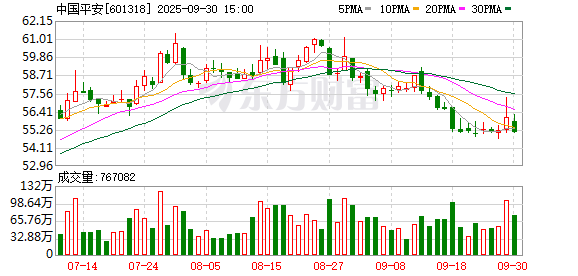
中国平安现3笔大宗交易 总成交金额4753.24万元
Zheng Quan Shi Bao Wang· 2025-09-30 14:46
| 成交量 (万 | 成交金 | 成交价 | 相对当日收盘 | 买方营业部 | 卖方营业部 | | --- | --- | --- | --- | --- | --- | | | 额(万 | 格 | 折溢价(%) | | | | 股) | 元) | (元) | | | | | 36.25 | 1997.74 | 55.11 | 0.00 | 广发证券股份有限公司 广州康王中路证券营业 | 中国国际金融股份有限公司北 京建国门外大街证券营业部 | | | | | | 部 | | | 25.00 | 1377.75 | 55.11 | 0.00 | 招商证券股份有限公司 | 广发证券股份有限公司总部 | | | | | | 北京景辉街证券营业部 | | | 25.00 | 1377.75 | 55.11 | 0.00 | 招商证券股份有限公司 | 广发证券股份有限公司总部 | | | | | | 北京景辉街证券营业部 | | 进一步统计,近3个月内该股累计发生8笔大宗交易,合计成交金额为3.30亿元。 (文章来源:证券时报网) 证券时报·数据宝统计显示,中国平安今日收盘价为55.11元,下跌1.61%,日换手率为 ...