
PING AN OF CHINA(02318)

Search documents
4Q25人身保险业利率研究专家咨询委员会例会点评:预定利率研究值或已筑底确认,中期再迎“炒停售”季概率较低
ZHONGTAI SECURITIES· 2026-01-21 05:37
Investment Rating - The report maintains an "Overweight" rating for the industry [1]. Core Insights - The current preset interest rate for ordinary life insurance products is 1.89%, a slight decrease from the previous value of 1.90%, indicating a narrowing decline in the preset interest rate research values over recent quarters [4]. - The report highlights that the long-end interest rates have stabilized since 2025, with a gradual upward trend established in the second half of 2025, suggesting a positive outlook for the industry [4]. - The report emphasizes the implementation of a dynamic adjustment mechanism linking preset interest rates to market rates, which is expected to guide companies in prudent pricing and asset-liability management [4]. - The likelihood of a "buy-stop" season in 2026 is considered low, as the preset interest rate research value is close to the maximum allowable rate for current products, making significant adjustments unlikely [4]. Summary by Sections Industry Overview - The report notes that the preset interest rate research values have shown a decreasing trend, with recent declines of 21bps, 14bps, 9bps, and 1bps, indicating a gradual stabilization [3]. - The financial regulatory authority has issued guidelines to link preset interest rates with market rates, which is expected to enhance the industry's pricing strategies [4]. Market Trends - The report indicates that the 5-year LPR remains at 3.5%, the 5-year fixed deposit benchmark rate at 1.3%, and the 10-year government bond yield at 1.85%, all showing stability compared to the previous quarter [4]. - The report suggests that the insurance sector has experienced a positive cyclical recovery since December of the previous year, with expectations for improved performance and valuation recovery [4]. Investment Recommendations - The report recommends continued attention to key players in the insurance sector, including China Life, China Pacific Insurance, Ping An Insurance, New China Life, China Property & Casualty Insurance, and AIA Group, as they are expected to benefit from the anticipated market conditions [4].



平安好医生升级“岁岁平安”守护服务 护航居家养老安全
Zheng Quan Ri Bao Wang· 2026-01-21 04:13
Core Insights - The article discusses the launch of the "Sui Sui Ping An" protection plan by Ping An, aimed at enhancing home care safety for elderly individuals, particularly those living alone [1][2] Group 1: Plan Overview - The "Sui Sui Ping An" plan integrates a complete closed-loop system of "identification-response-rescue" to improve safety for elderly individuals at home [1] - The plan builds on a previous daily check-in incentive program that has been active for over 1,200 days, with more than 10 million check-ins recorded, protecting over 60,000 elderly individuals, 65% of whom are living alone [1] Group 2: Service Features - The "Ping An Housekeeper" service brand offers a comprehensive service system that includes smart devices, platform monitoring, and human assistance, allowing elderly users to customize their service options [2] - The system incorporates fall detection radars and smart speakers to identify risks such as falls or unconsciousness, facilitating emergency assistance [2] - With a self-developed early warning platform and a 24/7 online housekeeper team, the system can achieve second-level response times and coordinate resources for on-site rescue services in emergencies [2]
中国平安:截至2025年上半年公司以公允价值计量且其变动计入其他综合收益的固收类金融资产金额为31701亿元
Zheng Quan Ri Bao Wang· 2026-01-21 03:56
证券日报网讯 1月20日,中国平安(601318)在互动平台回答投资者提问时表示,根据公司发布的2025 年半年度报告,截至2025年上半年,公司以公允价值计量且其变动计入其他综合收益(FVOCI)的固收 类金融资产金额为31701亿元,以公允价值计量且其变动计入当期损益(FVTPL)的固收类金融资产金 额为9449亿元,此外还有部分固收类金融资产以摊余成本计量(AC)。 ...
楚雄金融监管分局同意平安产险南华支公司营业场所变更
Jin Tou Wang· 2026-01-21 03:33
二、中国平安财产保险股份有限公司应按照有关规定及时办理变更及许可证换领事宜。 2026年1月8日,楚雄金融监管分局发布批复称,《中国平安财产保险股份有限公司楚雄中心支公司关于 中国平安财产保险股份有限公司南华支公司变更营业场所的请示》(平保产云分楚雄中支发〔2025〕11 号)收悉。经审核,现批复如下: 一、同意中国平安财产保险股份有限公司南华支公司营业场所变更为:云南省楚雄彝族自治州南华县龙 川镇省道S103以南湖畔佳苑(一期)4幢1楼107号、108号商铺。 ...
107股连续5日或5日以上获融资净买入
Zheng Quan Shi Bao Wang· 2026-01-21 03:24
Group 1 - The core point of the article highlights that as of January 20, a total of 107 stocks in the Shanghai and Shenzhen markets have experienced net buying through financing for five consecutive days or more [1] - The stock with the longest consecutive net buying days is Huatian Hotel, which has seen net buying for 12 consecutive trading days [1] - Other notable stocks with significant consecutive net buying days include China Merchants Bank, Ping An Bank, Focus Media, New China Life Insurance, Hongfuhuan, Kaile Shares, New Industry, and China Ping An [1]





科技驱动理赔全面提速
Jin Rong Shi Bao· 2026-01-21 01:44
Core Insights - The insurance industry has significantly improved claims processing speed and service efficiency by 2025, with "fast and full compensation" becoming a standard service feature [1][2][3] Group 1: Claims Processing Efficiency - In the life insurance sector, Xinhua Insurance reports that claims for small medical insurance under 5,000 yuan are settled in an average of 0.5 days, with 17% of claims processed within one hour and 70% within eight hours [1] - Ping An Life achieved a record claim payment in just 8 seconds, while ICBC-AXA's medical insurance claims can be settled in as little as 8 minutes for major claims [1] - China Life Property Insurance processed a claim in just 2.5 minutes, demonstrating strong emergency service capabilities even in complex disaster scenarios [2] Group 2: Digital Transformation and Technology Integration - The rapid improvement in claims speed is attributed to the implementation of digital transformation strategies and advanced technologies in the insurance sector [3] - Ping An Life introduced the DeepSeek model for intelligent claims review, achieving 93% of automated claims processed within 60 seconds [3] - China Life Health's intelligent claims review increased by 33.2% year-on-year, with an intelligent input rate exceeding 69% [3] Group 3: Expanded Insurance Services - Insurance services are evolving beyond mere financial compensation to encompass comprehensive health management and proactive risk reduction [4] - China Pacific Insurance aims to bridge the digital divide by providing personalized services for the elderly and vulnerable groups, reaching 947,000 people through online claims services [4] - The integration of technology is reshaping every aspect of the claims value chain, from reporting to payment, creating a more efficient and customer-friendly insurance service environment [4]

6元钱保障 守护牧民最珍贵的“家人”
Jin Rong Shi Bao· 2026-01-21 01:44
Core Viewpoint - The article highlights the efforts of the insurance company, Ping An, to promote yaks insurance in Tibet, addressing the challenges faced by herders in adopting electronic identification for their livestock while ensuring their financial protection against risks like infectious diseases and natural disasters [1][2]. Group 1: Insurance Promotion and Adoption - The government and insurance companies are actively promoting yak insurance to protect herders' interests amid increasing risks from infectious diseases and natural disasters [1]. - A significant barrier to adoption is the cultural perception of yaks as family members, making herders reluctant to accept ear tagging as it is seen as harmful [1]. - Ping An's team, led by Badu Qiuza, engages with herders to explain the benefits of ear tags as a form of protection and a key to quick claims processing [1]. Group 2: Technological Integration and Service Improvement - Since 2022, herders only need to pay 6 yuan per yak annually, supported by central government subsidies, to receive coverage for various risks [2]. - Ping An has developed a Tibetan language version of the "Ai Nong Bao" app to provide weather alerts and help herders prepare for adverse conditions, thereby reducing livestock mortality [2]. - The use of advanced technology, including "cow face recognition" and electronic ear tags, has streamlined the claims process, allowing for claims to be settled within 24 hours of reporting [2]. Group 3: Performance Metrics and Future Commitment - As of November 2025, Ping An's local branch has processed 2,891 claims, disbursing 15.095 million yuan, with a 100% claim closure rate and an average claim processing time of just 6.6 days [2]. - By August 2025, over 230,000 yaks in Tibet had been tagged, achieving a tagging rate of over 95% [2]. - Ping An is committed to its mission of serving the public through financial services, leveraging its dual strategy of comprehensive finance and technology to support rural revitalization and high-quality economic development [2].
智通港股沽空统计|1月21日
智通财经网· 2026-01-21 00:23
Group 1 - The core viewpoint of the news highlights the top short-selling ratios and amounts for various companies, indicating significant market sentiment towards these stocks [1][2]. - AIA Group (81299) and JD Group (89618) have the highest short-selling ratios at 100.00%, while Ping An Insurance (82318) follows with a ratio of 82.04% [1][2]. - The top three companies by short-selling amount are Pop Mart (09992) with 1.008 billion, Xiaomi Group (01810) with 0.825 billion, and Meituan (03690) with 0.777 billion [1][2]. Group 2 - The top short-selling ratio rankings show that AIA Group and JD Group both have a short-selling amount of 73,700 and 50,600 respectively, with Ping An Insurance at 1.6862 million [2]. - The short-selling amount rankings indicate that Pop Mart leads with 1.008 billion, followed by Xiaomi Group at 0.825 billion and Meituan at 0.777 billion [2]. - The deviation values, which reflect the difference between current short-selling ratios and the average over the past 30 days, show Ping An Insurance at 49.32%, JD Group at 43.39%, and Wanwu Cloud (02602) at 34.47% [1][2].




智通ADR统计 | 1月21日
智通财经网· 2026-01-20 22:29
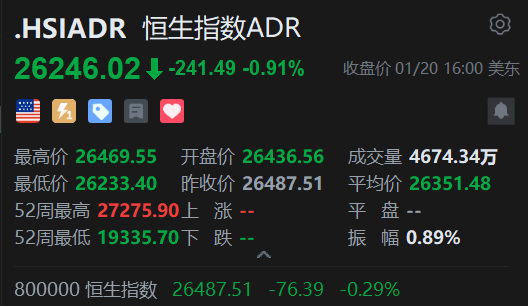
Market Overview - The Hang Seng Index closed at 26,246.02, down by 241.49 points or 0.91% [1] - The index reached a high of 26,469.55 and a low of 26,233.40 during the trading session [1] - The average price for the day was 26,351.48, with a trading volume of 46.7434 million [1] Major Blue-Chip Stocks Performance - HSBC Holdings closed at HKD 128.682, up by 0.22% compared to the Hong Kong close [2] - Tencent Holdings closed at HKD 593.183, down by 1.30% compared to the Hong Kong close [2] - Alibaba Group (W) closed at HKD 159.700, down by 0.44% [3] - Xiaomi Group (W) closed at HKD 35.480, down by 2.74% [3] - Meituan (W) closed at HKD 97.350, down by 1.17% [3] Stock Price Changes - Tencent Holdings saw a decrease of HKD 9.000, or 1.48% [3] - HSBC Holdings increased by HKD 1.400, or 1.10% [3] - China Ping An rose by HKD 0.600, or 0.88% [3] - BYD Company experienced a decline of HKD 3.700, or 3.67% [3] - Kuaishou Technology (W) fell by HKD 0.700, or 0.91% [3]





平安产险为冰雪大世界游客保驾护航
Xin Lang Cai Jing· 2026-01-20 21:54
Core Insights - Harbin Ice and Snow World is experiencing its most prosperous tourism season ever, with Ping An Property & Casualty Insurance providing 5.7 billion yuan in accident and public liability insurance coverage for construction workers, staff, and visitors [1][2] Group 1: Insurance Coverage and Risk Management - Ping An Property & Casualty Insurance is the exclusive underwriter for the 27th Ice and Snow World, offering comprehensive accident insurance [1] - The company has developed a three-dimensional protection system focusing on risk reduction, emergency response, and claims service [1] - The insurance coverage includes measures tailored to the unique risks of low temperatures, slippery roads, and high foot traffic in the park [1] Group 2: Safety Measures and Public Education - Ping An Property & Casualty Insurance implements a dual approach of "source prevention + safety education" to mitigate risks [1] - Physical safety measures include installing anti-slip facilities and increasing warning signs in key areas of the park [1] - Behavioral guidance is provided through on-site personnel promoting easy-to-learn anti-slip techniques and reinforcing safety knowledge among visitors [1] Group 3: Emergency Response and Healthcare Collaboration - The company has established a "medical insurance linkage" emergency rescue system in collaboration with nearby top-tier hospitals [2] - A 24-hour green channel is available for critically ill visitors, ensuring high-quality medical care through expert teams [2] - The initiative aims to protect visitors' health while minimizing economic losses from accidents by reducing emergency service fees and guiding precise treatment [2]