AI+保险

Search documents
卖保险一年狂赚13亿,元保被指“专骗老年人”
阿尔法工场研究院· 2026-03-23 00:04
Core Viewpoint - Yuanbao (YB.US) has demonstrated impressive financial performance, achieving significant revenue and profit growth, while also facing a rising number of customer complaints related to automatic deductions and misleading practices, particularly affecting elderly customers [4][5][19]. Financial Performance - In 2025, Yuanbao reported total revenue of 4.3732 billion yuan, a year-on-year increase of 33.1%, and a net profit of 1.3075 billion yuan, up 51.0%, with a net profit margin of 29.9% [4]. - The company had cash reserves of 4.04 billion yuan, reflecting a 72.9% increase year-on-year [4]. - The number of new insurance policies reached 30.66 million, marking a 36.7% increase, with approximately 7.9 million new policies in the fourth quarter, up 34.5% [4][11]. Business Model and Growth Strategy - Yuanbao operates as an insurance intermediary, leveraging AI technology to enhance efficiency across all business processes, including customer acquisition, underwriting, claims, and after-sales service [8][9]. - The company has developed over 4,900 AI models to analyze more than 5,700 user tags, with 70% of its workforce in research and development [8][9]. - The revenue growth is attributed to two main segments: insurance distribution services, generating 1.4468 billion yuan (up 33.8%), and system services, contributing 2.9227 billion yuan (up 33.2%) [9]. Customer Complaints and Trust Issues - As of March 10, 2026, Yuanbao faced 1,217 complaints on the Black Cat Complaints platform, primarily concerning automatic deductions and misleading practices targeting elderly individuals [5][19]. - Complaints often involve customers being charged for policies they did not knowingly purchase, highlighting issues with transparency and user consent [19][22]. - The company has been criticized for its marketing tactics, which some users claim misled them into unknowingly authorizing automatic payments [19][22]. Marketing and Sales Expenses - In 2025, Yuanbao's sales and marketing expenses reached 2.2172 billion yuan, accounting for 73.02% of total operating costs, indicating a heavy reliance on marketing to drive growth [10][28]. - The increase in sales and marketing expenses was lower than the growth in revenue and profit, suggesting that AI technology has improved the precision of customer acquisition and reduced costs [10][11]. Product Strategy - Yuanbao has adopted an inclusive insurance strategy, expanding coverage to individuals with pre-existing conditions and those over 60 years old, thus broadening its customer base [13][14]. - The majority of the insurance products distributed by Yuanbao are short-term policies, primarily health and critical illness insurance, which have lower premium thresholds and higher repurchase rates, facilitating internet traffic conversion [14][15]. Leadership and Company Background - Yuanbao was founded by Fang Rui, who has a background in internet and fintech, having previously worked at NetEase for 17 years [24][25]. - The company's leadership team consists of several former NetEase executives, contributing to its technology-driven approach and rapid growth in the insurance sector [25][26]. Industry Challenges - The ongoing complaints and trust issues faced by Yuanbao reflect broader challenges within the insurtech industry, particularly regarding compliance and consumer protection [29]. - The company must balance technological efficiency with maintaining consumer trust, as highlighted by regulatory requirements against misleading marketing practices [29].


低位四call非银-更左侧-更具弹性-更高赔率
2026-01-07 03:05
Summary of Conference Call on Non-Bank Financial Sector Industry Overview - The non-bank financial sector has seen significant capital inflows since October last year, particularly in the insurance segment, which has risen nearly three months. Despite some divergence in floating profits, the outlook for the year remains positive. [1][2] - The brokerage sector has experienced minor pullbacks, with a strong trend and rapid volume growth, surpassing 2.8 trillion RMB in trading volume. Maintaining a range of 2.5 to 3 trillion RMB will benefit the non-bank sector's market expansion. [1][3] Key Insights Insurance Sector - The insurance sector is expected to see a slowdown in performance growth this year (2025), but valuation increases will be the main driver. The regulatory body may classify several large insurers as systemically important financial institutions, enhancing their valuations. [2][4] - Investment strategies should focus on selecting stocks with high safety margins, low valuations, and low growth in the previous year. Recommended stocks include Taiping Insurance in Hong Kong and Taikang in A-shares. [5][6] Brokerage Sector - The overall increase in brokerage stocks is around 4%, with most stocks still in the early stages of recovery. [3][4] - Two investment strategies are suggested: - **Conservative**: Focus on leading brokerages like Guotai Junan and CITIC Securities. - **Aggressive**: Consider traditional brokerages with growth stories and smaller market caps, such as Xiangcai Securities. [5][6] Internet Brokerages - Major internet brokerages like Eastmoney and Tonghuashun have limited future growth potential due to their large market capitalizations. [5][6] - Recommended smaller internet brokerages with higher growth potential include Xiangcai and Dazhihui in A-shares, and Jiufang Zhitu in Hong Kong. These stocks have lower valuations and smaller market caps, indicating better growth prospects. [7] Financial Technology and Stablecoins - The non-bank financial sector is currently seen as having high cost-effectiveness, with a focus on financial technology and stablecoins. Hong Kong is set to issue stablecoin licenses in Q1, which will create a compliant trading environment and replace traditional cross-border payment systems. [8][10] - The cross-border payment market is underestimated, and the recovery of cryptocurrency prices supports this view. [9] Emerging Investment Opportunities - Investors are increasingly interested in diversified financial sectors, including futures and venture capital. The performance of commodity markets, especially precious and non-ferrous metals, is strong, indicating high earnings expectations for futures and venture capital companies. [11] - The digital RMB supply chain and AI+ insurance sectors are also highlighted as areas with significant policy support expected in 2026, presenting growth opportunities for emerging companies. [11]
“场景险第一股”白鸽在线通过港交所聆讯,高度依赖大客户构成生存威胁
Hua Xia Shi Bao· 2025-12-30 14:44
Core Viewpoint - The article discusses the challenges faced by Baige Online, a digital insurance intermediary, as it prepares for its IPO, highlighting its reliance on commission income and the risks associated with high customer concentration despite its growth in revenue and technological claims [2][4][5]. Group 1: Company Overview - Baige Online was established in 2015 and positions itself as an "insurance technology intermediary," focusing on "AI + insurance" to enhance the insurance transaction process [3]. - The company has developed over 1,900 customized insurance products covering 76 niche scenarios, claiming its technology platform can handle 100,000 policies per second [4]. Group 2: Revenue Structure - Nearly 90% of Baige Online's revenue comes from insurance transaction services, with income from this segment rising from 311 million yuan in 2022 to 825 million yuan in 2024, increasing its share of total revenue from 77.0% to 90.3% [4]. - The company's other business lines, including "precision marketing and digital solutions" and "third-party management services," contribute less than 10% to total revenue, indicating a heavy reliance on commission income [4]. Group 3: Financial Performance - Baige Online has reported continuous losses over three years, with net losses of 25.07 million yuan, 17.18 million yuan, and 27.71 million yuan from 2022 to 2024, despite revenue growth from 405 million yuan in 2022 to 914 million yuan in 2024 [5]. - In the first half of 2025, the company generated 567 million yuan in revenue but still faced a net loss of 21.54 million yuan [5]. Group 4: Investment and Marketing Strategy - The company's marketing expenses increased from 24.66 million yuan in 2022 to 41.91 million yuan in 2024, while R&D spending rose from 14.06 million yuan to 32.43 million yuan, indicating a disproportionate focus on marketing over technology development [5]. - The lack of significant breakthroughs in deep technology applications, such as AI and big data, raises concerns about the company's competitive edge in the insurance technology sector [5]. Group 5: Customer Concentration Risk - Baige Online's top five clients accounted for 55.3% of its revenue in 2022, increasing to 77.2% by 2024, which poses a risk to its revenue stability and bargaining power [7]. - The company acknowledges that losing any major client could significantly impact its growth and income, highlighting the vulnerability associated with its high customer concentration [7]. Group 6: Industry Context - The article notes a trend of insurance intermediaries, including Baige Online, seeking to go public amid pressures from early-stage investors and the need for capital to compete [9]. - The insurance industry is experiencing a shift towards direct sales by insurance companies, which threatens the traditional intermediary model, although the long-term value of third-party intermediaries remains [10].

上市潮未歇,AI成保险科技叙事新逻辑
Xin Lang Cai Jing· 2025-12-29 13:45
Core Insights - The insurance technology sector is experiencing a significant transformation, moving from a "traffic-driven" narrative to an "AI-driven" approach, reflecting a fundamental shift in growth paths and capital market valuations [3][24][30] Group 1: Market Developments - On December 23, 2025, Easy Health was listed and saw a first-day surge of 158%, reaching a market capitalization of over HKD 12 billion, marking it as a standout in the Hong Kong insurance technology sector [23] - White Dove Online has also passed the Hong Kong Stock Exchange's listing hearing, aiming to become the "first AI stock in the domestic insurance industry" [3][24] - The insurance technology industry is witnessing a new wave of listings, with various companies like Yuanbao and iCloud Insurance entering the market, indicating a robust trend towards public offerings [3][24][25] Group 2: AI Integration and Investment - In 2025, the Chinese insurance industry is projected to invest over CNY 67 billion in technology, with a focus on big data, cloud computing, and artificial intelligence [25] - McKinsey's research indicates that leading insurance companies utilizing AI have seen shareholder returns 6.1 times greater than those lagging behind, highlighting AI as a core competitive advantage [25] - Major insurance firms are evolving their strategies from "ALL in AI" to "AI in ALL," integrating AI across the entire value chain, including product design and risk management [25][26] Group 3: Competitive Landscape - Traditional insurance companies are enhancing their internal capabilities while new tech-driven firms are rapidly exploring boundaries, validating AI's value creation potential [26][28] - Companies like Easy Health and White Dove Online are leveraging AI technologies to transform traditional processes, focusing on areas such as health data structuring and scenario adaptation [26][28] - The competition is intensifying, with a clear divide in market valuations based on the effectiveness of AI implementation among different firms [4][25] Group 4: Narrative Reconstruction - The narrative surrounding insurance technology is shifting from acquiring large user bases to emphasizing AI technology barriers and digital solutions [30][31] - This transition is driven by market saturation, regulatory pressures, and changing consumer expectations for more precise and transparent services [32][33] - The new narrative emphasizes the importance of technology-driven value creation, moving away from the previous reliance on external traffic growth [34][39] Group 5: Challenges and Risks - The rise of AI in insurance also brings challenges related to data security and algorithm fairness, as companies must navigate the complexities of handling sensitive personal information [36][37] - There are significant risks associated with the interpretability of AI models, which can lead to unfair treatment of certain demographic groups if historical biases are present in training data [36][37] - Companies are urged to build resilience in technology and governance to address these challenges and ensure compliance with regulatory standards [36][38]




冲刺保险科技AI第一股 白鸽在线正式通过港交所聆讯
Zheng Quan Ri Bao Wang· 2025-12-23 13:13
Core Viewpoint - Baige Online (Xiamen) Digital Technology Co., Ltd. is set to become the first insurance technology company in the Hong Kong stock market with a focus on "AI + insurance," aiming to drive technological transformation in the traditional insurance industry [1] Group 1: Company Overview - Established in 2015, Baige Online specializes in digital risk management, connecting insurance companies, scenario partners, and end consumers through a digital platform [2] - The company's core business revolves around "scenario insurance," covering areas such as delivery services, shared mobility, and government services [2] - As of December 2025, Baige Online is projected to have serviced over 8.9 billion policies and connected more than 381 million insured individuals [2] Group 2: Technology and Innovation - Baige Online's core technological advantage lies in its self-developed "MaaS model," which includes six AI models such as "Ark," "Femtosecond," and "Smart Eye," supporting dynamic pricing, risk prediction, and automated claims processing [2] - The company's AI technology is integrated with its "9+N ecosystem," collaborating with 233 scenario partners to accumulate multidimensional data covering 381 million insured individuals [3] - The technology architecture allows for seamless API integration with partner systems, enabling real-time linkage between insurance services and scenario transactions, with the SaaS system "Baige e Insurance" capable of processing over 50 million policies daily [3] Group 3: Market Potential and IPO Plans - The market size for scenario insurance in China is expected to grow from 53.1 billion yuan in 2020 to 93.2 billion yuan in 2024, with a projected compound annual growth rate of 12.1% [4] - Baige Online plans to use the funds raised from its IPO primarily for technology research and development, ecosystem expansion, and potential mergers and acquisitions, including optimization of the MaaS model and big data infrastructure [4] - The IPO is seen as a critical step for Baige Online's development and offers a new perspective on the evolution of insurance technology [4]
六年普惠路:元保如何用AI重塑健康险叙事?
Bei Jing Shang Bao· 2025-12-09 03:39
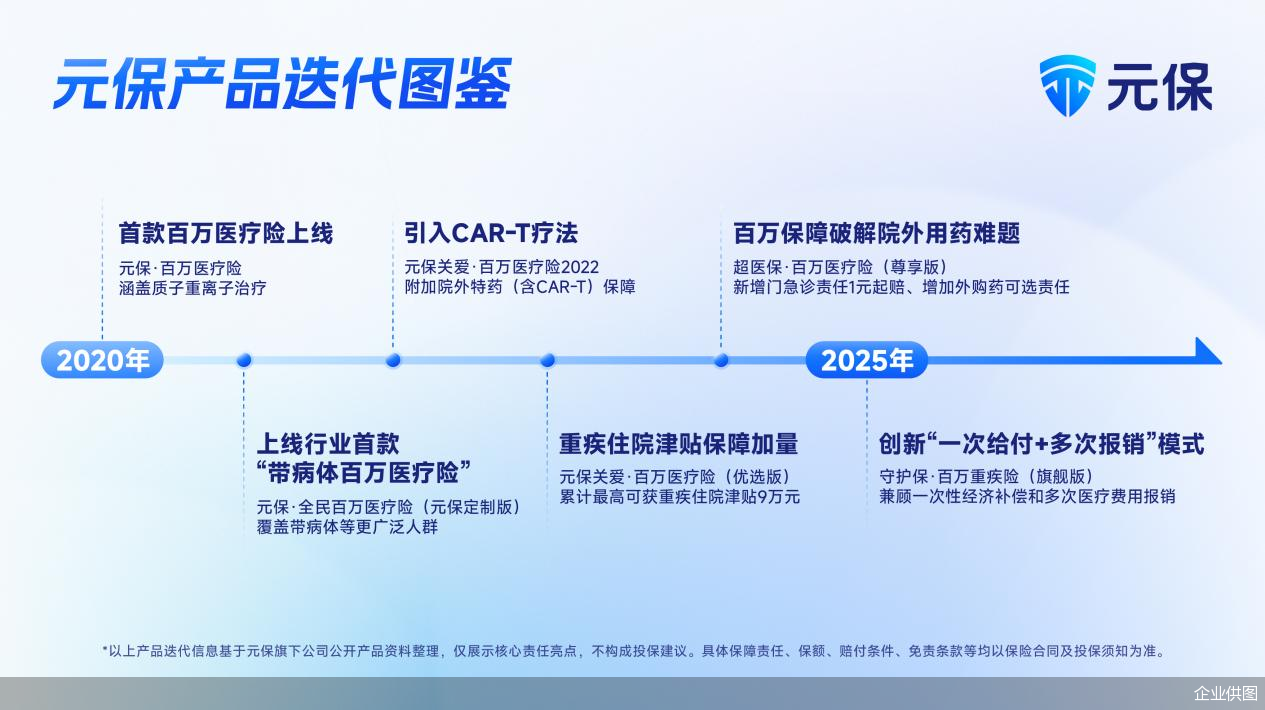
Core Insights - The article highlights the rapid redefinition of "inclusive" insurance in China's insurance industry, driven by national innovation signals and policy benefits, with a focus on the emergence of Yuanbao as a leading internet insurance technology platform [1][2] Group 1: Company Overview - Yuanbao is recognized as a leading internet insurance technology platform in China, having successfully listed within five years and becoming the second-largest independent distributor in the life insurance market [1][8] - The company operates with approximately 500 employees and holds national insurance brokerage and agency licenses [1] Group 2: Product Innovation - Yuanbao has introduced various innovative insurance products, such as the "Guarding Insurance · Million Critical Illness Insurance (Flagship Version)," which combines one-time payment with multiple reimbursements, addressing user needs effectively [2][5] - The company has continuously upgraded its offerings, including a "0 deductible" medical insurance and a "family plan," aimed at lowering insurance thresholds and expanding coverage [5][11] Group 3: Market Trends and Growth - The internet insurance market in China has experienced a compound annual growth rate of 32.8% in premium scale from 2013 to 2023, driven by increasing public demand for health insurance [3] - Yuanbao has expanded its product matrix to include critical illness insurance, outpatient insurance, and accident insurance, responding to the growing health protection needs of the population [3][4] Group 4: User-Centric Approach - Yuanbao emphasizes a user-centric approach, continuously adapting its products and services based on user insights and behavior analysis [9][10] - The company has developed a systematic user insight mechanism, conducting regular consumer research to understand diverse user needs across different demographics [10] Group 5: Technological Integration - Technology is identified as a core driver for inclusive insurance, with Yuanbao leveraging AI, big data, and cloud computing to enhance service efficiency and accessibility [11][12] - The company has built a comprehensive consumer service engine that covers user identification, outreach, sales conversion, and after-sales service, significantly improving the user experience [12][13] Group 6: Claims Process Improvement - Yuanbao has implemented features like "one-click claims" and "one-click upload," streamlining the claims process and reducing user burden [13] - The average claim processing time for cases under 10,000 yuan is reported to be 3.6 days, with some cases processed in as little as 3.7 minutes, showcasing the efficiency of their technology-driven claims system [13]
砥砺十载,携手新程:泰康在线十周年活动精彩预告!
Cai Fu Zai Xian· 2025-11-11 04:54
Core Insights - The insurance industry in China is transitioning towards high-quality development, facing challenges from traditional models while embracing digitalization, ecological integration, and intelligence as key transformation directions [1] - Taikang Online, as a pioneer in the industry, has demonstrated profound thinking and practical experience in this transformation over its ten-year journey [1] Group 1: Company Milestones - Taikang Online was established in 2015 with the mission to make insurance more secure, convenient, and affordable, collaborating closely with partners to build a new ecosystem for internet insurance [2] - In 2016, the company launched customized products for online shopping and the first rider insurance in the industry, supporting daily insurance for delivery personnel [2] - By 2017, Taikang Online had surpassed 100 million policies issued and introduced innovative health insurance products, significantly enhancing user experience [2] - The company addressed the accessibility of critical medications with the launch of the "Yao Shen Bao" plan in 2019 [2] - In 2022, Taikang Online's premium income exceeded 10 billion, serving over 200 million customers and launching new citizen insurance to enhance inclusive services [2] - As of 2023, the company has achieved historical highs in various metrics, serving 300 million customers, issuing 17.5 billion policies, and paying out over 30.5 billion in claims [2] Group 2: Future Directions - Taikang Online will hold a ten-year anniversary celebration on November 18 in Beijing, focusing on the theme "We, You, They" to reflect on its journey and set a forward-looking vision [3] - The event will explore the future direction of intelligent upgrades in insurance services, leveraging AI technology to reshape the customer experience [3] - The company aims to continue building an open and win-win insurance ecosystem, contributing to national strategies and enhancing public welfare [3]
半年10亿推广费,谁在以互联网保险之名收割老年人
Feng Huang Wang· 2025-11-03 08:45
Core Insights - The article highlights the controversial practices of Yuanbao, an internet insurance platform, which has been accused of automatically deducting fees from elderly customers without their knowledge, raising concerns about ethical marketing practices in the insurance industry [1][2][4]. Group 1: Company Practices - Yuanbao's marketing strategy heavily targets elderly individuals, leading to numerous complaints about unauthorized deductions, with some customers reporting annual charges exceeding 2500 yuan [1][2]. - The company has been found to utilize various platforms, including WeChat and SMS, to lure customers into automatic payment schemes, often without clear consent [2][4]. - Complaints against Yuanbao have surged, with over 1955 reported cases on consumer complaint platforms, primarily concerning unauthorized deductions and misleading information [4]. Group 2: Financial Performance - Yuanbao, founded in 2019, has shown significant revenue growth, achieving 3.85 billion yuan in 2021, 8.5 billion yuan in 2022, and 20.45 billion yuan in 2023, with a notable profit in the first half of 2024 [5]. - The company reported a record revenue of approximately 10.7 billion yuan in Q2 2025, marking a 25.2% year-on-year increase, and a net profit of 3.05 billion yuan, up 55.6% [5]. Group 3: Technology and Innovation - Yuanbao's competitive edge lies in its "AI + insurance" model, which has led to the development of over 4800 analytical models, enhancing its ability to target potential consumers effectively [6][7]. - The company has faced regulatory scrutiny in the past for not adhering to internet insurance regulations, indicating ongoing challenges in balancing technological innovation with compliance [7]. Group 4: Market Context - The insurance market in China has grown significantly, reaching a scale of 5.7 trillion yuan, with a particular focus on health insurance due to the aging population [9]. - Yuanbao's approach reflects a broader industry issue of supply-demand mismatch and trust deficits, raising questions about the ethical implications of its aggressive marketing tactics [8][9].
2025年保险行业AI应用全景洞察报告
艾瑞咨询· 2025-10-08 00:06
Core Viewpoint - The insurance industry is undergoing a transformation driven by AI technology, which is reshaping operational logic and enhancing efficiency while maintaining customer-centric values [1][2][4]. Development Background - The insurance sector is in urgent need of technology-driven transformation due to pressures from rough growth and operational challenges. AI is set to reconstruct the insurance value chain, evolving from an efficiency tool to a strategic hub [4][5]. Market Size and Growth - The Chinese insurance market is expected to exceed 6 trillion yuan by 2026, with original premium income projected to grow from 4.3 trillion yuan in 2019 to 5.7 trillion yuan in 2024, reflecting a compound annual growth rate of 6.0% [5]. - The insurance industry's technology investment is anticipated to surpass 67 billion yuan by 2025, with a focus on big data, cloud computing, and AI [5][14]. Technology Investment - The insurance sector's technology investment is growing at an annual rate of 14.6%, significantly outpacing the overall market growth, with a projected total investment of over 67 billion yuan by 2025 [14][18]. AI Applications in Insurance - AI applications in the insurance industry are transitioning from point solutions to comprehensive, centralized intelligent systems, enhancing efficiency and creating new value [27][55]. - AI is being integrated across the entire insurance value chain, including underwriting, claims processing, risk control, and customer service, driven by data and algorithmic models [22][28]. Trends in AI Integration - The insurance industry is witnessing a shift from using AI as an efficiency tool to adopting it as a strategic core, with a focus on deep integration of AI in product and service offerings [57][59]. - AI is facilitating the transition from traditional product sales to a service-oriented model, enhancing customer engagement and long-term value [59]. Risk Control and Compliance - AI applications in risk control and compliance present a dual impact, improving fraud detection and risk pricing accuracy while also raising concerns about compliance and data privacy [61]. Case Studies - iYunbao is leveraging AI to empower insurance agents through a flat management model, enhancing the entire sales process from product design to customer service [44]. - Ping An Life is a benchmark for intelligent transformation, utilizing AI for real-time responses, precise pricing, and proactive risk control [46]. - ZhongAn Technology is focusing on AI model applications across the insurance lifecycle, driving efficiency and innovation [52].

保险业最大AI公司冲击IPO!是“续命”还是“续亏”?
Sou Hu Cai Jing· 2025-09-26 17:22
Core Viewpoint - The rise of AI technology is significantly impacting various industries, including insurance, with companies like Nuanwa Technology aiming to become leaders in AI insurance solutions despite facing substantial financial challenges and market skepticism [1][22]. Group 1: Company Overview - Nuanwa Technology is China's largest independent AI insurance technology company, recently filing for an IPO in Hong Kong to become the "first AI insurance stock" [1]. - The company has developed AI underwriting and claims solutions, with its core products being the "Alamos" system for underwriting and the "Roborock" model for claims verification [4][6]. Group 2: Financial Performance - Despite revenue growth from 345 million in 2022 to 944 million in 2024, Nuanwa Technology has incurred cumulative losses of 718 million over three and a half years [7][22]. - The company's reliance on a few major clients, particularly ZhongAn Online, raises concerns about its sustainability and growth potential, with over 49% of its revenue coming from ZhongAn in the first half of 2025 [10][9]. Group 3: Market Position and Challenges - The AI insurance market is projected to grow from 746.8 billion to 1.35 trillion from 2024 to 2029, but existing insurance tech companies have faced significant stock price declines post-IPO [22]. - Nuanwa Technology's research and development spending has decreased significantly, raising questions about its ability to innovate and compete effectively in the market [16][22]. Group 4: Client Dependency and Risks - Nuanwa Technology's revenue is heavily dependent on a small number of clients, with the top five clients contributing over 73% of its revenue, which poses a risk to its business model [10][12]. - The company has faced reputational risks due to issues associated with its major client, ZhongAn Online, which has been criticized for customer complaints and regulatory penalties [19][22].