PING AN OF CHINA(02318)

Search documents
中国平安入选Brand Finance 2026全球品牌价值500强
Cai Jing Wang· 2026-01-22 06:30
1月21日,国际权威品牌评估机构Brand Finance发布《2026年全球品牌价值500强榜单》。中国平安以 488.39亿美元的品牌价值十度蝉联中国最具价值保险品牌,位列全球第32位,较2025年提升3位,排名 中国第10位,品牌价值同比增长13%。榜单方认为,中国平安在复杂多变的外部环境中,依然保持稳健 经营与持续增长,展现出突出的品牌韧性和长期价值。 ...

智通港股沽空统计|1月22日
智通财经网· 2026-01-22 00:24
Group 1 - The top short-selling stocks include Sun Hung Kai Properties (80016), China Resources Beer (80291), and AIA Group (81299), all with a short-selling ratio of 100.00% [1][2] - The highest short-selling amounts are recorded for Xiaomi Group (01810) at 1.128 billion, Baidu Group (09888) at 1.106 billion, and Alibaba Group (09988) at 995 million [1][2] - The highest deviation values are for Ping An Insurance (82318) at 58.81%, JD Group (89618) at 38.75%, and Sun Hung Kai Properties (80016) at 35.83% [1][2] Group 2 - The top short-selling ratio rankings show Sun Hung Kai Properties (80016) with a short-selling amount of 196,700 and a ratio of 100.00%, followed by China Resources Beer (80291) with 11,500 and 100.00% [2] - The top short-selling amounts list Xiaomi Group (01810) with 1.128 billion, Baidu Group (09888) with 1.106 billion, and Alibaba Group (09988) with 995 million [2] - The top deviation values list Ping An Insurance (82318) with a short-selling amount of 3.2371 million and a ratio of 92.98%, followed by JD Group (89618) with 320,900 and 98.46% [2]






Q4预定利率研究值为1.89%,产品预定利率保持稳定
GF SECURITIES· 2026-01-21 23:30
Investment Rating - The industry investment rating is "Buy" [3] Core Insights - The Q4 predetermined interest rate research value is 1.89%, indicating that product predetermined rates remain stable [6] - The insurance industry is expected to see a marginal improvement in the "interest and expense difference" due to regulatory guidance aimed at reducing liability costs and potential increases in asset yields [6] - The dynamic adjustment mechanism for predetermined rates and the transformation of participating insurance are expected to drive down the rigid liability costs of new policies, leading to a turning point for existing liability costs [6] - The report suggests focusing on the insurance sector, with specific stock recommendations including China Ping An, China Life, China Taiping, and others [6] Summary by Sections Industry Overview - The Q4 predetermined interest rate research value is 1.89%, which does not meet the conditions for a rate reduction, as it is only 11 basis points lower than the current traditional insurance predetermined rate of 2.0% [6] - The expected stability of the predetermined interest rate is projected to continue into Q1 2026, with an estimated value of around 1.9% [6] Regulatory Environment - The China Insurance Industry Association has set guidelines for adjusting predetermined rates, which require a 25 basis point difference over two consecutive quarters to trigger a reduction [6] - The report highlights the importance of the 10-year government bond yield as a key indicator influencing the research value [6] Investment Recommendations - The report recommends focusing on the insurance sector, particularly companies such as China Ping An (A/H), China Life (A/H), China Taiping (H), and others, due to expected improvements in profitability margins [6][7]



智通ADR统计 | 1月22日
智通财经网· 2026-01-21 22:19
Market Overview - The Hang Seng Index (HSI) closed at 26,547.45, down by 37.61 points or 0.14% [1] - The index reached a high of 26,639.66 and a low of 26,442.66 during the trading session [1] - The average price for the day was 26,541.16, with a trading volume of 49.443 million shares [1] Blue-Chip Stocks Performance - HSBC Holdings closed at 129.700 HKD, up by 1.17% compared to the previous close [2] - Tencent Holdings closed at 599.924 HKD, down by 0.43% compared to the previous close [2] - Alibaba Group (ADR) saw an increase of 2.19%, closing at 163.200 HKD [3] - Notable declines included NetEase, which fell by 3.70% to 208.000 HKD [3] Individual Stock Movements - Tencent Holdings (ADR) was priced at 599.924, reflecting a decrease of 0.43% compared to its Hong Kong price [3] - Alibaba's ADR was at 164.396, showing an increase of 0.73% compared to its Hong Kong price [3] - HSBC's ADR was at 129.700, indicating an increase of 1.17% compared to its Hong Kong price [3] - Other notable movements included Baidu Group, which increased by 3.29% to 153.700 HKD [3]




人身险预定利率不再下调?最新研究值降幅显著收窄,“存款大搬家”最不需要担心的或许就是保费
Xin Lang Cai Jing· 2026-01-21 13:55
Core Viewpoint - The core indicator for pricing life insurance products, the predetermined interest rate research value, has been updated to 1.89%, marking a continuous decline over four quarters since the dynamic adjustment mechanism was implemented in January 2025, with the rate decreasing from 2.34% to 2.13%, 1.99%, and 1.90%, with the latest adjustment being a minor drop of 1 basis point, indicating a shift from rapid decline to moderate stabilization [1][2][11]. Group 1: Predetermined Interest Rate Dynamics - The current predetermined interest rate research value is 1.89%, and the upper limit for ordinary life insurance has been reduced from 2.5% to 2% [3][12]. - The adjustment mechanism stipulates that a reduction in the predetermined interest rate is only necessary if the upper limit exceeds the research value by 25 basis points for two consecutive quarters; currently, the difference is only 11 basis points, not triggering a reduction [1][2][12]. - If the research value remains below 1.75% for the first two quarters of 2026, the earliest adjustment could occur in the third quarter of 2026, making the first half of 2026 a critical observation period [1][2][12]. Group 2: Market and Economic Context - The macroeconomic environment shows a continued decline in interest rates, with the 10-year government bond yield rising by 25 basis points to 1.85% in 2025, ending a four-year downward trend, although this level remains historically low [3][12]. - The 5-year LPR has remained stable at 3.5% for eight consecutive months, while some banks have lowered their 5-year fixed deposit rates to between 1.3% and 1.8%, further reducing the yield of similar savings products [4][12]. - Recent structural interest rate cuts by the central bank, including a 0.25 percentage point reduction in various lending rates, signal a potential easing of monetary policy, although it may not immediately affect the LPR [4][13]. Group 3: Industry Growth and Trends - The life insurance sector is experiencing a robust start to 2026, with many companies reporting double-digit growth in new premium income, driven by a shift in consumer preference towards stable, low-risk investment options amid a low-interest-rate environment [6][16][17]. - Major insurers like China Life and Ping An have reported new premium income growth exceeding 70%, with China Life's new premium income increasing by 76% from New Year's Day to mid-January [17]. - The insurance industry is transitioning from merely being a financial product to becoming a core component of family wealth planning and lifelong social security, emphasizing the integration of long-term returns and protection features in product offerings [8][16][17].
《Brand Finance 2026年全球品牌价值500强》榜单发布:7家中国保险业品牌上榜,中国平安位列第32名
Xin Lang Cai Jing· 2026-01-21 10:54
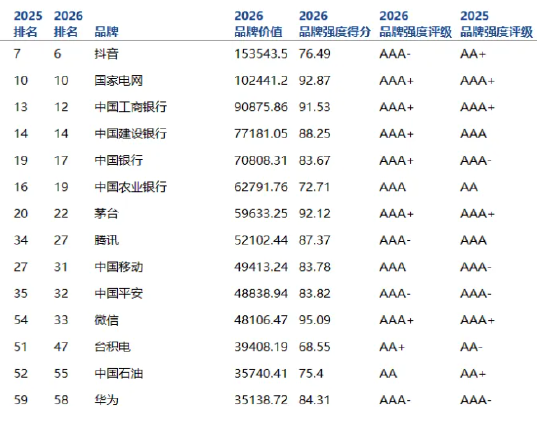
Core Insights - The Brand Finance 2026 Global Brand Value 500 report was released on January 20, 2026, in Davos, Switzerland, highlighting the performance of various brands globally [1][5]. Group 1: Chinese Brands Performance - A total of 68 Chinese brands made it to the list, with the insurance sector showing strong performance, featuring 7 insurance companies [1][5]. - The top Chinese insurance brands included Ping An (32nd), China Life Insurance (104th), and China People's Insurance (145th) [1][5]. - Among the 7 insurance brands, 6 experienced an increase in brand value, with China People's Insurance seeing a significant growth of 12%, reaching a brand value of $16.82 billion and moving up 5 places to rank 145th globally [1][5]. Group 2: Brand Rankings and Values - Notable rankings include Douyin at 6th with a brand value of $153.54 billion, State Grid at 10th with $102.44 billion, and ICBC at 12th with $90.88 billion [2][6]. - Other significant brands include China Construction Bank (14th), Bank of China (17th), and Agricultural Bank of China (19th), all maintaining strong brand values and ratings [2][6]. - The report indicates that the brand strength scores and ratings for these companies reflect their competitive positioning in the market, with many achieving AAA or AA ratings [2][6].

纽梅隆:在中国平安的持股比例升至5.75%
Ge Long Hui· 2026-01-21 09:48
Group 1 - The core point of the article is that Bank of New York Mellon has increased its stake in China Ping An's H-shares from 4.30% to 5.75% as of January 19 [1] Group 2 - The increase in ownership indicates a growing confidence from institutional investors in China Ping An [1] - The change in shareholding may reflect broader trends in investment strategies within the financial sector [1] - This adjustment in stake could potentially influence market perceptions and valuations of China Ping An [1]

2026银保“开门红”一片火热?新单保费或超700亿,背后有这几大影响因素…
Xin Lang Cai Jing· 2026-01-21 09:14
Core Insights - The insurance sector has seen a significant surge in new business through the bancassurance channel, with nearly 40 life insurance companies reporting a total new business scale exceeding 71.1 billion yuan, marking a substantial year-on-year increase [1][5] - The driving force behind this growth is attributed to the ongoing low interest rate environment, which has diminished the attractiveness of traditional deposits, prompting funds to seek alternative investment channels [6][8] Group 1: Market Dynamics - The bancassurance channel has successfully captured a large volume of funds that are looking for new outlets due to the declining interest rates, with the one-year and above fixed deposit maturity amount reaching 50 trillion yuan in 2026 [2][6] - The appeal of bancassurance products has been amplified in the context of low deposit rates, with standard products offering a maximum guaranteed interest rate of 2.0% and participating products providing a minimum return of 1.75% plus floating dividends [2][6] Group 2: Policy and Structural Changes - Recent policy adjustments, including the integration of insurance and banking services, have facilitated the growth of the bancassurance channel, allowing it to surpass individual insurance as the leading distribution channel in the first half of 2025 [3][7] - The growth in bancassurance premiums has translated into increased commission earnings for customer managers, enhancing customer retention and providing banks with a stable source of funds [7][8] Group 3: Future Outlook - The bancassurance channel's performance in 2026 is expected to be a result of both the low interest rate environment and the structural changes within the banking sector, with projections indicating that new business premium growth for listed insurance companies through this channel could exceed 30% [4][8]
从“事后理赔”到“全程守护”:平安24重塑全球出海安全新范式
Xin Lang Cai Jing· 2026-01-21 08:13
Core Viewpoint - The increasing trend of Chinese citizens going abroad presents significant safety challenges, necessitating enhanced support and solutions from the insurance industry [2][5]. Group 1: Current Trends and Challenges - By the end of 2024, Chinese investors are projected to establish 52,000 overseas enterprises across 190 countries, with 19,000 in Belt and Road Initiative countries [2][7]. - In 2024, outbound travel by mainland residents is expected to reach 146 million trips, a year-on-year increase of 67.8% [2][7]. - Three major challenges for Chinese citizens going abroad include complex international environments, limited rescue resources, and insufficient safety management capabilities for enterprises [2][7]. Group 2: "Ping An 24" Global Emergency Rescue Plan - Ping An Insurance has launched the "Ping An 24" global emergency rescue and protection plan, emphasizing a core philosophy of "prevention first, rescue second, compensation last" [3][9]. - The plan aims to provide 24/7 support across all time zones and seasons, ensuring immediate assistance and risk information dissemination [3][9][10]. - The service includes features such as real-time risk assessments, emergency hotlines, and rapid claims processing, with a commitment to respond within 10 seconds and complete claims in as little as 1 hour [4][11]. Group 3: Global Resource Integration and Response Mechanism - Ping An has integrated global resources by collaborating with top medical and safety rescue institutions, establishing eight operational centers that support over 70 languages and cover more than 230 countries and regions [4][11]. - The company promises a one-day arrival of rescue experts to assist clients in distress, reinforcing its commitment to safety for overseas travelers [4][11]. Group 4: Future Directions and Responsibilities - Ping An Insurance aims to deepen its overseas service ecosystem by focusing on three key areas: fulfilling its responsibility to enhance safety mechanisms, strengthening comprehensive risk management for clients, and leveraging financial technology to build a secure overseas service network [5][13]. - The company emphasizes its role as a stabilizer in society, actively participating in national policies to protect overseas personnel and institutions [5][13].
一周保险速览(1.10—1.16)
Cai Jing Wang· 2026-01-21 06:05
Industry Insights - In 2025, multiple insurance companies reported annual claims data showing a continuous increase in both the number and amount of claims, with an overall claim approval rate exceeding 99% [1] - Medical insurance had the highest number of claims, while critical illness insurance had the highest claim amounts, indicating a significant protection gap [1] - Claims processing times have significantly improved, with some companies achieving instant payouts; however, the "claims difficulty" issue persists mainly due to inaccurate health disclosures, misunderstandings of policy terms, and insufficient documentation, rather than widespread claim denials [1] - Experts recommend that consumers scientifically allocate medical and critical illness insurance based on age, income, and family responsibilities, particularly emphasizing adequate coverage for family breadwinners [1] Corporate Developments - Deutsche Bank's insurance subsidiary, Deutsche Bank Life Insurance Co., has increased its registered capital to 3.785 billion yuan, marking a 68.97% increase from 2.24 billion yuan [2] - On January 14, China Pacific Life Insurance Co. announced its participation in a stock acquisition of Shanghai International Airport Co., increasing its holdings to 124,415,684 shares, representing 5.00% of the A-share capital [3] - China Ping An is set to sell a 34% stake in Shenzhen United Property Exchange, comprising 170 million shares, with a listing price of 408 million yuan (2.4 yuan per share) [4] - On January 14, the general manager of Kaibin Property Insurance Co., Xia Dongyou, resigned for personal reasons, with Bai Chengmin appointed as the interim head to ensure a smooth management transition [5] - On January 14, Jiao Yin Life Insurance announced a leadership change, with Li Ya appointed as the new chairman, succeeding Wang Qingyan [6]