
PING AN OF CHINA(02318)

Search documents
中国平安新年2日累涨近9%,股价创逾5年新高
Ge Long Hui A P P· 2026-01-06 02:25
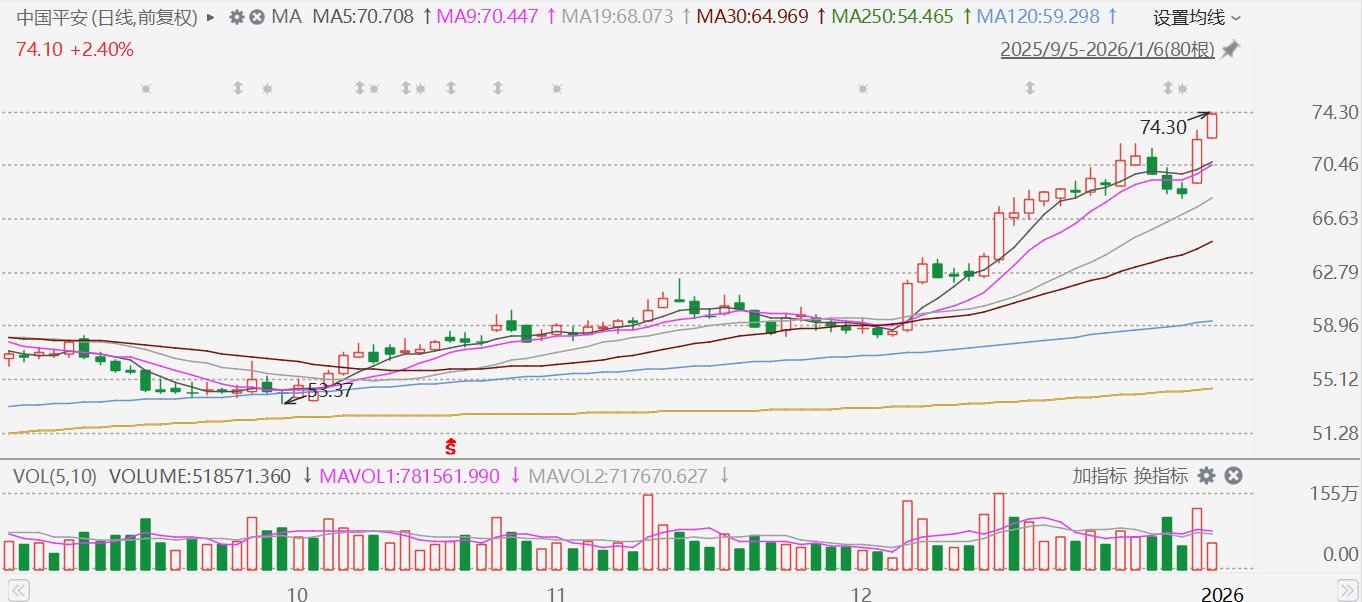
Core Viewpoint - The insurance sector, particularly China Ping An, is experiencing a strong upward trend, with significant stock price increases indicating a potential value reassessment in the industry [1] Group 1: Stock Performance - China Ping An's A-shares rose over 2% to 74.3 yuan, marking a new high since November 2020, with a cumulative increase of nearly 9% over the first two trading days of the new year [1] - The H-shares of China Ping An increased by over 3% to 71.2 Hong Kong dollars, reaching a new high since April 2021 [1] Group 2: Analyst Predictions - Shenwan Hongyuan Research has raised its earnings forecast for China Ping An, maintaining a "buy" rating and setting a target price of 93.8 yuan per share for A-shares [1] - The research highlights that China Ping An, due to its business characteristics, is a high-dividend stock that can be both offensive and defensive [1]


2026年首个交易日保险板块涨幅居首 新华保险、中国太保股价创新高
Shang Hai Zheng Quan Bao· 2026-01-06 02:11
Group 1 - The A-share insurance sector rose by 6.17%, leading the Shenwan secondary industry classification, with notable individual stock performances including New China Life up 8.87% and China Pacific Insurance up 7.52%, both reaching new highs [1] - Analysts attribute the positive performance of the insurance sector since December 2025 to supportive policies, including adjustments to risk factors for stocks held by insurance companies and the introduction of the draft Asset-Liability Management Measures for insurance companies, aimed at optimizing asset-liability matching [1][2] - The insurance sector's growth is also driven by favorable earnings expectations and market liquidity, with the sector experiencing a 26.42% increase throughout 2025 [1] Group 2 - On the liability side, measures such as lowering the preset interest rate and promoting dividend insurance have alleviated cost pressures for insurance companies, with insurance products becoming increasingly important for residents' asset allocation [2] - On the asset side, policies have been relaxed to encourage long-term investments, including increasing the proportion of equity investments and expanding investment channels, which has led to significant investment returns for insurance companies [2] - The first three quarters of 2025 saw the five major listed insurance companies in A-shares achieve a record net profit of approximately 426.04 billion yuan [2]



全国首张具身智能机器人“保险+租赁”保单落地
Zhong Guo Zheng Quan Bao· 2026-01-06 02:04
平安产险上海分公司总经理何莹表示:"我们将深度融合租赁场景规模化设备管理数据与平安产险海量 风险数据,通过AI算法实现对具身智能机器人实际使用风险的精准刻画、动态定价与实时风控。'保险 +租赁'这一模式不仅破解了单一设备投保中信息不对称的难题,更通过联合产业伙伴构建从'制造-使用- 保障'的全链路风控闭环,真正推动保险从'事后补偿'转向'事前预防、事中干预'升级。" (责任编辑:孟茜云) 具身智能机器人作为人工智能的尖端载体,正加速融入千行百业。然而,其保险保障需求长期面临三大 挑战:一是核心技术数据保密性强,保险公司难以精准评估风险;二是多数机器人厂商处于初创期,传 统保险服务模式难以匹配其灵活需求与成本考量;三是单一设备持有模式下道德风险防控难度较高。这 些因素使得具身智能机器人产业保险服务供需不匹配,保险在产品创新与市场化落地面临瓶颈。 具体来看,此次合作从机器人实际"使用端"切入,以融资租赁业务场景为载体实现批量投保,不仅明确 了机器人的具体应用场景与使用规范,更构建了"风险共担、信用增信"的合作框架,显著降低了整体业 务风险。同时,平安产险此次突破具身智能机器人仅常规硬件保障的局限,设计了含第三者责 ...


智通港股沽空统计|1月6日
智通财经网· 2026-01-06 00:28
Group 1 - The top short-selling ratios are led by China Resources Beer (100.00%), BYD Company (100.00%), and Xiaomi Group (75.49%) [1][2] - The highest short-selling amounts are recorded for Ping An Insurance (2.081 billion), Alibaba (1.871 billion), and Xiaomi Group (1.624 billion) [1][2] - The highest deviation values are for BYD Company (43.54%), CIFI Holdings (39.74%), and Xiaomi Group (34.28%) [1][2] Group 2 - The top short-selling amounts table shows Ping An Insurance at 2.081 billion, Alibaba at 1.871 billion, and Xiaomi Group at 1.624 billion [2] - The top short-selling ratios table lists China Resources Beer and BYD Company both at 100.00%, followed by Xiaomi Group at 75.49% [2] - The top short-selling deviation values table highlights BYD Company with a deviation of 43.54%, followed by CIFI Holdings at 39.74% and Xiaomi Group at 34.28% [2]




银行-保险-券商年度策略
2026-01-05 15:42
Summary of Conference Call Records Industry Overview - **Insurance Industry**: The insurance sector is expected to continue its recovery in 2026, with concerns over interest margin losses easing. Regulatory adjustments have lowered the preset interest rates, and the return on universal insurance products has decreased. Investment returns for insurance stocks are projected to exceed 5%, surpassing the intrinsic value assumptions, indicating a turning point for interest margin losses [1][4]. - **Brokerage Sector**: The brokerage industry is anticipated to benefit from the migration of household deposits, increased market activity, and relaxed regulatory policies. It is expected that the return on equity (ROE) for brokerages will enter an upward cycle from 2025 to 2026, driven by wealth management, investment banking, and international derivatives [1][10]. Key Insights and Arguments - **Investment in A-shares**: Insurance companies are expected to allocate 30% of new premiums to the A-share market annually, resulting in an influx of approximately 300-400 billion yuan, which will support capital market growth and enhance investment returns [1][4]. - **Property Insurance**: The top three property insurance companies maintain a stable market share, with auto insurance being a core growth area. The penetration rate of new energy vehicles is expected to drive an increase in average premiums. China Pacific Insurance anticipates a growth rate of over 4% in auto insurance business, aligning with GDP growth [1][5]. - **Non-auto Insurance Growth**: The non-auto insurance sector is benefiting from increased health insurance coverage, with premium growth expected to approach 10% in 2026 as certain low-base businesses recover. The comprehensive cost ratio for leading insurance companies is projected to stabilize around 97% [1][7]. - **Brokerage Performance Drivers**: Key performance drivers for brokerages include robust growth in wealth management, a recovering investment banking sector, and active proprietary trading. The anticipated improvement in ROE for brokerages could reach 9% under neutral conditions and exceed 10% in optimistic scenarios by 2027 [2][14]. Additional Important Points - **Market Dynamics**: The trend of household deposits moving away from traditional savings products is creating a competitive advantage for participating insurance products, which offer higher returns compared to fixed deposits [1][4]. - **Valuation Recovery**: The insurance sector's valuation is expected to recover significantly, with a potential P/EV (price-to-embedded value) ratio reaching 1.0 in the medium term. The average insurance stock in A-shares has about 40% room for recovery based on 2026 dynamic PEV estimates [8]. - **Recommended Companies**: Key insurance companies to watch include China Ping An, New China Life, China Taiping, China Life, and China Pacific Insurance, with China Ping An being highlighted for its diversified business model and high dividend characteristics [9]. - **Banking Sector Changes**: The banking sector is expected to undergo significant changes driven by policy adjustments, improved fundamentals, and favorable funding conditions, which will support valuation recovery [16]. - **Investment Recommendations**: In the current market environment, it is advisable to focus on stable high-dividend stocks and quality core assets, including major state-owned banks and leading commercial banks [17].
平安产险福建分公司:首单研发费用损失险落地南平 风险分担机制护航科技创新
Zhong Jin Zai Xian· 2026-01-05 11:37
Group 1 - The core viewpoint of the news is that Ping An Property & Casualty Insurance has signed the first technology project research and development expense loss insurance in Fujian province, providing 10.58 million yuan risk protection for a national high-tech enterprise's diabetes drug intermediate research project, marking a significant step in financial support for technological innovation [1][3][6]. Group 2 - The technology project research and development expense loss insurance directly addresses the core risks faced by high-tech enterprises, compensating for funding losses due to technical route errors, small-scale trial failures, or unmet acceptance standards [3]. - The insurance mechanism is designed to alleviate financial pressure on enterprises caused by research and development risks, integrating a comprehensive solution of "pre-risk prevention + in-process control + post-loss compensation" [3][6]. - The company has established a multi-layered technology insurance product system, responding to diverse needs of technology enterprises, and has provided over 100 billion yuan in technology risk protection for high-tech enterprises across the province [6][7]. Group 3 - The company aims to become a reliable partner for technology enterprises, ensuring that insurance serves as a support for technological innovation rather than a cost burden [7]. - Future plans include deepening collaboration with provincial technology departments, financial institutions, and research institutes to replicate and promote the "Fujian model" of technology insurance [7].
新年开市保险板块涨超6%,2026年估值将进一步提升
Di Yi Cai Jing· 2026-01-05 10:59
五家A股保险上市公司在1月5日均收获超过5%的涨幅。其中,新华保险(601336.SH;01336.HK)、中 国太保(601601.SH;02601.HK)全天涨幅分别为8.87%及7.52%,收盘价分别为75.88元/股及45.06元/ 股,均再次打破去年12月创下的股价历史新高。另外,中国平安(601318.SH;02318.HK)当日以72.36 元/股收盘,亦再创2021年3月以来的最高价。 【#新年开市保险板块涨超6%#,2026年估值将进一步提升】1月5日,A股开启了2026年的新征程。 Choice数据显示,首个交易日,保险板块(申万二级行业分类)延续去年的抢眼表现,持续走高,最终 以6.17%的涨幅位居A股申万二级行业分类所有板块首位。 ...
12连阳,沪指创33年最长连阳纪录!机构资金和各路游资纷纷出手,A股春季躁动行情渐入高潮,高盛高呼高配中国股票
Jin Rong Jie· 2026-01-05 10:47
整体看,A股交投气氛十分活跃,机构资金和各路游资纷纷出手,各有斩获。 数据显示,多家机构席位出现在了蓝色光标、盐湖股份、海格通信、西测测试的龙虎榜中,此外A股实 力游资章建平也出现在蓝色光标龙虎榜中,单日买入了6482.08万元,卖出了2.59亿元。 12连阳,沪指创33年最长连阳纪录,A股春季躁动行情渐入高潮! 1月5日,A股迎来2026年首个交易日,三大指数全天高开高走,截至收盘,沪指涨1.38%,报4023.42 点,深成指涨2.24%,报13828.63点,创业板指涨2.85%,报3294.55点,科创50指数涨4.4%,报1403.41 点。与此同时,资金纷纷疯狂涌入A股,今日沪深两市合计成交额25463.47亿元,较上一个交易日放量 5011亿。 值得注意的是,沪指在2025年末已经走出11连阳的强势走势。在今日A股实现开门红之后,沪指从2025 年12月17日至2026年1月5日的12个交易日中,成功实现12连阳,创下A股1993年以来最长连阳纪录。最 近33年间A股最长连阳纪录为11天,分别在2006年以及2017-2018年出现过。A股最长连阳纪录为99天, 但彼时A股才处于起步阶段,市场体 ...


新年开市,保险股涨超6%再居首,2026年估值将进一步提升
Di Yi Cai Jing· 2026-01-05 10:25
Core Viewpoint - The insurance sector in A-shares has shown strong performance at the beginning of 2026, with a notable increase in stock prices driven by favorable policies and improved asset-liability management [1][3]. Group 1: Market Performance - On January 5, 2026, the insurance sector recorded a 6.17% increase, leading all A-share sectors [1]. - Five A-share insurance companies saw stock price increases of over 5%, with New China Life Insurance and China Pacific Insurance rising by 8.87% and 7.52%, respectively [1]. - China Ping An also reached its highest price since March 2021, closing at 72.36 yuan per share [1]. Group 2: Policy and Market Drivers - The stock price increase is attributed to a series of supportive policies in 2025, which have enhanced the asset-liability dynamics within the insurance sector [3]. - In December 2025, regulatory changes optimized risk factors for long-term stock holdings by insurance companies, signaling a positive outlook for further market entry [3]. - The insurance industry is currently in the "New Year" period, which is crucial for life insurance liabilities, with over 20% of annual premium income typically generated in January [3]. Group 3: Valuation Insights - Analysts indicate that the P/EV (Price to Embedded Value) ratios for major A-share insurance companies remain low, ranging from 0.68 to 0.99 as of December 31 [4]. - There is an expectation for the valuation of insurance stocks to gradually recover towards 1.0 P/EV in 2026 [4].

盘点2025 | 万亿健康险转型深水区:政策破局、生态重构
Xin Lang Cai Jing· 2026-01-05 10:10
Core Insights - The establishment of the Ping An Health Management Company marks a significant step in the transformation of the health insurance sector, reflecting a shift towards a "managed care" model and the reconstruction of a new ecosystem in health insurance [1][16] - As of November 2025, the cumulative premium for commercial health insurance reached 943.9 billion yuan, with a year-on-year growth of 2.3%, indicating a stable market but falling short of the 2 trillion yuan target set for 2025 [1][16] - The Chinese commercial health insurance market is at a crossroads, focusing on high-quality development driven by regulatory guidance and innovation in health management and product offerings [1][16] Market Structure - The commercial health insurance market is maintaining stability amid slowing growth, with a shift in focus from scale expansion to quality improvement [3][18] - In the first 11 months of 2025, life insurance companies accounted for 76.8% of health insurance premiums, totaling 725.2 billion yuan, but their growth rate has stagnated, while property insurance companies saw a 10.2% increase in premiums [3][18] - The market's stability is evidenced by a monthly premium of 49.6 billion yuan in November 2025, with life insurance companies contributing 40.2 billion yuan and property insurance companies 9.4 billion yuan [3][18] Policy Support - Regulatory measures have been pivotal in driving the transformation of the health insurance industry, with multiple initiatives launched to enhance product standards and payment reforms [4][19] - The "Guiding Opinions on Promoting the High-Quality Development of Health Insurance" issued on September 30, 2025, outlines a vision for the role of health insurance in the national health security system by 2030 [4][19] - The policy emphasizes the integration of health insurance with health management, aiming to create a new health service guarantee system that combines prevention, management, and protection [4][19] Product Innovation - The health insurance sector is entering a phase of deep product innovation, with a focus on dual attributes of "protection + returns" in dividend insurance products [7][22] - Personal account-based long-term medical insurance is highlighted as a key area supported by policy, addressing the industry's challenges with traditional short-term medical insurance [7][22] - The mid-to-high-end medical insurance market is expanding, with major players enhancing their offerings to include comprehensive solutions beyond mere reimbursement [8][23] Ecosystem Reconstruction - The competition in the health insurance industry is shifting towards building an ecosystem, with a consensus on the "insurance + health management" model [10][26] - Major insurance companies are establishing health management firms to create a comprehensive health service system, moving from post-claim reimbursement to full-cycle health management [10][26] - The establishment of health management companies by leading insurers is seen as a localized innovation of the mature "managed care" model from developed markets, aiming to enhance service quality and sustainability [12][27] Technological Empowerment - The application of new technologies such as AI, big data, and blockchain is deepening in the health insurance sector, enhancing efficiency across product design, underwriting, and customer service [13][28] - Ping An has integrated AI into its health strategy, creating a comprehensive service system that covers various health service scenarios [13][28] - The focus on digitalization and the development of personalized health management platforms are expected to improve user experience and support dynamic pricing and risk control [13][28]