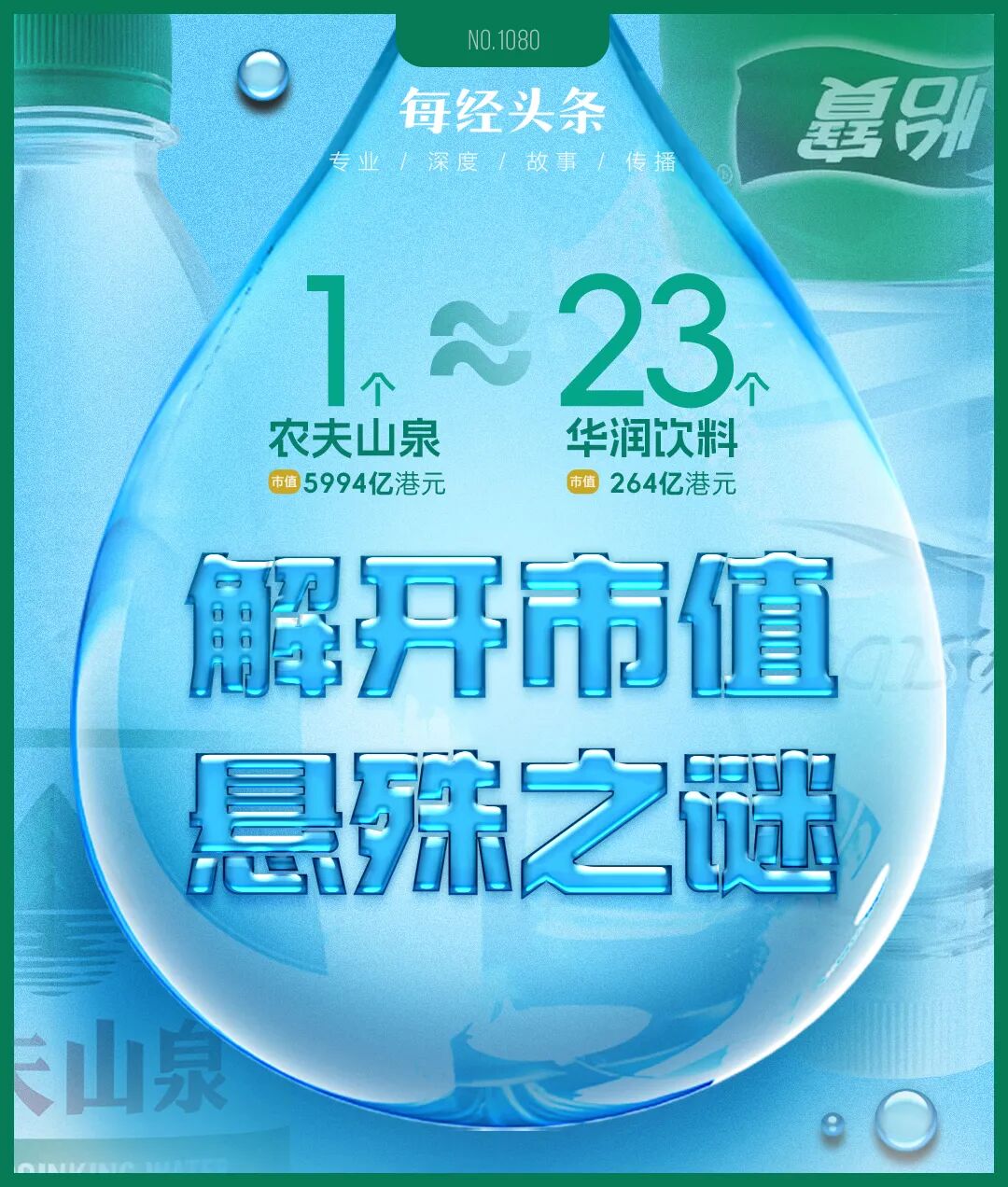
China Resources Beverage (Holdings) Company(02460)

Search documents
华润饮料(02460) - 董事名单与其角色和职能
2025-12-08 10:02
董事名單與其角色和職能 華潤飲料(控股)有限公司董事(「董事」)會(「董事會」)成員載列如下: (以存續方式於開曼群島註冊成立的有限公司) ( 股份代號: 2460) 周永健博士 李引泉先生 姚洋博士 鄭寶川女士 1 董事會設立四個委員會。下表提供各董事在該等委員會中所擔任的職位。 | | | 董事會委員會 | | | | --- | --- | --- | --- | --- | | | | | 薪酬與考核 | 戰略與投資 | | 董事 | 審核委員會 | 提名委員會 | 委員會 | 委員會 | | 張偉通先生 | | C | | | | 李樹清先生 | | | | M | | 周劍波先生 | | | | M | | 張建民先生 | | | M | | | 林國龍先生 | M | | | | | 肖寧先生 | | | | M | | 王德剛先生 | M | | M | C | | 趙典博士 | | M | | M | | 周永健博士 | M | | M | | | 李引泉先生 | M | M | C | | | 姚洋博士 | C | M | | M | | 鄭寶川女士 | M | M | M | | 附註: ...
华润饮料(02460) - 董事变更及董事会下属委员会组成之变更
2025-12-08 10:01
香港交易及結算所有限公司及香港聯合交易所有限公司對本公告的內容概不負 責,對其準確性或完整性亦不發表任何聲明,並明確表示,概不對因本公告全部或任 何部分內容而產生或因倚賴該等內容而引致的任何損失承擔任何責任。 及 董事會下屬委員會組成之變更 非執行董事、戰略與投資委員會主席、審核委員會成員及薪酬與考核委員會成員之辭任 華潤飲料(控股)有限公司(「本公司」,連同其附屬公司統稱「本集團」)董事 (「董事」)會(「董事會」)謹此宣佈,曹越女士(「曹女士」)因其他工作安排, 自2025年12月8日起辭任非執行董事、本公司戰略與投資委員會(「戰略與投資委員 會」)主席、本公司審核委員會(「審核委員會」)成員及本公司薪酬與考核委員會 (「薪酬與考核委員會」)成員職務。 曹女士已確認,彼與董事會概無意見分歧,亦無任何有關彼辭任的事宜須提呈本公司 股東及香港聯合交易所有限公司(「聯交所」)垂注。 (以存續方式於開曼群島註冊成立的有限公司) ( 股份代號: 2460) 董事變更 王先生已與本公司訂立委任函件,任期為三年,惟須根據本公司組織章程細則於股東 大會輪值退任及膺選連任。王先生將不會從本公司收取董事袍金及其他形式的薪酬。 ...
华润饮料(02460) - 截至二零二五年十一月三十日止月份之股份发行人的证券变动月报表
2025-12-04 09:04
股份發行人及根據《上市規則》第十九B章上市的香港預託證券發行人的證券變動月報表 截至月份: 2025年11月30日 狀態: 新提交 致:香港交易及結算所有限公司 公司名稱: 華潤飲料(控股)有限公司 呈交日期: 2025年12月4日 I. 法定/註冊股本變動 | 1. 股份分類 | 普通股 | 股份類別 | 不適用 | | | 於香港聯交所上市 (註1) | | 是 | | | --- | --- | --- | --- | --- | --- | --- | --- | --- | --- | | 證券代號 (如上市) | 02460 | 說明 | | | | | | | | | | | 法定/註冊股份數目 | | | 面值 | | | 法定/註冊股本 | | | 上月底結存 | | | 100,000,000,000 | USD | | 0.0000005 | USD | | 50,000 | | 增加 / 減少 (-) | | | | | | | USD | | | | 本月底結存 | | | 100,000,000,000 | USD | | 0.0000005 | USD | | 50,000 | ...
研判2025!中国即饮咖啡行业发展历程、市场政策、产业链图谱、销售现状、竞争格局及发展趋势分析:雀巢咖啡龙头优势明显[图]
Chan Ye Xin Xi Wang· 2025-11-29 05:27
Core Insights - The ready-to-drink (RTD) coffee market in China has seen significant growth, with 2023 offline sales reaching 3.76 billion liters and a revenue of 10.653 billion yuan, but a decline is expected in 2024 due to economic slowdown and competition from freshly brewed coffee [1][5]. Overview - RTD coffee refers to coffee products that can be consumed directly without brewing, primarily packaged in bottles and cans, characterized by convenience and stable shelf life [1]. Development History - The development of China's RTD coffee industry can be divided into four stages: initial enlightenment, steady growth, diversified competition, and high-quality upgrade, with a focus on health, premium quality, and localization since 2020 [2]. Regulatory Policies - The food and beverage industry is facing stricter regulations, impacting the RTD coffee sector, which must comply with various food safety laws throughout the production process [3]. Industry Chain - The RTD coffee industry chain includes upstream suppliers of raw materials (coffee beans, milk, etc.), midstream production processes, and downstream sales channels such as convenience stores and e-commerce [4]. Upstream Supply - Yunnan province is the primary coffee bean production area in China, contributing over 90% of the national output, with 2024 production expected to reach 150,200 tons [4]. Consumer Demographics - By 2024, the number of coffee consumers in China is projected to reach 417 million, with a significant portion of the core consumer group aged 25-35, primarily urban professionals [5]. Current Market Status - The RTD coffee market is becoming mainstream in China, with a notable increase in consumer adoption, although a decline in sales volume is anticipated for 2024 [1][5]. Competitive Landscape - The market is highly concentrated, with the top five companies holding an 87.2% market share. Nestlé leads with a 60.4% share, while new brands are emerging, intensifying competition [6][7]. Company Analysis - **China Resources Beverage**: A state-owned enterprise with a revenue of 6.206 billion yuan and a gross profit margin of 46.67% in the first half of 2025 [8]. - **Nongfu Spring**: A leading beverage company with a revenue of 25.62 billion yuan and a gross profit margin of 60.3% in the first half of 2025 [8]. Future Trends - Health-oriented products, including sugar-free and plant-based options, are expected to dominate the market, along with the introduction of functional ingredients in RTD coffee [9].




华润饮料、伊利、霸王茶姬、绿茶……多家食品饮料企业驰援香港
Guo Ji Jin Rong Bao· 2025-11-28 07:29
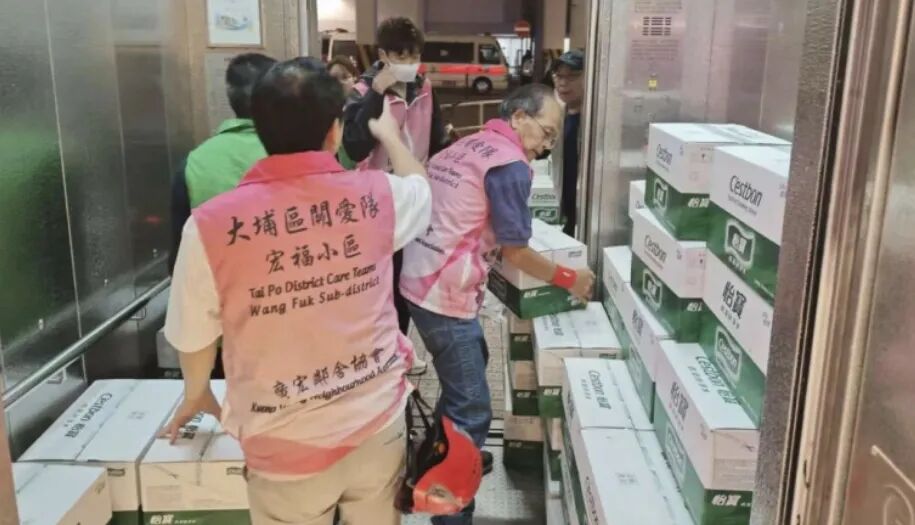
Core Viewpoint - The fire disaster in Hong Kong's Tai Po district has resulted in significant casualties and property damage, prompting a swift response from various companies to provide aid and support for recovery efforts [1]. Company Responses - China Resources Beverage activated its emergency response mechanism, delivering 10,080 bottles of water within two hours to ensure basic drinking water safety for affected residents [1]. - China Resources Vanguard coordinated with local welfare agencies to provide over 5,000 essential supplies, including milk and instant noodles, to support disaster relief efforts [1]. - China Resources Charity Fund donated HKD 20 million for emergency rescue, medical assistance, and emotional support for victims [1]. - Wens Foodstuff Group pledged HKD 40 million in cash and supplies to assist local residents with recovery and rebuilding efforts [1]. - Nongfu Spring delivered drinking water and beverages to shelters and donated HKD 10 million in cash and HKD 5 million in supplies for emergency relief and recovery [5]. - Haitian Flavoring & Food Company donated HKD 10 million for medical aid, emergency housing, and rebuilding efforts [7]. - Heytea contributed HKD 5 million to support disaster relief and subsequent recovery efforts for affected residents [11]. - Cha Baidao initiated a donation of HKD 5 million for medical assistance and rebuilding efforts for the affected population [13]. - Yum China, through its brands, donated RMB 3 million to aid Hong Kong's Tai Po fire relief efforts [15]. - Green Tea Group donated HKD 1 million for emergency assistance to affected residents and will continue to monitor the situation [18]. - Haidilao initiated an emergency response, sending over 1,200 boxes of instant food and donating RMB 4 million for medical aid and essential supplies [22].



华润饮料入选食品饮料行业社会责任发展指数前十榜单 获评“ESG治理先锋”等多项ESG荣誉
Jiang Nan Shi Bao· 2025-11-21 07:00
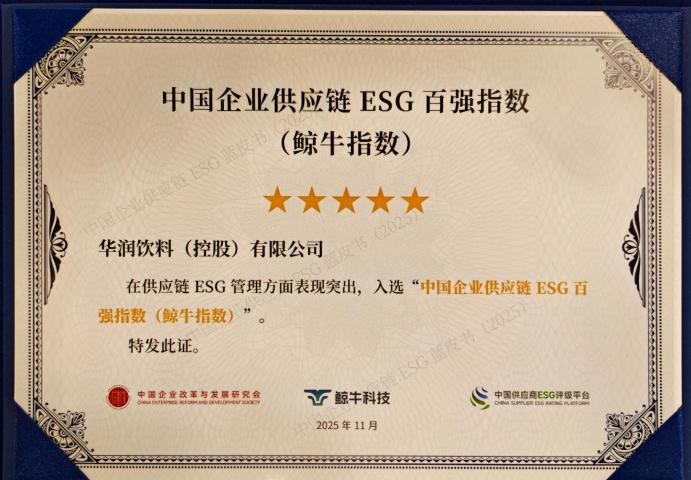
华润饮料入选"中国企业供应链ESG百强指数(鲸牛指数)" 此次发布的《企业社会责任蓝皮书(2025))》对国有企业100强、民营企业100强、外资企业100强以 及14个重点行业、部分优秀企业在社会责任(ESG)管理和信息披露方面的表现进行了整体评价。同时 公布了电力、建筑、食品饮料、互联网等14个重点行业的社会责任发展指数。华润饮料首次入选该指 数,位列食品饮料行业第8名。 为期两天的会议还发布了《中国企业供应链ESG蓝皮书(2025)》暨"中国企业供应链ESG百强指数 (鲸牛指数)"和2025年"ESG鲸牛奖"。华润饮料凭借在供应链ESG管理及ESG治理方面的优秀实践和成 效,成功入选"中国企业供应链ESG百强指数(鲸牛指数)",获评ESG鲸牛奖之"ESG治理先锋"。 未来,华润饮料将继续以ESG为重要抓手,不断深化理念与实践,持续推动公司实现更高质量、更可持 续的发展。 11月20日-21日,由中国企业改革与发展研究会、责任云研究院主办的ESG中国·第八届北京责任展开幕 式暨《企业社会责任蓝皮书(2025)》发布会在北京召开。会上,华润饮料入选"食品饮料行业社会责 任发展指数"前十榜单、中国企业供应链E ...
华润饮料(02460) - 截至二零二五年十月三十一日止月份之股份发行人的证券变动月报表
2025-11-06 09:18
股份發行人及根據《上市規則》第十九B章上市的香港預託證券發行人的證券變動月報表 截至月份: 2025年10月31日 狀態: 新提交 致:香港交易及結算所有限公司 公司名稱: 華潤飲料(控股)有限公司 呈交日期: 2025年11月6日 I. 法定/註冊股本變動 | 1. 股份分類 | 普通股 | 股份類別 | 不適用 | | 於香港聯交所上市 (註1) | | 是 | | | --- | --- | --- | --- | --- | --- | --- | --- | --- | | 證券代號 (如上市) | 02460 | 說明 | | | | | | | | | | 法定/註冊股份數目 | | | 面值 | | 法定/註冊股本 | | | 上月底結存 | | | 100,000,000,000 | USD | | 0.0000005 USD | | 50,000 | | 增加 / 減少 (-) | | | | | | USD | | | | 本月底結存 | | | 100,000,000,000 | USD | | 0.0000005 USD | | 50,000 | 本月底法定/註冊股本總額: USD ...
1个农夫山泉≈23个华润饮料,怡宝水战输在哪?解开市值悬殊之谜
Xin Lang Cai Jing· 2025-10-18 01:08
Core Viewpoint - The market capitalization of Nongfu Spring is significantly higher than that of its competitor, China Resources Beverage, with a ratio of approximately 23 times, raising questions about the reasons behind this disparity in valuation [1] Financial Performance - Nongfu Spring reported a gross profit margin of 60.3% in the first half of the year, while China Resources Beverage's gross profit margin was only 46.7% [1] Revenue Composition - Nongfu Spring has established a "water + beverage" dual-engine strategy, with tea beverage revenue accounting for 39.4% of its total revenue, compared to only 15.4% for China Resources Beverage [1] Supply Chain Model - Nongfu Spring operates a fully self-sufficient production model, whereas over half of China Resources Beverage's products rely on outsourcing, incurring approximately 2 billion yuan in annual "cooperative production partner service fees," which compresses profit margins [1] Future Plans - China Resources Beverage has recognized its supply chain issues and plans to increase its own production capacity to over 60% by 2025, although building this capacity will take time [1]
1个农夫山泉≈23个华润饮料 怡宝“水战”输在哪?解开市值悬殊之谜
Mei Ri Jing Ji Xin Wen· 2025-10-17 13:47
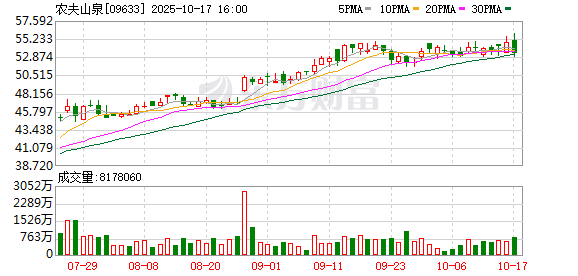
Core Viewpoint - The stark valuation difference between Nongfu Spring and China Resources Beverage, despite similar product pricing, highlights the underlying value dynamics in the bottled water industry, with Nongfu Spring commanding a market capitalization of 599.4 billion HKD compared to China Resources Beverage's 26.4 billion HKD [2][7]. Group 1: Market Performance - As of October 17, 2023, Nongfu Spring's market capitalization increased by 217.6 billion HKD, while China Resources Beverage's decreased by 1.7 billion HKD, illustrating a significant valuation gap where one Nongfu Spring is equivalent to approximately 23 China Resources Beverages [7]. - In the first half of 2025, Nongfu Spring reported revenue of 25.622 billion CNY and a net profit of 7.622 billion CNY, with bottled water revenue accounting for 36.9% of total revenue. In contrast, China Resources Beverage had revenue of 6.206 billion CNY and a net profit of only 0.805 billion CNY, with bottled water revenue making up 84.6% of its total [7][9]. Group 2: Profitability Metrics - Nongfu Spring's gross margin reached 60.3% in the first half of 2025, while China Resources Beverage's was 46.7%, indicating a 13.6 percentage point advantage for Nongfu Spring [9][19]. - The gross margins for Nongfu Spring have consistently been higher than those of China Resources Beverage, with a notable difference of 10.8 percentage points in 2024 [9]. Group 3: Competitive Landscape - The bottled water market has seen intense competition, with Nongfu Spring emerging as a leader, while China Resources Beverage has struggled to maintain its market position, leading to a decline in market share for the latter [9][10]. - Nongfu Spring has diversified its product offerings beyond bottled water, with tea beverages contributing significantly to its revenue, while China Resources Beverage is still in the process of expanding its beverage portfolio [9][10]. Group 4: Supply Chain and Production Models - Nongfu Spring operates a fully self-sufficient production model, controlling its supply chain from water source to bottling, which enhances its cost efficiency and profitability [19][22]. - In contrast, China Resources Beverage relies heavily on a contract manufacturing model, which incurs additional costs and risks associated with outsourcing production [19][22][27]. Group 5: Future Strategies - China Resources Beverage is actively working to increase its self-production capacity, aiming for 60% of its bottled water production to come from its own facilities by 2025, as part of its strategic expansion plan [28][29]. - The industry is witnessing a trend towards self-built production facilities, as companies recognize the importance of supply chain control in maintaining competitive advantage [30][31].
1个农夫山泉≈23个华润饮料,怡宝“水战”输在哪?解开市值悬殊之谜
Mei Ri Jing Ji Xin Wen· 2025-10-17 13:36
Group 1 - The article highlights the stark contrast in market valuation between two leading bottled water companies, Nongfu Spring and China Resources Beverage, despite their similar product offerings and pricing [2][3] - Nongfu Spring's market capitalization reached 599.4 billion HKD, while China Resources Beverage's market cap was only 26.4 billion HKD, indicating a significant disparity in investor perception [7] - Over the past three years, Nongfu Spring has maintained a gross margin close to 60%, while China Resources Beverage's gross margin has been around 40%, showcasing the profitability difference between the two companies [7][9] Group 2 - From January to October 2023, Nongfu Spring's market value increased by 217.6 billion HKD, while China Resources Beverage's decreased by 1.7 billion HKD, further emphasizing the valuation gap [7] - In the first half of 2025, Nongfu Spring reported revenue of 25.622 billion CNY and a net profit of 7.622 billion CNY, with bottled water revenue accounting for 36.9% of total revenue [7] - In contrast, China Resources Beverage's revenue was 6.206 billion CNY, with a net profit of only 0.805 billion CNY, and bottled water revenue making up 84.6% of its total revenue [7] Group 3 - The article discusses the competitive landscape in the bottled water market, noting that Nongfu Spring has successfully captured market share from China Resources Beverage, which has seen a decline in its market position [9][10] - Nongfu Spring has diversified its product offerings, with tea beverages contributing significantly to its revenue, while China Resources Beverage is still in the process of expanding its beverage portfolio [10][11] - The cost structure of bottled water production is highlighted, with Nongfu Spring benefiting from a fully self-sufficient production model, while China Resources Beverage relies on outsourcing, leading to higher costs and lower margins [15][19] Group 4 - The article emphasizes the importance of supply chain management in the bottled water industry, with companies increasingly focusing on building their own production facilities to reduce costs and improve margins [38] - Nongfu Spring has established multiple production bases and water sources, enhancing its operational efficiency, while China Resources Beverage is working to increase its self-production ratio [22][30] - The competitive advantage in the industry is shifting towards those who can effectively manage their supply chains and production capabilities, indicating a long-term strategic focus for both companies [38][39]