China Life(02628)

Search documents
国都港股操作导航:每日投资策略:港股高开低收,恒指收跌 384 点-20260227
Guodu Securities Hongkong· 2026-02-27 05:52
Group 1: Market Overview - The Hang Seng Index opened high but closed down 384 points, or 1.44%, at 26,381 points, with significant selling pressure observed throughout the day [3][4] - The market saw a total turnover of 25.93 billion HKD, with net outflow from northbound trading amounting to 736.6 million HKD [3] Group 2: Company Performance - NIO's subsidiary GeniTech secured over 2.257 billion RMB in investment from Chinese investors, maintaining a 62.7% controlling stake post-transaction [12] - New World Department Store China reported a 3.93 times increase in interim profit to 15.327 million HKD, despite a 12.44% decrease in revenue to 536 million HKD [13] - Chow Tai Fook Jewelry Group announced a 15.26% increase in interim profit to 1.334 billion HKD, with revenue rising 5.9% to 12.827 billion HKD [14] - Baidu reported a 65.68% decrease in net profit to 1.782 billion RMB for the fourth quarter, with total revenue declining 4.06% to 32.74 billion RMB [15] Group 3: Industry Developments - Hong Kong Exchanges and Clearing is exploring the development of a multi-asset tokenization platform, contingent on technological capabilities and market demand [7] - The People's Bank of China issued a notice to enhance the management of RMB cross-border interbank financing, aiming to improve transparency and stability in offshore RMB liquidity [10] - The Hong Kong government plans to inject 10 billion HKD into the Hong Kong-Shenzhen Innovation and Technology Park and the New Territories Science Park to bolster public-private partnerships [9]



智通港股通资金流向统计(T+2)|2月27日
智通财经网· 2026-02-26 23:38
Core Insights - The article highlights the net inflow and outflow of capital in the Hong Kong stock market, with specific focus on the top companies experiencing significant changes in capital flow [1][2]. Net Inflow Summary - The top three companies with the highest net inflow of capital are: - Southern Hang Seng Technology (03033) with a net inflow of 1.556 billion, representing a 21.87% increase in capital [2]. - Meituan-W (03690) with a net inflow of 448 million, showing a 13.77% increase [2]. - Xiaomi Group-W (01810) with a net inflow of 436 million, reflecting a 10.02% increase [2]. - Other notable companies with significant net inflows include: - UBTECH (09880) with 362 million and a 28.57% increase [2]. - Techtronic Industries (00669) with 276 million and a 30.43% increase [2]. Net Outflow Summary - The top three companies with the highest net outflow of capital are: - Zijin Mining (02899) with a net outflow of -592 million, indicating a -24.54% decrease [2]. - Jiangxi Copper (00358) with a net outflow of -262 million, reflecting a -32.21% decrease [2]. - China Life (02628) with a net outflow of -251 million, showing a -10.30% decrease [2]. - Other companies with significant net outflows include: - Minmetals Resources (01208) with -243 million and a -43.98% decrease [2]. - PetroChina (00857) with -223 million and a -24.59% decrease [2]. Net Inflow Ratio Summary - The companies with the highest net inflow ratios are: - Midea Real Estate (03990) with a net inflow ratio of 434.41% [2]. - MIRXES-B (02629) with a net inflow ratio of 137.09% [2]. - Southern East Selection (03441) with a net inflow ratio of 125.93% [2]. - Additional companies with notable net inflow ratios include: - Maoyan Entertainment (01896) with 108.12% [3]. Net Outflow Ratio Summary - The companies with the highest net outflow ratios are: - CRRC Corporation (01766) with a net outflow ratio of -137.15% [3]. - China Communications Construction (03969) with a net outflow ratio of -131.76% [3]. - Jiuxing Holdings (01836) with a net outflow ratio of -117.95% [3]. - Other companies with significant net outflow ratios include: - Xianjian Technology (01302) with -104.69% [3].



智通港股通活跃成交|2月26日
智通财经网· 2026-02-26 11:01
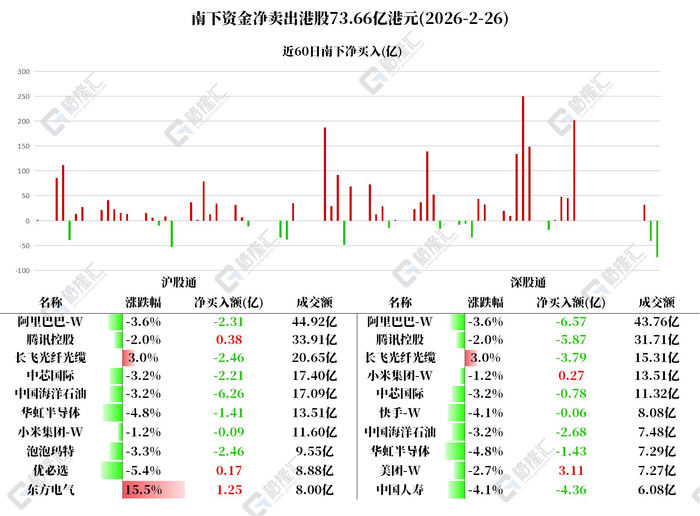
Core Insights - On February 26, 2026, Alibaba-W (09988), Tencent Holdings (00700), and Yangtze Optical Fibre and Cable (06869) were the top three companies by trading volume in the Southbound Stock Connect, with trading amounts of 4.492 billion, 3.391 billion, and 2.065 billion respectively [1] - The same companies also led in trading volume in the Shenzhen-Hong Kong Stock Connect, with trading amounts of 4.376 billion, 3.171 billion, and 1.531 billion respectively [1] Southbound Stock Connect Trading Activity - **Top Active Companies**: - Alibaba-W (09988): Trading amount of 4.492 billion, net buy of -0.231 billion [2] - Tencent Holdings (00700): Trading amount of 3.391 billion, net buy of +37.9726 million [2] - Yangtze Optical Fibre and Cable (06869): Trading amount of 2.065 billion, net buy of -0.246 billion [2] - SMIC (00981): Trading amount of 1.740 billion, net buy of -0.221 billion [2] - CNOOC (00883): Trading amount of 1.709 billion, net buy of -0.626 billion [2] Shenzhen-Hong Kong Stock Connect Trading Activity - **Top Active Companies**: - Alibaba-W (09988): Trading amount of 4.376 billion, net buy of -0.657 billion [2] - Tencent Holdings (00700): Trading amount of 3.171 billion, net buy of -0.587 billion [2] - Yangtze Optical Fibre and Cable (06869): Trading amount of 1.531 billion, net buy of -0.379 billion [2] - Xiaomi Group-W (01810): Trading amount of 1.351 billion, net buy of +27.0028 million [2] - Kuaishou-W (01024): Trading amount of 0.808 billion, net buy of -0.06332 billion [2]

图解丨南下资金连续第2日净卖出港股,抛中海油、阿里




Ge Long Hui A P P· 2026-02-26 10:29
净卖出中国海洋石油8.93亿、阿里巴巴-W 8.88亿、长飞光纤光缆6.24亿、腾讯控股5.48亿、中国人寿 4.36亿、中芯国际2.98亿、华虹半导体2.84亿、泡泡玛特2.45亿。 据统计,南下资金已连续7日净买入美团,共计36.1242亿港元;连续5日净买入小米,共计32.2538亿港 元;连续4日净卖出中海油,共计12.2479亿港元。 格隆汇2月26日|南下资金今日净卖出港股73.66亿港元,为连续第2日净卖出。其中: 净买入美团-W 3.11亿、东方电气1.25亿; ...

港股26日跌1.44% 收报26381.02点
Xin Hua Wang· 2026-02-26 10:08
Market Performance - The Hang Seng Index fell by 384.7 points, a decrease of 1.44%, closing at 26,381.02 points [1] - The H-share Index dropped by 220.46 points, closing at 8,814.29 points, a decline of 2.44% [1] - The Hang Seng Tech Index decreased by 151.17 points, closing at 5,109.33 points, down by 2.87% [1] Blue Chip Stocks - Tencent Holdings decreased by 2.01%, closing at 512 HKD [1] - Hong Kong Exchanges and Clearing rose by 0.78%, closing at 415.4 HKD [1] - China Mobile fell by 0.88%, closing at 78.6 HKD [1] - HSBC Holdings increased by 1.61%, closing at 145 HKD [1] Local Hong Kong Stocks - Cheung Kong Holdings rose by 3.04%, closing at 48.06 HKD [1] - Sun Hung Kai Properties fell by 0.07%, closing at 136.3 HKD [1] - Henderson Land Development decreased by 0.4%, closing at 34.44 HKD [1] Chinese Financial Stocks - Bank of China fell by 0.64%, closing at 4.65 HKD [1] - China Construction Bank decreased by 1.6%, closing at 8 HKD [1] - Industrial and Commercial Bank of China fell by 0.62%, closing at 6.42 HKD [1] - Ping An Insurance dropped by 4.64%, closing at 67.85 HKD [1] - China Life Insurance decreased by 4.1%, closing at 31.38 HKD [1] Oil and Petrochemical Stocks - Sinopec fell by 1.63%, closing at 5.43 HKD [1] - PetroChina decreased by 1.46%, closing at 9.46 HKD [1] - CNOOC dropped by 3.22%, closing at 24.66 HKD [1]



北水动向|北水成交净卖出73.66亿 北水再度抛售芯片股 全天减持中海油(00883)近9亿港元
智通财经网· 2026-02-26 09:59
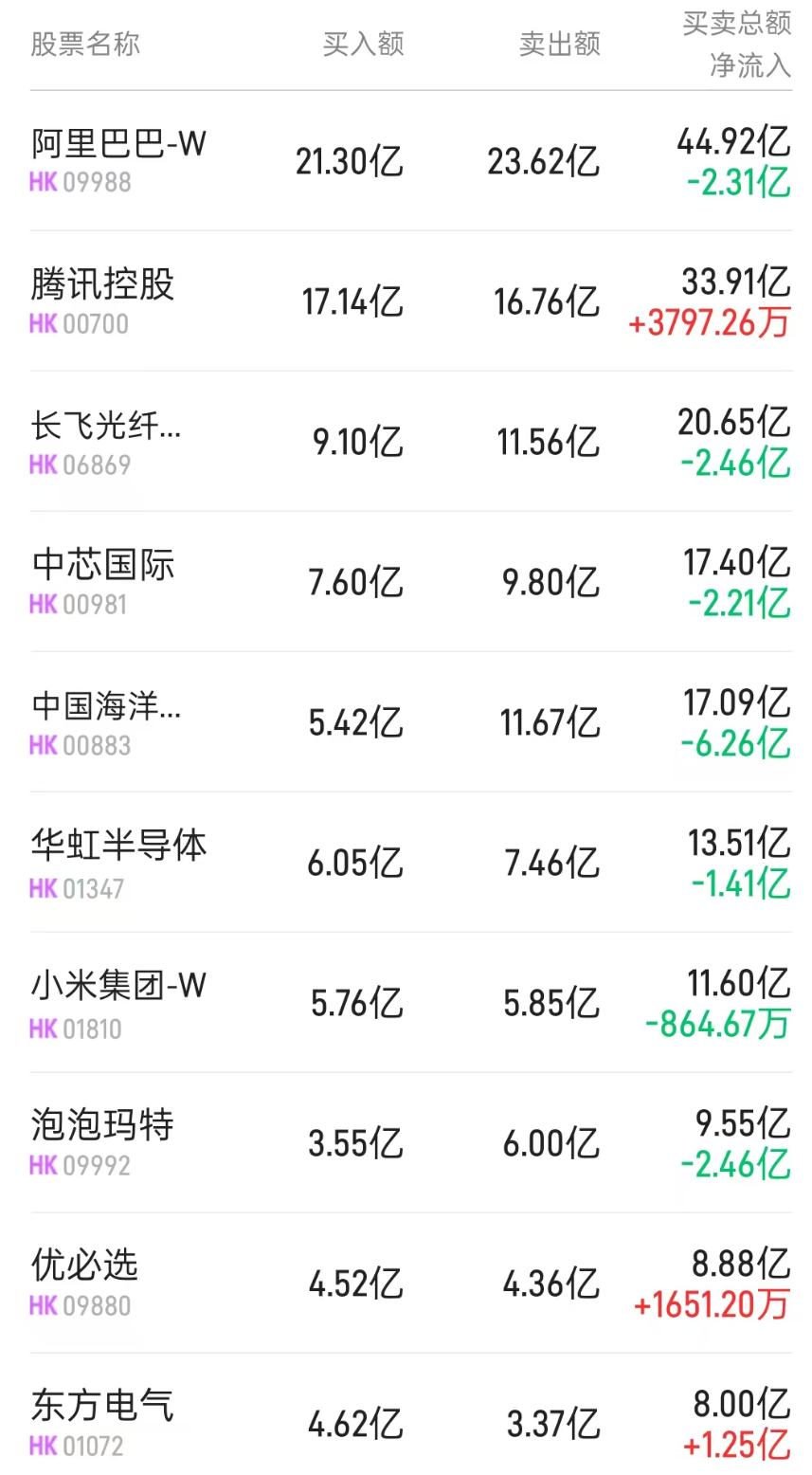
Core Viewpoint - The Hong Kong stock market experienced significant net selling from northbound capital, totaling HKD 73.66 billion, with notable net sell-offs in major stocks like Alibaba and CNOOC [1][2]. Group 1: Northbound Capital Flow - Northbound capital recorded a net sell of HKD 73.66 billion, with HKD 23.11 billion from the Shanghai Stock Connect and HKD 50.55 billion from the Shenzhen Stock Connect [1]. - The stocks with the highest net buying were Meituan (03690), Dongfang Electric (01072), and Xiaomi Group (01810) [1]. - The stocks with the highest net selling included CNOOC (00883), Alibaba (09988), and Changfei Optical Fiber (06869) [1]. Group 2: Individual Stock Performance - Alibaba (09988) had a buy amount of HKD 21.30 billion and a sell amount of HKD 23.62 billion, resulting in a net outflow of HKD 2.31 billion [2]. - CNOOC (00883) faced a net sell of HKD 8.93 billion, influenced by a drop in WTI crude oil prices below USD 65 per barrel and an increase in commercial crude oil inventory [6]. - Xiaomi Group (01810) saw a net buy of HKD 183.5 million, with the CEO emphasizing a focus on core technologies over the next five years [5]. Group 3: Market Reactions and Trends - The semiconductor sector is experiencing a divide due to AI demand, with upstream manufacturers benefiting while downstream PC and mobile manufacturers face cost pressures [5]. - Dongfang Electric (01072) received a net buy of HKD 1.25 billion, linked to the upcoming signing of a power supply commitment by major tech companies [4]. - Meituan (03690) had a net buy of HKD 3.11 billion, indicating strong investor interest [7].

华源晨会精粹20260226-20260226
Hua Yuan Zheng Quan· 2026-02-26 09:55
Group 1: Construction and Building Materials - The report emphasizes the importance of monitoring the resumption of work after the holiday, with expectations for a strong start in Q1 2026, driven by the release of projects and investment growth [2][7] - Historical analysis of previous five-year plans indicates that infrastructure investment typically shows a pattern of "high at the beginning, stable later," with the first half of the "14th Five-Year Plan" demonstrating this clearly [2][7] - In Q4 2025, Honglu Steel Construction achieved a production volume of 1.41 million tons, a year-on-year increase of 11.94%, indicating a significant return on the past three years of investment in automation [8] Group 2: Non-Banking Financial Institutions - China Life Insurance reported a 54.8% year-on-year increase in revenue and a 91.5% increase in net profit for Q3, reaching 298.7 billion yuan and 126.9 billion yuan respectively [12][13] - The company’s new business value (NBV) grew by 41.8% year-on-year, reflecting strong sales performance and improved sales capabilities [14][15] - The total investment return rate increased by 104 basis points to 6.42%, attributed to a rise in equity investments and successful participation in market opportunities [15] Group 3: Hong Kong Stock Exchange - The Hong Kong Stock Exchange reported a 37% year-on-year increase in revenue and a 45% increase in net profit for the first three quarters of 2025, reaching 21.9 billion HKD and 13.4 billion HKD respectively [19][20] - The average daily trading amount (ADT) for stock securities products increased by 150% year-on-year, indicating strong market activity [20] - The exchange continues to implement strategic measures to enhance market vitality, including the introduction of new trading facilities and adjustments to trading fees [21][22] Group 4: Basic Chemicals - Sanyou Chemical is expected to achieve a net profit of approximately 0.91 billion yuan in 2025, a decline of 82% year-on-year due to falling prices of soda ash, caustic soda, and organic silicon [26][27] - The report highlights the potential recovery in the viscose staple fiber industry, with no new capacity added in recent years and a significant increase in profitability expected from price increases [27][28] - The report suggests that the profitability of soda ash and caustic soda may have bottomed out, with market dynamics indicating a potential recovery in the future [29][30] Group 5: Transportation and Logistics - Hongchuan Wisdom is expected to report a net loss of 4.4 to 4.7 billion yuan in 2025, reflecting challenges in the chemical storage business due to decreased demand [31][32] - The chemical industry is showing signs of recovery, with increased production activity and improved demand expected to enhance profitability in the future [33] - The company is positioned as a leader in chemical storage, with ongoing capacity expansion through self-built and acquired facilities [34]


26年险资配置调查结果出炉,增配权益而久期策略不变
GF SECURITIES· 2026-02-26 08:47
Core Insights - The report indicates that insurance assets are expected to steadily increase their allocation to equities in 2026, while maintaining their duration strategy unchanged [6] - The survey conducted by the China Banking and Insurance Asset Management Association reflects the industry's expectations regarding market trends and allocation strategies for 2026 [6] Asset Allocation - In terms of major asset allocation, stocks and securities investment funds are generally favored by insurance institutions for domestic investments in 2026, with some institutions planning to slightly increase their stock investments [6] - The allocation ratios for bank deposits and bonds are expected to remain stable compared to 2025 [6] - Most insurance institutions hold a neutral outlook on the bond market for 2026, with the overall duration strategy expected to remain unchanged [6] - The yield on 10-year government bonds is anticipated to be in the range of 1.8%-1.9%, while 30-year government bonds are expected to yield between 2.2%-2.4% [6] - Over half of the insurance institutions predict that the yield center for high-grade credit bonds will be around 2.0%-2.5%, with credit spreads expected to show a fluctuating trend [6] A-Share Market Outlook - Most insurance institutions maintain an optimistic view of the A-share market for 2026, with plans to slightly increase their allocation to A-shares [6] - The sectors favored include technology, non-ferrous metals, power equipment, computers, communications, pharmaceuticals, and basic chemicals, with a focus on themes such as semiconductors, defense, AI, robotics, and high-dividend stocks [6] Overseas Investment - Hong Kong stocks are the most favored overseas investment option for insurance institutions in 2026, with half of the asset management institutions planning to slightly increase their allocation to Hong Kong stocks [6] - Gold and US stocks are also receiving considerable attention from insurance institutions [6] Company Recommendations - The report suggests that the insurance sector's equity elasticity is expected to continue improving, with a favorable long-term trend for the insurance premium difference [6] - Specific companies recommended for investment include China Ping An (A/H), China Life (A/H), China Taiping (H), New China Life (A/H), China Pacific Insurance (A/H), China People’s Insurance Group (H), and AIA Group (H) [6]




中国人寿(02628):个险销售能力突出,投资表现良好的寿险公司
Hua Yuan Zheng Quan· 2026-02-26 07:52
Investment Rating - The report assigns a "Buy" rating for China Life Insurance, indicating a positive outlook based on strong individual insurance sales capabilities and good investment performance [5]. Core Insights - China Life's Q3 revenue and net profit attributable to shareholders grew by 54.8% and 91.5% year-on-year, reaching CNY 298.7 billion and CNY 126.9 billion, respectively, which boosted the year-to-date revenue and net profit growth rates to 25.9% and 60.5% [5][10]. - The company's net assets attributable to shareholders increased by 22.8% to CNY 625.8 billion by the end of Q3, outperforming peers [8]. - The new business value (NBV) grew by 41.8% year-on-year, and the total investment return rate increased by 104 basis points to 6.42% [5][7]. Financial Performance - For the first three quarters of 2025, total investment income rose by 41% to CNY 368.6 billion, with a total investment return rate of 6.42% [7][10]. - The net profit for Q3 2025 reached CNY 126.9 billion, a significant increase from CNY 66.2 billion in Q3 2024, driven by reduced insurance service costs and strong new policy sales [8][10]. - The company has shown a strong improvement in new policy sales, with a year-on-year growth rate of 52.5% in Q3 2025 [8]. Earnings Forecast and Valuation - The report forecasts China Life's net profit for 2025-2027 to be CNY 153.0 billion, CNY 174.2 billion, and CNY 196.1 billion, with year-on-year growth rates of 43%, 14%, and 13% respectively [10]. - The estimated embedded value per share for 2025-2027 is projected to be CNY 56.0, CNY 61.7, and CNY 67.3, with current price-to-embedded value (P/EV) ratios of 0.55, 0.50, and 0.46 [10].
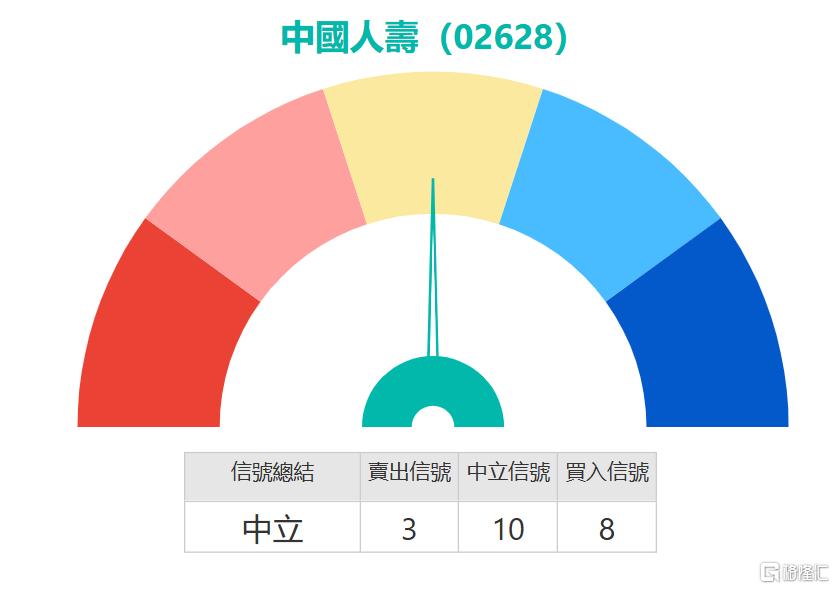
中國人壽超賣區間現買入信號,31.5元支持位成關鍵
Ge Long Hui· 2026-02-26 05:47
Core Viewpoint - The performance of China Life Insurance (02628) has been weak, with the stock price dropping over 3% to a low of 31.42 HKD, indicating a potential for a technical rebound due to oversold conditions [1][3]. Technical Analysis - The stock price has fallen below the 10-day moving average (33.92 HKD) and the 30-day moving average (33.5 HKD), but remains above the 60-day moving average (30.97 HKD) [1]. - The stochastic oscillator indicates that the stock is in the oversold zone, suggesting a buy signal, while the RSI is at 48, indicating a neutral to weak position [1][3]. - Current support levels are at 31.5 HKD (first support) and 30.2 HKD (second support), with resistance levels at 34.3 HKD (first resistance) and 35.4 HKD (second resistance) [1][3]. Product Review - On February 16, China Life recorded a 2.55% increase, while UBS bull certificates (56355) and HSBC bull certificates (67560) achieved a 19% increase. UBS call options (22612) and Bank of China call options (23200) recorded a 12% increase during the same period, outperforming the underlying stock [4]. Investment Products - Notable call options include Bank of China 23200 (exercise price 35.02 HKD, 7.5x leverage) and UBS 22612 (exercise price 35.02 HKD, 7.4x leverage), both targeting the second resistance level [6]. - Put options such as JPMorgan 24962 and Morgan Stanley 25287 (exercise price 28.24 HKD, 6.2x leverage) are suitable for hedging against downside risks below the second support level [6]. - Bull certificates to consider include JPMorgan 56767 (redemption price 26.2 HKD, 4.5x leverage) and Societe Generale 60104 (redemption price 26.8 HKD, 5.2x leverage), which are positioned safely away from the current stock price [6]. - Bear certificates include Societe Generale 59427 (redemption price 38.8 HKD, 5.2x leverage) and UBS 56360 (redemption price 38 HKD, 6.1x leverage), suitable for bearish strategies [6].