BANK COMM(03328)

Search documents
公募权益基金代销百强名单出炉,股票型指数基金成发力重点
Zhong Guo Zheng Quan Bao· 2025-09-14 14:54
Core Insights - The China Securities Investment Fund Industry Association reported significant growth in the public fund sales scale for the first half of the year, with Ant Fund and China Merchants Bank leading the way with increases exceeding 80 billion yuan each [1][6] - The top 100 distribution institutions saw a collective increase in equity fund holdings, particularly in stock index funds, which became a focal point for these institutions [1][7] Group 1: Distribution Institutions Overview - The top 100 distribution institutions include 24 banks, 57 securities firms, 18 third-party distributors, and 1 insurance company, with the number of banks and securities firms increasing by one each since the end of 2024 [2] - The top ten institutions in the distribution rankings remained unchanged from the end of 2024, highlighting a "stronger gets stronger" trend [2] Group 2: Fund Holdings Data - The total equity fund holdings of the top 100 distribution institutions reached 51,374 billion yuan, an increase of 2,856 billion yuan or 5.89% from the end of 2024 [6] - Non-monetary market fund holdings totaled 101,993 billion yuan, growing by 6,626 billion yuan or 6.95% [6] - Stock index fund holdings surged to 19,522 billion yuan, marking a significant increase of 2,483 billion yuan or 14.57% [6] Group 3: Institutional Performance - Ant Fund and China Merchants Bank each saw their equity fund holdings increase by over 80 billion yuan, with non-monetary market fund holdings rising by 1,146 billion yuan and 915 billion yuan, respectively [6][7] - The number of institutions with equity fund holdings exceeding 100 billion yuan rose to 11, while those with non-monetary market fund holdings above 100 billion yuan reached 26, up from 22 at the end of 2024 [6] Group 4: Index Fund Growth - The stock index fund holdings of the top 100 distribution institutions grew by 14.57%, significantly outpacing other fund types [7] - Securities firms maintained a dominant position in the index fund distribution sector, with 57 firms making it into the top 100 equity fund distributors [7] - Commercial banks also increased their focus on index fund distribution, with their stock index fund holdings rising by 38.69% to 2,667 billion yuan [7]





上半年公募代销榜百强出炉!三类产品保有规模环比均上涨
Bei Jing Shang Bao· 2025-09-14 14:16
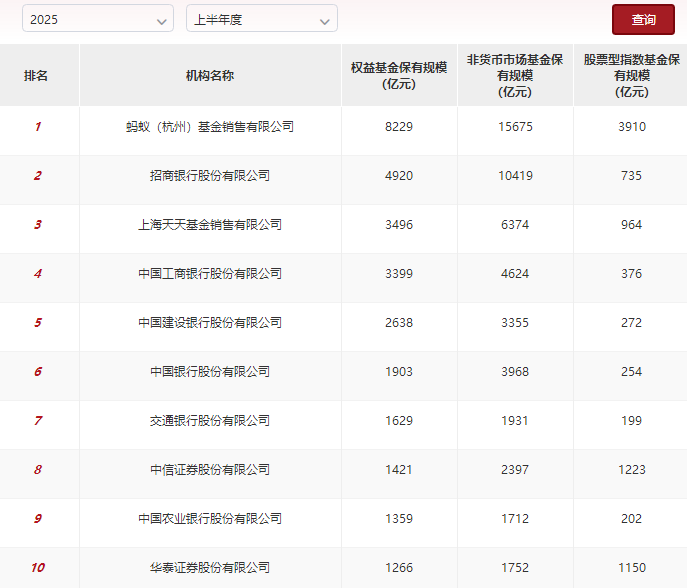
Core Insights - The China Securities Investment Fund Association (CSIA) released the top 100 public fund sales institutions for the first half of 2025, showing growth in the retained scale of equity funds, non-monetary market funds, and stock index funds compared to the end of 2024 [1][3] Fund Sales Rankings - The top three institutions in terms of retained scale for equity funds are Ant Group, China Merchants Bank, and Tian Tian Fund, with retained scales of 822.9 billion, 492 billion, and 349.6 billion respectively [2][7] - The total retained scale for equity funds among the top 100 institutions reached 5,137.4 billion, a 5.89% increase from the end of 2024 [3] - The retained scale for stock index funds reached 1,952.2 billion, reflecting a 14.57% increase [3] Institutional Performance - Among the top 100 institutions, securities firms hold 57 seats, banks have 24, and independent fund sales institutions have 17 [3] - Commercial banks lead in the retained scale of non-monetary market funds, with a share of 43.1%, while securities firms dominate stock index funds with a share of 55.34% [4][5] Market Trends - The growth in stock index fund retained scale is attributed to market volatility and the performance differentiation of individual stocks and actively managed equity funds, leading to increased interest from institutional and individual investors [4] - The future of public fund distribution channels is expected to maintain a diversified trend, with a focus on head institutions, professionalism, and personalization as key factors for investors [8]

每周股票复盘:交通银行(601328)财政部持股增至35.02%成控股股东
Sou Hu Cai Jing· 2025-09-13 17:28
Group 1 - The stock price of Bank of Communications (601328) closed at 7.13 yuan on September 12, 2025, down 1.79% from the previous week's 7.26 yuan [1] - The highest intraday price on September 12 was 7.3 yuan, while the lowest was 7.12 yuan [1] - The current total market capitalization of Bank of Communications is 634.452 billion yuan, ranking 6th among state-owned large banks and 22nd among 5153 A-shares [1] Group 2 - The Ministry of Finance increased its shareholding in Bank of Communications from 23.88% to 35.02%, becoming the controlling shareholder [2][3] - The acquisition complies with the regulations of the "Measures for the Administration of the Acquisition of Listed Companies" and has fulfilled relevant reporting and announcement obligations [2] - The Ministry of Finance has committed not to transfer the acquired shares for five years from the end of the issuance [2][3]

牛市基金代销格局揭晓:增量资金源源不断,前一百名机构资产超10.199万亿(附全部排名)
华尔街见闻· 2025-09-13 10:08
Core Viewpoint - The influx of incremental funds into the mutual fund industry is significant, with the top 100 fund sales institutions' non-monetary fund holdings reaching 10.199 trillion yuan by mid-2025, reflecting a monthly investment of approximately 110 billion yuan [2][3]. Group 1: Equity Funds - Equity funds are highlighted as one of the most popular mutual fund types in 2025, with Ant Fund leading in equity fund holdings at 822.9 billion yuan, followed by China Merchants Bank at 492 billion yuan [3][4]. - The competition among major sales institutions is intense, with institutions like Ant Fund, China Merchants Bank, and others vying for market share in equity fund sales [2][3]. Group 2: Non-Monetary Market Funds - Ant Fund also leads in non-monetary market fund holdings with 15.675 trillion yuan, while China Merchants Bank follows with 10.419 trillion yuan, indicating the presence of two major distribution channels [5][6]. - The growth in non-monetary market fund holdings is notable, with Ant Fund and China Merchants Bank showing significant increases of 1.146 trillion yuan and 915 billion yuan, respectively [10]. Group 3: Stock Index Funds - In the stock index fund category, Ant Fund again leads with 391 billion yuan, followed by CITIC Securities and Huatai Securities, both exceeding 100 billion yuan in holdings [7][8]. - The competitive landscape for stock index funds is expanding, with several institutions entering the top ranks, indicating a robust market for index fund investments [7][8]. Group 4: Growth Trends - The growth momentum of institutions like Ant Fund and China Merchants Bank is noteworthy, with both showing substantial increases in equity fund holdings, indicating a strong competitive environment [10][11]. - Other institutions such as China Life and CITIC Securities also reported significant growth in their equity fund holdings, exceeding 10 billion yuan [10].


上半年大卖!银行系股票指数基金保有量规模激增37.9%,上半年销售机构公募基金保有量50强榜单来了
Zhong Guo Ji Jin Bao· 2025-09-13 05:51
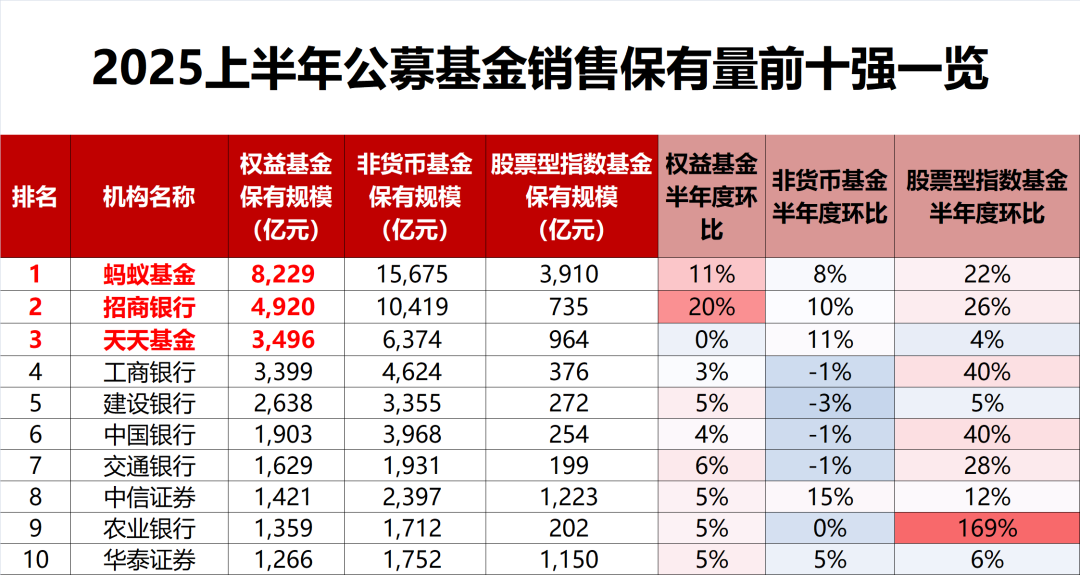
Core Insights - The public fund market in China has experienced significant changes in the first half of 2025, with a notable increase in the scale of bank-affiliated stock index funds, which surged by 37.9% [1][8] - Ant Fund and China Merchants Bank have shown strong growth in equity fund holdings, maintaining their positions at the top of the market [1][5] Group 1: Fund Performance and Rankings - Ant Fund's equity fund holdings reached 822.9 billion yuan, with a year-on-year increase of 11%, remaining the market leader [2] - China Merchants Bank's equity fund holdings amounted to 492 billion yuan, with a remarkable growth rate of 20%, leading among bank-affiliated institutions [3] - The top ten public fund sales institutions maintained their rankings, with other notable players including Tian Tian Fund and Industrial and Commercial Bank of China, both exceeding 330 billion yuan in equity fund holdings [3][4] Group 2: Growth Trends in Different Fund Types - The overall scale of equity funds in the market has shown a robust growth trend, with brokerages experiencing the highest increase in equity fund holdings at 6.6% [6] - The acceptance of stock index funds among bank clients has significantly increased, with a 37.9% rise in holdings, indicating a shift towards passive investment strategies [7][8] - Agricultural Bank of China reported a staggering 169% increase in stock index fund holdings, while Industrial and Commercial Bank and China Bank also saw substantial growth of 40% [5][8] Group 3: Market Dynamics and Investor Behavior - The rapid recovery of the stock market has led to increased investment in equity funds, particularly among brokerage clients who typically have a higher risk appetite [6] - The growth in stock index funds is attributed to the effective marketing strategies of banks and the significant profit potential observed in the stock market, attracting more conservative investors [8]
交通银行跌2.06%,成交额19.11亿元,主力资金净流出6.04亿元
Xin Lang Zheng Quan· 2025-09-12 08:53
Core Viewpoint - The stock price of Bank of Communications has experienced a decline, with significant net outflows of capital and a decrease in shareholder numbers, indicating potential challenges in market performance and investor sentiment [1][2]. Group 1: Stock Performance - As of September 12, the stock price of Bank of Communications fell by 2.06% to 7.12 CNY per share, with a trading volume of 19.11 billion CNY and a turnover rate of 1.02%, resulting in a total market capitalization of 629.15 billion CNY [1]. - Year-to-date, the stock has decreased by 3.67%, with a 1.93% drop over the last five trading days, a 4.17% decline over the last 20 days, and a 10.33% decrease over the last 60 days [1]. Group 2: Financial Performance - For the first half of 2025, Bank of Communications reported an operating income of 0.00 CNY, while the net profit attributable to shareholders was 46.016 billion CNY, reflecting a year-on-year growth of 1.61% [2]. Group 3: Shareholder and Dividend Information - As of June 30, 2025, the number of shareholders decreased to 263,100, a reduction of 5.37%, with an average of 111,247 circulating shares per shareholder, down by 29.42% [2]. - Since its A-share listing, Bank of Communications has distributed a total of 337.762 billion CNY in dividends, with 83.694 billion CNY distributed over the past three years [3]. - Among the top ten circulating shareholders, Hong Kong Central Clearing Limited holds 1.396 billion shares, an increase of 10.8003 million shares from the previous period, while Huaxia SSE 50 ETF is a new entrant holding 523 million shares [3].
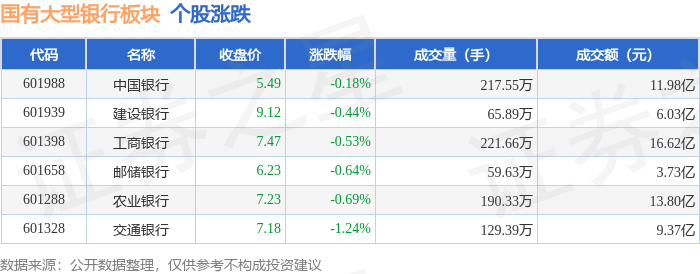
国有大型银行板块9月12日跌0.5%,交通银行领跌,主力资金净流出10.08亿元
Zheng Xing Xing Ye Ri Bao· 2025-09-12 08:38
Group 1 - The state-owned large bank sector experienced a decline of 0.5% on September 12, with Bank of Communications leading the drop [1] - The Shanghai Composite Index closed at 3883.69, up 0.22%, while the Shenzhen Component Index closed at 12996.38, up 0.13% [1] - The trading volume and turnover for major state-owned banks showed significant activity, with Industrial and Commercial Bank of China having a turnover of 1.662 billion and China Bank at 1.198 billion [1] Group 2 - The net outflow of main funds from the state-owned large bank sector was 1.008 billion, while retail investors saw a net inflow of 559 million [1] - The detailed fund flow for individual banks indicated that China Bank had a main net inflow of 60.06 million, while Agricultural Bank experienced a significant outflow of 1.80 billion [2] - Bank of Communications had the highest net outflow among the major banks, totaling 777 million, while retail investors contributed a net inflow of 327 million [2]


从星期五的“红”,到美好生活的“虹”:交通银行信用卡以金融三棱镜折射幸福光谱
2 1 Shi Ji Jing Ji Bao Dao· 2025-09-12 01:37
Core Insights - The government aims to boost consumption and improve investment efficiency as part of a strategy to expand domestic demand, with financial institutions playing a key role in supporting consumer spending [1] Group 1: Financial Support for Consumption - The People's Bank of China and six other departments issued guidelines to enhance financial services for consumption, outlining 19 key measures to promote consumer spending [1] - Financial resources are being directed towards key consumption sectors such as wholesale retail, accommodation, dining, entertainment, tourism, education, and resident services, signaling a recovery in the consumer market [1] Group 2: "Most Red Friday" Campaign - The "Most Red Friday" campaign by Bank of Communications has been a staple for 15 years, evolving into a weekend consumption ritual for customers [2] - The campaign has been upgraded to include a "Direct Access" feature, allowing cardholders to participate in exclusive offers and promotions, enhancing the consumer experience [2][3] - The campaign effectively covers high-frequency consumption scenarios like takeout, commuting, dining, and fuel, making discounts easily accessible [3] Group 3: "Hundred Counties, Ten Thousand Stores" Initiative - The initiative targets third and fourth-tier cities, aiming to stimulate consumption by providing financial services and reducing costs for residents [5] - The program has reached nearly 100 counties, focusing on small, frequent purchases and creating a year-round discount ecosystem across various sectors [5] - The initiative also supports trade-in and discount activities for high-quality products, aligning with national consumption promotion policies [5][6] Group 4: Localized Marketing Strategies - The Sichuan branch of Bank of Communications has established dedicated points in key commercial areas, offering new customers immediate benefits and discounts [6] - The bank's efforts in local markets aim to enhance consumer experience and provide tangible financial benefits, reinforcing its role in promoting consumption and improving living standards [6]
从星期五的“红”,到美好生活的“虹”:交通银行信用卡以金融三棱镜折射幸福光谱
21世纪经济报道· 2025-09-12 01:30
Core Viewpoint - The article emphasizes the strategic deployment of expanding domestic demand through consumption and investment efficiency, highlighting the role of financial institutions in promoting consumption and improving residents' quality of life [1][8]. Financial Support for Consumption - In June, the People's Bank of China and six departments issued guidelines to support consumption, outlining 19 key measures to enhance financial services in the consumption sector [1]. - The focus is on key consumption areas such as wholesale retail, accommodation, dining, entertainment, tourism, education, and resident services, signaling a recovery in the consumption market [1]. "Most Red Friday" Campaign - The "Most Red Friday" campaign by Bank of Communications has been a marketing initiative for 15 years, becoming a ritual for weekend consumption since 2010 [2]. - The campaign has been upgraded to include a "Direct Access" feature, allowing cardholders to participate in exclusive offers and promotions every Friday, enhancing customer engagement [2][3]. "Hundred Counties, Ten Thousand Stores" Initiative - The "Hundred Counties, Ten Thousand Stores" initiative targets third and fourth-tier cities, aiming to stimulate local consumption and reduce costs for residents [5]. - The initiative has reached nearly 100 counties, providing a one-stop discount chain for essential consumer goods and services, thus supporting the upgrade of consumption in these areas [5][6]. Digital Ecosystem and Differentiated Services - The Bank of Communications is leveraging digital ecosystems and differentiated services to enhance its role in promoting consumption and expanding the financial ecosystem [8]. - The bank's efforts are aimed at activating consumer credit and meeting diverse customer needs across different regions [8].

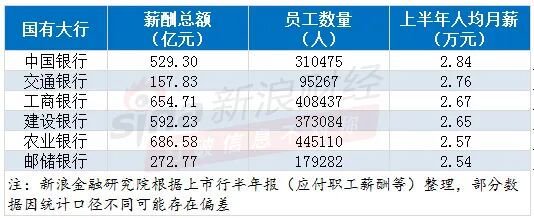
银行上半年“人均月薪”有多少?招商、兴业超4.5万元
Xin Lang Cai Jing· 2025-09-12 00:55
Summary of Key Points Core Viewpoint - The recent strong performance of the banking sector has drawn attention to the salary situation of listed banks, with significant differences in average salaries between state-owned banks and joint-stock banks [1][2]. Salary Data of State-Owned Banks - In the first half of 2025, the average monthly salary for employees in state-owned banks ranged from 25,400 to 28,400 yuan, with Agricultural Bank having the lowest average salary at 25,100 yuan [4][11]. - The total salary expenditure for Agricultural Bank reached 68.658 billion yuan, ranking first among state-owned banks, followed by Industrial and Commercial Bank with 65.471 billion yuan [3][4]. Salary Data of Joint-Stock Banks - Joint-stock banks generally offered higher average monthly salaries, with China Merchants Bank and Industrial Bank exceeding 45,000 yuan, specifically 50,100 yuan and 45,700 yuan respectively [6][7]. - The total salary expenditure for China Merchants Bank was 35.484 billion yuan, leading among joint-stock banks, while several others exceeded 10 billion yuan [5][6]. Employee Count Changes - Many banks reported a reduction in employee numbers, with Agricultural Bank reducing its workforce by 9,606 employees, and Industrial and Commercial Bank by over 6,700 employees [8][12]. - In contrast, China Merchants Bank was the only bank to increase its employee count, adding 867 employees [10][12]. Performance-Based Salary Mechanisms - Several banks have implemented performance-based salary mechanisms, including deferred payment and clawback provisions for high-risk positions, as seen in the practices of Minsheng Bank and Shanghai Pudong Development Bank [13][14]. - The trend of extending salary resources to county-level operations is noted, with Agricultural Bank allocating over 50% of its recruitment plan to county areas to support rural revitalization efforts [16].