
Chongqing Rural Commercial Bank(03618)

Search documents
港股内银股普遍上扬 农业银行盘中涨近3%
Mei Ri Jing Ji Xin Wen· 2025-11-12 03:19
Group 1 - Hong Kong banking stocks generally rose, with notable increases in share prices [1] - Chongqing Rural Commercial Bank (03618.HK) increased by 3.21%, reaching HKD 6.76 [1] - Agricultural Bank of China (01288.HK) rose by 2.73%, trading at HKD 6.4 [1] - Chongqing Bank (01963.HK) saw a rise of 1.98%, priced at HKD 8.75 [1] - Industrial and Commercial Bank of China (01398.HK) gained 1.69%, with shares at HKD 6.6 [1]



港股异动 | 内银股普遍上扬 农业银行(01288)盘中涨近3%创新高 机构看好银行板块配置价值
智通财经网· 2025-11-12 03:08
Core Viewpoint - The banking sector in China is experiencing a positive trend, with several banks' stock prices rising following the release of the People's Bank of China's monetary policy report, indicating a favorable outlook for the industry [1] Group 1: Stock Performance - Chongqing Rural Commercial Bank (03618) increased by 3.21%, reaching HKD 6.76 [1] - Agricultural Bank of China (01288) rose by 2.73%, priced at HKD 6.4 [1] - Chongqing Bank (01963) saw a 1.98% increase, trading at HKD 8.75 [1] - Industrial and Commercial Bank of China (01398) gained 1.69%, with a price of HKD 6.6 [1] Group 2: Monetary Policy Insights - The People's Bank of China released the "2025 Q3 China Monetary Policy Implementation Report" on November 11, focusing on several key areas [1] - Key points include a narrowing decline in new loan interest rates, a reasonable growth in loans, and the importance of maintaining a reasonable interest margin [1] - There is an emphasis on increasing support for consumption and reforming small and medium-sized institutions [1] Group 3: Investment Outlook - Huatai Securities highlights a positive policy outlook, suggesting structural opportunities in the banking sector [1] - Yinhe Securities reports that insurance funds continue to increase their holdings in the banking sector, indicating ongoing investment value [1] - The "14th Five-Year Plan" is expected to drive transformation in the banking industry, with improved net profits in Q3 and sustained dividend strength [1]
监管研究系列三:存款非银化对流动性风险指标的影响与测算
KAIYUAN SECURITIES· 2025-11-11 14:12
Investment Rating - The investment rating for the banking industry is "Positive" (maintained) [1] Core Insights - The report highlights the ongoing trend of deposit non-bankization, which is leading to a marginal decline in liquidity indicators for banks. This trend is particularly pronounced among large banks, with a notable increase in the proportion of non-bank deposits [12][16] - The liquidity coverage ratio (LCR) and net stable funding ratio (NSFR) are critical indicators for banks, and the report provides quantitative assessments of how deposit non-bankization impacts these metrics. The effects are manageable for major banks, with LCR expected to remain above 120% even under significant conversion scenarios [4][34] Summary by Sections 1. Deposit Non-Bankization and Liquidity Management - The process of deposit non-bankization is intensifying the demand for banks to manage liquidity indicators more stringently. Since May 2025, the growth rate of personal fixed deposits has been declining, with large banks showing a decrease in monthly increments compared to the same period in 2024 [12][16] - The report quantifies the impact of deposit non-bankization on LCR and NSFR for major banks, indicating that even with a 70% conversion of personal fixed deposits to non-bank deposits, the LCR for most large banks is expected to remain above 120% [4][34] 2. Liquidity Indicator Management - The management of LCR focuses on maintaining liquidity asset reserves, while NSFR management emphasizes improving the liability structure. Issuing long-term interbank certificates of deposit is highlighted as an effective method to optimize these liquidity indicators [5][22] - The report details how the conversion of personal fixed deposits to non-bank deposits affects various liquidity risk indicators, with specific calculations provided for LCR and NSFR under different conversion scenarios [18][23] 3. Investment Recommendations - The report suggests a tiered investment strategy: - Core holdings should focus on large state-owned banks, benefiting from institutions like Agricultural Bank of China and Industrial and Commercial Bank of China - Core allocations should include leading comprehensive banks such as China Merchants Bank and CITIC Bank - Flexible allocations can target regional banks like Jiangsu Bank and Chongqing Bank [6][19]

真金白银!年内十余家上市银行获股东、高管增持,银行“防御性板块”角色要变?
Xin Lang Cai Jing· 2025-11-10 12:57
Core Viewpoint - The recent surge in share buybacks by various banks, including Qilu Bank and Qingdao Bank, reflects strong confidence in the long-term value of the banking sector, with over 10 listed banks participating in this trend [1][9][10]. Group 1: Share Buybacks - Qilu Bank announced that its directors, supervisors, and senior executives have collectively increased their holdings by 3.15 million yuan, accounting for 90% of the planned buyback amount [1]. - Qingdao Bank's major shareholder, Qingdao Guoxin Financial Holdings, increased its holdings by 957 million yuan, raising its stake to 15.42%, making it the largest shareholder [4]. - Xiamen Bank's executives completed a buyback plan exceeding the minimum target, with total contributions reaching 1.6857 million yuan [5]. Group 2: Market Sentiment - The buyback activities are interpreted as a recognition of the banking sector's valuation, with a current price-to-book ratio of 0.72 and a dividend yield of 3.99%, attracting long-term capital [10][12]. - The banking sector has seen a collective "self-purchase" phenomenon, with various regional banks also engaging in buybacks, indicating a broader trend across the industry [6][8]. Group 3: Performance and Valuation - Despite a slight decline in revenue and net profit for 42 A-share listed banks in the first quarter, 24 banks reported growth in both metrics, particularly city and rural commercial banks [10]. - The net interest margin for listed banks is projected to stabilize, with a simulated net interest margin of 1.32% for Q3 2025, marking a potential turning point after four years of decline [12]. - Long-term capital, particularly from insurance funds, has been increasingly allocated to the banking sector, with a reported increase of 8.36 billion shares held by insurance funds in Q3 2025 [12][13].






从增量扩面到提质控险 银行业普惠金融迈向差异化精准服务
2 1 Shi Ji Jing Ji Bao Dao· 2025-11-10 04:21
Core Insights - The report highlights the significant growth and development of inclusive finance in China, particularly focusing on small and micro enterprises and rural areas, with a notable annual growth rate of over 20% in inclusive micro loans during the 14th Five-Year Plan period [1][2] - As of June 2025, the balance of inclusive micro loans reached 36 trillion yuan, which is 2.3 times that of the end of the 13th Five-Year Plan, with a decrease in interest rates by 2 percentage points [1][2] - The average interest rate for newly issued inclusive micro loans was 3.48% as of June 2025, reflecting a decrease of 66 basis points year-on-year [1][2] Group 1: Digital Empowerment - Digital technology has been a key driver for the development of inclusive finance, with banks utilizing big data and AI to enhance loan approval efficiency and reduce financing costs [2][7] - The market structure among banks is changing, with large commercial banks holding a 45.11% share of inclusive micro loans, while rural financial institutions have seen a decline in their market share [2][3] - The average growth rate of inclusive micro loans has been slowing down, with a decrease from 30.9% in 2020 to 12.3% by mid-2025 [2][3] Group 2: Performance of Listed Banks - Among listed banks, Agricultural Bank of China, Industrial and Commercial Bank of China, and Beijing Bank reported the highest growth rates in inclusive micro loans at 18.50%, 17.30%, and 17.27% respectively [3][4] - In contrast, some banks, including Shanghai Bank and Zhengzhou Bank, experienced negative growth rates of -3.97% and -2.06% [3][4] - The performance of different banks varies significantly, with state-owned banks generally showing stronger growth in inclusive micro loans compared to smaller banks [3][4] Group 3: Interest Rates and Risk Management - The interest rates for newly issued inclusive micro loans have decreased across various banks, with the highest rate at 4.20% and the lowest at 2.94% [7][8] - The gap in interest rates between large and small banks is narrowing, with some large banks' rates aligning closely with those of smaller banks [8][9] - The report emphasizes the importance of risk management in the inclusive finance sector, with several banks focusing on improving asset quality and managing non-performing loans [9][10]


渝农商行增长下的隐忧:零售贷款不良率升至2.04% 高层或代职超期
Xi Niu Cai Jing· 2025-11-07 10:29
Core Viewpoint - The financial performance of Chongqing Rural Commercial Bank (渝农商行) in the first three quarters of 2025 shows a slowdown in revenue growth compared to local peers, raising concerns about its operational outlook [2][3]. Financial Performance - For Q3 2025, the bank reported operating revenue of 6,916.9 million, a year-on-year increase of 1.10%, and a net profit of 3,078.0 million, up 2.14% [1]. - For the first nine months of 2025, the bank's operating revenue reached 21,657.7 million, reflecting a growth of 0.67%, while the net profit was 10,924.9 million, an increase of 3.32% [1][3]. - Interest income for the first three quarters was 347.59 million, down 6.49%, while interest expenses decreased by 9.62% to 169.09 million, indicating that the growth in net interest income was primarily due to reduced expenses rather than increased income [4]. Comparison with Peers - Chongqing Rural Commercial Bank's revenue growth is significantly lagging behind that of Chongqing Bank, which reported a 10.40% increase in revenue for the same period [2]. Investment Income - The bank's investment income for the first three quarters was 34.95 million, down 8.10%, contrasting with many domestic banks that reported substantial increases in investment income [4]. Cost Management - The bank's business and management expenses for the first three quarters were 58.92 million, a year-on-year increase of 1.84%, with other general and administrative expenses decreasing by 9.17% [5]. Asset Quality - As of Q3 2025, the bank's non-performing loan balance was 87.11 million, an increase of 2.92 million from the end of 2024, with a non-performing loan ratio of 1.12%, down 0.06 percentage points [5]. Leadership Changes - The bank has experienced significant leadership changes, with the chairman resigning in October 2024 and the current acting chairman, Sui Jun, serving in this role for nearly a year, which exceeds the regulatory limit of six months for acting positions [7][9][10].


齐鲁银行渝农商行苏州银行今日涨幅垫底银行板块
Zhong Guo Jing Ji Wang· 2025-11-07 09:11
Core Points - The banking sector experienced a slight decline today, with a drop of 0.16% overall [1] - Qilu Bank's stock closed at 6.08 yuan, reflecting a decrease of 1.46% [1] - Chongqing Rural Commercial Bank's stock closed at 7.01 yuan, down by 1.13% [1] - Suzhou Bank's stock closed at 8.33 yuan, with a decline of 1.07% [1] - Qilu Bank, Chongqing Rural Commercial Bank, and Suzhou Bank were the largest decliners in the banking sector today [1]
农商行板块11月7日跌0.26%,渝农商行领跌,主力资金净流出5990.34万元
Zheng Xing Xing Ye Ri Bao· 2025-11-07 08:37
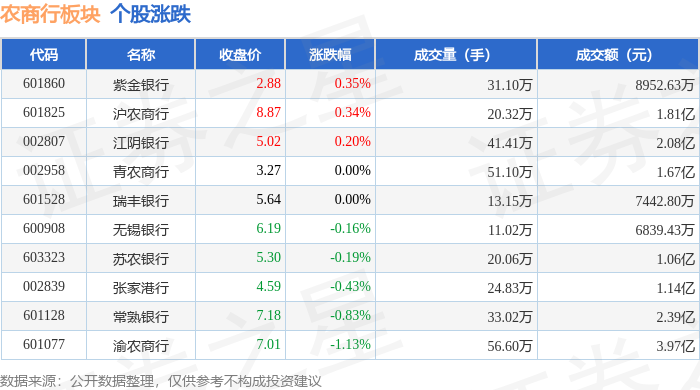
Market Overview - On November 7, the rural commercial bank sector declined by 0.26% compared to the previous trading day, with Yunnan Rural Commercial Bank leading the decline [1] - The Shanghai Composite Index closed at 3997.56, down 0.25%, while the Shenzhen Component Index closed at 13404.06, down 0.36% [1] Individual Stock Performance - Key stock performances in the rural commercial bank sector included: - Zijin Bank: Closed at 2.88, up 0.35% with a trading volume of 311,000 shares and a turnover of 89.53 million yuan - Hu'nong Commercial Bank: Closed at 8.87, up 0.34% with a trading volume of 203,200 shares and a turnover of 181 million yuan - Jiangyin Bank: Closed at 5.02, up 0.20% with a trading volume of 414,100 shares and a turnover of 208 million yuan - Yunnan Rural Commercial Bank: Closed at 7.01, down 1.13% with a trading volume of 566,000 shares and a turnover of 397 million yuan [1] Fund Flow Analysis - The rural commercial bank sector experienced a net outflow of 59.90 million yuan from institutional investors and 50.91 million yuan from retail investors, while there was a net inflow of 111 million yuan from individual investors [1] - Detailed fund flow for individual stocks showed: - Yunnan Rural Commercial Bank: Net outflow of 10.11 million yuan from retail investors, with a net inflow of 777.16 thousand yuan from institutional investors [2] - Jiangyin Bank: Net outflow of 560.48 thousand yuan from institutional investors, with a net inflow of 1.24 million yuan from retail investors [2] - Common trends included significant net outflows from institutional and speculative investors across various banks, while retail investors showed some net inflows in several cases [2]


资产规模前十大农商行部分财务指标
Zhong Guo Zheng Quan Bao· 2025-11-06 20:15
Core Insights - The article provides a summary of the financial performance of various rural commercial banks in China as of September 2025, highlighting their total assets, operating income, and net profit compared to the previous year [1] Group 1: Financial Performance - Chongqing Rural Commercial Bank reported total assets of 165.58 billion yuan, a 9.30% increase, with operating income of 21.66 billion yuan and net profit of 10.93 billion yuan [1] - Shanghai Rural Commercial Bank's total assets reached 155.81 billion yuan, up 4.72%, with operating income of 19.83 billion yuan and net profit of 10.81 billion yuan [1] - Guangzhou Rural Commercial Bank had total assets of 141.64 billion yuan, a 3.96% increase, with operating income of 1.10 billion yuan and net profit of 0.17 billion yuan [1] - Beijing Rural Commercial Bank's total assets were 134.98 billion yuan, a 7.29% increase, with operating income of 1.19 billion yuan and net profit of 0.60 billion yuan [1] - Chengdu Rural Commercial Bank reported total assets of 99.92 billion yuan, a 9.29% increase, with operating income of 1.42 billion yuan and net profit of 0.60 billion yuan [1] - Shenzhen Rural Commercial Bank experienced a decline in total assets to 80.25 billion yuan, down 1.78%, with no disclosed operating income or net profit [1] - Dongguan Rural Commercial Bank's total assets were 76.97 billion yuan, a 3.19% increase, with operating income of 0.86 billion yuan and net profit of 0.37 billion yuan [1] - Jiangsu Jiangnan Rural Commercial Bank reported total assets of 61.65 billion yuan, a 5.39% increase, with operating income of 0.99 billion yuan and net profit of 0.40 billion yuan [1] - Hangzhou United Bank had total assets of 59.61 billion yuan, a 6.39% increase, with operating income of 0.87 billion yuan and net profit of 0.42 billion yuan [1] - Qingdao Rural Commercial Bank reported total assets of 50.99 billion yuan, a 3.01% increase, with operating income of 0.80 billion yuan and net profit of 0.33 billion yuan [1]

跻身农商行“资产万亿俱乐部” 谁是下一位
Zhong Guo Zheng Quan Bao· 2025-11-06 20:15
Core Insights - The strategic layout and scale leap of rural commercial banks reflect regional development dynamics and industrial vitality, with a clear picture of "leading benchmarks at the top and new competition at the bottom" emerging from the 2025 Q3 disclosure reports [1] Group 1: Asset Scale and Performance - The top four rural commercial banks, namely Chongqing, Shanghai, Guangzhou, and Beijing, have solidified their positions in the "trillion-yuan club" with a combined asset scale exceeding 5.9 trillion yuan, accounting for nearly 60% of the top ten rural commercial banks [2][3] - Chongqing Rural Commercial Bank leads with an asset scale of 1.66 trillion yuan, a 9.30% increase from the previous year, while Shanghai follows with 1.56 trillion yuan, growing at 4.72% [2] - In terms of net profit, Chongqing and Shanghai Rural Commercial Banks reported 109.25 billion yuan and 108.14 billion yuan respectively, establishing a "double hundred billion benchmark" for profitability [2] Group 2: Second Tier Banks and Growth Potential - The second tier of rural commercial banks is characterized by a clear stratified sprint, with Chengdu Rural Commercial Bank nearing the trillion-yuan mark at 999.19 billion yuan, showing significant growth [3] - Shenzhen and Dongguan Rural Commercial Banks, with asset scales of 802.47 billion yuan and 769.70 billion yuan respectively, represent the "core layer" of the second tier, although Shenzhen experienced a slight decline in assets [3] - Jiangsu Jiangnan Rural Commercial Bank, Hangzhou United Bank, and Qingdao Rural Commercial Bank form an asset range of 500 billion to 700 billion yuan, with growth rates of 5.39%, 6.39%, and 3.01% respectively [3] Group 3: Competitive Advantages and Market Positioning - The leading rural commercial banks benefit from unique regional economic advantages and have established distinct competitive edges through localized operations and differentiated strategies [4][5] - Chongqing Rural Commercial Bank has a significant channel advantage with a vast network of branches and service points, particularly in rural areas, supporting its leading position in the county-level deposit and loan market [4] - Shanghai Rural Commercial Bank has leveraged its long-standing presence and local economic strengths to expand its business, particularly in small and micro enterprises and agricultural finance [5] Group 4: Industry Challenges and Future Outlook - The rural commercial banking sector plays an increasingly vital role in supporting the real economy, yet faces challenges such as resource disparities with larger banks and a competitive market environment [6] - The need for differentiated development paths is crucial for rural commercial banks to achieve high-quality growth amidst narrowing interest margins and intensified competition [6][7] - Chengdu Rural Commercial Bank is identified as a strong candidate to join the trillion-yuan club, with its asset scale just shy of the mark and promising growth in revenue and net profit [7]