
Chongqing Rural Commercial Bank(03618)

Search documents
研报掘金丨浙商证券:维持渝农商行“买入”评级,目标价7.81元
Ge Long Hui A P P· 2025-08-27 07:12
浙商证券研报指出,25H1渝农商行营收、归母净利润同比分别+0.5%、+4.6%,盈利保持平稳增长,增 速环比25Q1分别下降0.9pc、1.6pc。驱动因素来看,息差拖累小幅改善,但非息负增压力加大。(1) 息差:渝农商行25H1日均息差较25Q1微降1bp至1.60%,息差韧性较强,对盈利的拖累改善;(2)非 息:渝农商行25H1非息同比下降16.6%,降幅较25Q1扩大4.4pc。其中,中收同比下降13.2%,降幅较 25Q1扩大10pc,判断主要压力点来自银行卡中收,25H1银行卡中收同比下降56%;其他非息同比下降 17.7%,降幅较25Q1扩大1pc。展望未来,考虑到渝农商行拨备水平充足,扩表动能较强,2025年全年 利润增速有望保持平稳。维持目标价7.81元/股,对应2025年PB估值0.66x,现价空间21%,维持"买 入"评级。 ...

渝农商行(601077):信贷同比多增,息差保持平稳
GOLDEN SUN SECURITIES· 2025-08-27 06:48
Investment Rating - The report maintains a "Buy" rating for Chongqing Rural Commercial Bank (601077.SH) [5] Core Views - Chongqing Rural Commercial Bank's performance shows a steady increase in credit and stable net interest margins, benefiting from the construction of the Chengdu-Chongqing economic circle [10] - The bank's net profit for the first half of 2025 is projected to grow at rates of 5.81%, 6.15%, and 6.67% for the years 2025, 2026, and 2027 respectively [10] Financial Performance - In the first half of 2025, the bank achieved revenue of 14.7 billion yuan, a year-on-year increase of 0.46%, and a net profit of 7.7 billion yuan, up 4.63% year-on-year [1] - The net interest margin for the first half of 2025 was 1.60%, showing a slight decrease of 1 basis point compared to the previous year [2] - Interest income increased by 5.98% year-on-year, while non-interest income decreased by 13.2% [2][3] Asset and Liability Management - As of the end of Q2 2025, total assets reached 1.63 trillion yuan, with total loans amounting to 765.2 billion yuan, both reflecting year-on-year growth of 8.0% and 8.3% respectively [4] - The bank's total deposits reached 1.03 trillion yuan, a year-on-year increase of 8.9% [4] Asset Quality - The non-performing loan (NPL) ratio stood at 1.17% at the end of Q2 2025, remaining stable compared to the previous quarter [9] - The bank's provision coverage ratio was 355.6%, indicating a slight decrease of 8 percentage points from the previous quarter [9] Investment Outlook - The bank is expected to benefit from increased credit support and stable net interest margins, maintaining a favorable position among high-dividend banks [10]
渝农商行(601077):信贷扩张提速,负债成本改善
HTSC· 2025-08-27 05:28
Investment Rating - The report maintains a "Buy" rating for the company with a target price of HKD 7.19 and RMB 7.46 [7][5]. Core Insights - The company has shown a steady increase in total assets, loans, and deposits, with year-on-year growth rates of 8.0%, 8.3%, and 8.9% respectively [2]. - Credit growth has accelerated, primarily supported by infrastructure projects, with new loans in Q2 reaching RMB 20.8 billion, significantly higher than the RMB 9.9 billion in the same period last year [2]. - The net interest margin has narrowed slightly to 1.60%, benefiting from improved funding costs, while non-interest income has seen a decline [3]. - The overall asset quality remains stable, with a non-performing loan (NPL) ratio of 1.17% and a provision coverage ratio of 356% [4]. Summary by Sections Financial Performance - For H1 2025, the company reported a net profit of RMB 12.2 billion, a 4.6% increase year-on-year, and a revenue growth of 0.5% [1]. - The annualized ROA and ROE for H1 2025 were 1.01% and 11.94%, reflecting slight declines from the previous year [1]. Credit and Asset Quality - The company has maintained a stable NPL ratio of 1.17% with a slight decrease in the provision coverage ratio [4]. - The retail loan segment has shown some volatility, with an increase in the NPL ratio to 2.04% [4]. Valuation and Forecast - The forecast for net profit from 2025 to 2027 is RMB 12.2 billion, RMB 13.0 billion, and RMB 14.0 billion, with expected growth rates of 6.2%, 6.6%, and 7.5% respectively [5]. - The report suggests a price-to-book (PB) ratio of 0.63 for A shares and 0.56 for H shares in 2025 [5].
渝农商行2025年上半年归母净利润同比增长4.63%至76.99亿元
Zhong Guo Jin Rong Xin Xi Wang· 2025-08-27 03:08
Core Viewpoint - The report from Chongqing Rural Commercial Bank (渝农商行) indicates stable growth in revenue and profit for the first half of 2025, with a focus on supporting rural and local economies through various financial services [1][2]. Financial Performance - The bank achieved an operating income of 14.741 billion yuan, a year-on-year increase of 0.46% [1] - The net profit attributable to shareholders reached 7.699 billion yuan, up 4.63% year-on-year [1] - Total assets amounted to 1.630131 trillion yuan, an increase of 115.189 billion yuan from the end of the previous year [1] - Deposit balance was 1.025195 trillion yuan, growing by 83.249 billion yuan [1] - Loan balance stood at 765.245 billion yuan, an increase of 50.972 billion yuan [1] Asset Quality - The non-performing loan ratio was 1.17%, a decrease of 0.01 percentage points from the end of the previous year [1] - Capital adequacy ratio was 15.11% [1] - Provision coverage ratio was 355.58% [1] - Cost-to-income ratio was 26.58% [1] - Interest rate on deposits was 1.52%, down 27 basis points year-on-year [1] Support for Local Economy - The bank maintains a leading position in rural finance, with nearly 70% of personnel and 80% of outlets focused on rural areas [1] - Agricultural loan balance reached 260.218 billion yuan, with a leading market share in Chongqing [1] Strategic Initiatives - The bank is accelerating urban development efforts, with technology loan balance at 99.805 billion yuan [2] - Green credit balance reached 80.219 billion yuan, increasing by 12.466 billion yuan [2] - Inclusive finance initiatives include credit card and consumer loan balances exceeding 150 billion yuan, leading in Chongqing [2] - Loans for small and micro enterprises totaled 147.846 billion yuan [2] - The bank supports key projects in the Chengdu-Chongqing economic circle with a loan balance of 26.822 billion yuan [2] - Financing for the New International Land-Sea Trade Corridor reached 58.725 billion yuan, an increase of 4.169 billion yuan [2]
重庆农商行获批向浙江网商银行提供12亿元综合授信及3000万元服务费
Jing Ji Guan Cha Wang· 2025-08-27 02:44
Core Viewpoint - Chongqing Rural Commercial Bank Co., Ltd. has approved a related party transaction with Zhejiang Wangshang Bank, involving a total amount not exceeding 1.23 billion yuan [1] Group 1: Transaction Details - The bank agreed to provide a comprehensive credit limit of 1.2 billion yuan to Zhejiang Wangshang Bank for a term of one year [1] - Additionally, the bank will pay up to 30 million yuan in loan service fees, bringing the total related party transaction amount to not exceed 1.23 billion yuan [1] - The transaction has been reviewed and approved by the bank's independent directors and the related party transaction control committee, thus not requiring shareholder meeting approval [1] Group 2: Governance and Compliance - The transaction is classified as a related party transaction due to Mr. Peng Yulong, a director of Chongqing Rural Commercial Bank, also serving as a director at Zhejiang Wangshang Bank [1] - The announcement emphasizes that the pricing of the transaction adheres to market principles and is not more favorable than similar transactions with non-related parties [1] - It is stated that the transaction will not have a significant impact on the bank's normal operations and financial status [1]

重庆农商行2025年中报:资产总额突破1.63万亿元,净利润78.47亿元同比增长3.79%
Jing Ji Guan Cha Wang· 2025-08-27 02:34
Group 1 - The core viewpoint of the article highlights the financial performance of Chongqing Rural Commercial Bank for the first half of 2025, showcasing steady growth in key metrics [1] - The total assets of the bank reached 1,630.131 billion yuan, an increase of 115.189 billion yuan compared to the end of the previous year [1] - The net profit for the bank was 7.847 billion yuan, reflecting a year-on-year growth of 3.79% [1] Group 2 - The bank's deposit balance stood at 1,025.195 billion yuan, up by 83.249 billion yuan from the end of the previous year [1] - The loan balance was 765.245 billion yuan, which increased by 50.972 billion yuan compared to the previous year-end [1] - The non-performing loan ratio improved to 1.17%, a decrease of 0.01 percentage points from the end of the previous year [1] Group 3 - The bank demonstrated strong risk compensation capabilities with a capital adequacy ratio of 15.11% and a provision coverage ratio of 355.58% [1] - The cost-to-income ratio improved to 26.58%, indicating enhanced operational efficiency [1] - The interest rate on deposits decreased by 27 basis points to 1.52% year-on-year, reflecting effective cost control measures [1]
渝农商行(601077):利润稳健增长
ZHESHANG SECURITIES· 2025-08-27 01:14
Investment Rating - The investment rating for the company is "Buy" and is maintained [5] Core Views - The company has shown steady profit growth with a year-on-year increase in revenue and net profit of 0.5% and 4.6% respectively for the first half of 2025, although the growth rates have slightly decreased compared to the first quarter [2][5] - The net interest margin remains resilient, with a slight decrease to 1.60% in the first half of 2025, indicating improved profitability despite challenges in non-interest income [2][3] - The non-interest income has faced significant pressure, declining by 16.6% year-on-year, primarily due to a substantial drop in card-related income [2] Summary by Sections Financial Performance - For the first half of 2025, the company reported a revenue of 28,741 million and a net profit attributable to the parent company of 12,114 million, with respective year-on-year growth rates of 0.5% and 4.6% [6] - The non-performing loan ratio remained stable at 1.17% as of the end of Q2 2025, while the provision coverage ratio decreased by 8 percentage points to 356% [4][6] Profitability and Margins - The average net interest margin for the first half of 2025 was 1.60%, slightly down from the previous quarter, with the asset yield decreasing to 3.05% [3] - The cost of liabilities improved, with a decrease in the cost of time deposits contributing to a better margin [3] Asset Quality - The non-performing loan ratio for retail operating loans increased to 2.46% by the end of the first half of 2025, indicating a need for close monitoring of this segment [4] - The company’s TTM non-performing loan generation rate was 0.86%, showing a slight increase in pressure [4] Earnings Forecast and Valuation - The company is expected to achieve a net profit growth of 5.2%, 5.5%, and 6.3% for the years 2025 to 2027, with a target price of 7.81 CNY per share, reflecting a potential upside of 21% [5]
渝农商行:上半年实现归属于本行股东的净利润76.99亿元,同比增长4.63%
Cai Jing Wang· 2025-08-27 01:01
Core Insights - The core viewpoint of the article is the financial performance of Chongqing Rural Commercial Bank in the first half of 2025, highlighting growth in revenue and net profit along with improvements in asset quality and capital adequacy [1] Financial Performance - In the first half of 2025, the bank achieved an operating income of 14.741 billion yuan, and a net profit of 7.847 billion yuan, representing year-on-year growth of 0.46% and 3.79% respectively [1] - The net profit attributable to shareholders was 7.699 billion yuan, an increase of 341 million yuan, with a growth rate of 4.63% [1] Asset and Deposit Growth - As of the end of the first half, the total assets of the bank reached 1.63 trillion yuan, an increase of 115.189 billion yuan compared to the end of the previous year [1] - The deposit balance stood at 1.03 trillion yuan, reflecting a growth of 83.249 billion yuan from the end of the previous year [1] - The loan balance was 765.245 billion yuan, which increased by 50.972 billion yuan compared to the end of the previous year [1] Loan Quality and Capital Adequacy - The bank's non-performing loan ratio was 1.17%, a decrease of 0.01 percentage points from the end of the previous year, indicating improved loan quality [1] - The capital adequacy ratio was reported at 15.11%, and the provision coverage ratio was 355.58%, demonstrating strong risk absorption capacity [1] Cost Management - The cost-to-income ratio was 26.58%, while the deposit interest rate was 1.52%, which decreased by 27 basis points year-on-year, indicating effective cost control measures [1]
重庆农商行上半年实现归母净利76.99亿元 不良贷款率微降
Bei Jing Shang Bao· 2025-08-26 14:56
Group 1: Financial Performance - As of the end of the reporting period, the total assets of Chongqing Rural Commercial Bank reached 1,630.131 billion yuan, an increase of 115.189 billion yuan compared to the end of the previous year [1] - The bank's operating income for the first half of 2025 was 14.741 billion yuan, an increase of 0.068 billion yuan, representing a growth rate of 0.46% year-on-year [3] - The net profit for the first half of 2025 was 7.847 billion yuan, an increase of 0.286 billion yuan, with a growth rate of 3.79% year-on-year [3] Group 2: Asset Quality and Capital Adequacy - The non-performing loan ratio stood at 1.17%, a decrease of 0.01 percentage points from the end of the previous year, indicating improved asset quality [1] - The capital adequacy ratio was reported at 15.11%, and the provision coverage ratio was 355.58%, demonstrating strong risk compensation capabilities [1] - The cost-to-income ratio was 26.58%, and the interest rate on deposits was 1.52%, which decreased by 27 basis points year-on-year [1] Group 3: Deposits and Loans - The deposit balance reached 1,025.195 billion yuan, an increase of 83.249 billion yuan compared to the end of the previous year [1] - The loan balance was 765.245 billion yuan, reflecting an increase of 50.972 billion yuan from the previous year [1]

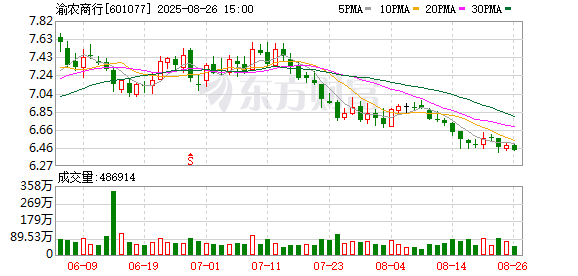
渝农商行:8月26日召开董事会会议
Mei Ri Jing Ji Xin Wen· 2025-08-26 14:55
每经头条(nbdtoutiao)——能给主人"打电话"的宠物智能手机也来了!宠物产业3000亿元市场大爆 发,行业上市公司"涨"声一片 每经AI快讯,渝农商行(SH 601077,收盘价:6.44元)8月26日晚间发布公告称,公司第五届第六十次 董事会会议于2025年8月26日在本行总行401会议室以现场结合通讯方式召开。会议审议了《关于审议重 庆农村商业银行股份有限公司2025年半年度报告及其摘要、业绩公告的议案》等文件。 2025年1至6月份,渝农商行的营业收入构成为:利息收入占比105.29%,债务工具投资占比51.72%,非 利息收入占比6.43%。 截至发稿,渝农商行市值为731亿元。 (记者 王晓波) ...