Chongqing Rural Commercial Bank(03618)

Search documents
债券增值税新规对上市银行影响:营收静态影响0.4%
ZHONGTAI SECURITIES· 2025-08-03 12:20
Investment Rating - The industry investment rating is "Overweight (Maintain)" [2] Core Insights - The new bond value-added tax regulation is expected to have a static impact of approximately 0.4% on annual revenue and 0.95% on profit for listed banks [6][14] - The report emphasizes the importance of banks enhancing their trading capabilities in the medium to long term due to the new tax implications [6][11] - The investment recommendation focuses on the stability and sustainability of the banking sector, highlighting two main stock selection strategies: regional banks with strong certainty and large banks with high dividend yields [6][18] Summary by Sections Background - The report discusses the need to adjust fund allocation, optimize the bond market pricing mechanism, and deepen fiscal and tax system reforms [10][11] Impact on Bank Behavior - In the short term, banks can mitigate the impact of increased tax costs through the realization of floating profits in OCI accounts, while in the long term, there will be a greater emphasis on improving trading capabilities [11][12] Impact on Bank Performance - The static assessment indicates that the increase in tax costs will affect annual revenue by about 0.4%, with a projected increase in tax costs of approximately 232 billion yuan for the next year [14][15] - The cumulative tax cost increase over five years is estimated to be around 1,439 billion yuan, representing about 2.7% of the projected revenue for 2025 [14][15] Investment Recommendations - The report continues to recommend focusing on bank sector stocks, particularly emphasizing regional banks with strong advantages and large banks known for their high dividends [18][19]



银行业周报(20250728-20250803):债券增值税新规推出,高股息红利资产优势凸显-20250803
Huachuang Securities· 2025-08-03 05:44
Investment Rating - The report maintains a "Recommended" investment rating for the banking sector, expecting the industry index to outperform the benchmark index by over 5% in the next 3-6 months [24]. Core Insights - The introduction of new VAT regulations on bond interest income is expected to favor older bonds, as they remain exempt from VAT, thus enhancing their attractiveness and potentially driving up their prices [2][3]. - The banking sector's dividend yield is projected to be around 3.8% in 2025, significantly higher than the 10-year government bond yield of approximately 1.7%, highlighting the advantages of high-dividend assets in a declining interest rate environment [3][8]. - The report emphasizes the importance of strategic allocation within the banking sector, particularly focusing on state-owned banks and select regional banks with strong asset quality and dividend policies [8]. Summary by Sections Market Overview - The report notes a decline in major indices, with the Shanghai Composite Index down by 0.94% and the ChiNext Index down by 0.74% during the week of July 28 to August 3, 2025 [7]. - The average daily trading volume in the A-share market was 11,292.71 billion yuan, reflecting a decrease of 7.96% compared to the previous week [7]. Bond Market Impact - The new VAT regulations apply only to newly issued government bonds, local bonds, and financial bonds, while existing bonds continue to enjoy tax exemptions, making them more favorable for banks [2]. - The proportion of government and policy financial bonds held by major banks exceeds 70%, indicating a strong focus on these assets [2]. Investment Recommendations - The report suggests a diversified investment strategy focusing on high-dividend banks, particularly large state-owned banks and stable joint-stock banks like China Merchants Bank and CITIC Bank [8]. - It also highlights the potential for improved return on equity (ROE) in undervalued joint-stock banks, recommending attention to banks like Shanghai Pudong Development Bank [8]. Company Earnings Forecasts - The report provides earnings per share (EPS) and price-to-earnings (PE) ratios for key banks, with recommendations for several banks based on their projected performance [9]. - For instance, China Merchants Bank is expected to have an EPS of 5.86 yuan in 2025 with a PE ratio of 7.58, indicating a strong investment case [9].



银行行业点评报告:企业短贷高增与票据利率的窄幅波动
KAIYUAN SECURITIES· 2025-08-01 11:43
Investment Rating - The industry investment rating is "Positive" (maintained) [2] Core Insights - Since 2025, banks have shown a new characteristic of using short-term loans to replace bills for credit expansion, with significant seasonal growth in short-term loans [4][14] - The volatility of bill rates has decreased, and there is a notable inversion between short and long-term rates [24][34] - Investment recommendations focus on state-owned banks with controllable retail risks, joint-stock banks with high safety margins, and city and rural commercial banks with strong profit growth potential [7][36] Summary by Sections 1. New Characteristics of Credit Expansion - In 2025, banks have not prominently used bills to boost loans, but short-term loans have seen significant growth, with new additions of 1.44 trillion and 1.16 trillion yuan in March and June, respectively, exceeding historical averages [14][18] - Bill financing saw a notable contraction in June, with a decrease of 4.109 trillion yuan, significantly higher than the three-year average [14][18] 2. Decreased Volatility of Bill Rates - In the first half of 2025, the 6M national stock bill discount rate fluctuated between 0.98% and 1.60%, showing reduced volatility compared to 170 basis points in 2023 and 105 basis points in 2024 [24][29] - The weakening of the credit attribute of bills is attributed to banks preferring short-term loans for credit scale, leading to a lack of significant fluctuations in bill rates [24][29] 3. Investment Recommendations - Recommended stocks include state-owned banks with controllable retail risks, such as China Construction Bank and Agricultural Bank of China [36] - Joint-stock banks with high safety margins and signs of clearing existing risks, such as CITIC Bank and China Merchants Bank, are also recommended [36] - City and rural commercial banks with growth potential and strong provisioning capabilities, including Jiangsu Bank and Hangzhou Bank, are highlighted [36]


渝农商行(601077) - 渝农商行H股公告
2025-08-01 09:30
FF301 | 2. 股份分類 | 普通股 | 股份類別 | A | | 於香港聯交所上市 (註1) | | 否 | | | --- | --- | --- | --- | --- | --- | --- | --- | --- | | 證券代號 (如上市) | 601077 | 說明 | | | | | | | | | | 法定/註冊股份數目 | | | 面值 | | 法定/註冊股本 | | | 上月底結存 | | | 8,843,663,959 | RMB | | 1 RMB | | 8,843,663,959 | | 增加 / 減少 (-) | | | | | | RMB | | | | 本月底結存 | | | 8,843,663,959 | RMB | | 1 RMB | | 8,843,663,959 | 致:香港交易及結算所有限公司 公司名稱: 重慶農村商業銀行股份有限公司 呈交日期: 2025年8月1日 I. 法定/註冊股本變動 股份發行人及根據《上市規則》第十九B章上市的香港預託證券發行人的證券變動月報表 截至月份: 2025年7月31日 狀態: 新提交 | 1. 股份分類 | 普通股 | 股 ...
重庆农村商业银行(03618) - 截至2025年7月31日止月份之股份发行人的证券变动月报表
2025-08-01 08:45
FF301 股份發行人及根據《上市規則》第十九B章上市的香港預託證券發行人的證券變動月報表 截至月份: 2025年7月31日 狀態: 新提交 致:香港交易及結算所有限公司 公司名稱: 重慶農村商業銀行股份有限公司 呈交日期: 2025年8月1日 I. 法定/註冊股本變動 | 1. 股份分類 | 普通股 | 股份類別 | H | | | 於香港聯交所上市 (註1) | | 是 | | | --- | --- | --- | --- | --- | --- | --- | --- | --- | --- | | 證券代號 (如上市) | 03618 | 說明 | | | | | | | | | | | 法定/註冊股份數目 | | | 面值 | | | 法定/註冊股本 | | | 上月底結存 | | | 2,513,336,041 | RMB | | 1 | RMB | | 2,513,336,041 | | 增加 / 減少 (-) | | | | | | | RMB | | | | 本月底結存 | | | 2,513,336,041 | RMB | | 1 | RMB | | 2,513,336,041 | | ...
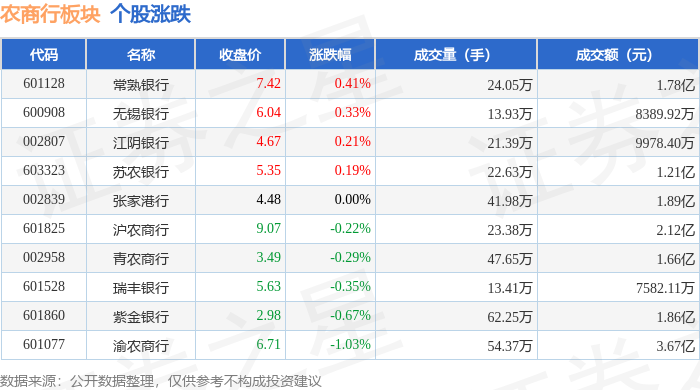
农商行板块8月1日跌0.31%,渝农商行领跌,主力资金净流入2151.16万元
Zheng Xing Xing Ye Ri Bao· 2025-08-01 08:42
| 代码 | 名称 | 主力净流入(元) | 主力净占比 游资净流入(元) | | 游资净占比 散户净流入(元) | | 散户净占比 | | --- | --- | --- | --- | --- | --- | --- | --- | | 600908 | 无锡银行 | 1350.54万 | 16.10% | -1062.60万 | -12.67% | -287.94万 | -3.43% | | 601860 | 紫金银行 | 1115.48万 | 6.01% | 377.82万 | 2.04% | -1493.30万 | -8.04% | | 601128 | 常熟银行 | 789.98万 | 4.44% | -371.05万 | -2.08% | -418.92万 | -2.35% | | 002958 青农商行 | | 718.15万 | 4.32% | -87.24万 | -0.52% | -630.91万 | -3.80% | | 002807 | 江阴银行 | 472.97万 | 4.74% | -663.01万 | -6.64% | 190.03万 | 1.90% | | 601528 瑞丰银 ...




智通港股通资金流向统计(T+2)|8月1日
智通财经网· 2025-07-31 23:32
Key Points - The top three companies with net inflows from southbound funds are Xiaomi Group-W (01810) with 1.665 billion, Tencent Holdings (00700) with 830 million, and Alibaba-W (09988) with 747 million [1] - The companies with the highest net outflows are Pop Mart (09992) with -354 million, China Life (02628) with -351 million, and Kingsoft Cloud (03896) with -300 million [1] - In terms of net inflow ratio, Qin Port Co. (03369) leads with 78.68%, followed by Reshaping Energy (02570) with 76.94%, and Cang Port Railway (02169) with 65.01% [1] - The companies with the highest net outflow ratios include Chongqing Rural Commercial Bank (03618) at -61.37%, Bank of China Aviation Leasing (02588) at -53.31%, and Swire Properties (01972) at -45.99% [1] Net Inflow Rankings - Xiaomi Group-W (01810) had a net inflow of 1.665 billion, representing a 12.37% increase [2] - Tencent Holdings (00700) saw a net inflow of 830 million, with an 8.94% increase [2] - Alibaba-W (09988) recorded a net inflow of 747 million, reflecting a 10.60% increase [2] - The highest net inflow was observed in CSPC Pharmaceutical Group (01093) with 654 million and a 21.81% increase [2] Net Outflow Rankings - Pop Mart (09992) experienced a net outflow of -354 million, with a -10.47% decrease [2] - China Life (02628) had a net outflow of -351 million, reflecting a -11.90% decrease [2] - Kingsoft Cloud (03896) recorded a net outflow of -300 million, with a -24.18% decrease [2] - Meituan-W (03690) also saw a significant outflow of -291 million, representing a -5.32% decrease [2] Net Inflow Ratio Rankings - Qin Port Co. (03369) leads with a net inflow ratio of 78.68% and a net inflow of 340,000 [3] - Reshaping Energy (02570) follows with a net inflow ratio of 76.94% and a net inflow of 10.53 million [3] - Cang Port Railway (02169) has a net inflow ratio of 65.01% with a net inflow of 4.3967 million [3] - Other notable companies include Meizhong Jiahe (02453) with a 61.71% net inflow ratio [3] Net Outflow Ratio Rankings - Chongqing Rural Commercial Bank (03618) has the highest net outflow ratio at -61.37% with a net outflow of -1.04 billion [3] - Bank of China Aviation Leasing (02588) follows with a net outflow ratio of -53.31% and a net outflow of -15.3728 million [3] - Swire Properties (01972) has a net outflow ratio of -45.99% with a net outflow of -29.4662 million [3]


泉果基金调研渝农商行,围绕“五篇大文章”做实金融服务
Xin Lang Cai Jing· 2025-07-30 05:41
Core Viewpoint - The article discusses the recent research conducted by QuanGuo Fund on the listed company YuNong Commercial Bank, highlighting the fund's performance and the bank's competitive advantages in the retail banking sector. Group 1: Fund Performance - QuanGuo Fund was established on February 8, 2022, and currently manages assets totaling 16.396 billion yuan across six funds with five fund managers [1] - The best-performing fund in the past year is QuanGuo XuYuan Three-Year Holding Mixed A (016709), which recorded a return of 31.73% [1][2] - As of July 25, 2025, the top six non-monetary funds' performance over the past year includes returns of 31.73% for fund 016709 and 31.21% for fund 016710 [2] Group 2: Competitive Advantages of YuNong Commercial Bank - The bank's core competitive advantage lies in its extensive service network, providing "zero-distance" financial services, ensuring coverage in all districts and counties [1] - The bank focuses on rural finance, maintaining a strong presence in county and rural areas, with a network that ensures service availability at the grassroots level [1] - The bank adopts a customer-centric service philosophy, continuously optimizing its product system and enhancing customer experience through digital transformation and professional service teams [1] Group 3: Risk Management and Revenue Stability - As of the end of 2024, the bank reported a 0% non-performing loan ratio in the real estate sector, indicating manageable overall risk [3] - The bank aims to optimize its credit structure and enhance risk management through digital transformation and data integration, focusing on pre-loan investigations and post-loan warnings [3] - The bank plans to balance non-interest income and interest income stability by diversifying non-interest income sources and expanding investment trading opportunities [3][4]
A股银行股出现反弹,邮储银行涨逾2%,青农商行涨近2%,兰州银行、渝农商行等涨逾1%。
news flash· 2025-07-30 02:00
A股银行股出现反弹,邮储银行涨逾2%,青农商行涨近2%,兰州银行、渝农商行等涨逾1%。 ...


智通港股通资金流向统计(T+2)|7月30日
智通财经网· 2025-07-29 23:31
Key Points - The top three stocks with net inflow of southbound funds are BYD Company (01211) with 14.916 billion, Yinhua Fund (02800) with 7.287 billion, and Hang Seng China Enterprises (02828) with 2.288 billion [1][2] - The top three stocks with net outflow of southbound funds are Kuaishou-W (01024) with -0.667 billion, China Mobile (00941) with -0.519 billion, and WuXi Biologics (02269) with -0.322 billion [1][2] - In terms of net inflow ratio, BYD Company (01211) leads with 439.44%, followed by Bank of China Aviation Leasing (02588) with 61.50%, and Shenzhen Expressway Company (00548) with 58.69% [1][2] - The top three stocks with the highest net outflow ratio are Chongqing Rural Commercial Bank (03618) at -59.13%, Swire Properties (01972) at -49.77%, and Standard Chartered Group (02888) at -46.27% [1][2] Net Inflow Rankings - The top ten stocks by net inflow include: - BYD Company (01211): 14.916 billion, 439.44%, closing price 129.600 (-1.89%) [2] - Yinhua Fund (02800): 7.287 billion, 32.42%, closing price 25.880 (-1.07%) [2] - Hang Seng China Enterprises (02828): 2.288 billion, 13.81%, closing price 93.620 (-1.10%) [2] Net Outflow Rankings - The top ten stocks by net outflow include: - Kuaishou-W (01024): -0.667 billion, -13.47%, closing price 72.500 (-4.86%) [2] - China Mobile (00941): -0.519 billion, -28.60%, closing price 86.550 (-0.86%) [2] - WuXi Biologics (02269): -0.322 billion, -11.41%, closing price 31.500 (+5.53%) [2] Net Inflow Ratio Rankings - The top stocks by net inflow ratio include: - BYD Company (01211): 439.44%, 14.916 billion, closing price 129.600 (-1.89%) [2] - Bank of China Aviation Leasing (02588): 61.50%, 24.3857 million, closing price 74.700 (0.00%) [3] - Shenzhen Expressway Company (00548): 58.69%, 10.1284 million, closing price 6.900 (-0.43%) [3] Net Outflow Ratio Rankings - The top stocks by net outflow ratio include: - Chongqing Rural Commercial Bank: -59.13%, -1.08 billion, closing price 6.430 (-3.89%) [3] - Swire Properties (01972): -49.77%, -23.1478 million, closing price 20.550 (-0.48%) [3] - Standard Chartered Group (02888): -46.27%, -76.9779 million, closing price 142.500 (-0.70%) [3]