
HANSOH PHARMA(03692)

Search documents
翰森制药:授予罗氏新型靶向CDH17抗体药物偶联物HS-20110独占许可,潜在交易总额最高可达14.5亿美元
Cai Jing Wang· 2025-10-17 20:31
Core Viewpoint - Hansoh Pharmaceutical Group Limited has signed a licensing agreement with Roche for HS-20110, a targeted antibody-drug conjugate (ADC) utilizing a clinically validated topoisomerase inhibitor, granting Roche exclusive rights for development and commercialization outside of Greater China [1] Group 1: Licensing Agreement Details - The agreement includes an upfront payment of $80 million and potential milestone payments based on development, regulatory approval, and commercialization progress, with a total deal value of up to $1.45 billion [1] - HS-20110 is a novel potential first-in-class ADC, combining a humanized monoclonal antibody targeting cadherin-17 (CDH17) with a topoisomerase inhibitor payload [1] Group 2: Clinical Development - The therapy shows broad application potential in solid tumors and is currently undergoing global Phase I clinical trials for the treatment of colorectal cancer and other solid tumors in China and the United States [1]

翰森制药与罗氏子公司订立许可协议,里程碑付款最高可达14.5亿美元
Bei Jing Shang Bao· 2025-10-17 12:47
Core Viewpoint - Hansoh Pharmaceutical (03692.HK) has entered into a licensing agreement with F. Hoffmann-La Roche Ltd for the global exclusive rights to develop, manufacture, and commercialize HS-20110, excluding mainland China, Hong Kong, Macau, and Taiwan [1] Group 1: Licensing Agreement Details - The licensing agreement grants Roche the rights to develop and commercialize HS-20110, a CDH17-targeted antibody-drug conjugate (ADC) currently in Phase I clinical trials for colorectal cancer (CRC) and other solid tumors in China and the U.S. [1] - Hansoh will receive an upfront payment of $80 million and is entitled to up to $1.45 billion in milestone payments based on the product's development, regulatory approval, and commercialization progress [1] Group 2: Financial Implications - The agreement includes potential tiered royalties on future product sales, which could significantly enhance Hansoh's revenue stream depending on the product's market performance [1]
智通港股解盘 | 美国小银行爆雷引发蝴蝶效应 创新药BD引发炒作
Zhi Tong Cai Jing· 2025-10-17 12:46
Market Overview - Recent reactions to China's rare earth measures have led to significant declines in global stock markets, with major Asian markets dropping sharply, particularly in Japan and Taiwan, which fell over 1% [1] - In the U.S., regional banks Zions Bancorp and Western Alliance Bancorp reported losses due to fraudulent commercial mortgage investments, causing their stock prices to plummet by 13% and 11% respectively, triggering widespread panic in the banking sector [1] - The fear index VIX has risen above 25 for the first time in five months, indicating increased market anxiety [1] Commodity Insights - Gold prices have surged past $4,300, with a total market capitalization exceeding $30 trillion, leading to strong performances in gold jewelry stocks such as Chow Tai Fook and Lao Poo Gold, which rose over 5% and 3% respectively [2] - In contrast, oil prices have declined significantly, with WTI crude oil falling to $56.99 per barrel, a drop of 2.3%, attributed to decreased consumption and increased production from OPEC and the U.S. [3] Sector Focus - The logistics sector is being prioritized for cost reduction and efficiency improvements, with a focus on building a modern logistics system that integrates digital infrastructure and supports small and micro enterprises [6] - Companies like Jitu Express and SF Express are highlighted as key players in the logistics market [7] Company Developments - Xiansheng Pharmaceutical Group has completed the first patient dosing in a Phase I clinical trial for its innovative cancer drug SIM0505 in the U.S., which targets advanced solid tumors [8] - The company reported a 15.1% year-on-year revenue growth to 3.585 billion yuan, driven by its innovative drug business, which accounted for 77.4% of total revenue [9] - The company has multiple innovative drugs in the pipeline, with significant potential for future growth, including two new drug applications expected to be submitted within the next 1-2 years [9]
一周医药速览(10.13-10.17)
Cai Jing Wang· 2025-10-17 12:12
Group 1: Investment Activities - CICC (Zhangzhou) Medical Industry Investment Partnership has been established with a total investment of 1 billion RMB, focusing on healthcare investments including traditional Chinese medicine and biomedicine [1] - Pizaihuang plans to invest 200 million RMB, representing 20% of the target fundraising scale of the CICC Medical Fund [1] - Beautiful Garden Medical Health is acquiring 100% of Shanghai Siyuanli Industrial for 1.25 billion RMB, aiming to strengthen its position in high-end beauty services [2] Group 2: Financial Performance - Johnson & Johnson reported Q3 revenue of 23.993 billion USD, a 6.8% year-on-year increase, with total revenue for the first nine months reaching 69.629 billion USD, up 5.0% [3] - Meinian Health expects a net profit of 42 million to 62 million RMB for the first three quarters, representing a year-on-year growth of 70.51% to 151.7% [4] - The company reported that revenue from AI technology applications reached approximately 249.64 million RMB, a 71.02% increase compared to the previous year [4] Group 3: Strategic Developments - Johnson & Johnson plans to spin off its orthopedic business into a new independent company named DePuy Synthes, focusing on six key growth areas [3] - Hansoh Pharmaceutical has granted Roche exclusive rights to develop and commercialize the HS-20110 antibody-drug conjugate, with a potential total transaction value of up to 1.45 billion USD [6] - Valiant Biopharma has entered into a global exclusive licensing agreement with Dianthus Therapeutics for the dual antibody LBL-047, with a potential total transaction value of up to 1 billion USD [7]


港股收盘(10.17) | 恒指收跌2.48% 科技股集体下挫 老铺黄金(06181)逆市涨超3%
智通财经网· 2025-10-17 08:48
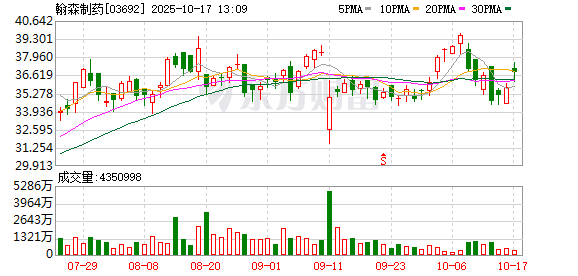
Market Overview - The credit crisis among U.S. regional banks has intensified, leading to a decline in U.S. stock markets and a significant drop in Hong Kong stocks, with the Hang Seng Index falling nearly 3% at one point [1] - The Hang Seng Index closed down 2.48% at 25,247.1 points, with a total turnover of HKD 314.62 billion, while the Hang Seng Tech Index dropped 4.05% [1] - For the week, the Hang Seng Index fell 3.97%, the Hang Seng China Enterprises Index fell 3.7%, and the Hang Seng Tech Index fell 7.98% [1] Blue Chip Performance - Hansoh Pharmaceutical (03692) rose 2.13% to HKD 36.5, contributing 1.43 points to the Hang Seng Index, after signing a licensing agreement with Roche for its ADC HS-20110, with a total deal value of USD 1.53 billion [2] - Chow Tai Fook (01929) increased by 5.02%, while Link REIT (00101) rose 0.57% [2] - BYD Electronic (00285) fell 8.13%, negatively impacting the index by 4.21 points [2] Sector Performance - Major tech stocks collectively declined, with Alibaba down over 4% and Tencent nearly 2% [3] - Chip stocks saw significant losses, with ZTE Corporation down over 12% and Hua Hong Semiconductor down nearly 7% [3][4] - The photovoltaic sector continued to decline, with rumors about a multi-crystalline silicon storage platform being unsubstantiated, leading to further losses in solar stocks [4][6] Cryptocurrency Market - The cryptocurrency market experienced a sharp decline, with Bitcoin dropping nearly 5% to USD 104,986, and Ethereum down nearly 7% [6] - The decline was attributed to concerns over credit markets following recent events involving U.S. regional banks and the ongoing government shutdown [6] Notable Stock Movements - Lao Pu Gold (06181) rose 3.11% after announcing a price adjustment for its products, marking its third price change this year [7] - China Duty Free Group (01880) increased by 2.05% following the announcement of expanded duty-free shopping policies in Hainan [8] - NIO Inc. (09866) saw a 2.17% increase, responding to a lawsuit that is not related to its recent operational status [9] - Fuyao Glass (03606) fell 5.73% after announcing a leadership change and reporting Q3 revenue of approximately CNY 11.855 billion, up 18.86% year-on-year [10]

罗氏锁定瀚森制药 创新药出海破浪
2 1 Shi Ji Jing Ji Bao Dao· 2025-10-17 05:09
Core Insights - The article highlights the strategic importance of business development (BD) for domestic innovative drug companies, exemplified by Hansoh Pharmaceutical's licensing agreement with Roche for HS-20110, a targeted antibody-drug conjugate (ADC) [2][3]. Group 1: Licensing Agreement Details - Hansoh Pharmaceutical signed a licensing agreement with Roche for HS-20110, granting Roche exclusive rights to develop and commercialize the drug globally, excluding mainland China, Hong Kong, Macau, and Taiwan [2]. - Hansoh will receive an upfront payment of $80 million, along with potential milestone payments and tiered royalties based on future sales [2]. - This agreement is part of a broader trend, as Hansoh has previously secured over $7 billion in license-out collaborations with companies like GSK and Merck [2]. Group 2: Market Implications - The partnership with Roche allows Hansoh to leverage Roche's extensive experience in antibody drug development and commercialization, addressing Hansoh's weaknesses in overseas channels [3]. - The ADC market is experiencing significant growth, driven by policy support, capital influx, and increasing demand, positioning companies with international perspectives and solid R&D capabilities to benefit [3]. Group 3: Financial Performance - Hansoh reported revenue of approximately 7.434 billion yuan, a year-on-year increase of about 14.3%, with sales from innovative drugs and collaborative products reaching approximately 6.145 billion yuan, up 22.1% [5]. - The revenue from innovative drugs and collaborative products accounted for about 82.7% of total revenue, indicating a strong performance in this segment [5]. Group 4: ADC Market Trends - The global ADC market is rapidly expanding, with the lung cancer ADC market projected to exceed $4 billion in 2024, and over $2.5 billion in sales in the first half of 2025 [8]. - As of October 2025, five ADC drugs have been approved for lung cancer treatment, marking a significant milestone in the field [8]. - The strong growth of the ADC market is attributed to its clinical advantages, combining antibody specificity with potent cytotoxic drugs to target cancer cells while minimizing damage to normal tissues [8]. Group 5: Future Outlook - The ADC market is expected to continue expanding, with Chinese ADC drugs gaining recognition globally since 2022-2023 [9]. - The market is still in a growth phase, with expectations for multiple product approvals in the coming years, highlighting the innovative capabilities of Chinese companies [9]. - The focus on new payloads and dual-target ADCs is anticipated to be a key area of development in the ADC industry [11].


罗氏锁定瀚森制药,创新药出海破浪
2 1 Shi Ji Jing Ji Bao Dao· 2025-10-17 04:43
Core Insights - The collaboration between Hansoh Pharmaceutical and Roche for HS-20110 marks a significant step in the strategic expansion of domestic innovative drugs, highlighting the importance of business development (BD) in the industry [1][2] - The ADC (antibody-drug conjugate) market is experiencing rapid growth, with increasing interest from both domestic and international pharmaceutical companies, indicating a shift towards innovative drug development in China [6][8] Company Summary - Hansoh Pharmaceutical has signed a licensing agreement with Roche for HS-20110, a targeted ADC, receiving an upfront payment of $80 million and potential milestone payments based on development progress [1] - This is not Hansoh's first major overseas licensing deal, having previously partnered with GSK, Merck, and Regeneron, totaling over $7 billion in license-out collaborations [1][2] - The company reported a revenue of approximately 7.434 billion yuan in the first half of 2025, a year-on-year increase of about 14.3%, with innovative drugs and collaborative product sales accounting for approximately 82.7% of total revenue [3] Industry Summary - The ADC market is projected to grow significantly, with the global lung cancer ADC market expected to exceed $4 billion by 2024, driven by the clinical advantages of ADCs [5][6] - The trend of increasing BD transactions in the Chinese pharmaceutical sector reflects a growing recognition of the value of innovative drugs, with a notable shift from "me-too" products to "first-in-class" and "best-in-class" assets [10][11] - The collaboration between Chinese pharmaceutical companies and multinational corporations is becoming more frequent, showcasing the international recognition of Chinese innovative drugs [8][10]
翰森制药(03692):翰森制药CDH17ADC授权罗氏,总对价超15亿美元
Haitong Securities International· 2025-10-17 03:51
Investment Rating - The report maintains a positive outlook on Hansoh Pharmaceutical, indicating an expectation of outperforming the market in the next 12-18 months [15]. Core Insights - Hansoh Pharmaceutical has entered into a licensing agreement with Roche for HS-20110 (CDH17 ADC), which includes an upfront payment of USD80 million and potential milestone payments of up to USD1.45 billion, along with royalties on product sales [5][6]. - The company anticipates significant growth in milestone revenues and out-licensing opportunities, with management raising the full-year revenue guidance to mid-to-high double-digit growth [6][7]. - Revenue from innovative drugs is projected to exceed CNY10 billion in 2025, with innovative drug revenue likely surpassing 80% of total revenue [6][7]. - The core product Aumolertinib is expected to achieve sales exceeding CNY6 billion in 2025, with peak sales potential reaching CNY8 billion [7]. Summary by Sections Licensing Agreement - Hansoh has licensed HS-20110 (CDH17 ADC) to Roche, receiving an upfront payment of USD80 million and up to USD1.45 billion in milestone payments tied to development and commercialization [5][6]. Revenue Growth - The company’s milestone revenues for the first half of 2025 have significantly exceeded expectations, prompting an upward revision of the revenue guidance [6]. - Combined milestone and upfront payments are projected to exceed CNY2.2 billion [6]. Product Pipeline - Aumolertinib has received approval for four indications, with anticipated sales growth and further approvals expected to solidify its market position [7]. - The early-stage pipeline includes innovative molecules like EGFR/cMET ADC and CDH6 ADC, which present out-licensing opportunities [6].
翰森ADC药物卖给罗氏,首付款5.8亿元
Jing Ji Guan Cha Wang· 2025-10-17 03:06
Core Insights - Hansoh Pharmaceutical has entered into a licensing agreement with a Roche subsidiary for its investigational drug HS-20110, allowing global development, production, and commercialization while retaining rights in Greater China [1] - The deal includes an upfront payment of $80 million and potential milestone payments totaling up to $1.45 billion, with a total potential deal value of $1.53 billion [1] - The drug is a targeted ADC (antibody-drug conjugate) aimed at CDH17, currently in global Phase I clinical trials for colorectal cancer and other solid tumors [1] Company Summary - Hansoh Pharmaceutical has previously engaged in two licensing deals in the ADC field with GlaxoSmithKline, with upfront payments of $85 million and $185 million, and potential milestone payments of $1.485 billion and $1.525 billion respectively [2] - The company reported a research and development expenditure of approximately RMB 1.441 billion in the first half of 2025 [1] - Following the announcement of the licensing deal, Hansoh Pharmaceutical's stock rose by 3.92%, reaching HKD 37.1 per share, with a total market capitalization of HKD 224.6 billion [2] Industry Summary - ADC drugs have become a highly competitive area in the innovative pharmaceutical sector, with major multinational companies actively acquiring ADC assets [2] - Roche has significantly increased its investment in ADC assets, completing three licensing deals in the ADC field within three months earlier this year, with a cumulative potential total amount exceeding $4 billion [2]
创新药出海再下一城!翰森制药与罗氏签订结直肠癌药物授权协议,价值最高14.5亿美元
Hua Er Jie Jian Wen· 2025-10-17 03:00
Core Insights - The collaboration between Hansoh Pharmaceutical and Roche highlights the increasing significance of Chinese biotechnology in the global innovation landscape [1] - The agreement allows Roche to develop, produce, and commercialize the ADC HS-20110 outside Greater China, with a total deal value potentially reaching $1.45 billion [1][2] Financial Terms - Hansoh Pharmaceutical will receive an upfront payment of $80 million, with additional milestone payments tied to the drug's development and commercialization progress [2] - The total potential value of the agreement, including milestone payments and tiered royalties from future sales, could reach $1.45 billion [2] Focus Asset - HS-20110 is a targeted ADC aimed at CDH17, currently in global Phase I clinical trials for treating colorectal cancer and other solid tumors, addressing a significant unmet medical need [3] - Roche's substantial investment indicates confidence in HS-20110's potential as an innovative therapy [3] Global Licensing and Market Division - The licensing agreement is a typical "license-out" collaboration, with Hansoh retaining rights in Greater China while Roche secures exclusive rights in all other global markets [4] - This partnership allows Hansoh to leverage Roche's extensive global clinical development and commercialization network while focusing on its domestic market [4]