BANK OF CHINA(03988)

Search documents
中国银行山东省分行民营企业贷款余额突破2000亿元大关
Zhong Guo Jin Rong Xin Xi Wang· 2025-11-21 08:03
Core Insights - Shandong Bank has achieved a milestone with its private enterprise loan balance exceeding 200 billion yuan by the end of Q3 2025, marking a significant phase in the "14th Five-Year Plan" and serving as a starting point for future endeavors [1][3] Group 1: Financial Support for Private Enterprises - The bank has made serving private enterprises a core strategic pillar, continuously increasing credit resources and optimizing credit policies to ensure smooth financial support for the private economy [1] - Shandong Bank has implemented dedicated work plans and measures to support the development of private enterprises, enhancing the assessment weight of financing business for these enterprises and prioritizing their credit needs [1][2] Group 2: Internationalization and Risk Management - The bank leverages its foreign exchange and trade expertise to assist private enterprises in international expansion, providing tailored services for exchange rate risk management and facilitating participation in major trade events [2] - As of Q3 2025, Shandong Bank has conducted foreign exchange market analysis for nearly 320 foreign-related enterprises and provided global cash management services to over 2,000 companies [2] Group 3: Comprehensive Financial Services - Shandong Bank is broadening financing channels for enterprises by integrating group resources and enhancing collaboration, offering a range of financial services including equity, loans, bonds, investments, insurance, and leasing [2] - The bank has supported several private enterprises in issuing green bonds and innovative financial products, with a total issuance of 1.8 billion yuan and underwriting of 265 million yuan as of Q3 2025 [2]

金融助力中国企业“走出去”报告
第一财经研究院· 2025-11-21 05:51
Investment Rating - The report indicates a positive investment outlook for Chinese enterprises going global, with a projected increase in foreign direct investment (FDI) to 1.16 trillion RMB in 2024, reflecting an 11.30% year-on-year growth [8]. Core Insights - Chinese enterprises are actively exploring new pathways for international expansion, adapting strategies in response to geopolitical challenges and evolving market conditions [4][8]. - The ASEAN region has emerged as a key destination for Chinese investment, with its share of China's outbound investment rising from 6.34% in 2014 to 17.88% in 2024 [8]. - The structure of China's outbound investment is shifting, with significant increases in the wholesale, retail, and manufacturing sectors, indicating a deeper integration into global value chains [8][52]. Summary by Sections Part A: Challenges and Pathways for Chinese Enterprises Going Global - The Chinese government is committed to high-quality outbound investment, emphasizing the importance of maintaining a stable international economic environment despite rising geopolitical tensions [18][19]. - The share of China's exports in global trade is projected to reach 14.64% in 2024, maintaining its position as the world's largest exporter [19][23]. - Chinese enterprises are increasingly focusing on the ASEAN region for investment, with a notable rise in direct investment since the implementation of the RCEP [44][52]. Part B: Financial Support for Outbound Expansion - Chinese financial institutions are enhancing their overseas presence, with major banks establishing branches in numerous countries to support outbound enterprises [9]. - There is a strong emphasis on integrating domestic and international resources, with banks providing cross-border credit and financing solutions for projects under the Belt and Road Initiative [9][11]. - Innovative financial products and services are being developed to support overseas investments, including specialized loans for infrastructure projects and comprehensive solutions for cross-border e-commerce [9][11]. Part C: Future Outlook and Recommendations - Recommendations include optimizing overseas network construction, enhancing multi-tiered financial service systems, and expanding the use of cross-border RMB [12][13]. - A comprehensive risk management system is suggested to help enterprises navigate geopolitical uncertainties and market volatility [12][13]. - Strengthening collaboration between financial institutions and industries is crucial for supporting enterprises in their global expansion efforts [12][13].



金融“活水”助力退役军人创业创新 “多点发力”让退役军人获得感成色更足
Yang Shi Wang· 2025-11-21 03:04
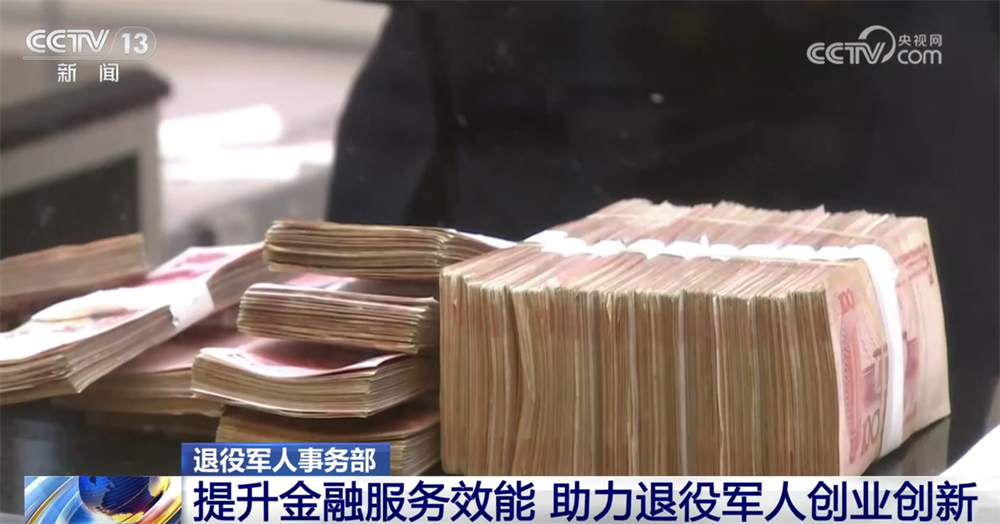
Core Points - The Ministry of Veterans Affairs is enhancing financial services for veterans by collaborating with financial institutions to launch entrepreneurial loan products to support veterans in entrepreneurship and innovation [1][3] Group 1: Financial Services Initiatives - A new financial service agreement has been signed between the Ministry of Veterans Affairs and Bank of China, introducing the "Hui Jun Loan" service, which includes a green approval channel and support in collateral, interest rates, and credit limits for veterans starting high-tech enterprises [1] - The Bank of China will also donate funds for care and support projects for veterans in need and provide exclusive insurance for veterans in underdeveloped western regions, strengthening the risk protection network for veteran families [3] Group 2: Employment and Support Measures - The agreement emphasizes increasing the provision of quality job opportunities for transitioning military officers and retired soldiers, aiming to facilitate the employment of outstanding veterans in financial positions [4] - The Ministry of Veterans Affairs plans to focus on urgent issues faced by veterans, seeking greater support from enterprises and society for employment assistance, major illness relief, and children's education, to enhance the sense of gain for veterans [6]


中国银行股价续创历史新高!银行ETF天弘(515290)成交额超5000万元,机构:国有大行明年或迎来一轮估值修复
2 1 Shi Ji Jing Ji Bao Dao· 2025-11-21 02:56
Group 1 - The banking sector showed active trading on November 21, with the China Securities Bank Index down 0.20% at the time of reporting, while China Bank saw a rise of over 2%, reaching a historical high [1] - A comprehensive cooperation agreement was signed between China Agricultural Development Bank and China Construction Bank on November 19, involving 13 branches for deeper collaboration in financial markets, syndicate loans, and consulting services [1] - The banking industry in China is transitioning from a phase of scale expansion to one of transformation and value creation, as stated by the president of China Merchants Bank at the 2025 Shenzhen International Financial Conference [1] Group 2 - Shenwan Hongyuan reiterated a focus on a dual strategy of "leading banks as the platform + bottom-tier joint-stock banks and quality city commercial banks as the performers," suggesting that state-owned banks and China Merchants Bank will elevate the valuation center [2] - It is anticipated that relatively undervalued state-owned banks may experience a valuation recovery next year, while quality small and medium-sized banks with improving fundamentals and high credit growth are expected to show significant stock price elasticity amid improving economic expectations [2]



监管数据显示商业银行净息差企稳,国企红利ETF(159515)高股息投资价值凸显
Sou Hu Cai Jing· 2025-11-21 02:44
Core Viewpoint - The performance of the China Securities State-Owned Enterprises Dividend Index has shown a decline, with a drop of 0.58% as of November 21, 2025, indicating potential challenges in the state-owned enterprise sector [1]. Group 1: Market Performance - The China Securities State-Owned Enterprises Dividend Index has seen a decline, with leading stocks including Jianfa Co., China Bank, and Nanjing Bank, while Lu Xi Chemical, Zhongwen Media, and Western Mining have lagged [1]. - The National State-Owned Enterprises Dividend ETF (159515) has undergone adjustments, reflecting changes in the underlying index [1]. - The average daily trading volume of the National State-Owned Enterprises Dividend ETF was 2.9372 million yuan over the past week as of November 20 [1]. Group 2: Banking Sector Insights - As of the end of Q3 2023, the total assets of China's banking financial institutions reached 474.3 trillion yuan, marking a year-on-year growth of 7.9% [1]. - The net interest margin for commercial banks stood at 1.42%, remaining stable quarter-on-quarter, with a slight increase of 0.01 percentage points for joint-stock commercial banks [1]. - The banking sector has shown signs of stability in net interest margins and asset quality, indicating strong resilience in the industry [1]. Group 3: Profitability and Future Outlook - Listed banks have experienced improved profit growth in Q3, driven by a decrease in provision for bad debts, stabilization of net interest margins, and improved wealth management-related income [2]. - The revenue growth for banks is expected to continue improving, enhancing the stability of their performance and highlighting the investment value of high dividend yields [2]. - The China Securities State-Owned Enterprises Dividend Index includes 100 listed companies with high and stable cash dividend yields, reflecting the overall performance of high-dividend securities among state-owned enterprises [2].

直面内外部不确定性:中国银行业在挑战中寻找成长
2 1 Shi Ji Jing Ji Bao Dao· 2025-11-21 02:12
本文节选自《2025中国银行业竞争力研究报告》。 21世纪经济报道记者 唐婧 2025年,全球经济增长呈现"碎片化"特征,主要央行政策分化加剧外部不确 定性;国内经济总体保持平稳,但有效需求不足仍是主要挑战。在此背景下,中国银行业展现出较强韧 性:三季度上市银行净息差出现企稳迹象,中收修复提速,资产质量总体可控,信贷结构持续向新质生 产力领域优化。同时,金融监管体系在"防风险、强监管、促发展"的主线下加速完善,一系列重磅政策 的出台为银行业的稳健运行与高质量发展构筑了坚实的制度基础。展望未来,在宏观政策协同呵护与监 管持续引导下,银行业有望在平衡风险与发展的道路上稳步前行。 一、外部宏观环境分析:碎片化复苏与政策分化并存 2025 年前三季度全球经济呈现 "弱修复" 特征。IMF 在秋季《世界经济展望》中将全球增长预期从 3.0% 上调至 3.2%,但这一修正并非源于增长动能增强,而是风险冲击的"边际缓和"。一是美国关税政策冲 击"弱于初始评估",私营部门通过供应链重构实现了适应性调整;二是人工智能技术扩散带动的生产力 提升,尤其在美欧科技产业表现显著。 经济增长的"碎片化"特征显著。发达经济体中,美国增速预 ...
中国银行股价再创新高
Xin Lang Cai Jing· 2025-11-21 01:36
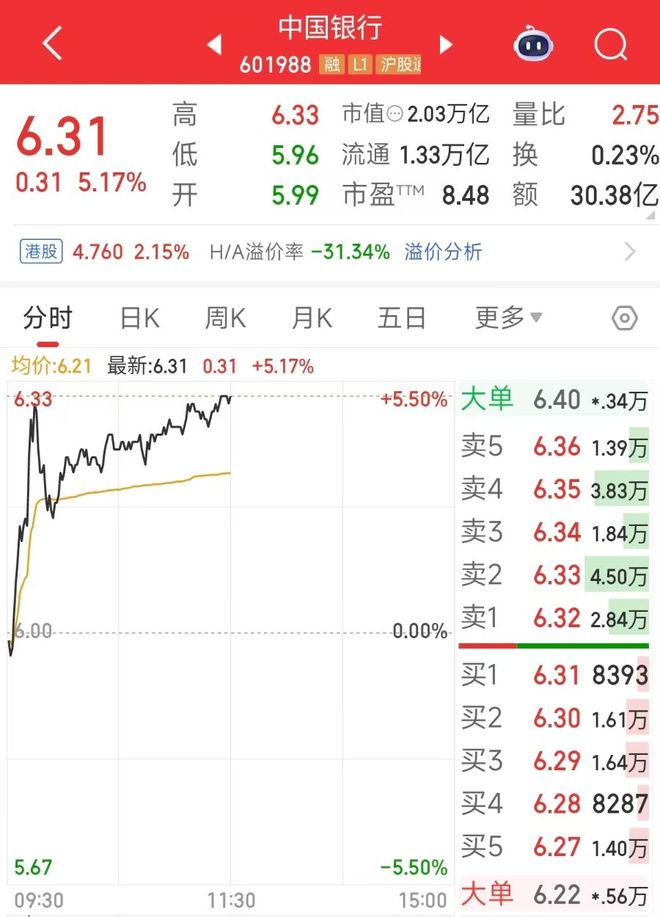
中国银行涨1.6%,报6.34元/股,股价再创新高,总市值突破2.04万亿元,成交额达2.16亿元。 ...
银行股再“逆袭”,走强并非偶然丨每日研选
Shang Hai Zheng Quan Bao· 2025-11-21 01:17
Core Viewpoint - The banking sector is experiencing a significant inflow of funds, indicating a potential new cycle of stable profitability, driven by a combination of favorable policies, improving performance, and changing market conditions [1][2][3]. Group 1: Market Performance - On November 20, the banking sector saw a net inflow of 2.16 billion yuan, leading all sectors in the Shenwan first-level industry classification [1]. - The overall trading volume for banking stocks reached 42.51 billion yuan, with main funds flowing in at 23.30 billion yuan and flowing out at 21.14 billion yuan [1]. - High dividend yields in the banking sector are attracting funds as a reliable "safe haven" amid market volatility [1]. Group 2: Policy Environment - The central bank aims to maintain relatively loose social financing conditions and strengthen the execution and transmission of monetary policy [2]. - There is an expectation of a reasonable slowdown in loan growth due to structural changes in social financing and economic development [2]. - Structural monetary policy tools are being implemented to support key areas of the economy, enhancing the banking sector's ability to operate steadily [2]. Group 3: Performance Improvement - By Q3 2025, commercial banks' net profit increased by 2% year-on-year, with large commercial banks and city commercial banks seeing profit growth of 4% and 9%, respectively [2]. - The optimization of credit structure and consumer policy support are expected to further improve banks' asset quality and profitability [2]. Group 4: Future Outlook - Analysts believe the banking sector is entering a new cycle of stable profitability, with long-term capital still actively entering the market [3]. - A favorable macro environment, including potential improvements in PPI and long-term interest rates, could enhance the banking sector's profitability [3]. - The strategy of combining leading banks with smaller banks is expected to elevate valuations, with specific banks like Industrial Bank and CITIC Bank showing potential for price elasticity [3]. Group 5: Valuation and Investment Appeal - The banking sector's valuation remains low historically, making it attractive for medium to long-term investments [4]. - High dividend assets represented by state-owned banks offer significant value compared to risk-free rates [4]. - Recommended stocks include CITIC Bank, Construction Bank, Agricultural Bank, and others, highlighting their investment appeal [4].

小红日报 | 中国银行涨超4%创新高,标普红利ETF(562060)标的指数收跌0.36%
Xin Lang Ji Jin· 2025-11-21 01:02
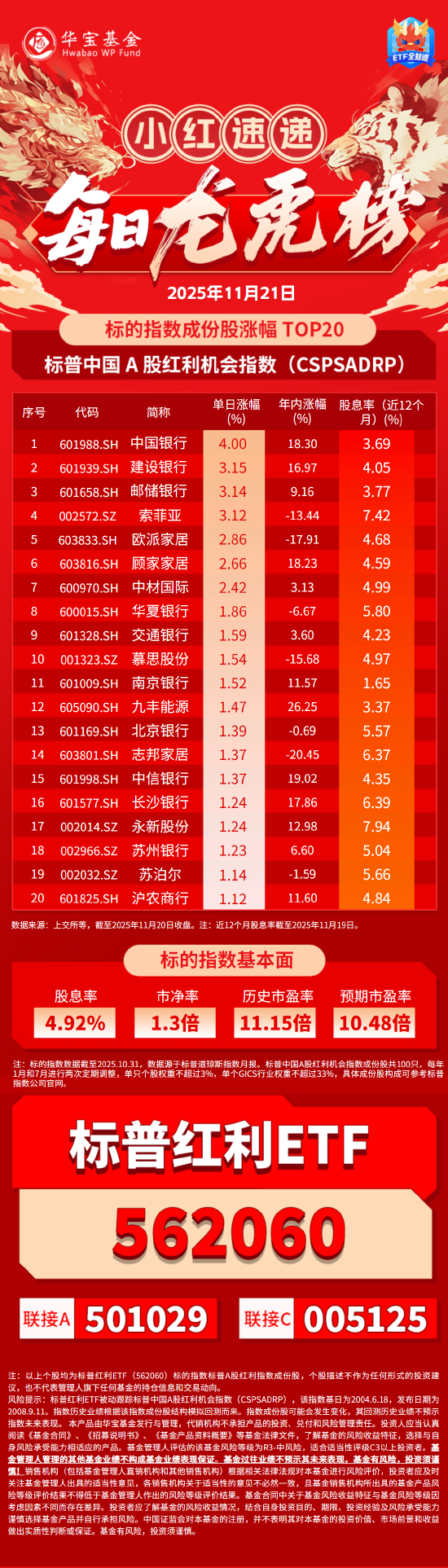
Core Insights - The article highlights the top-performing stocks in the S&P China A-Share Dividend Opportunity Index, showcasing significant gains and dividend yields for various companies [1] Group 1: Stock Performance - China Bank (601988 SH) leads with a 4.00% daily increase and an 18.30% year-to-date gain, along with a dividend yield of 3.69% [1] - Construction Bank (601939 SH) follows with a 3.15% daily rise and a 16.97% year-to-date increase, offering a dividend yield of 4.05% [1] - Postal Savings Bank (601658.SH) shows a daily increase of 3.14% and a year-to-date gain of 9.16%, with a dividend yield of 3.77% [1] Group 2: Notable Declines - Home Depot (002572.SZ) has a daily increase of 3.12% but a year-to-date decline of 13.44%, with a dividend yield of 7.42% [1] - Oppein Home Group (603833.SH) experiences a 2.86% daily rise but a significant year-to-date drop of 17.91%, with a dividend yield of 4.68% [1] - Kuka Home (603816.SH) shows a daily increase of 2.66% and a year-to-date gain of 18.23%, with a dividend yield of 4.59% [1] Group 3: Additional Performers - Huaxia Bank (600015.SH) has a daily increase of 1.86% but a year-to-date decline of 6.67%, with a dividend yield of 5.80% [1] - Beijing Bank (601169 SH) shows a daily increase of 1.39% and a slight year-to-date decline of 0.69%, with a dividend yield of 5.57% [1] - CITIC Bank (601998.SH) has a daily increase of 1.37% and a year-to-date gain of 19.02%, with a dividend yield of 4.35% [1]


中国银行股价创历史新高,市净率仍未修复
2 1 Shi Ji Jing Ji Bao Dao· 2025-11-21 00:31
Group 1 - The banking sector experienced significant movement on November 20, with China Bank (601988.SH) reaching a historical high of 6.33 CNY per share, while Construction Bank (601939.SH) rose by 4.73% and Postal Savings Bank (601658.SH) increased by 3.84%, leading to a 1.93% rise in the banking index (881155.TI) [1] - As of the midday close, China Bank's market-to-book ratio was 0.76, indicating that it has not yet recovered to above 1, with only Agricultural Bank and China Merchants Bank among 42 A-share listed banks having a market-to-book ratio greater than 1, reflecting investor skepticism about the banks' book values [3] Group 2 - Tianfeng Securities noted that in a low interest rate environment, the divergence between loan growth and bond investment growth in banks' asset structures may become more pronounced, suggesting a reversal in the competitive landscape of the banking system [3] - Open Source Securities indicated that bond market interest rates may have reached a favorable allocation point for state-owned banks, predicting significant bond purchasing activity in Q4, while emphasizing that bank valuations remain historically low and suggesting an increase in bank sector allocations [3] - The recommendation includes allocating to large state-owned banks like Agricultural Bank and Industrial and Commercial Bank as core holdings, while also suggesting core allocations to leading comprehensive banks such as China Merchants Bank, CITIC Bank, and Industrial Bank, with flexible allocations to Jiangsu Bank, Chongqing Bank, and Chongqing Rural Commercial Bank [3]