
MICROSOFT(04338)

Search documents
瑞穗上调微软目标价至640美元

Ge Long Hui A P P· 2025-10-20 09:30
格隆汇10月20日|瑞穗将微软的目标价从625美元上调至640美元,维持"跑赢大市"评级。(格隆汇) ...
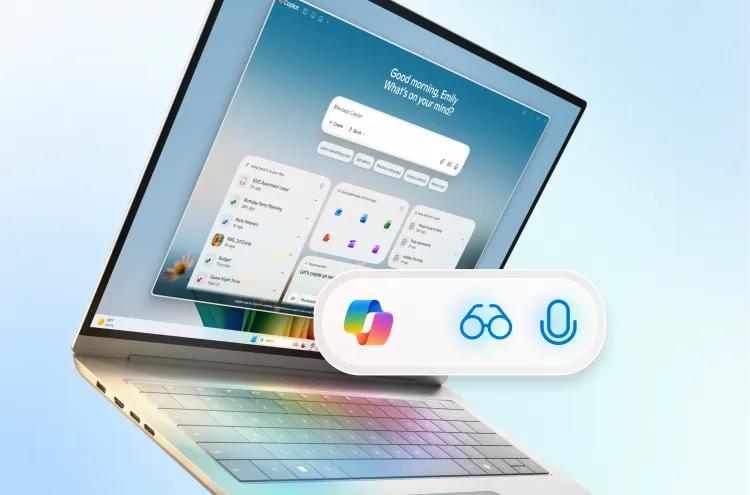
微软全面升级Windows 11,语音成为核心交互方式
3 6 Ke· 2025-10-17 09:39
Core Insights - Microsoft aims to transform every Windows 11 PC into a "true AI PC" by enhancing the Copilot feature, focusing on creating a more natural human-computer interaction and smarter AI performance [2] Group 1: Voice Interaction - Microsoft is promoting voice as the core interaction method for PCs, allowing users to activate AI by simply saying "Hey, Copilot" without needing to click icons [3] - The design aims to eliminate barriers to using voice assistants, with internal data showing that voice interactions with Copilot occur twice as frequently as text inputs [3][4] Group 2: Visual Understanding - The newly launched Copilot Vision enables AI to "see" and understand screen content, providing contextual assistance across applications [6] - Unlike the previous Recall feature, which faced privacy concerns, Vision has a more cautious privacy approach, requiring user authorization to activate screen sharing [6][9] - Vision can analyze screen content in real-time, offering step-by-step guidance and troubleshooting assistance [6][7] Group 3: Intelligent Agent Evolution - Copilot Actions allows AI to perform multi-step tasks directly on the user's PC, marking a shift from a passive assistant to an active intelligent agent [10] - Users can describe tasks in natural language, and the AI will interact with desktop and web applications to complete them [10][12] Group 4: Gaming Integration - Microsoft is exploring AI's role in enhancing entertainment experiences, integrating AI with portable gaming devices like ROG Xbox Ally [13] - The Gaming Copilot can provide real-time game strategies and tips without interrupting gameplay [15] Group 5: Overall Vision - Microsoft envisions its AI PC as a trusted assistant and partner, aiming for users to experience a PC that is more than just a tool [16]

坐视OpenAI扶持甲骨文,“老奸巨猾”的微软在想什么?
Hua Er Jie Jian Wen· 2025-10-17 08:13
Core Insights - Microsoft and OpenAI have engaged in a complex negotiation regarding data center supply, culminating in Microsoft relaxing its exclusive agreement, allowing OpenAI to sign significant cloud service contracts with competitors like Oracle, with payments expected to exceed Microsoft's own by 2030 [1][5] - Despite the apparent concession, Microsoft remains the sole provider of supercomputing resources for OpenAI's model training, a critical aspect of AI development, and will continue to receive a 20% revenue share from OpenAI's soaring earnings [1][6] - OpenAI has allocated a staggering $450 billion budget for server expenditures by 2030, with payments to competitors projected to surpass those to Microsoft [5][6] Group 1: Negotiation Dynamics - Tensions between Microsoft and OpenAI began in early 2024, as OpenAI's CEO Sam Altman demanded significantly more computing power, which would require Microsoft to invest hundreds of billions in additional infrastructure [3][4] - Delays in the construction of dedicated data centers exacerbated the conflict, with Altman expressing frustration over Microsoft's inability to expedite the process [3][4] - Microsoft's financial team, led by CFO Amy Hood, raised concerns about the risks of unlimited expansion to meet OpenAI's demands, leading to the decision to relax the exclusive agreement [4][6] Group 2: Strategic Outcomes - The summer of 2024 marked a turning point, with Altman requesting permission to negotiate with other cloud providers, prompting Microsoft to retain priority supply rights while allowing OpenAI to seek additional suppliers [5][6] - OpenAI's contracts with Oracle and other providers, including a $22.4 billion deal with CoreWeave, highlight the scale of its cloud service agreements, which have driven significant stock price increases for Oracle [5][6] - Microsoft is expected to receive approximately $135 billion in server rental fees from OpenAI by 2030, maintaining a critical role in the AI development ecosystem despite the competitive landscape [1][6]

微软Windows 11 更新:Copilot聊天框取代搜索框
Huan Qiu Wang· 2025-10-17 03:41
Core Insights - Microsoft is set to launch a significant update for Windows 11, replacing the taskbar's Windows search box with a Copilot chat interface, aimed at enhancing user efficiency and interaction [1][2] Group 1: Product Features - The new Copilot integration in the taskbar will be an optional feature, fully replacing the Windows search pane when enabled, allowing for AI chat and local file and application searches [2] - Microsoft assures that the new Copilot experience will not automatically grant access to users' applications or files, instead utilizing existing Windows search APIs to display results [2] Group 2: Release Timeline - The new Copilot integration is expected to roll out a preview version in the coming weeks, with a full launch potentially not occurring until sometime in 2026 for all Windows 11 users [2]

微软-2026 年第一季度前瞻:软件领域的核心持仓
2025-10-17 01:46
Summary of Microsoft 1Q26 Preview Conference Call Company Overview - **Company**: Microsoft Corporation - **Industry**: Software - **Market Cap**: $3,832,583 million - **Current Share Price**: $513.43 (as of October 15, 2025) - **Price Target**: $625.00 - **Stock Rating**: Overweight Key Points Industry and Market Dynamics - Microsoft is positioned strongly in the software industry, particularly in cloud services and AI, with a focus on Azure and Generative AI technologies [1][6][8] - The company is expected to maintain a high-30s percentage growth in Azure for Q1, supported by strong channel checks and positive CIO survey data [8][11] Financial Performance and Projections - Microsoft reported a 39% year-over-year growth in Azure, exceeding expectations of 35% [10] - The company anticipates sustaining Azure growth at 37%+ in Q1 and 37-38% in Q2, setting a foundation for mid-teens total revenue growth in FY26 [10][12] - Operating margins are projected to improve slightly, with expectations of low-to-mid single-digit operating expense growth offsetting gross margin pressures [10][60] OpenAI Relationship and Strategic Decisions - Microsoft has opted to pass on recent large OpenAI compute contracts, indicating a strategy to maximize profits within resource constraints [3][38] - Concerns exist regarding the revenue share from OpenAI, which currently stands at 20% but may decrease in future agreements, potentially impacting Microsoft's Azure AI revenue [37][38] - The company is focusing on diversifying Azure AI revenue streams, especially in light of a $300 billion contract signed by Oracle with OpenAI [38] Growth Drivers and Risks - Key growth drivers include strong demand for Azure AI and a diverse portfolio aligned with CIO priorities [3][11] - Risks include potential gross margin compression due to increased costs associated with scaling AI infrastructure and the impact of OpenAI losses on EPS [59][60] - The company is expected to reach a cap on OpenAI losses by FY4Q26, which could lead to significant EPS acceleration in FY27 [8][40] Market Position and Competitive Landscape - Microsoft is seen as the top incremental share gainer in the cloud market, particularly in AI and machine learning, as per CIO surveys [16][27] - The company is well-positioned to capture a significant share of GenAI spending, benefiting from its extensive product offerings and infrastructure investments [16][27] Additional Insights - The supply side for AI infrastructure is improving, with expectations of increased shipments of AI server racks, although constraints remain in data center space and power availability [15][14] - Microsoft's employee growth has plateaued, but revenue per employee has consistently increased, indicating improved productivity [63] This summary encapsulates the key insights from the conference call, highlighting Microsoft's strategic positioning, financial outlook, and the dynamics of its relationship with OpenAI.
微软让老板一眼看出谁用AI最多,Viva变身“全景监控”:公开员工Copilot使用率,还要做成内部排行榜?
3 6 Ke· 2025-10-17 00:47
Core Insights - Microsoft has introduced a new feature in Viva Insights that allows managers to benchmark AI usage among teams, revealing which teams are actively embracing AI and which are not [1][3][4] Group 1: Overview of Viva Insights - Viva Insights is a module within Microsoft's Viva suite, designed as an employee experience platform to analyze team behaviors and work habits [3] - It collects and analyzes data from various Microsoft applications to provide insights into internal team behaviors and allows for benchmarking against other companies [3] Group 2: Introduction of Copilot Benchmarks - The latest update to Viva Insights includes the Copilot usage benchmarks, enabling managers to compare AI usage across teams [4] - Managers can view active Copilot user ratios, application usage, and return user rates by team, manager type, region, or job function [4][5] - The external benchmarking data is generated through a random mathematical model, ensuring that no single company's data is used [4] Group 3: Definition and Implications of Active Copilot Users - An "active Copilot user" is defined as an employee who has intentionally interacted with AI features in Microsoft applications [5] - This feature helps track return on investment for Copilot licenses and identifies leading and lagging teams in AI usage [5] Group 4: Changing Attitudes Towards AI in Companies - There is a growing trend among companies to make AI usage a mandatory requirement rather than a recommendation [6][7] - This shift reflects a change in corporate attitudes towards AI, moving from a tool for efficiency to a new metric for assessment and management [7] Group 5: Potential Challenges of Mandatory AI Usage - Mandatory AI usage may lead to employee backlash and decreased creativity, as some studies indicate that AI tools do not significantly enhance productivity and may even reduce efficiency in complex tasks [7] - The integration of Viva Insights with Copilot aims to quantify workplace AI usage and drive adoption, but the long-term impact on productivity and creativity remains uncertain [7]
微软官宣Windows 11全新AI升级;苹果公司正筹备推出搭载触控屏的Mac电脑丨全球科技早参
Mei Ri Jing Ji Xin Wen· 2025-10-17 00:22
Group 1: Microsoft - Microsoft announced the integration of AI features into Windows 11, aiming to encourage users to upgrade their personal computers, marking the entry into an "AI-native" era for the PC industry [1] Group 2: Oracle - Oracle revealed that its AI infrastructure project, with a total revenue of $60 billion over six years, could achieve a gross margin of 35%, alleviating market concerns about its cloud business profitability [2] - The company expects its cloud infrastructure annual revenue to reach $166 billion by fiscal year 2030, accounting for nearly 75% of total revenue [2] Group 3: Apple - Apple is preparing to launch a MacBook Pro with a touchscreen, featuring a thinner design and M6 series chips, which is expected to be released in late 2026 or early 2027, potentially at a higher price due to the use of more expensive components [4] - This move represents a significant shift in Apple's positioning of the MacBook Pro as a "productivity tool," breaking a 20-year tradition [4] Group 4: Neuroscience - Researchers at New York University developed a new brain implant that can precisely deliver drugs to multiple areas of the brain, opening new pathways for treating neurological diseases [5] - The implant, named SPIRAL, is a thin, flexible catheter capable of accurately releasing medication while maintaining a minimally invasive profile [5]

微软推出Windows 11全新AI升级,全面增强Copilot功能
Xin Lang Cai Jing· 2025-10-16 13:55
Core Insights - Microsoft has launched a series of AI upgrades for Windows 11, enhancing the Copilot functionality and aiming to transform Windows 11 into an AI-centric platform [1] Group 1: AI Enhancements - The updates simplify task automation processes and improve cross-device service connectivity [1] - Users can now activate the AI assistant by using the wake word "Hey Copilot" and execute voice commands [1] Group 2: User Interaction - The new features support natural interaction through voice, visual, and action-based commands [1]
据报道,到2030年,OpenAI在甲骨文服务器上的支出可能会超过在微软服务器上的支出
Hua Er Jie Jian Wen· 2025-10-16 13:05
Core Insights - The article discusses the recent financial performance of a specific company, highlighting significant revenue growth and strategic initiatives that have contributed to its success [1] Financial Performance - The company reported a revenue increase of 25% year-over-year, reaching $2.5 billion in the last quarter [1] - Net income rose to $300 million, reflecting a 15% increase compared to the previous year [1] Strategic Initiatives - The company has launched a new product line that is expected to capture a larger market share, contributing to future revenue growth [1] - Investments in technology and innovation have been prioritized, with a budget allocation of $150 million for R&D in the upcoming fiscal year [1] Market Position - The company has strengthened its market position, now holding a 20% share in its primary sector, up from 15% last year [1] - Competitive analysis indicates that the company is well-positioned against its main rivals, with a focus on customer satisfaction and service quality [1]
Q3净利润创新高,台积电涨超2%;德意志银行上调阿斯麦目标价至1000欧元;Nscale与微软达成140亿美元新协议【美股盘前】
Mei Ri Jing Ji Xin Wen· 2025-10-16 10:53
Group 1 - Major stock index futures are showing positive movement, with Dow futures up 0.25%, S&P 500 futures up 0.27%, and Nasdaq futures up 0.42% [1] - Semiconductor stocks are experiencing a broad increase, with Nvidia up 1.07%, Broadcom up 1.69%, AMD up 0.78%, and Micron Technology up 2.66% [1] - TSMC reported a record high net profit for Q3, with consolidated revenue of NT$989.92 billion, a year-on-year increase of 30.3%. In USD, revenue for the quarter was $33.1 billion, and net profit was NT$452.3 billion, a 39.1% year-on-year increase, with a gross margin of 59.5% [1] Group 2 - NIO's stock fell over 7% following a lawsuit from Singapore's sovereign wealth fund, which accused the company and its executives of securities fraud related to a short-selling report from June 2022 [2] - Deutsche Bank raised ASML's target price from €900 to €1000 while maintaining a "buy" rating, anticipating fourth-quarter orders to rise to €6.9 billion [2] - Salesforce expects to exceed $60 billion in revenue by 2030, surpassing analyst expectations of $58.37 billion, leading to a stock increase of over 5% [3] - Nscale announced a $14 billion agreement with Microsoft for the purchase of approximately 200,000 Nvidia GPUs, contributing to a 0.26% increase in Microsoft's stock [3] - Canada is threatening legal action against Stellantis over plans to shift production of a vehicle model to a U.S. factory, resulting in a 0.59% decline in Stellantis' stock [3]


