
QDPI(06198)

Search documents
重来重回赋能优装优卸,山东港口青岛港纸浆码头向“模式”要价值
Qi Lu Wan Bao· 2026-02-09 08:01
Core Viewpoint - The Qingdao Port is implementing an innovative logistics model called "Return and Reload," which aims to optimize the loading and unloading of pulp shipments, reducing costs and improving efficiency in the supply chain [1][2][3]. Group 1: Logistics Model Implementation - The "Return and Reload" model addresses the traditional issue of ships arriving full and leaving empty, which has been a common problem in pulp transportation [2][3]. - This model allows for simultaneous loading and unloading, enabling ships to carry both incoming pulp and outgoing goods, thus creating a closed-loop logistics system [1][2]. - The implementation of this model has led to a reduction in overall logistics costs for clients by 10%-15% [3]. Group 2: Strategic Importance - The Qingdao Port recognizes the need to integrate deeply into national development strategies, enhancing supply chain resilience and collaboration amid changing global trade dynamics [2]. - The port aims to transform from basic loading services to high-value supply chain organization and resource allocation services [2][3]. Group 3: Technological and Operational Support - The success of the "Return and Reload" model relies on advanced technology, including AI-based systems for real-time coordination and optimization of logistics operations [5][6]. - The port has developed a digital platform called "Pulp Crane" to integrate resources across logistics, trade, and finance, enhancing the efficiency of the supply chain [6][7]. Group 4: Future Development - The model is expected to attract more shipping routes and cargo sources, further enhancing the port's operational efficiency and service levels [8][9]. - Future efforts will focus on integrating the model with multimodal transport systems to create a standardized logistics solution that can quickly match incoming ships with optimal return cargo [8][9].

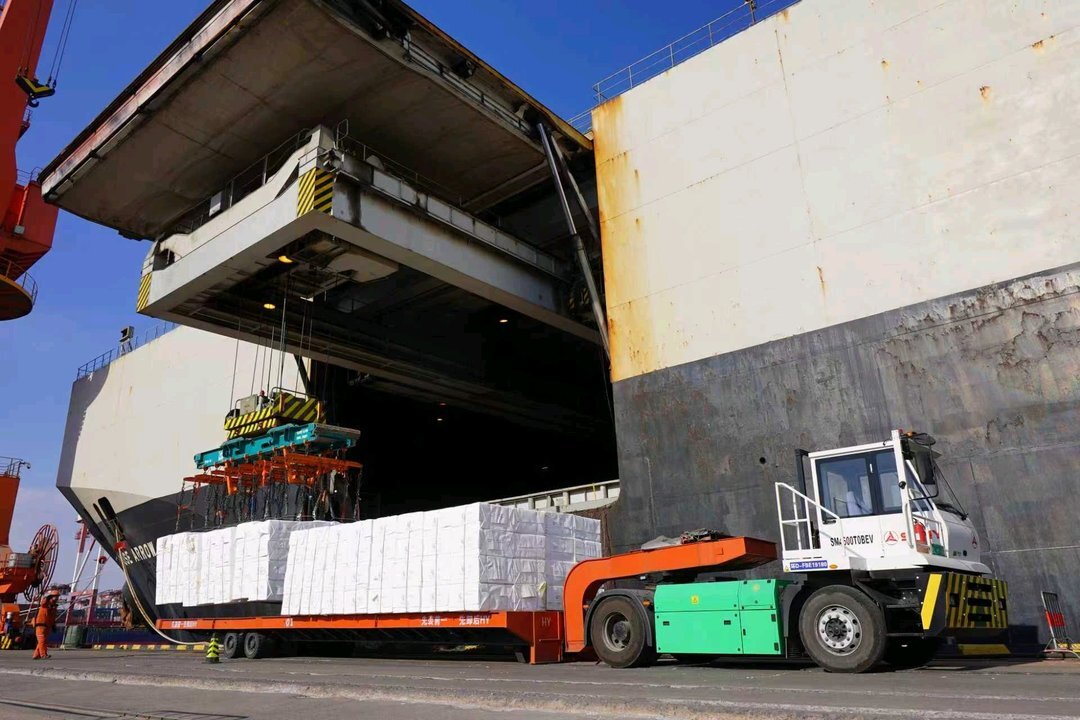
向“模式”要价值 青岛港纸浆码头打造“重来重回”物流新生态
Da Zhong Ri Bao· 2026-02-09 02:34
Core Insights - The article highlights the innovative "Return and Revisit" logistics model implemented at Qingdao Port, which allows for efficient loading and unloading of cargo, thereby addressing the traditional issue of empty return trips for vessels [3][4][6]. Group 1: Logistics Model - The "Return and Revisit" model aims to solve the structural problem of "full on arrival, empty on return" in pulp logistics, enhancing operational efficiency and reducing costs for clients [3][4]. - This model has successfully enabled dual-direction cargo transfer, allowing vessels to carry both imported pulp and exported goods, thus optimizing shipping processes and reducing overall logistics costs by 10%-15% [7][11]. Group 2: Strategic Importance - Qingdao Port recognizes the need to integrate deeply into national development strategies, enhancing supply chain resilience and collaboration amid changing global trade dynamics [4][6]. - The port's strategic shift is crucial for addressing long-standing challenges in pulp logistics, which have historically increased operational costs for shipping companies [4][6]. Group 3: Technological Integration - The success of the "Return and Revisit" model relies on advanced technology, including AI-driven systems for real-time coordination and optimization of logistics operations [8][10]. - The development of the "Pulp Crane" platform integrates logistics, trade, and finance, facilitating a seamless connection between cargo owners, the port, and shipping companies [10][11]. Group 4: Infrastructure and Network - Qingdao Port has established multiple international logistics routes, enhancing its role as a key hub for pulp imports and exports, thereby expanding its service radius and economic hinterland [7][11]. - The port's extensive intermodal transport network, including rail connections to inland regions, significantly improves the efficiency of logistics operations and reduces costs for clients [11][12]. Group 5: Future Development - The "Return and Revisit" model opens new avenues for business upgrades at Qingdao Port, attracting more shipping routes and cargo sources while leveraging advanced technologies to enhance operational efficiency [12][13]. - Future efforts will focus on integrating this model with multimodal transport systems to create a standardized logistics solution that can quickly match vessels with optimal return cargo [12][13].

聚焦:春运火热开启;千问春节30亿免单,即时零售竞争再加码:交通运输行业周报(20260202-20260208)-20260208
Huachuang Securities· 2026-02-08 09:30
Investment Rating - The report maintains a "Recommend" rating for the aviation sector, highlighting potential opportunities in the industry [2][3]. Core Insights - The Spring Festival travel rush has begun, with air passenger volume averaging 2.313 million per day, up 5.5% year-on-year, while railway passenger volume averaged 11.792 million, down 0.7% year-on-year [1][10]. - The report emphasizes the competitive landscape in instant retail, particularly with the launch of the "30 Billion Free Order" campaign by Qianwen, which saw over 10 million orders in just 9 hours [2][35]. - The report identifies key players in the aviation sector, including China National Airlines, Southern Airlines, and Eastern Airlines, as well as low-cost carriers like Spring Airlines, which are expected to benefit from high price elasticity and operational efficiency [2][34]. Industry Data Tracking - Air freight rates at Pudong Airport increased by 5.3% week-on-week and 8.9% year-on-year as of February 2 [7][44]. - The VLCC freight rate rose by 2% week-on-week, while the BDI decreased by 10% [7][48]. - The report highlights the growth potential in the express logistics sector, particularly for leading companies like Zhongtong and Yuantong, as well as the promising outlook for instant retail leader SF Express [7][31]. Investment Recommendations - The report suggests focusing on "performance elasticity" and "dividend value" as key investment themes for the transportation sector in 2026 [7][31]. - It recommends continued investment in the aviation sector due to expected low growth in aircraft supply and a projected 5% increase in passenger numbers [2][31]. - The report also emphasizes the importance of dividend assets, recommending companies like Sichuan Chengyu and China Merchants Port for their stable performance and potential for increased dividends [7][31].



一月份四线齐发 青岛港全球航线网络持续加密
Zheng Quan Ri Bao Zhi Sheng· 2026-02-06 10:14
一月之内四条重要航线同时落地青岛港,充分彰显了全球市场对青岛港枢纽地位与硬核实力的信赖和认 可。作为中国第二大外贸口岸和沿黄流域最大出海口,青岛港区位优势显著,依托56个内陆港和86条海 铁联运班列构建起覆盖广阔的"黄金通道",海铁联运箱量已连续11年领跑全国。在运营层面,青岛港拥 有世界领先的全自动化集装箱码头,并13次刷新装卸效率世界纪录;通过推行"一企一策"定制服务 及"船边直提"等便利模式,其船舶直靠率与作业效率持续位居全球主要港口前列。此外,口岸营商环境 持续优化,青岛港与海关协同打造的智慧监管模式,连续五年获评跨境贸易营商环境最高星级,为2025 年青岛口岸实现2.65万亿元外贸总值提供了坚实保障。 新航线的密集开通,远不止于箱量的增长,更是服务能级的跃升。每条新航线都是一条贯通内外的高效 供应链,将为外贸企业开拓新兴市场、优化出口结构提供强有力的物流支撑,使青岛港成为国内国际双 循环的关键枢纽。未来,青岛港将继续优化全球航线网络布局,提升综合服务效能与枢纽能级,在服务 国家重大战略、赋能经济社会高质量发展的新征程上展现更大担当。 (编辑 张明富) 本报讯 (记者刘钊)2月6日,记者从青岛港了解到 ...
港口行业2026年度信用风险展望(2026年2月):吞吐量增速放缓,基建与内需托底行业基本面
Lian He Zi Xin· 2026-02-06 09:26
Investment Rating - The report indicates a stable outlook for the port industry, with a focus on infrastructure and domestic demand supporting the industry fundamentals [7][8]. Core Insights - The growth rate of cargo and container throughput in Chinese ports is slowing down, influenced by GDP and import-export growth deceleration. Coastal ports dominate in terms of throughput, with significant differentiation in growth rates among major ports [8][9]. - Since 2018, investment in inland waterway transportation has consistently exceeded that of coastal ports, leading to structural overcapacity in coastal ports. However, there remains a demand for terminal upgrades, optimization of port layouts, and channel construction, with a clear trend towards larger and more specialized port berths [8][9]. - The overall revenue of sampled port enterprises is steadily increasing, with strong operational cash flow capabilities. Future capital expenditures are expected to remain substantial due to increased financing driven by port-related project investments [8][9]. - The report anticipates that global economic growth will remain low, with uncertainties surrounding trade policies potentially impacting China's foreign trade. However, domestic demand is expected to expand, providing some support for port throughput [8][9]. Industry Overview Macroeconomic Environment - In 2025, China's economy is projected to stabilize, with domestic demand expected to support cargo throughput at ports. The economic policies are characterized by a multi-dimensional collaborative approach, focusing on stabilizing growth and enhancing domestic consumption [9][10]. - The port industry is highly sensitive to macroeconomic cycles, with the performance of cargo and container throughput closely linked to economic conditions and foreign trade developments [10][11]. Industry Policies and Regulatory Environment - The government has introduced various policies to guide the development of smart, green, safe, and efficient ports, aiming to enhance the competitive capabilities of ports through a market-oriented pricing system [11][12]. - Recent policies emphasize the integration of rail-water transport and the construction of a modern comprehensive transportation system, with significant investments expected in port infrastructure [11][12]. Industry Operating Conditions - The throughput growth of Chinese ports has shown signs of slowing down, with a notable differentiation in growth rates among major coastal ports. In 2024, the total cargo throughput reached 1,759.5 million tons, growing by 3.7% [16][20]. - Container throughput growth has also slowed, with a total of 33.2 million TEUs in 2024, reflecting a 7.0% increase [17][20]. Financial Performance - Sampled port enterprises have shown steady revenue growth, with total revenue reaching 643.36 billion yuan in the first nine months of 2025, maintaining a stable operational performance [34][36]. - The cash flow from operating activities has been strong, with a cash income ratio exceeding 100%, indicating that cash flow can meet capital expenditure needs [36][39]. Debt Levels - The total debt of sampled port enterprises has increased, with a total debt of 1,162.86 billion yuan by September 2025, primarily for new terminal construction and upgrades [41][43]. - The short-term debt ratio is moderate, with a significant portion of financing coming from bank loans and bond issuances [41][43]. Debt Repayment Capacity - Most sampled port enterprises face manageable short-term repayment pressures, with strong long-term repayment capabilities. However, some enterprises have heavier debt burdens and historical personnel liabilities that require attention [44][45]. Bond Market Performance - The report notes a decrease in bond issuance rates for port enterprises, with a total of 180 bonds issued in 2025, reflecting a 7.57% increase in issuance scale [48][49].


青岛港跌2.26%,成交额2.98亿元,后市是否有机会?
Xin Lang Cai Jing· 2026-02-06 07:47
Core Viewpoint - Qingdao Port experienced a decline of 2.26% in stock price, with a trading volume of 298 million yuan and a market capitalization of 61.665 billion yuan [1] Group 1: Company Overview - Qingdao Port International Co., Ltd. is located in Qingdao, Shandong Province, and was established on November 15, 2013, with its listing date on January 21, 2019 [6] - The company primarily engages in the loading and unloading of various goods, including containers, metal ores, coal, and crude oil, as well as logistics and port value-added services [6] - The revenue composition of the company includes 56.72% from loading and related services, 36.96% from logistics and port value-added services, and smaller percentages from other port-related services [6] Group 2: Financial Performance - For the period from January to September 2025, Qingdao Port achieved an operating income of 14.238 billion yuan, representing a year-on-year growth of 1.86%, and a net profit attributable to shareholders of 4.180 billion yuan, with a growth of 6.33% [6] - The company has distributed a total of 13.77 billion yuan in dividends since its A-share listing, with 6.638 billion yuan distributed over the past three years [7] Group 3: Market Position and Strategic Initiatives - Qingdao Port is strategically positioned in the center of the Bohai Sea and Yangtze River Delta port clusters, benefiting from the China-South Korea Free Trade Agreement and the Belt and Road Initiative [2] - The company has signed a cooperation agreement with Huawei to accelerate the development of smart port operations in major domestic ports [3] Group 4: Shareholder and Institutional Holdings - As of September 30, 2025, the number of shareholders of Qingdao Port increased to 38,300, reflecting a growth of 7.23% [6] - The top ten circulating shareholders include various institutional investors, with notable increases in holdings from Southern S&P China A-share Large Cap Dividend Low Volatility ETF and Hong Kong Central Clearing Limited [8]
青岛港跌2.06%,成交额2.44亿元,主力资金净流出192.57万元
Xin Lang Cai Jing· 2026-02-06 06:35
Core Viewpoint - Qingdao Port's stock price has experienced fluctuations, with a recent decline of 2.06% and a year-to-date increase of 14.15%, indicating volatility in market performance [1]. Financial Performance - For the period from January to September 2025, Qingdao Port achieved a revenue of 14.238 billion yuan, reflecting a year-on-year growth of 1.86%, while the net profit attributable to shareholders was 4.180 billion yuan, up by 6.33% [2]. - Since its A-share listing, Qingdao Port has distributed a total of 13.770 billion yuan in dividends, with 6.638 billion yuan distributed over the past three years [3]. Shareholder Information - As of September 30, 2025, the number of shareholders for Qingdao Port increased to 38,300, marking a rise of 7.23% compared to the previous period [2]. - The top ten circulating shareholders include notable entities such as the Southern S&P China A-share Large Cap Dividend Low Volatility 50 ETF, which increased its holdings by 2.884 million shares, and the Hong Kong Central Clearing Limited, which raised its stake by 3.0728 million shares [3]. Market Activity - On February 6, Qingdao Port's stock traded at 9.52 yuan per share, with a total transaction volume of 244 million yuan and a turnover rate of 0.47%, indicating active trading [1]. - The stock has seen a slight decline of 0.10% over the last five trading days, but a significant increase of 13.74% over the past 20 days [1]. Business Overview - Qingdao Port International Co., Ltd. specializes in the handling and logistics of various goods, including containers, metal ores, coal, and crude oil, with its main business revenue sources being cargo handling and related services (56.72%) and logistics and port value-added services (36.96%) [1].
1月青岛港连开4条集装箱外贸航线
Zhong Guo Xin Wen Wang· 2026-02-04 14:04
其中,中远海运红海航线将青岛港与沙特阿拉伯的吉达港等串联,为能源、建材等大宗商品搭建了稳定 跨洋物流通道,为中国新能源汽车、光伏产品等新兴产业"出海"提供坚实支撑,高效助力共建"一带一 路"的高质量发展。 中新社青岛2月4日电 (胡耀杰 张孝鹏)山东港口青岛港集团有限公司(简称"青岛港")4日发布消息称, 2026年1月,该港连续开通4条集装箱外贸航线,外贸航线总数扩容至近240条,与全球180余个国家和地 区的700余个港口实现互联互通。 而两条东南亚航线的开通,进一步加密青岛港至泰国林查班等东盟主要港口的航线网络,深度释放关税 减免、贸易便利化政策效能,为电子产品、特色农产品等货物往来铺设"海上高速"。(完) 据介绍,山东强劲的贸易动能为青岛港航线的扩容带来坚实支撑。今年1月,该港分别开通地中海航运 澳大利亚新航线、中远海运红海航线、中远海运东南亚航线以及正利航运东南亚航线。 地中海航运澳大利亚新航线的开通,实现中国北方地区与澳大利亚悉尼、布里斯班等核心枢纽港的直达 互通,可直接服务于中国北方地区的机电、化工等产业"出海",同时便捷承接澳大利亚货物的进口分 拨。 ...
今年1月山东港口青岛港连开4条集装箱外贸航线 与全球超700个港口互通
Zhong Guo Xin Wen Wang· 2026-02-04 13:14
Core Viewpoint - Qingdao Port has expanded its international container shipping routes, increasing the total number of foreign trade routes to nearly 240, connecting with over 700 ports in more than 180 countries and regions by January 2026 [1][3]. Group 1: Expansion of Shipping Routes - In January 2023, Qingdao Port launched four new international container shipping routes, including the Mediterranean Shipping's Australia route and COSCO's Red Sea and Southeast Asia routes [1][3]. - The Red Sea route connects Qingdao Port with Jeddah Port in Saudi Arabia, facilitating stable logistics for bulk commodities and supporting the export of China's emerging industries such as new energy vehicles and photovoltaic products [3]. - The new Mediterranean route provides direct access between northern China and key Australian ports like Sydney and Brisbane, enhancing service for the machinery and chemical industries [3]. Group 2: Economic Impact and Trade Facilitation - Shandong Province's foreign trade import and export value is projected to reach 3.53 trillion RMB in 2025, reflecting a year-on-year growth of 4.5%, which supports the expansion of Qingdao Port's shipping routes [3]. - The two Southeast Asia routes enhance the benefits of the Regional Comprehensive Economic Partnership (RCEP), deepening regional economic cooperation and facilitating trade in electronic products and specialty agricultural products [3]. - Qingdao Port's network includes 56 inland ports and 86 sea-rail intermodal trains, forming a "golden channel" that has maintained the highest container volume in sea-rail intermodal transport in China for 11 consecutive years [4].
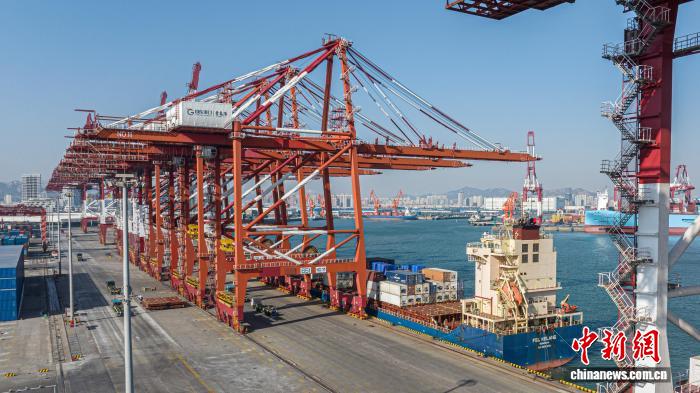
一月连开4条国际航线,山东港口青岛港织密全球航运网络
Qi Lu Wan Bao· 2026-02-04 11:22
齐鲁晚报·齐鲁壹点记者 赵波 2026年开局,山东港口青岛港(601298)航线拓展按下"加速键":短短一个月内,地中海航运澳新线、 中远海运红海线及东南亚线、正利航运东南亚线4条集装箱新航线密集开通,外贸航线总数扩容至近240 条,稳居北方港口航线数量、密度双第一。这一突破不仅为北方外贸企业搭建起连通全球的"海上高 速",更以精准布局服务"一带一路"建设、中澳经贸合作、RCEP区域融合等国家战略,彰显出东北亚国 际航运枢纽的核心竞争力与辐射带动力。 新航线布局蕴含"战略深意" 航线布局,是观察区域经济脉动与国家战略布局的重要窗口。数据显示,2025年山东省外贸进出口总值 3.53万亿元人民币,同比增长4.5%,对共建"一带一路"国家进出口占比超六成,对非洲、中东地区进出 口增速分别为38.6%、18.5%。 强劲的贸易动能为航线扩容提供了坚实支撑。4条新航线密集开通,便是青岛港精准对接国家发展战 略,联动全球航运巨头适配外贸发展新形势的主动作为。 从激活RCEP区域合作红利看,两条东南亚线进一步深化区域经贸合作,加密了青岛港至泰国林查班等 东盟主要港口的航线网络,深度释放关税减免、贸易便利化政策效能,为电子 ...