
集装箱航运服务

Search documents
德翔海运20260323
2026-03-24 01:27
Key Points Summary of the Conference Call Company Overview - The company is a major player in the global container shipping industry, ranking 20th as of December 31, 2025, operating 46 routes covering over 50 ports across 22 countries and regions, with the Asia-Pacific region contributing approximately 91% of its cargo volume [3][4]. Financial Performance - In 2025, the company reported revenues of $1.28 billion, a decrease of 4.2% year-on-year, with net profit attributable to shareholders at $329 million, down 10.1% [2][4]. - The average container shipping rate fell by 6.6% to $718 per TEU, impacting overall revenue [4]. - The gross profit decreased by 19.5% to $254 million, with a gross margin contraction of 3.8 percentage points to 19.7% [4]. - Operating cash flow remained strong at $502 million, marking 12 consecutive years of positive cash flow [4]. Fleet and Capacity Management - The company plans to increase its owned vessel ratio to 89% by 2025, with a total capacity expected to reach 240,000 TEU by 2029, reflecting a compound annual growth rate (CAGR) of 15.6% [2][3]. - The fleet capacity decreased by 6.9% to 134,000 TEU due to the return of some chartered vessels [3]. Cost Management - The company achieved a 36% reduction in chartering costs by increasing the proportion of owned containers to 40% [2][4]. - Fuel costs decreased by 13.7% year-on-year due to falling oil prices, amounting to $164 million [4]. Strategic Adjustments - The company optimized its route structure by reducing capacity from North Asia to Southeast Asia and increasing capacity to the Middle East and the Indian subcontinent, which together contributed 18% of cargo volume in 2025 [2][3]. - A new service, MEX, was launched to enter the South American market, while services to the U.S. were terminated due to regulatory changes [3]. Dividend and Financial Policy - The company maintains a dividend payout ratio of 30%-50%, proposing a final dividend of $0.1 per share, totaling $167 million, which aligns with its commitment to distribute at least $70 million in dividends for 2024 and 2025 [5]. Market Outlook - The company anticipates continued demand in the Asia-Pacific region, driven by trade fragmentation and economic growth in ASEAN, China, the Middle East, and India [6]. - The market is expected to remain volatile in 2026 due to geopolitical tensions, but the company believes that its strong balance sheet and strategic route adjustments will mitigate risks [6][7]. Risk Management - In response to the Middle East situation, the company has implemented surcharges of $2,000 to $3,000 to cover additional costs, with minimal impact on overall profitability [7][8]. - The company has proactively hedged fuel costs to ensure supply for upcoming months [9]. Competitive Advantages - The company has a diversified customer base and a strong operational network, allowing it to maintain stability in cargo volumes and service quality [17][18]. - Its fleet is designed for efficiency in port operations, enhancing its competitive position in the market [15][18]. Future Plans - The company plans to receive three new 14,000 TEU vessels by 2027, exploring both self-operated routes and potential leasing opportunities [10]. - It aims to expand its presence in non-Asian markets while maintaining a strong focus on its core Asian routes [11]. Cost Trends - Container handling fees are expected to rise, with the company planning to pass on these costs to customers [13]. - The overall cost structure is projected to remain stable, with TEU costs expected to stay around $620 [13]. Conclusion - The company is well-positioned to navigate the challenges of the current geopolitical landscape while capitalizing on growth opportunities in the Asia-Pacific region and beyond, supported by a robust financial foundation and strategic operational adjustments [6][15].
投资收益近80亿元,449亿供应链收入加持,中远海控夯实多元增长
Quan Jing Wang· 2026-03-20 05:58
Core Viewpoint - The company, COSCO Shipping Holdings, reported a robust performance in 2025 despite challenges in the global container shipping market, focusing on a digital supply chain operation and investment platform centered on container shipping [1][2] Financial Performance - In 2025, the company achieved a revenue of RMB 219.5 billion, with an EBIT of RMB 45.01 billion and a net profit of RMB 35.23 billion, translating to a net profit attributable to shareholders of RMB 30.87 billion [1] - The company maintained a strong profit trend in Q4, achieving a net profit attributable to shareholders of RMB 3.8 billion despite a decline in freight rates and industry cycle downturn [1] - Investment income and net financial income reached RMB 7.94 billion, contributing to a solid financial structure characterized by low debt, high cash, and stable profitability [1] Strategic Development - The company is actively adapting to the globalization and diversification of trade, enhancing integrated development in "container shipping + ports + related logistics" [2] - It is focusing on a comprehensive service capability by promoting joint ventures and strengthening the layout of key port hubs and inland logistics resources [2] - The container shipping segment generated supply chain revenue of RMB 44.89 billion, a year-on-year increase of 9.64%, becoming a new growth engine for the company [2] Future Outlook - The company aims to maintain its positioning as a global digital supply chain operation and investment platform centered on container shipping, advancing full-chain, intelligent, green, and integrated development [2] - It plans to enhance its core competitiveness in sustainable development to address market uncertainties and solidify its foundation for long-term growth [2]
中远海控2025年实现营业收入2195.04亿元
Zheng Quan Ri Bao Wang· 2026-03-20 05:49
Core Insights - COSCO Shipping Holdings Co., Ltd. reported a revenue of 219.5 billion yuan and a net profit of approximately 35.2 billion yuan for the year 2025, with a significant focus on container shipping and terminal operations [1][2] Financial Performance - In 2025, COSCO achieved an EBIT of 45.0 billion yuan and a net profit attributable to shareholders of about 30.9 billion yuan [1] - The container shipping business handled a cargo volume of 27.4 million TEUs, marking a year-on-year increase of 5.76%, generating revenue of 210.7 billion yuan with a gross margin of 19.44% [1] - The terminal business reported a total throughput of 153 million TEUs, up 6.22% year-on-year, with a revenue of 12.0 billion yuan and a gross margin of 25.91% [1] Capital Structure and Returns - By the end of 2025, the company's debt-to-asset ratio decreased to 41.42%, down approximately 1.28 percentage points from the previous year [1] - The cash and cash equivalents balance reached 150.9 billion yuan, and the company announced a cash dividend of 0.44 yuan per share, expected to distribute around 50% of the net profit attributable to shareholders for the year [1] Strategic Initiatives - COSCO has executed four rounds of share buybacks, totaling 866 million shares and over 9.8 billion yuan in buyback amounts [2] - The company aims to establish a global digital supply chain operation and investment platform centered on container shipping, integrating shipping, port, and logistics services [2] - COSCO maintains a fleet of 590 container ships with a capacity of approximately 3.6 million TEUs, leading the industry with a 75% share of owned and chartered vessels [2] Future Outlook - For 2026, COSCO anticipates increased complexity and uncertainty in the container shipping market, focusing on global and scalable development while enhancing digital, green, and integrated operations [3] - The company aims to leverage digital capabilities to optimize service efficiency and operational performance, striving to create a resilient and timely transportation service network for customers [3]
中东航线单柜运费跳涨三千美元,多家船司实施紧急冲突附加费
经济观察报· 2026-03-02 13:11
Core Viewpoint - The recent geopolitical tensions in the Middle East, particularly the military actions involving the US and Israel against Iran, have severely disrupted shipping routes, leading to increased logistics costs and delays for Chinese companies reliant on this region for transshipment trade [2][4][10]. Group 1: Shipping and Logistics Impact - The closure of the Strait of Hormuz and the Red Sea shipping lanes has resulted in significant delays and uncertainties for cargo shipments, particularly affecting seasonal trade for businesses preparing for the Ramadan market [2][4]. - Major shipping companies, including MSC and Maersk, have suspended services to the Middle East, leading to further delays for goods destined for countries like the UAE and Oman [5][6]. - Freight rates have surged, with companies like CMA CGM and Hapag-Lloyd imposing additional fees ranging from $1,500 to $3,500 per container due to the conflict [7][8]. Group 2: Domestic Market Repercussions - The rising shipping costs are expected to impact domestic logistics, with ports like Dalian, Tianjin, and Qingdao experiencing varying degrees of pressure based on their cargo types [9]. - The shipping disruptions have led to a significant increase in freight rates for routes to South America, with a reported 36.5% rise in prices [9]. Group 3: Energy Market Reactions - The geopolitical tensions have caused a surge in the A-share oil and gas sector, with companies like China National Petroleum and Sinopec seeing their stock prices hit the daily limit [13]. - Concerns over potential disruptions in oil supply from the Middle East have led analysts to predict that Brent crude oil prices could rise above $80 per barrel if the situation persists [14]. Group 4: Chinese Companies in the Middle East - Chinese solar companies have been actively investing in the Middle East, with significant projects like JinkoSolar's $1 billion investment in Saudi Arabia's NEOM city [15][16]. - The logistics disruptions could hinder these companies' ability to utilize their Middle Eastern bases for accessing European and American markets, increasing operational risks due to higher transportation costs and delivery delays [19][20]. - Despite the geopolitical tensions, some companies like JinkoSolar and JA Solar report that their projects in the region have not yet faced substantial impacts [21].

Hapag-Lloyd (OTCPK:HLAG.F) M&A announcement Transcript
2026-02-17 14:02
Summary of Hapag-Lloyd and ZIM Merger Conference Call Industry and Companies Involved - **Industry**: Container Shipping - **Companies**: Hapag-Lloyd and ZIM Core Points and Arguments 1. **Merger Agreement**: Hapag-Lloyd signed a merger agreement to acquire 100% of ZIM shares for $35 per share, totaling $4.2 billion, which is a significant premium over ZIM's recent closing price [2][4] 2. **Strategic Positioning**: The merger aims to secure Hapag-Lloyd's position among the top five global shipping companies, increasing its fleet to over 400 vessels with a capacity exceeding 3 million TEUs [3][10] 3. **Synergies**: Expected synergies from the merger are estimated at up to EUR 500 million, primarily from network and procurement efficiencies, to be realized within a few years [3][9] 4. **Regulatory Approval**: The merger requires approval from ZIM's general meeting and various Israeli ministries, as well as antitrust authorities, with an expected closing date in 2026 [4][17] 5. **ZIM's Profile**: ZIM operates over 100 modern ships, with a capacity of around 700,000 TEUs, and has a strong customer base and market position [5][6] 6. **Fleet Composition**: Post-merger, Hapag-Lloyd's fleet will have a higher percentage of chartered vessels, which is seen as beneficial for flexibility in uncertain market conditions [37] 7. **Financial Strength**: Hapag-Lloyd plans to fund the acquisition primarily from its liquidity reserve of approximately $7.5 billion, with a bridge financing facility of up to $2.5 billion [21][22] 8. **Market Outlook**: The industry is expected to grow by 6.5% in 2024 and close to 5% in 2025, which supports the merger's rationale despite potential market fluctuations [27][28] 9. **Integration and Brand Strategy**: ZIM will operate under a new independent brand managed by FIMI Opportunity Funds, while Hapag-Lloyd will integrate the majority of ZIM's operations into its own brand [20][40] Other Important Content 1. **Employee Skills**: The merger is expected to enhance Hapag-Lloyd's talent pool by integrating ZIM's skilled workforce [16][8] 2. **Long-term Strategy**: Hapag-Lloyd aims to remain a pure play container carrier, and the merger aligns with this strategy by enhancing its trade portfolio and operational scale [6][10] 3. **Synergy Realization Timeline**: The realization of synergies is projected to be 65% in the first year, 90% in the second year, and 100% by the third year [14][41] 4. **Contractual Obligations**: Hapag-Lloyd will honor existing contracts with other carriers, including VSAs, during the integration process [39][41] 5. **Market Positioning**: The combined entity will be closer to the top four competitors in the market, enhancing its competitive position [10][12] This summary encapsulates the key points discussed during the conference call regarding the merger between Hapag-Lloyd and ZIM, highlighting the strategic, financial, and operational implications of the transaction.
斯蒂加斯海运股价下跌3.08%,受行业运价下行及公司运营波动影响
Jing Ji Guan Cha Wang· 2026-02-12 20:00
Industry Environment - The container shipping market has seen a continuous decline in spot rates since late January 2026, with a significant drop in rates on the US and European routes due to weak terminal demand and insufficient cargo support [1] - The Shanghai Shipping Exchange reported that the SCFI index has fallen for three consecutive weeks, with the East US route experiencing a decline of over 8.5%, prompting shipping companies to lower prices to fill slots before and after the Lunar New Year [1] Company Performance - Stiggas Shipping's Q3 2025 financial report indicated a 10% year-over-year revenue growth, but the operational utilization rate dropped to 90.3% due to increased idle time of spot vessels and rising voyage costs [2] - Only 57% of the company's fleet days were covered by one-year contracts, leaving the remainder reliant on the spot market or short-term charters, which may lead to revenue uncertainty during the downward price cycle [2] Market Reaction - On February 12, the US shipping sector overall declined by 0.37%, while the Nasdaq index fell by 1.51%, with Stiggas Shipping's stock price drop exceeding the sector average, reflecting the dual impact of macro market sentiment and industry fundamentals [3]
全球集装箱航运市场介绍:东南亚航线
Zhong Xin Qi Huo· 2026-02-10 09:30
1. Report Industry Investment Rating No relevant content provided. 2. Core Viewpoints - The China - Southeast Asia shipping route is the world's largest trade corridor, showing resilience in trade tensions. The Southeast Asian container shipping market has strong growth momentum driven by economic growth and industrial transfer [8][33]. - In 2025, the North Asia - Southeast Asia route had the highest capacity share and the fastest growth rate among intra - Asia trades. However, future capacity growth may be constrained by the high average age and low orderbook of feeder vessels [26][34]. - Southeast Asian shipping routes generally have lower freight rate volatility than long - haul routes, with certain correlations to Northern Europe rates. New contracts listed by the Shanghai International Energy Exchange provide more options for hedging [2][35]. 3. Summary by Directory 3.1 Current Situation of the Southeast Asia Container Shipping Market - The China - Southeast Asia route is the world's largest trade corridor. In 2025, the trade value between China and ASEAN reached 1,055.87 billion USD, up 7.3% year - on - year. Asian intra - regional routes are the world's largest container shipping market. From January to October 2025, the cargo volume in this regional market reached 41.234 million TEUs, accounting for 25.9% of the global total, with a year - on - year growth rate of 5.1% [8]. - Due to short shipping distances, the China - Southeast Asia route is highly competitive, with carriers including global giants and regional specialists. Major routes include services from China to Singapore/Malaysia, Thailand/Vietnam, and Indonesia [11]. - Freight rates on Southeast Asian routes generally have lower volatility than long - haul routes, with seasonal patterns. Rates usually retreat from highs in January and February, rebound in early March, and are driven up in mid - April by the Songkran Festival. In 2025, due to tariff - driven front - running, rates surged prematurely between March and May, fell during the traditional peak period (June - August), hit a floor in the August - September off - season, and rebounded in October [12][13]. 3.2 Demand in Southeast Asian Shipping Market - The six major economies of ASEAN (Singapore, Indonesia, the Philippines, Malaysia, Thailand, and Vietnam) have shown economic resilience, with a three - year compound GDP growth rate of 3% in 2024, surpassing the overall GDP growth rate of Asia by 0.3 percentage points [16]. - The trade war between China and the United States has led to a global supply chain restructuring, and Southeast Asia has become an important destination for industrial transfer. From January to November 2025, China's exports to five ASEAN countries reached 492.33 billion US dollars, a year - on - year increase of 14.6%. By October 2025, the container cargo volume in the Asian market reached 41.234 million TEUs, a cumulative year - on - year increase of 5.3% [20]. - Among the commodities transported by general cargo containers, Vietnam accounts for the highest proportion (31.5%) of China's exports to the five ASEAN countries. In 2025, the total value of China's exports of 33 categories of commodities to the five ASEAN countries reached US$202.48 billion [24]. 3.3 Southeast Asian market capacity and competition landscape - In 2025, the North Asia - Southeast Asia route had the highest capacity share (56.1%) and the fastest growth rate (19.1% year - on - year) among all intra - Asia trades. By the end of 2025, the total capacity deployed by carriers within the intra - Asia market reached 3.415 million TEUs, a year - on - year increase of 11.7% [26]. - Regional carriers such as Wan Hai, SITC, and TS Lines maintain a strong presence in the intra - Asia market. They focus on strategic layouts within Southeast Asian feeder routes and offer differentiated services, serving as essential supplements to regional market coverage [30]. 3.4 Outlook - From a demand perspective, the Southeast Asian market shows diversified and high - growth characteristics in importing Chinese goods, driven by economic growth and industrial transfer dividends [33]. - Future capacity growth may be constrained by the high average age and low orderbook of feeder vessels. - Southeast Asian routes typically have lower freight rate volatility than long - haul routes, with a 75.8% correlation between rates from China to Singapore and Malaysia and Northern Europe rates, and a 51.7% correlation for Thailand, Vietnam, and the Philippines. New contracts EC2605, EC2607, and EC2609 listed on February 10th provide more options for hedging [35].
一月份四线齐发 青岛港全球航线网络持续加密
Zheng Quan Ri Bao Zhi Sheng· 2026-02-06 10:14
Core Insights - Qingdao Port has achieved a significant breakthrough in expanding its shipping routes, launching four new container lines in January 2026, bringing the total number of routes to nearly 240, reinforcing its status as the hub with the most and densest northern shipping routes [1][2] Group 1: Shipping Route Expansion - The newly opened routes include the Mediterranean shipping Australia-New Zealand line, COSCO's Red Sea line, and two Southeast Asia lines, enhancing connectivity with over 700 ports in more than 180 countries and regions [1] - The Red Sea line supports the "Belt and Road" initiative, connecting key ports in the Middle East and Africa, facilitating cross-border cooperation in industries such as energy and new energy vehicles [1] - The Australia-New Zealand line strengthens trade relations between China and Australia, enabling direct access to core ports and promoting the export of advantageous industries [1] - The Southeast Asia line aims to activate the RCEP regional cooperation benefits, enhancing trade in electronic products and agricultural products while integrating regional industrial chains [1] Group 2: Operational Strengths - Qingdao Port is recognized as China's second-largest foreign trade port and the largest export port in the Yellow River basin, benefiting from significant geographical advantages [2] - The port has established a vast "golden channel" through 56 inland ports and 86 sea-rail intermodal trains, leading the nation in sea-rail intermodal container volume for 11 consecutive years [2] - Qingdao Port operates a world-leading fully automated container terminal and has set 13 world records for loading and unloading efficiency [2] - The port's business environment continues to improve, with a smart supervision model developed in collaboration with customs, earning the highest star rating for cross-border trade business environment for five consecutive years [2] Group 3: Future Outlook - The opening of new shipping routes signifies not only an increase in container volume but also an elevation in service capabilities, providing robust logistics support for foreign trade enterprises to explore emerging markets and optimize export structures [2] - Qingdao Port aims to continue optimizing its global route network and enhancing comprehensive service efficiency, positioning itself as a key hub in supporting national strategic initiatives and contributing to high-quality economic and social development [2]

红海航线重启前景加剧盈利下滑压力!全球航运或迎“二次寒冬”
智通财经网· 2026-02-04 04:19
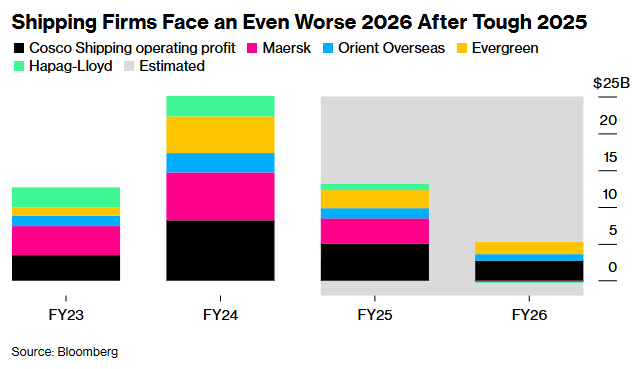
Core Viewpoint - The potential reopening of the Red Sea shipping route is expected to pressure freight rates and exacerbate the existing structural overcapacity in the global container shipping industry, leading to weaker earnings for major shipping companies in 2026 [1][4][8]. Group 1: Market Conditions - Analysts from Bank of America indicate that the reopening of the Red Sea route will intensify the current structural overcapacity issue, with new shipping capacity projected to increase by 36% from 2023 to 2027 [4]. - Container shipping demand is anticipated to decline by 1.1% in 2026 if companies fully return to the Red Sea route, despite a record expansion in shipping capacity [4]. - The Drewry World Container Index reported a 4.7% decrease in freight rates for a 40-foot container, bringing the price down to $2,107 as of January 29 [4]. Group 2: Company Performance - Major shipping companies like Maersk, Hapag-Lloyd, and Nippon Yusen Kaisha are expected to report weaker performance in 2026 following a challenging 2025 marked by tariff volatility [1][8]. - HSBC analysts predict that if the Red Sea route remains open, freight rates could drop an additional 10%, potentially leading to losses for Maersk and Hapag-Lloyd [8]. - Market consensus suggests that Maersk will issue a "soft" profit guidance for 2026 and reduce its stock buyback program by 50%, with expectations of its first annual loss since 2017 [8]. Group 3: Operational Challenges - Shipping companies remain cautious about significantly adjusting their route networks due to the unpredictable nature of the Houthi activities, which could necessitate a rapid change in shipping strategies [9]. - The volatility in the region has led to hesitance among cargo owners to risk high-value goods, resulting in longer shipping cycles [9]. - Despite some companies like Maersk resuming operations, others, such as CMA CGM, have reversed their decisions to use the Red Sea route, highlighting the area's instability [9]. Group 4: Regional Insights - Asian shipping companies may have a relative advantage in profit margins compared to European counterparts due to stronger regional demand and more resilient spot rates [10]. - The ongoing geopolitical disturbances, including tariff uncertainties and Red Sea security risks, continue to impact major global trade routes, particularly trans-Pacific and Asia-Europe routes [10].
首月开通4条新航线 山东港口青岛港北方枢纽能级再跃升
Da Zhong Ri Bao· 2026-02-04 04:01
Core Insights - Shandong Port Qingdao Port has achieved significant breakthroughs in expanding shipping routes, opening four new container lines within a month, enhancing flexibility and options for customers, and ensuring the stability of supply chains [1][2][4] Group 1: Shipping Route Expansion - The total number of foreign trade routes from Qingdao Port has expanded to nearly 240, solidifying its position as the hub with the most routes and highest density in northern ports [1] - The newly opened routes include the Mediterranean shipping Australia-New Zealand line, COSCO's Red Sea line, and Southeast Asia lines, which connect Qingdao Port with over 700 ports in more than 180 countries and regions [1][2] Group 2: Strategic Significance - The expansion of shipping routes reflects a strategic alignment with national development goals, particularly in supporting the Belt and Road Initiative, with over 60% of Shandong's foreign trade involving Belt and Road countries [2][3] - The new Red Sea line connects Qingdao Port with key ports in the Middle East and Africa, facilitating the transport of bulk commodities and supporting emerging industries like new energy vehicles and photovoltaic products [2][3] Group 3: Regional Economic Cooperation - The two new Southeast Asia lines enhance regional economic cooperation, deepening trade links with ASEAN countries and facilitating the movement of electronic products and specialty agricultural goods [3] Group 4: Hub Advantages - The simultaneous launch of four important routes at Qingdao Port indicates strong recognition of its comprehensive strength, including location, economic vitality, operational efficiency, and service quality [4] - Qingdao Port is positioned as China's second-largest foreign trade port and the largest in northern China, benefiting from its unique geographical advantages and extensive inland port network [4][5] Group 5: Operational Efficiency - Qingdao Port boasts world-leading automated container terminals and has broken loading and unloading efficiency records multiple times, ensuring smooth vessel turnover and quick cargo movement [4][5] - The port's customized service offerings and high vessel docking rates contribute to its competitive edge in the global shipping industry [4] Group 6: Business Environment - The continuous optimization of the port's business environment, including seamless integration of smart regulation, has made it a core competitive factor in attracting global shipping companies [5] - In 2025, Qingdao Port's total import and export value reached 2.65 trillion yuan, with exports growing by 5.1%, highlighting its robust trade performance [5] Group 7: Future Outlook - The new shipping routes are expected to enhance the capacity of foreign trade channels, providing timely logistics support for northern foreign trade enterprises and facilitating the dual circulation of domestic and international markets [6][7] - Qingdao Port aims to continue optimizing its global shipping network and enhancing service efficiency, contributing to national strategies and high-quality development [7]