SPD BANK(600000)
Search documents
首单落地,光谷推出“科创金融小银团”,助力解决成长期科技企业“融资困境”
Sou Hu Cai Jing· 2025-11-02 07:19
Core Viewpoint - The successful implementation of the "Science and Innovation Financial Small Syndicate" mechanism in the East Lake High-tech Zone is marked by the first credit loan of 5 million yuan from Hankou Bank, indicating a new approach to financing for growth-oriented technology enterprises [1][2]. Group 1 - The first "Small Syndicate" involves a joint investment of 35 million yuan from five banks, including Industrial and Commercial Bank of China, Wuhan Rural Commercial Bank, Hankou Bank, Shanghai Pudong Development Bank, and Huaxia Bank, tailored for the enterprise Hanning Rail [1]. - The "Science and Innovation Financial Small Syndicate" model innovates on traditional syndicate loans by allowing banks to independently approve loans while sharing information and discussing credit limits, enhancing transparency and trust in financing [1][2]. - This financing model targets growth-stage technology enterprises with financing needs ranging from 20 million yuan to 500 million yuan, addressing common challenges such as insufficient credit limits from single banks and high communication costs among multiple banks [1]. Group 2 - Hubei Province Science and Technology Guarantee Company acts as the operational body, coordinating among banks based on their risk preferences and processes to ensure efficient operation of the mechanism [2]. - In case of operational disruptions for funded enterprises, the Hubei Province Science and Technology Guarantee Company will lead discussions among cooperating banks to stabilize loans, renew loans, or develop orderly exit plans, preventing risks associated with single bank withdrawals [2]. - The initial success of the "Science and Innovation Financial Small Syndicate" has attracted nine banks, with ten enterprise projects accelerating, and nearly 400 enterprises in the reserve pool, indicating strong future growth potential [2].
汇金、证金持仓动向揭秘
财联社· 2025-11-02 02:19
Core Viewpoint - The latest holdings of the "national team" in A-share listed companies have been revealed, with significant investments in major financial institutions and other sectors, indicating a strategic focus on stability and growth in the market [1][2]. Group 1: National Team Holdings - A total of 233 A-share listed companies have the "national team" (China Securities Finance Corporation and Central Huijin) among their top ten shareholders [1]. - There are 30 stocks with a holding value exceeding 10 billion yuan, including major banks like China Construction Bank, Agricultural Bank of China, and Bank of China, with holdings valued at 1.3288 trillion yuan, 1.1429 trillion yuan, and 1.1138 trillion yuan respectively [1][2]. - The top holdings also include companies from various sectors such as insurance, food and beverage, and energy, showcasing a diversified investment strategy [1][2]. Group 2: New Additions and Performance - Farah Electronics has been newly added to the "national team" holdings, with a market value of 158 million yuan [3]. - For the third quarter, Farah Electronics reported a revenue of 3.944 billion yuan, a year-on-year increase of 14.69%, and a net profit of 888 million yuan, also up by 14.58% [3]. - The company’s capacitor products are utilized in ultra-high voltage transmission applications, indicating a focus on high-demand technology sectors [3].
“国家队”持仓动向揭秘!Q3持仓超100亿A股上市公司名单一览
Xin Lang Cai Jing· 2025-11-02 00:45
Core Insights - The latest holdings of the "national team" in A-share listed companies have been revealed, with 233 companies having the "national team" as one of their top ten shareholders [1][2] - In the third quarter, the "national team" held over 10 billion yuan in market value in 30 stocks, including major banks and insurance companies [1] Group 1: Major Holdings - The top three holdings by market value are: - China Construction Bank: 13,288.15 billion yuan - Agricultural Bank of China: 11,429.52 billion yuan - Bank of China: 11,138.27 billion yuan [1] - Other significant holdings include: - Industrial and Commercial Bank of China: 9,914.42 billion yuan - New China Life Insurance: 751.22 billion yuan - Ping An Insurance: 734.02 billion yuan [1][2] Group 2: New Additions - Farah Electronics is a new addition to the "national team" holdings, with a market value of 1.58 billion yuan [2] - The company reported a revenue of 3.944 billion yuan for the first three quarters, a year-on-year increase of 14.69%, and a net profit of 888 million yuan, also up 14.58% [2] - In the third quarter alone, Farah Electronics achieved a revenue of 1.445 billion yuan, reflecting a year-on-year growth of 9.31% [2]
多家银行合计被罚超2亿元,回应来了
Zhong Guo Ji Jin Bao· 2025-11-01 13:39
Core Points - The National Financial Regulatory Administration announced significant fines totaling over 215 million yuan for five major banks in China, including China Bank, Agricultural Bank, Minsheng Bank, Ping An Bank, and Shanghai Pudong Development Bank, due to various regulatory violations [1][4]. Group 1: China Bank - China Bank was fined 97.9 million yuan for issues related to corporate governance, loan management, interbank transactions, bill management, asset quality, and non-performing asset disposal [4]. - Five responsible personnel received warnings and fines totaling 300,000 yuan [4]. - The bank emphasized its commitment to rectifying the identified issues and improving risk management and internal controls [4]. Group 2: Agricultural Bank - Agricultural Bank faced a fine of 27.2 million yuan for non-compliance in product sales, service fees, and improper management of credit fund flows [5]. - One responsible individual was warned and fined 100,000 yuan [5]. - The bank stated that the penalty was a follow-up to previous inspections and highlighted its efforts in addressing the regulatory concerns [5]. Group 3: Minsheng Bank - Minsheng Bank was fined 58.65 million yuan for imprudent management of loans, bills, and interbank transactions, as well as non-compliance in data reporting [5]. - Six responsible personnel received warnings and fines totaling 360,000 yuan [5]. - The bank had previously been fined 5.9 million yuan in September for issues related to system management and operational controls [5]. Group 4: Ping An Bank and Shanghai Pudong Development Bank - Both Ping An Bank and Shanghai Pudong Development Bank were fined for imprudent management of internet loans and agency sales [5]. - Ping An Bank was fined 18.8 million yuan, with two personnel receiving warnings and fines totaling 100,000 yuan [5]. - Shanghai Pudong Development Bank was fined 12.7 million yuan, with one personnel receiving a warning and a fine of 70,000 yuan [5].
“数智化”赋能高质量发展 浦发银行三季度业绩稳中向优
Zhong Guo Jing Ying Bao· 2025-11-01 11:32
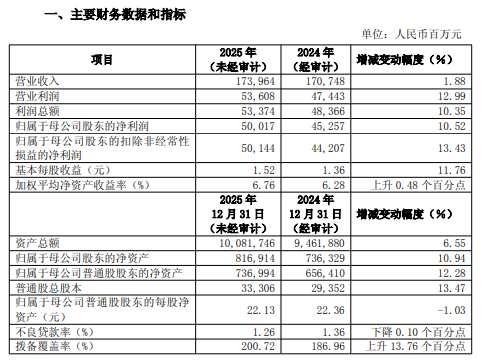
Core Insights - Shanghai Pudong Development Bank (SPDB) reported a positive performance for the first three quarters of 2025, with steady growth in asset and liability scale, improved asset quality, and a solid foundation for high-quality development [1][2] Financial Performance - As of September 30, 2025, SPDB's total assets reached 98,922.14 billion yuan, a 4.55% increase from the end of the previous year [2] - The total amount of loans (including bill discounting) was 56,721.30 billion yuan, up by 2,806.00 billion yuan, reflecting a growth of 5.20% [2] - The bank achieved operating income of 1,322.80 billion yuan, a year-on-year increase of 1.88%, and a net profit attributable to shareholders of 388.19 billion yuan, up 10.21% year-on-year [2] Asset Quality and Risk Management - SPDB maintained a dual approach of "controlling new and reducing old" in risk management, resulting in a decrease in both non-performing loan balance and non-performing loan ratio [2][3] - As of September 30, 2025, the non-performing loan balance was 728.89 billion yuan, a reduction of 2.65 billion yuan, with a non-performing loan ratio of 1.29%, down by 0.07 percentage points [2] - The provision coverage ratio improved to 198.04%, an increase of 11.08 percentage points from the previous year, enhancing the bank's risk mitigation capacity [2] Strategic Initiatives - SPDB is focusing on enhancing its service capabilities for the real economy, accelerating credit issuance in key sectors and regions, and optimizing its asset-liability management [3] - The bank's total deposits increased by 4,727.58 billion yuan, a growth of 9.19%, while the average interest rate on deposits decreased by 38 basis points year-on-year [3] Capital Management - SPDB successfully completed a significant capital action with a 500 billion yuan convertible bond, achieving a high conversion rate of 99.67%, marking it as the largest single convertible bond conversion in A-share history [4] - The full conversion of the bond effectively replenished the bank's core tier one capital, significantly enhancing its capacity to serve the real economy [4] Integrated Development and Regional Focus - The bank is reinforcing its integrated development strategy, with its subsidiaries achieving a combined revenue of 10.56 billion yuan and a net profit of 3.37 billion yuan in the first three quarters [5] - SPDB is focusing on key regions such as the Yangtze River Delta, Beijing-Tianjin-Hebei, and the Guangdong-Hong Kong-Macao Greater Bay Area to enhance credit issuance [5] Sector-Specific Strategies - In technology finance, SPDB has established a "Group Big Technology Innovation" ecosystem, serving over 250,000 technology enterprises with a loan balance exceeding 1 trillion yuan [6] - The bank has also made significant strides in supply chain finance, serving 32,708 clients, a 72.91% increase from the previous year, and achieving an online supply chain business volume of 5,748.56 billion yuan, up 267.65% [6] Inclusive and Cross-Border Finance - SPDB has developed a deep digital "PuHui Loan" product system, with inclusive loan balances reaching 509.9 billion yuan, a 9.49% increase [7] - In cross-border finance, the bank's transaction settlement volume reached 32,879 billion yuan, a 47% year-on-year increase, with cross-border loans totaling 3,258 billion yuan, up 23% [7] Wealth Management and Retirement Services - The bank's personal financial assets under management reached 4.62 trillion yuan, a 19.07% increase, while its pension account scale grew significantly [8] - SPDB is advancing its retirement financial services, with a net increase of 785,300 clients in personal pension accounts, reflecting a growth of over 76% [8] Future Outlook - Looking ahead, SPDB aims to deepen its digital transformation, optimize financial supply structures, and enhance credit issuance to support the real economy, aligning with national strategic deployments [8]
浦发银行被罚1270万 相关互联网贷款等业务管理不审慎
Zhong Guo Jing Ji Wang· 2025-11-01 08:19
Group 1 - The core point of the article is that Shanghai Pudong Development Bank has been penalized for improper management of internet loans and related businesses, resulting in a fine of 12.7 million yuan [1][2] - The financial regulatory authority issued a warning and a fine of 70,000 yuan to a responsible individual named He Rong [1][2] Group 2 - The administrative penalty information was disclosed by the National Financial Supervision and Administration Commission [1] - The violations were specifically related to the management of internet loans and agency sales [2]
中行、农行、民生、平安、浦发五家银行合计被罚超2.15亿元
Jing Ji Guan Cha Bao· 2025-11-01 07:34
Core Viewpoint - The tightening of financial regulation is leading to increased scrutiny and penalties for major banks in China, highlighting compliance failures and internal control weaknesses across the industry [2][8][9]. Group 1: Regulatory Actions - Five major banks, including Bank of China, Agricultural Bank of China, Minsheng Bank, Ping An Bank, and Pudong Development Bank, were collectively fined over 215 million yuan for various violations [2][4]. - The penalties reflect a broader trend of intensified regulatory oversight aimed at improving risk management and compliance within the banking sector [3][8]. Group 2: Specific Bank Penalties - Bank of China received the highest fine of 97.9 million yuan, with penalties against responsible individuals totaling 300,000 yuan, primarily due to issues identified during a risk management inspection [4][5]. - Agricultural Bank of China was fined 27.2 million yuan, with a focus on non-compliance in product sales and loan management practices [5]. - Minsheng Bank faced a fine of 58.65 million yuan, with violations related to loan management and regulatory data reporting [6]. - Ping An Bank was penalized 18.8 million yuan for issues in internet lending and product distribution management [6]. - Pudong Development Bank was fined 12.7 million yuan, primarily for similar issues in internet lending and product distribution [6]. Group 3: Industry Implications - The penalties indicate a systemic issue within the banking sector, where even large institutions struggle with compliance and internal controls, particularly in the context of rapidly evolving financial products [7][9]. - The regulatory environment is shifting towards a model where compliance is becoming a core competitive advantage for financial institutions, necessitating proactive risk management strategies [9].
多家银行,合计被罚超2亿元!回应来了
Zhong Guo Ji Jin Bao· 2025-11-01 06:53
Core Viewpoint - Five banks in China received significant fines totaling over 215 million yuan due to various regulatory violations, highlighting ongoing issues in risk management and compliance within the banking sector [1][4]. Group 1: Fines and Violations - China Bank was fined 97.9 million yuan for imprudent management in areas such as corporate governance, loans, and asset quality, with five responsible personnel receiving warnings and fines totaling 300,000 yuan [2][3]. - Agricultural Bank was fined 27.2 million yuan for non-compliance in product sales and service fees, with one responsible person receiving a warning and a fine of 100,000 yuan [2][4]. - China Minsheng Bank faced a fine of 58.65 million yuan for imprudent management in loans and data reporting, with six responsible personnel receiving warnings and fines totaling 360,000 yuan [2][4]. - Ping An Bank and Shanghai Pudong Development Bank were both fined for imprudent management in internet loans and agency sales, with Ping An Bank fined 18.8 million yuan and Shanghai Pudong Development Bank fined 12.7 million yuan [2][5]. Group 2: Responses and Remedial Actions - China Bank emphasized its commitment to rectifying issues identified during a 2023 risk management inspection and has reportedly completed most of the necessary corrections [4]. - Agricultural Bank stated that the fine was a follow-up to previous inspections and that it has addressed most issues promptly, adhering to a principle of comprehensive remediation [4]. - Minsheng Bank acknowledged previous fines and has taken steps to address regulatory concerns, indicating a proactive approach to compliance [5].
多家银行,合计被罚超2亿元!回应来了
中国基金报· 2025-11-01 06:48
Summary of Key Points Core Viewpoint - Five banks in China received significant fines totaling over 215 million yuan, highlighting ongoing regulatory scrutiny in the banking sector [2]. Group 1: Regulatory Actions and Penalties - China Bank was fined 97.9 million yuan for imprudent management in areas such as corporate governance, loans, and asset quality, with five responsible individuals receiving warnings and fines totaling 300,000 yuan [3][4]. - Agricultural Bank faced a penalty of 27.2 million yuan due to non-compliance in product sales and service fees, with one individual fined 100,000 yuan [5]. - China Minsheng Bank was fined 58.65 million yuan for imprudent management in loans and data reporting, with six individuals receiving warnings and fines totaling 360,000 yuan [5]. - Ping An Bank and Shanghai Pudong Development Bank were both fined for imprudent management in internet loans and related services, with Ping An Bank fined 18.8 million yuan and Shanghai Pudong Development Bank fined 12.7 million yuan [6]. Group 2: Responses from Banks - China Bank emphasized its commitment to rectifying issues identified during regulatory inspections and improving risk management and internal controls [4]. - Agricultural Bank stated that it has addressed most issues raised by regulators and is focused on systematic rectification [5]. - China Minsheng Bank acknowledged previous penalties and has taken steps to address regulatory concerns [5].
股份制银行三季报分化加剧 光大银行盈利下滑幅度超同业
Jing Ji Guan Cha Wang· 2025-11-01 05:28
Core Insights - The performance of China’s listed commercial banks shows a clear divide, with some banks like Shanghai Pudong Development Bank (SPDB) demonstrating strong profit growth, while China Everbright Bank (CEB) faces significant declines in both revenue and net profit [3][4]. Financial Performance - SPDB reported a net profit of 38.819 billion yuan for the first three quarters, a year-on-year increase of 10.21%, while CEB's revenue and net profit fell by 7.94% and 3.63%, respectively [3][4]. - In Q3 alone, CEB's revenue and net profit saw declines of 13.01% and 10.99%, contrasting sharply with the stable or growing performance of peers like SPDB [3][4]. Comparative Analysis - CEB's revenue decline of 7.94% is significantly worse than peers such as China Merchants Bank (-0.51%) and SPDB (+1.88%) [4][5]. - CEB's net profit decline of 3.63% ranks it among the lowest in the sector, while SPDB leads with a 10.21% increase [4][5]. Revenue and Profit Drivers - CEB's net interest income decreased by 5.11%, reflecting a narrowing net interest margin due to falling loan rates and rigid funding costs [6]. - Non-interest income showed volatility, with a significant drop in investment income, which shifted from a net gain of 3.758 billion yuan to a net loss of 4.982 billion yuan [6]. Asset Quality Concerns - CEB's non-performing loan ratio slightly increased to 1.26%, and its provision coverage ratio decreased by 11.67 percentage points to 168.92%, indicating potential risks and profit erosion [6]. Strategic Challenges - CEB is investing heavily in technology finance, green finance, and digital transformation, which has led to increased short-term costs and pressure on profit margins [7]. - The bank's shift towards lower-priced policy-oriented credit assets has further exacerbated the narrowing net interest margin [7]. Industry Context - The banking sector is facing a critical challenge as traditional interest margin benefits diminish, raising questions about future profitability [8]. - CEB's struggles reflect a broader industry trend where banks must adapt quickly to find sustainable business models amid changing economic conditions [8].