SPD BANK(600000)

Search documents
五家银行跻身绿色信贷“万亿俱乐部” 绿色债券存量规模近2万亿
2 1 Shi Ji Jing Ji Bao Dao· 2025-11-05 23:42
Core Insights - Green finance has transitioned from an optional choice to a mandatory requirement for the banking industry, serving as a new engine for strategic transformation and a blue ocean market for future growth [1] - The balance of green financing at Industrial Bank has reached nearly 2.5 trillion yuan, with green loans exceeding 1 trillion yuan and a non-performing loan rate of only 0.57% [1] - The People's Bank of China and other departments have issued a unified policy framework for green finance, effective from October 1, 2025, to standardize various financial products [2] Group 1: Green Credit Growth - As of the end of 2024, the total balance of green credit among 42 A-share listed banks exceeded 27 trillion yuan, reflecting a year-on-year growth of approximately 20% [3] - State-owned banks dominate the green credit market, with the six major state-owned banks accounting for over 21 trillion yuan, representing 77.6% of the total [3] - Industrial Bank's green loan balance has risen to 1.08 trillion yuan, joining the "trillion club" [3] Group 2: Performance and Sector Focus - The average growth rate of green credit for A-share listed banks in 2024 was 20.6%, a slowdown from approximately 28% in 2023, yet leading institutions maintained strong growth [4] - The focus of green credit issuance is concentrated in four key areas: clean energy, green transportation, energy conservation and environmental protection, and green buildings [4] - The Yangtze River Delta, Guangdong-Hong Kong-Macau Greater Bay Area, and Chengdu-Chongqing Economic Circle are identified as core regions for green credit [4] Group 3: Product Innovation - A-share listed banks are deepening innovation in green financial products, creating a multi-dimensional product system that includes loans, bonds, asset securitization, insurance, and carbon finance [5] - Sustainable Development Linked Loans (SLL), carbon emission rights pledge financing, and environmental rights collateral loans are gaining traction [5] - Industrial Bank has launched the first green loan with biodiversity protection insurance, while Bohai Bank introduced a green loan linked to data center energy efficiency [6] Group 4: Broader Financial Tools - The issuance of green bonds has expanded, with the cumulative issuance of labeled green bonds in 2024 surpassing 4 trillion yuan [6] - Banks are actively participating in green wealth management and fund products, enhancing investor engagement through innovative offerings [6] - Carbon finance tools are transitioning from pilot programs to broader applications, with various banks introducing carbon emission rights pledge financing products [6] Group 5: Future Directions - The banking industry is expected to continue innovating green financial products to support sustainable economic development, moving beyond traditional green credit [7] - The development of ESG-linked loans and financing models using carbon emission rights as collateral will be explored [7] - These innovations will not only assist in achieving national carbon reduction goals but also cultivate new growth momentum for banks [7]




陕西省“基金+项目”投融资对接活动在沪举办
Shan Xi Ri Bao· 2025-11-05 23:13
Core Insights - The event held on November 4 in Shanghai aimed to deepen financial and industrial collaboration between Shaanxi Province and developed regions, attracting investment to boost local industry development [1] Group 1: Event Overview - The "Fund + Project" investment and financing matchmaking event was organized by the Shaanxi provincial government, with support from various provincial departments [1] - The event included strategic signing and project roadshow segments to facilitate capital cooperation [1] Group 2: Strategic Partnerships - Shaanxi Caijin Investment Management Co., Ltd. signed strategic cooperation agreements with Shanghai Pudong Development Bank and Guotai Junan Securities [1] - Shaanxi Provincial Government Investment Guidance Fund Management Co., Ltd. entered into fund cooperation agreements with several firms, including Xingsheng Innovation Capital Management and Bank of China International, with a total scale of 3 billion yuan [1] Group 3: Investment Focus - The funds will primarily target sectors such as biomedicine, innovative manufacturing, and artificial intelligence, which are considered hard technology fields [1] Group 4: Project Roadshow - The project roadshow featured high-quality sci-tech projects and investment opportunities that attracted attention from numerous investment institutions in the Yangtze River Delta [1] Group 5: Future Outlook - The Shaanxi Provincial Government Investment Guidance Fund aims to attract more funds and projects to the province through market-oriented operations, laying the groundwork for precise cooperation between the two regions [1]


翻遍9家银行财报,我发现行业洗牌的秘密藏在这些数字里
凤凰网财经· 2025-11-05 13:27
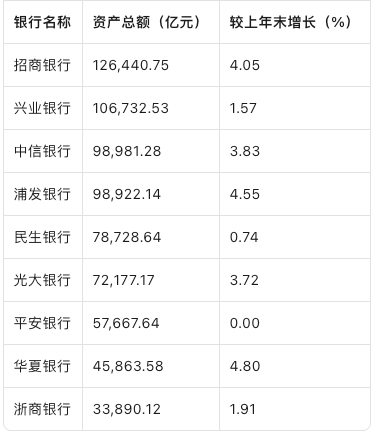
Core Viewpoint - The overall performance of the nine listed joint-stock banks in China showed a decline in both revenue and net profit for the first three quarters, indicating a challenging environment for the banking sector [2][5]. Group 1: Overall Performance - The nine joint-stock banks collectively achieved an operating income of 1.12 trillion yuan, a year-on-year decrease of 2.56%, and a net profit of 406.1 billion yuan, down nearly 1% year-on-year [2][5]. - There is a notable divergence in performance among the banks, with four banks experiencing declines in both revenue and profit, while others managed to achieve growth [2][5]. Group 2: Individual Bank Performance - As of the end of Q3, China Merchants Bank led with total assets of 12.64 trillion yuan, followed by Industrial Bank at 10.67 trillion yuan, with Shanghai Pudong Development Bank showing the fastest growth rate of 4.55% [3][4]. - Only Minsheng Bank and Shanghai Pudong Development Bank reported year-on-year revenue growth of 6.74% and 1.88%, respectively, while the remaining seven banks saw declines, with Ping An Bank experiencing the largest drop at 9.8% [7][8]. Group 3: Net Interest Income - Among the nine banks, only three reported an increase in net interest income, with China Merchants Bank leading at 160.04 billion yuan, a growth of 1.74% [11][12]. - The net interest margin pressure remains a common challenge, with most banks experiencing a decline in this metric, except for Minsheng Bank, which saw a slight increase [13][14]. Group 4: Asset Quality - Most banks reported a decrease in non-performing loan (NPL) ratios, with China Merchants Bank having the lowest at 0.94%, while the others ranged between 1% and 1.5% [15][16]. - The provision coverage ratio decreased for most banks, with Ping An Bank showing the largest decline of 21.11 percentage points [17]. Group 5: Future Outlook - The banks face challenges in narrowing net interest margins in a low-interest-rate environment, and the potential impact of "deposit migration" due to stock market recovery will test their adaptability [17].






翻遍9家银行财报,行业洗牌的秘密藏在这些数字里
Feng Huang Wang Cai Jing· 2025-11-05 13:19
Core Insights - The overall performance of the nine listed joint-stock banks in China showed a decline in both revenue and net profit for the first three quarters, with total operating income of 1.12 trillion yuan, down 2.56% year-on-year, and net profit of 406.1 billion yuan, down nearly 1% [1][4] Group 1: Performance Overview - Four banks experienced a decline in both revenue and net profit, while two banks, Minsheng Bank and Pudong Development Bank, achieved revenue growth [1][4] - Among the nine banks, only Pudong Development Bank reported both revenue and net profit growth, with a net profit increase of 10.21%, making it the leader in profit growth among joint-stock banks [5][11] Group 2: Asset Scale and Growth - As of the end of Q3, China Merchants Bank led with total assets of 12.64 trillion yuan, followed by Industrial Bank at 10.67 trillion yuan, with Pudong Development Bank showing the fastest growth rate of 4.55% [2][3] Group 3: Revenue and Profit Analysis - Revenue performance varied significantly, with only Minsheng Bank and Pudong Development Bank achieving positive year-on-year growth rates of 6.74% and 1.88%, respectively [4][5] - The largest revenue declines were observed in Ping An Bank and Everbright Bank, with decreases exceeding 6%, and Ping An Bank experiencing a 9.78% drop [4][5] Group 4: Net Interest Income and Margin - Net interest income showed a mixed performance, with only three banks reporting growth, while six banks saw declines, the largest drop being 8.25% at Ping An Bank [6][7] - The net interest margin pressure remains a challenge for all listed joint-stock banks, with only Minsheng Bank showing a slight increase in net interest margin [8] Group 5: Asset Quality - Most banks reported a decrease in non-performing loan (NPL) ratios, with China Merchants Bank having the lowest NPL ratio at 0.94% [9][10] - The provision coverage ratio declined for seven banks, with Ping An Bank experiencing the largest drop of 21.11 percentage points [10][11] Group 6: Future Outlook - The banks face challenges in narrowing net interest margins in a low-interest-rate environment, and the upcoming year-end performance will be critical for their strategies [11]
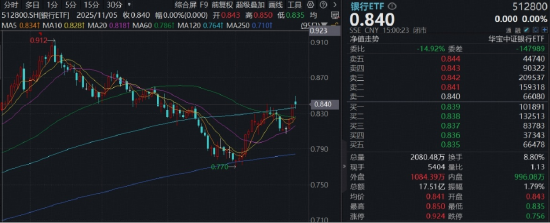
银行变脸转弱,风格还切换吗?规模最大银行ETF(512800)半年线强支撑,历史11-12月胜率较大
Xin Lang Ji Jin· 2025-11-05 11:33
Group 1 - The A-share market experienced fluctuations, with banks showing strong performance, particularly Industrial and Commercial Bank of China reaching a historical high [1] - The largest bank ETF (512800) saw a trading volume of 1.751 billion yuan, maintaining high liquidity despite a slight decline after three consecutive days of gains [1][5] - Analysts suggest that the banking sector is a crucial component for balanced asset allocation as the market approaches year-end, with banks being favored for their defensive qualities amid increased market volatility [3][4] Group 2 - Historical data indicates that the banking sector tends to perform well in November and December, with a higher probability of absolute returns during this period [4] - Factors such as improved earnings, favorable policies, and increased capital allocation are expected to support the ongoing positive trend in bank stocks [4] - The bank ETF (512800) is the largest in A-shares, with a scale exceeding 19.8 billion yuan and an average daily trading volume of over 800 million yuan, making it an efficient investment tool for tracking the banking sector [5]
10月6家银行收到超千万罚单,有行长任职资格罕见被否
21世纪经济报道· 2025-11-05 11:29
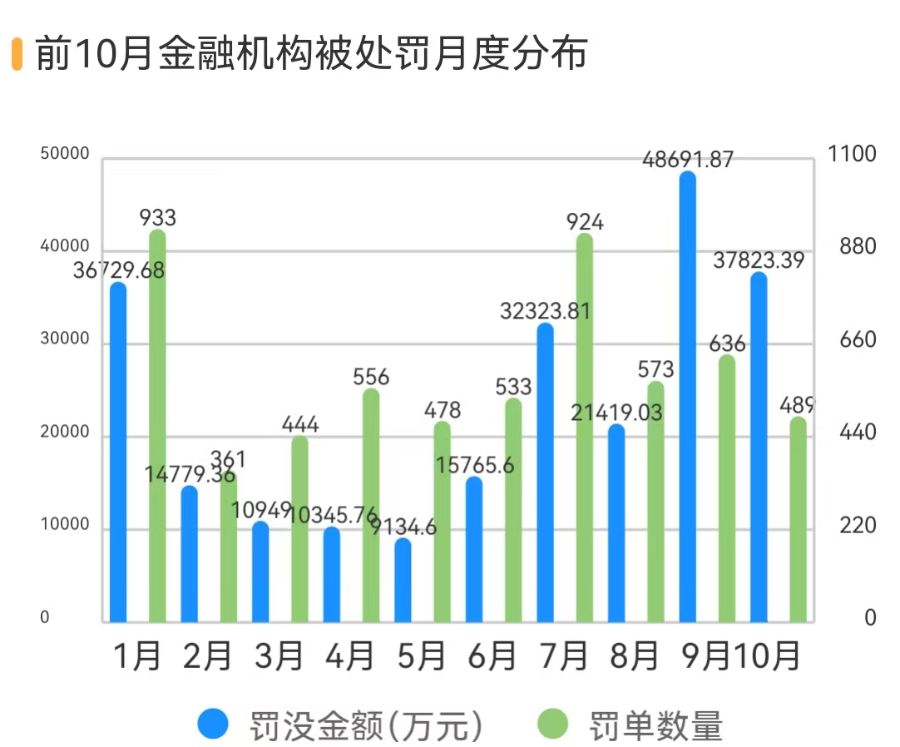
Core Viewpoint - In October, financial institutions received 489 fines, a year-on-year decrease of 2.59%, but the total penalty amount reached 378 million yuan, a significant increase of 223.08% compared to the previous year [2]. Group 1: Penalty Overview - The number of fines in October decreased significantly compared to the first three months of the year, but the total penalty amount remains high, with October being the second highest this year after September [4]. - Regulatory bodies such as the National Financial Supervision Administration, the People's Bank of China, the China Securities Regulatory Commission, and the State Administration of Foreign Exchange all issued fewer fines in October [7]. - Banks received a total of 310 fines, a month-on-month decrease of 24.39%, while insurance companies received 108 fines, down 16.92%, and securities firms received 16 fines, down 42.86% [9]. Group 2: Major Fines - In October, six fines exceeded 10 million yuan, with the largest fine against a bank for issues related to corporate governance, loans, interbank transactions, bills, asset quality, and non-performing asset management [12]. - The largest fine was against the Bank of China, amounting to 97.9 million yuan, for various management failures [13]. - Other significant fines included China Minsheng Bank (28.62 million yuan), Agricultural Bank of China (27.2 million yuan), and Ping An Bank (18.8 million yuan) for similar management issues [14]. Group 3: Compliance Cases - Five Mining Securities was criticized for publishing incorrect coupon rates and issuance results during a bond issuance process, failing to comply with relevant regulations [15][16]. - Tianjin Investment Futures was ordered to rectify its operations due to ineffective risk isolation between its brokerage and proprietary trading businesses, leading to significant losses [17]. - A rare case occurred where the qualification of a bank president was denied due to non-compliance with regulatory requirements, highlighting increased scrutiny on corporate governance in small and medium-sized banks [18]. Group 4: Compliance Characteristics - There was a more than double increase in fines for illegal loan issuance, with 19 fines issued in October, reflecting a year-on-year increase of 111.11% [21]. - Fines related to internal control management also increased, with 32 fines issued in October, a month-on-month increase of 52.38% [23]. Group 5: Penalty Rankings - China Agricultural Development Bank had the highest penalty amount in the third quarter and continued to lead in October [27]. - Zhongcheng Trust received the largest penalty among non-bank institutions in October, with a fine of 6.6 million yuan for various violations [29].
上市银行2025年三季报综述:盈利温和修复,利息与中收共振回暖
Ping An Securities· 2025-11-05 10:38
Investment Rating - The report maintains a "stronger than the market" rating for the banking sector [1][4]. Core Views - As of the end of October, 42 listed banks reported a 1.5% year-on-year increase in net profit for the first three quarters of 2025, an improvement of 0.7 percentage points compared to the first half of 2025 [4][9]. - The report highlights a continued recovery in profitability, driven by a rebound in interest income and non-interest income [4][10]. - The report anticipates that the positive signals from interest margin and non-interest income will persist into the fourth quarter of 2025, with a focus on the impact of policies aimed at reducing competition and the quality of retail assets [15][4]. Summary by Sections Profitability Analysis - The net interest income for the first three quarters of 2025 decreased by 0.6% year-on-year, while non-interest income from fees and commissions grew by 4.6% [10][6]. - The report notes that the profitability of individual banks varies, with some banks like Shanghai Pudong Development Bank and Agricultural Bank of China showing significant growth rates of 10.2% and 3.0% respectively [4][9]. Operational Breakdown - Total asset growth for the 42 listed banks was 9.3% year-on-year, with loan growth at 7.7% and deposit growth at 7.9% [22][4]. - The annualized net interest margin for the third quarter was stable at 1.36%, with a decrease in the cost of interest-bearing liabilities [4][6]. Investment Recommendations - The report suggests a shift towards reallocation rather than trading, emphasizing the importance of structural changes in funding flows that support valuation recovery in the banking sector [6][4]. - Specific banks such as Chengdu Bank, Jiangsu Bank, and Suzhou Bank are highlighted for their regional advantages and potential for continued profit growth [6][4].


浦发银行(600000) - 上海浦东发展银行股份有限公司关于参加2025年上海辖区上市公司三季报集体业绩说明会的公告
2025-11-05 10:30
公告编号:临2025-068 一、业绩说明会类型 本次业绩说明会以网络互动方式召开,公司将针对2025年前三季度的经营情 况、战略推进情况等与投资者进行互动交流和沟通。 二、业绩说明会召开的时间、地点、方式 1 会议召开时间:2025 年 11 月 13 日(星期四)15:00-16:30 会议召开地点:上证路演中心(https://roadshow.sseinfo.com) 会议召开方式:网络互动 投资者可于 11 月 12 日(星期三)17:00 前通过公司邮箱 bdo@spdb.com.cn 进行提前留言提问,公司将在业绩说明会上对投资者普遍关注的问题进 行回答。 (一)会议召开时间:2025年11月13日(星期四)15:00-16:30 证券代码:600000 证券简称:浦发银行 优先股代码:360003 360008 优先股简称:浦发优1 浦发优2 上海浦东发展银行股份有限公司 关于参加 2025 年上海辖区上市公司三季报 集体业绩说明会的公告 本公司董事会及全体董事保证本公告内容不存在任何虚假记载、误导性陈述 或者重大遗漏,并对其内容的真实性、准确性和完整性承担法律责任。 重要内容提示: 上海浦东 ...
五家银行跻身绿色信贷“万亿俱乐部”,绿色债券存量规模近2万亿
2 1 Shi Ji Jing Ji Bao Dao· 2025-11-05 09:41
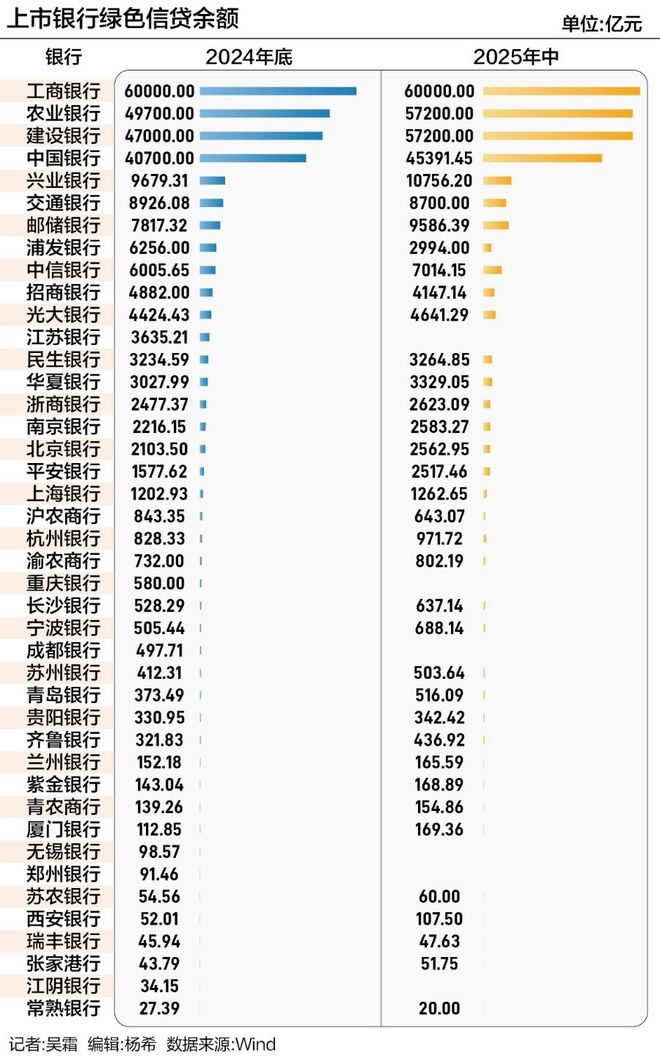
Core Insights - Green finance has transitioned from an optional strategy to a mandatory focus for banks, becoming a new engine for strategic transformation and a blue ocean market in the context of a shift towards a green low-carbon economy [1][2] - The balance of green financing at Industrial Bank has reached nearly 2.5 trillion yuan, with green loans exceeding 1 trillion yuan and a non-performing loan rate of only 0.57% [1] - The People's Bank of China and other departments have issued a unified policy framework for green finance, effective from October 1, 2025, to standardize the support scope for green loans and bonds [2] Green Credit Landscape - By the end of 2024, the total balance of green credit among 42 A-share listed banks exceeded 27 trillion yuan, with a year-on-year growth of approximately 20% [3] - State-owned banks are the main contributors to green credit, with the six major state-owned banks holding over 21 trillion yuan, accounting for 77.6% of the total [3] - The growth pattern shows large banks maintaining scale, joint-stock banks demonstrating strong vitality, and regional banks achieving rapid growth [3] Green Loan Balances - As of the end of 2024, only four listed banks had green loan balances exceeding 1 trillion yuan: Industrial Bank, Agricultural Bank, Construction Bank, and Bank of China [5] - Industrial Bank's green loan balance rose to 1.08 trillion yuan in the first half of the year, joining the "trillion club" [5] - Among joint-stock banks, Industrial Bank, CITIC Bank, and Pudong Development Bank lead in green credit scale, collectively accounting for nearly 40% of the total [5] Growth Rates and Sector Focus - The average growth rate of green credit for A-share listed banks in 2024 was 20.6%, a slowdown from approximately 28% in 2023, yet leading institutions maintained strong growth [5] - The focus of green credit is heavily concentrated in clean energy, green transportation, energy conservation, and green buildings, with key regions being the Yangtze River Delta, Guangdong-Hong Kong-Macau Greater Bay Area, and Chengdu-Chongqing economic circle [6] Financial Product Innovation - A-share listed banks are deepening innovation in green financial products, creating a multi-dimensional product system that includes loans, bonds, asset securitization, insurance, and carbon finance [7] - Green loans remain the core vehicle for green finance, with a total balance exceeding 27 trillion yuan by the end of 2024, reflecting a year-on-year growth of about 20% [7] - Innovative tools such as sustainability-linked loans and carbon emission rights pledge financing are gaining traction [7] Bond and Investment Developments - The issuance of green bonds has expanded, with the cumulative issuance of labeled green bonds in 2024 surpassing 4 trillion yuan [8] - Banks are actively participating in green wealth management and fund products, enhancing investor engagement through innovative offerings [8] - Carbon finance tools are transitioning from pilot programs to broader applications, with banks launching carbon emission rights pledge financing products [8] Future Directions - The banking sector is expected to continue innovating green financial products to support sustainable economic development more effectively [9] - This evolution will extend beyond traditional green loans to include financing models linked to carbon emissions and environmental rights [10]

10月6家银行收到超千万罚单 行长任职资格罕见被否
2 1 Shi Ji Jing Ji Bao Dao· 2025-11-05 09:25
Core Insights - In October, financial institutions received 489 fines, a year-on-year decrease of 2.59%, but the total penalty amount reached 378 million yuan, a significant increase of 223.08% compared to the previous year [1][3] Summary by Categories Penalty Overview - The number of fines issued in October decreased compared to the first three months of the year, but the total penalty amount remains substantial, with October being the second highest for penalties this year, following September [1][3] Institution-Specific Penalties - Banks received 310 fines, a month-on-month decrease of 24.39% - Insurance companies received 108 fines, a month-on-month decrease of 16.92% - Securities firms received 16 fines, a month-on-month decrease of 42.86% - Futures and private equity fines also decreased, while insurance asset management companies remained stable compared to the previous month [5] Major Fines - Six fines in October exceeded 10 million yuan, with the largest fines against banks for issues related to corporate governance, loans, interbank transactions, and asset quality management [8][9] Compliance Cases - Five major compliance cases were highlighted, including: 1. Wenkang Securities faced criticism for issuing incorrect bond rates and results due to improper management of the issuance process [10] 2. Jintou Futures was ordered to rectify its operations after significant losses due to ineffective risk management [11] 3. A rare case of a bank president's qualification being denied due to non-compliance with regulatory requirements [13] Compliance Trends - There was a notable increase in penalties for improper loan issuance, with 19 fines issued, reflecting a year-on-year increase of 111.11% [14] - Penalties related to internal control management also rose, with 32 fines issued, a month-on-month increase of 52.38% [15] Penalty Rankings - China Agricultural Development Bank had the highest penalty amount in October, continuing its trend from the third quarter [18] - Zhongcheng Trust received the largest penalty among non-bank institutions, totaling 6.6 million yuan for various compliance violations [21]