
HUA XIA BANK(600015)

Search documents
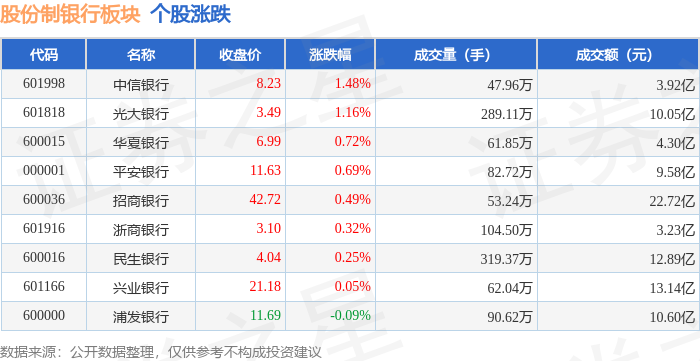
股份制银行板块11月10日涨0.5%,中信银行领涨,主力资金净流入3.71亿元
Zheng Xing Xing Ye Ri Bao· 2025-11-10 08:48
Core Insights - The banking sector saw a 0.5% increase on November 10, with CITIC Bank leading the gains [1] - The Shanghai Composite Index closed at 4018.6, up 0.53%, while the Shenzhen Component Index closed at 13427.61, up 0.18% [1] Banking Sector Performance - CITIC Bank (601998) closed at 8.23, up 1.48% with a trading volume of 479,600 shares and a transaction value of 392 million [1] - Other notable banks included: - Everbright Bank (601818) at 3.49, up 1.16%, with a transaction value of 1 billion [1] - Huaxia Bank (600015) at 6.99, up 0.72%, with a transaction value of 430 million [1] - Ping An Bank (000001) at 11.63, up 0.69%, with a transaction value of 958 million [1] - China Merchants Bank (600036) at 42.72, up 0.49%, with a transaction value of 2.27 billion [1] Capital Flow Analysis - The banking sector experienced a net inflow of 371 million from main funds, while retail and speculative funds saw net outflows of 131 million and 240 million, respectively [1] - Detailed capital flow for major banks included: - China Merchants Bank: Main funds net inflow of 29 million, speculative funds net outflow of 1.47 billion, retail funds net outflow of 1.43 billion [2] - Ping An Bank: Main funds net inflow of 92 million, speculative funds net outflow of 70 million, retail funds net outflow of 21 million [2] - CITIC Bank: Main funds net inflow of 73 million, speculative funds net outflow of 39 million, retail funds net outflow of 34 million [2]






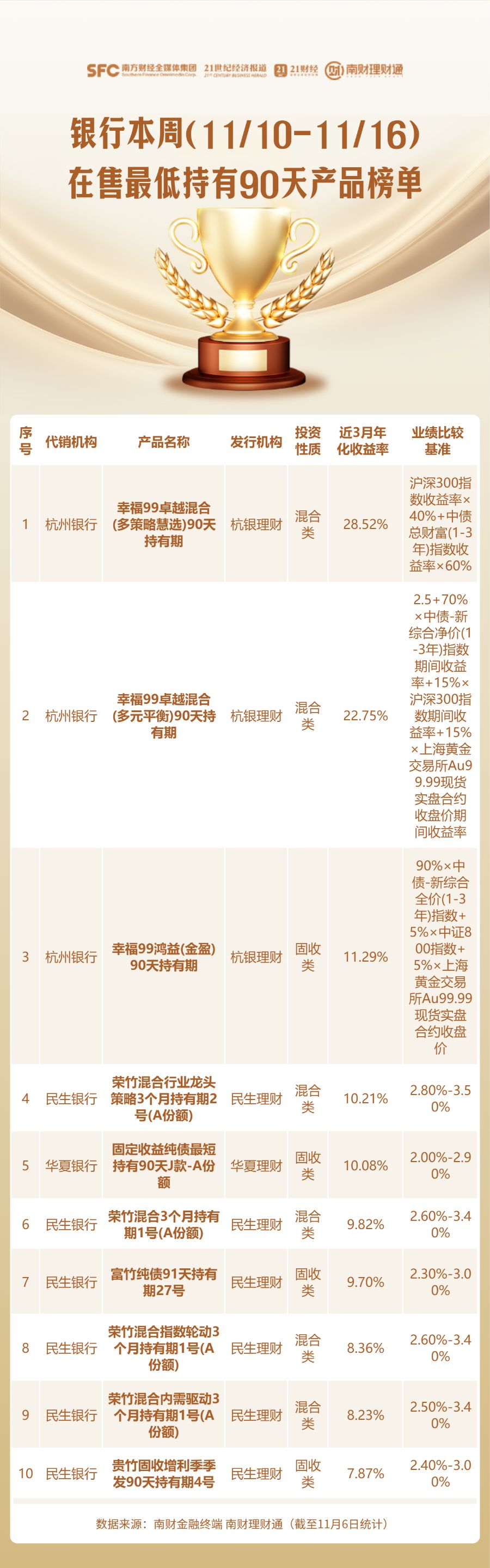
本周在售最低持有期产品哪家强?
2 1 Shi Ji Jing Ji Bao Dao· 2025-11-10 08:44
Core Insights - The article emphasizes the importance of distinguishing between various bank wealth management products, which often have similar names and vague characteristics, to help investors make informed choices [1] - The South Finance Wealth Management team compiles a weekly performance ranking of wealth management products available through different distribution channels, focusing on those with the best performance [1] Product Performance Summary - The report categorizes products based on minimum holding periods of 90 days, 180 days, and 365 days, calculating annualized returns for each category [1] - A total of 28 distribution institutions are involved in the ranking, including major banks such as Industrial and Commercial Bank of China, Bank of China, and Agricultural Bank of China [1] - The ranking is based on the assumption of the product's "on-sale" status, but actual availability may vary due to factors like sold-out quotas or differences in product listings for different customers [1] 90-Day Holding Period Products - The top-performing product for a 90-day holding period is from Hangzhou Bank, with an annualized return of 22.75% [4] - Other notable products include those from Minsheng Bank and Huaxia Bank, with returns of 10.21% and 10.08%, respectively [5] 180-Day Holding Period Products - For the 180-day holding period, Hangzhou Bank's product leads with a return of 14.04% [7] - Minsheng Bank also features prominently with products yielding 12.26% and 10.26% [7] 365-Day Holding Period Products - The report indicates that products with a 365-day holding period are also being evaluated, with specific performance data yet to be detailed in the provided excerpts [9]





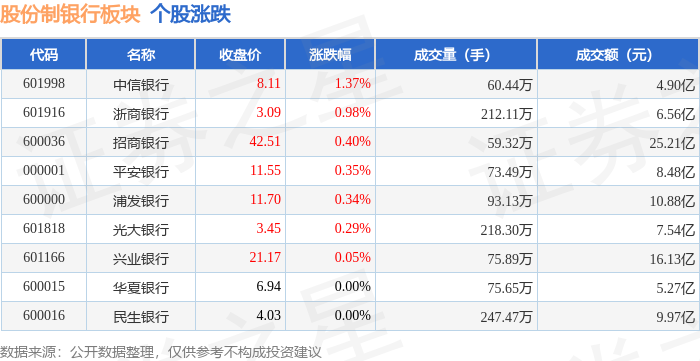
股份制银行板块11月7日涨0.42%,中信银行领涨,主力资金净流出1513.37万元
Zheng Xing Xing Ye Ri Bao· 2025-11-07 08:37
Core Insights - The banking sector saw a slight increase of 0.42% on November 7, with CITIC Bank leading the gains [1] - The Shanghai Composite Index closed at 3997.56, down 0.25%, while the Shenzhen Component Index closed at 13404.06, down 0.36% [1] Banking Sector Performance - CITIC Bank's closing price was 8.11, with a rise of 1.37% and a trading volume of 604,400 shares, amounting to a transaction value of 490 million [1] - Other notable banks included Zhejiang Commercial Bank at 3.09 (up 0.98%), China Merchants Bank at 42.51 (up 0.40%), and Ping An Bank at 11.55 (up 0.35%) [1] - The overall trading volume for the banking sector showed mixed results, with some banks experiencing slight increases while others remained flat or decreased [1] Fund Flow Analysis - The banking sector experienced a net outflow of 15.13 million from institutional investors, while retail investors saw a net inflow of 18.1 million [1] - Specific banks like China Merchants Bank had a net inflow of 17.9 million from institutional investors, while CITIC Bank faced a net outflow of 24.62 million from retail investors [2] - The overall trend indicates a divergence in fund flows, with institutional investors pulling back while retail investors are more active in the sector [2]
上市银行大类资产配置跟踪:信贷投放稳健,债券配置灵活性提升
Ping An Securities· 2025-11-07 08:10
Industry Investment Rating - The investment rating for the banking sector is "Outperform" [1] Core Insights - The proportion of corporate loans has increased, while retail demand recovery is being monitored. As of mid-2025, the proportion of corporate loans among listed banks rose by 1.65 percentage points from the end of 2024 to 60.2%. The manufacturing sector's loans accounted for 18.5% of corporate loans, reflecting a recovery in the operations of manufacturing enterprises [3][12] - The flexibility in bond allocation has increased, with bond trading helping to stabilize market fluctuations. In the first half of 2025, listed banks saw a significant decline in other comprehensive income and fair value changes due to interest rate fluctuations. Some banks, primarily state-owned, increased bond trading to enhance investment returns and stabilize net profit growth [3][6] - Asset quality pressure is manageable, with a focus on risks in the retail sector. The overall asset quality remains stable, with the non-performing loan (NPL) ratio for A-share listed banks holding steady at 1.15% as of Q3 2025. However, the average NPL ratio for retail loans increased by 15 basis points to 1.58% compared to the end of 2024 [3][6] Summary by Sections Corporate Loan Structure - The overall asset structure of listed banks shows an increase in loan allocation, with the loan proportion rising by 0.1 percentage points from the end of 2024. State-owned banks increased interbank asset allocation, while small and medium-sized banks focused more on loan issuance [12][19] - Corporate loans remain the primary focus of credit allocation, with corporate loans accounting for 91.1% of all new loans in the first nine months of 2025. Short-term corporate loans made up 33.7% of new corporate loans [17][18] Bond Investment Preferences - The preference for flexible bond allocation has increased, with banks primarily investing in government bonds and central bank bills. The proportion of OCI accounts has risen, indicating a shift towards more flexible investment strategies [6][3] Asset Quality and Risk Monitoring - The asset quality of the banking sector is stable, with a non-performing loan ratio of 1.15% as of Q3 2025. The retail loan sector has shown slight increases in NPL ratios, necessitating ongoing monitoring of risks in this area [3][6]

5家银行不良率下降,零售AUM增长成亮点
Nan Fang Du Shi Bao· 2025-11-06 23:10
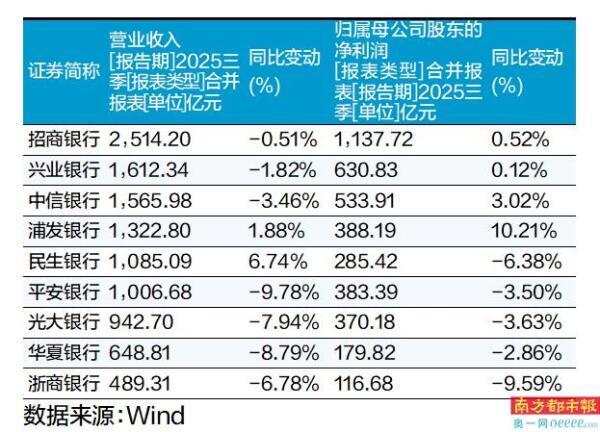
Core Viewpoint - The performance of A-share listed joint-stock banks in the third quarter of 2025 shows a mixed picture, with seven banks experiencing a year-on-year decline in operating income and five banks reporting a drop in net profit. Only Shanghai Pudong Development Bank achieved growth in both metrics [1][2][3]. Group 1: Revenue Performance - Among the nine listed joint-stock banks, only Shanghai Pudong Development Bank and Minsheng Bank reported year-on-year revenue growth, with Minsheng Bank achieving the highest growth rate of 6.74% [2]. - China Merchants Bank led in revenue scale with 2,514.20 billion yuan, followed by Industrial Bank and CITIC Bank with 1,612.34 billion yuan and 1,565.98 billion yuan, respectively [2][3]. - Ping An Bank experienced the most significant revenue decline at -9.78%, while several other banks, including Everbright Bank and Huaxia Bank, also saw declines exceeding 6% [2][3]. Group 2: Net Profit Analysis - China Merchants Bank maintained the highest net profit at 1,137.72 billion yuan, with a slight increase of 0.52% year-on-year. Shanghai Pudong Development Bank saw a notable increase of 10.21% in net profit [3]. - The banks that reported a decline in net profit include Zhejiang Commercial Bank, which had the largest drop at -9.59%, along with Minsheng Bank, Ping An Bank, and others experiencing varying degrees of decline [3]. Group 3: Interest Income and Net Interest Margin - Interest income growth varied significantly, with China Merchants Bank leading at 1,600.42 billion yuan and a 1.74% increase. Shanghai Pudong Development Bank had the highest growth rate in interest income at 3.93% [5]. - The net interest margin faced pressure across the industry, with CITIC Bank experiencing the largest decline of 16 basis points. Only Minsheng Bank reported a slight increase of 2 basis points [5][6]. Group 4: Asset Quality and Provision Coverage - The asset quality of joint-stock banks showed resilience, with a mixed performance in non-performing loan (NPL) ratios. China Merchants Bank had the best NPL ratio at 0.94%, while several banks saw slight increases in their NPL ratios [8]. - Provision coverage ratios decreased for most banks, with China Merchants Bank still leading at 405.93%, despite a decline of 6.05 percentage points [9][10]. Group 5: Loan Structure - The loan structure indicates a shift towards corporate loans, with all five banks reporting growth in corporate loans, while personal loan growth was weak for several banks [11][12]. - China Merchants Bank led in personal loan balance with nearly 3.7 trillion yuan, while corporate loan growth was particularly strong for CITIC Bank, which saw a 10.45% increase [11][12].
银行差异化应对“黄金征税”新政,黄金理财风向有变
Sou Hu Cai Jing· 2025-11-06 10:02
Core Viewpoint - The new gold tax policy, effective from November 1, 2025, distinguishes between "investment" and "non-investment" uses of gold, leading to significant adjustments in banking operations and investor behavior [1][2]. Group 1: Impact on Banking Operations - Major banks have temporarily suspended certain gold-related services, such as招商银行's "金生利" and工商银行's gold accumulation services, in response to the new tax policy [1][3]. - The new tax policy allows for VAT exemption on standard gold transactions through designated exchanges, while non-investment uses will incur a reduced VAT of 6% [2]. Group 2: Changes in Investor Behavior - Investors are shifting towards more rational investment strategies, with banks advising clients to limit gold investments to about 10% of their portfolios and to adopt a long-term holding approach [4]. - The demand for gold has surged, leading to increased prices and longer delivery times for gold products, with some banks adjusting their pricing strategies accordingly [3][4]. Group 3: Alternative Investment Products - With restrictions on physical gold, banks are promoting "paper gold" products, which allow for virtual trading of gold without the need for physical delivery, providing a more flexible investment option [6][9]. - "Paper gold" includes various forms such as gold accounts, gold ETFs, and gold futures, which offer advantages like low transaction costs and high liquidity [9].


翻遍9家银行财报,我发现行业洗牌的秘密藏在这些数字里
3 6 Ke· 2025-11-06 02:03
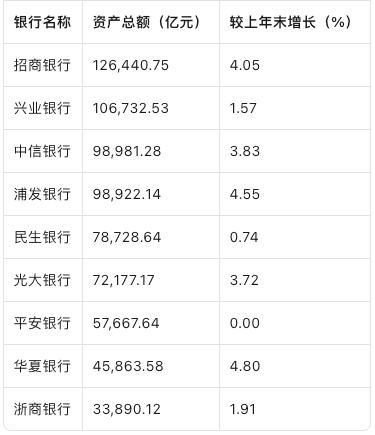
Core Insights - The overall performance of the nine listed joint-stock banks in China showed a decline in both revenue and net profit for the first three quarters of the year, with total operating income at 1.12 trillion yuan, down 2.56% year-on-year, and net profit at 406.1 billion yuan, down nearly 1% [1][3] Group 1: Performance Overview - Among the nine banks, four experienced declines in both revenue and net profit, while some banks managed to achieve growth in both metrics [1][4] - The top joint-stock banks by asset size are China Merchants Bank (12.64 trillion yuan), Industrial Bank (10.67 trillion yuan), and CITIC Bank, with Shanghai Pudong Development Bank showing the fastest growth rate at 4.55% [1][2] Group 2: Revenue and Profit Analysis - Only Minsheng Bank and Shanghai Pudong Development Bank reported year-on-year revenue growth, with increases of 6.74% and 1.88%, respectively; the remaining seven banks saw revenue declines, with Ping An Bank experiencing the largest drop at 9.8% [3][4] - In terms of net profit, only four banks, including Shanghai Pudong Development Bank, reported growth, with the latter achieving a 10.21% increase, making it the leader in profit growth among joint-stock banks [4] Group 3: Net Interest Income and Margin - Net interest income, a key indicator of banks' operating income, showed mixed results, with only three banks reporting growth; China Merchants Bank led with 160.04 billion yuan, up 1.74% [5][6] - The net interest margin (NIM) faced pressure, with most banks experiencing declines; China Merchants Bank maintained the highest NIM at 1.87%, while CITIC Bank saw the largest drop of 16 basis points [7] Group 4: Asset Quality and Risk Management - The non-performing loan (NPL) ratio improved for most banks, with China Merchants Bank having the lowest NPL ratio at 0.94% [9][10] - However, the provision coverage ratio decreased for seven banks, with Ping An Bank showing the largest decline of 21.11 percentage points; Shanghai Pudong Development Bank's coverage ratio increased by 11.08 percentage points, indicating enhanced risk mitigation [10][11]

债市成拖累?多家银行非息收入承压,央行重启国债买卖有何利好
Xin Lang Cai Jing· 2025-11-06 00:38
Core Viewpoint - The bond market's volatility has significantly impacted the non-interest income and overall revenue growth of listed banks in China during the first three quarters of the year [1][3][7]. Group 1: Non-Interest Income Decline - Among 42 A-share listed banks, 24 reported a year-on-year decline in non-interest income, with 8 banks experiencing a drop in net investment income [1][2]. - For instance, China Merchants Bank reported a 4.23% decrease in non-interest net income, primarily due to reduced bond and fund investment returns [3][4]. - Ping An Bank's revenue fell by 9.8%, influenced by declining loan rates and market volatility affecting non-interest income [3]. Group 2: Fair Value Changes - The significant drop in fair value changes has also been a major factor in revenue growth decline, with China Merchants Bank reporting a cumulative loss of 8.827 billion yuan in fair value changes for the first three quarters [4]. - Other banks like Everbright Bank and Huaxia Bank also reported losses in fair value changes, amounting to 4.982 billion yuan and 4.505 billion yuan, respectively [4]. - Analysts noted that fair value changes are highly influenced by bond market fluctuations, with smaller banks being more affected due to a higher proportion of FVTPL assets [4]. Group 3: Future Outlook and Central Bank Actions - The People's Bank of China announced the resumption of government bond trading operations, which is expected to help lower bond yields and benefit banks' non-interest income [11][12]. - Some bank executives expressed uncertainty about future non-interest income growth due to ongoing market volatility, suggesting that the bond market may remain in a fluctuating state [9][10]. - Analysts believe that the resumption of government bond trading will provide a safety net for the bond market, potentially stabilizing yields and supporting both bond and equity markets in the long term [12][13].


五家银行跻身绿色信贷“万亿俱乐部” 绿色债券存量规模近2万亿
2 1 Shi Ji Jing Ji Bao Dao· 2025-11-05 23:42
Core Insights - Green finance has transitioned from an optional choice to a mandatory requirement for the banking industry, serving as a new engine for strategic transformation and a blue ocean market for future growth [1] - The balance of green financing at Industrial Bank has reached nearly 2.5 trillion yuan, with green loans exceeding 1 trillion yuan and a non-performing loan rate of only 0.57% [1] - The People's Bank of China and other departments have issued a unified policy framework for green finance, effective from October 1, 2025, to standardize various financial products [2] Group 1: Green Credit Growth - As of the end of 2024, the total balance of green credit among 42 A-share listed banks exceeded 27 trillion yuan, reflecting a year-on-year growth of approximately 20% [3] - State-owned banks dominate the green credit market, with the six major state-owned banks accounting for over 21 trillion yuan, representing 77.6% of the total [3] - Industrial Bank's green loan balance has risen to 1.08 trillion yuan, joining the "trillion club" [3] Group 2: Performance and Sector Focus - The average growth rate of green credit for A-share listed banks in 2024 was 20.6%, a slowdown from approximately 28% in 2023, yet leading institutions maintained strong growth [4] - The focus of green credit issuance is concentrated in four key areas: clean energy, green transportation, energy conservation and environmental protection, and green buildings [4] - The Yangtze River Delta, Guangdong-Hong Kong-Macau Greater Bay Area, and Chengdu-Chongqing Economic Circle are identified as core regions for green credit [4] Group 3: Product Innovation - A-share listed banks are deepening innovation in green financial products, creating a multi-dimensional product system that includes loans, bonds, asset securitization, insurance, and carbon finance [5] - Sustainable Development Linked Loans (SLL), carbon emission rights pledge financing, and environmental rights collateral loans are gaining traction [5] - Industrial Bank has launched the first green loan with biodiversity protection insurance, while Bohai Bank introduced a green loan linked to data center energy efficiency [6] Group 4: Broader Financial Tools - The issuance of green bonds has expanded, with the cumulative issuance of labeled green bonds in 2024 surpassing 4 trillion yuan [6] - Banks are actively participating in green wealth management and fund products, enhancing investor engagement through innovative offerings [6] - Carbon finance tools are transitioning from pilot programs to broader applications, with various banks introducing carbon emission rights pledge financing products [6] Group 5: Future Directions - The banking industry is expected to continue innovating green financial products to support sustainable economic development, moving beyond traditional green credit [7] - The development of ESG-linked loans and financing models using carbon emission rights as collateral will be explored [7] - These innovations will not only assist in achieving national carbon reduction goals but also cultivate new growth momentum for banks [7]

绿色金融赋能产业园区低碳转型
Jing Ji Ri Bao· 2025-11-05 22:18
Core Viewpoint - Green finance is becoming a significant force in promoting low-carbon transformation of local economies, exemplified by the collaboration between Huaxia Bank and the Asian Development Bank (ADB) to support the green transition of industrial parks in Huzhou [1][2]. Group 1: Financing and Collaboration - Huaxia Bank's Huzhou branch has secured 315 million yuan in financing support for the Huzhou Modern Logistics Equipment High-Tech Industrial Park, marking an innovative case of utilizing ADB's funds for green low-carbon development [1]. - The total funding for this collaboration is nearly 3 billion yuan, with loans provided on a 1:1 matching basis to specifically support the green transformation of industrial parks across the country [1]. - The project employs a financing model combining "ADB low-cost loans + Huaxia Bank's self-operated funds," resulting in a reduction of approximately 1.5 percentage points in comprehensive financing costs compared to traditional project loans [1]. Group 2: Project Implementation and Impact - A joint working group has been established between Huaxia Bank's Huzhou branch and the Huzhou High-tech Zone to design a "distributed photovoltaic + energy storage + smart scheduling" virtual power plant project, optimizing local power consumption [2]. - Upon completion, the project is expected to generate approximately 133 million kilowatt-hours of electricity annually, replacing 38,000 tons of standard coal and reducing carbon dioxide emissions by 115,000 tons, equivalent to the annual carbon absorption of 630 hectares of forest [2]. - The park's green electricity consumption ratio will exceed 65%, with a local clean energy consumption rate surpassing 90%, leading to an 18% reduction in overall energy intensity and an annual energy cost saving of about 32 million yuan [2]. Group 3: Future Developments - Huaxia Bank plans to further explore the integration of the virtual power plant management platform with the green credit system, utilizing IoT to collect generation data for automatic review and traceability of carbon assets [2]. - The "green digital twin" system will be employed to achieve visual management of the project's entire lifecycle [2]. - The leadership of Huaxia Bank's Hangzhou branch indicated intentions to continue leveraging the ADB cooperation framework to replicate and promote this model, aiding more parks in achieving "zero carbon" upgrades [2].