CMBC(600016)

Search documents
股份制银行板块8月12日涨0.24%,中信银行领涨,主力资金净流入2.24亿元
Zheng Xing Xing Ye Ri Bao· 2025-08-12 08:31
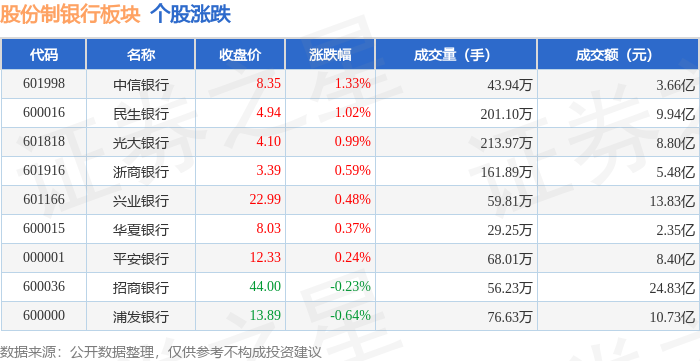
证券之星消息,8月12日股份制银行板块较上一交易日上涨0.24%,中信银行领涨。当日上证指数报收于 3665.92,上涨0.5%。深证成指报收于11351.63,上涨0.53%。股份制银行板块个股涨跌见下表: | 代码 | 名称 | 收盘价 | 涨跌幅 | 成交量(手) | 成交额(元) | | --- | --- | --- | --- | --- | --- | | 601998 | 中信银行 | 8.35 | 1.33% | 43.94万 | 3.66亿 | | 600016 | 民生银行 | 4.94 | 1.02% | 201.10万 | 9.94亿 | | 601818 | 光大银行 | 4.10 | 0.99% | 213.97万 | 8.80亿 | | 601916 | 浙商银行 | 3.39 | 0.59% | 161.89万 | 5.48亿 | | 601166 | 兴业银行 | 22.99 | 0.48% | 59.81万 | 13.83亿 | | 600015 | 半夏银行 | 8.03 | 0.37% | 29.25万 | 2.35 Z | | 000001 | 平安银行 | 12. ...






服务业经营主体贷款贴息方案落地!年贴息比例为1个百分点,21家银行参与经办
Bei Jing Shang Bao· 2025-08-12 08:03
贴息标准方面,《实施方案》明确,对于经办银行向服务业经营主体发放的贷款,财政部门按照贷款本 金对经营主体进行贴息,贴息期限不超过1年,年贴息比例为1个百分点,中央财政、省级财政分别承担 贴息资金的90%、10%。单户享受贴息的贷款规模最高可达100万元。相关贷款包括用于改善消费基础 设施的固定资产贷款以及用于提升服务供给能力的流动资金贷款。同一笔贷款不得重复享受中央财政其 他贴息政策;已享受地方财政相关贴息政策的,此次贴息不得超出扣除已有贴息后的实际利率水平。 北京商报讯(记者 宋亦桐)8月12日,据财政部官网消息,为贯彻落实党中央和国务院关于大力提振消 费、全方位扩大国内需求的决策部署,财政部、民政部、人力资源社会保障部、商务部、文化和旅游 部、国家卫生健康委、中国人民银行、金融监管总局、体育总局发布关于印发《服务业经营主体贷款贴 息政策实施方案》的通知(以下简称《实施方案》)。 据了解,中央财政给予贴息的服务业经营主体贷款经办银行为21家全国性银行,包括国家开发银行、中 国进出口银行、中国农业发展银行、中国工商银行股份有限公司、中国农业银行股份有限公司、中国银 行股份有限公司、中国建设银行股份有限公司、交 ...



银行理财子公司再扩容 “破净”产品已不足千款
Xin Hua Wang· 2025-08-12 06:25
Core Viewpoint - Minsheng Wealth Management has been approved to commence operations, increasing the number of approved wealth management subsidiaries under national joint-stock banks to nine [1][2]. Group 1: Company Developments - The China Banking and Insurance Regulatory Commission has granted approval for Minsheng Wealth Management to operate, following a year and a half of preparation since its establishment approval in December 2020 [2]. - Minsheng Wealth Management is the fourth bank wealth management subsidiary approved to operate this year, bringing the total number of approved subsidiaries to 26, with 29 banks having received establishment approval [2]. - The major banks, including state-owned and joint-stock banks, have been proactive in establishing wealth management subsidiaries, with all six major state-owned banks now operational [2]. Group 2: Market Trends - The A-share market's rebound has led to a noticeable recovery in the net value of bank wealth management products, with the number of "broken net" products dropping from 1,680 at the end of March to under 1,000 by June 19 [1][4]. - As of June 19, only 987 out of 13,298 disclosed bank wealth management products had a unit net value below 1, resulting in a "broken net" ratio of 7.42%, down from 14.77% in March [4]. - The issuance of bank wealth management products has stabilized, with 966 products issued in May, a slight decrease from the previous month, while the total number of products on sale increased by 140 to 2,746 [4]. Group 3: Financial Performance - The financial performance of wealth management subsidiaries has been strong, with 12 out of 17 publicly listed banks reporting a net profit increase exceeding 100% last year [3]. - Notably, Zhaoyin Wealth Management achieved a net profit of 3.203 billion yuan [3].
数字化赋能成效凸显 银行零售业务快速发展
Xin Hua Wang· 2025-08-12 06:17
Core Insights - The retail business has become a strategic focus for many banks, with increasing attention from institutional investors on its development [1][4] - Digital transformation is playing a crucial role in enhancing retail banking capabilities and service offerings [5][6] Group 1: Retail Business Development - Several listed banks are actively expanding their retail business, with notable growth in personal financial asset management and deposits [2][3] - For instance, Hu'nong Commercial Bank reported a 10.89% increase in managed personal financial assets, reaching 687.33 billion yuan by September 2022 [2] - Minsheng Bank's retail customer total assets grew by 1.19 billion yuan, with retail business revenue accounting for 49.01% of total revenue, up 5.57 percentage points year-on-year [3] Group 2: Digital Empowerment - Digitalization is integral to the transformation of retail banking, with banks implementing various digital strategies to enhance customer engagement and service efficiency [5][6] - Minsheng Bank has successfully engaged 37.4 million customers through digital channels, achieving an 11.39% success rate in customer activation [5] - Nanjing Bank is leveraging big data to provide integrated financial services, focusing on wealth management and product innovation [6] Group 3: Future Challenges and Strategies - The retail banking sector faces challenges such as high costs and competition from alternative financial services, necessitating a focus on sustainable value creation [4][7] - Banks are encouraged to maintain strategic focus and invest in retail banking while exploring partnerships with external institutions to enhance service offerings [8] - The future growth of retail banking is expected to be driven by improved asset management capabilities and wealth management services [8]
贷款大单频落地 银行业促进民企发展壮大
Xin Hua Wang· 2025-08-12 06:16
日前,工商银行、农业银行、中国银行、建设银行、交通银行五大行牵头,联合民生银行、进出口 银行、浦发银行,共同组成银团,向上海复星高科技(集团)有限公司(以下简称"复星高科")提供总 计人民币120亿元贷款。这是今年开年以来,银行签约的最大一笔民营企业贷款。 近年来,银行对民营企业的信贷支持力度不断加大。多家银行表示,将进一步完善敢贷、愿贷、能 贷、会贷长效机制,持续优化信贷政策,提供多元化综合服务,促进民营经济发展壮大。 民企大额贷款频现 截至2022年11月末,普惠型小微企业贷款余额23.2万亿元,同比增长23.7%。银行业民营小微企业 信贷投放总体呈现"量增、面扩、价降、质升"的良好态势。 1月16日,复星高科与8家国内银行签署贷款协议。根据协议,工商银行、农业银行、中国银行、建 设银行、交通银行作为联合牵头行,民生银行、进出口银行、浦发银行作为参贷行,共同组成银团,向 复星高科提供总计120亿元人民币贷款。 业内人士指出,2022年底召开的中央经济工作会议提出,要从制度和法律上把对国企民企平等对待 的要求落下来,从政策和舆论上鼓励支持民营经济和民营企业发展壮大。此次银团贷款成功落地,是银 行机构积极发挥 ...




民生银行发布2024年年报:业务结构持续优化 客户基础不断夯实
Xin Hua Wang· 2025-08-12 06:10
Core Insights - Minsheng Bank reported total assets of 78,149.69 billion yuan as of the end of 2024, an increase of 1,400.04 billion yuan, or 1.82% year-on-year [1] - The bank's net interest margin for 2024 was 1.39%, a decrease of 7 basis points from the previous year, but the decline has narrowed [1] - The bank focused on supporting key areas of the real economy, optimizing its asset-liability structure, and stabilizing net interest margins [1] Asset Side - The total amount of loans and advances reached 44,504.80 billion yuan, increasing by 656.03 billion yuan, or 1.50% year-on-year [1] - Growth rates for green credit, manufacturing loans, and inclusive small and micro enterprise loans were 22.41%, 9.38%, and 8.24%, respectively, all exceeding the average loan growth rate [1] - Loans in key regions such as Beijing-Tianjin-Hebei, Yangtze River Delta, and Guangdong-Hong Kong-Macao Greater Bay Area accounted for 65.57% of total loans, up 0.69 percentage points from the previous year [1] Liability Side - The bank actively reduced high-cost liabilities and expanded demand deposit sources, achieving a 4.54% increase in total deposits to 42,490.95 billion yuan [2] - The proportion of demand deposits in total deposits rose to 34.08%, an increase of 2.61 percentage points from the previous half-year [2] - The bank emphasized customer management, resulting in a steady increase in customer numbers and enhanced sustainable development capabilities [2] Small and Medium Enterprises (SMEs) - The bank aims to become the primary bank for small and medium-sized enterprises by optimizing its service model and enhancing customer acquisition channels [3] - As of the end of 2024, the loan balance for small and medium enterprises was 9,720.41 billion yuan [3] - The number of institutional clients increased by 15.96% year-on-year, reaching 39,637 [3] Inclusive Finance - The bank has enhanced its differentiated advantages in small and micro finance, with small micro loans totaling 8,551.02 billion yuan, an increase of 638.86 billion yuan [4] - The average interest rate for inclusive small micro enterprise loans was 4.27%, down 38 basis points from the previous year [4] - Retail customer numbers grew by 5.99% to 134.29 million, with private banking clients increasing by 12.48% [4]
银行股持续拉升
Di Yi Cai Jing· 2025-08-12 05:49
Core Viewpoint - Agricultural Bank of China saw its stock price increase by over 1% during trading, reaching a new historical high, with other banks such as Everbright Bank, Postal Savings Bank, Industrial Bank, Minsheng Bank, and Chongqing Bank also experiencing gains [1] Group 1 - Agricultural Bank of China achieved a stock price increase of over 1% [1] - The stock price of Agricultural Bank of China reached a new historical high [1] - Other banks including Everbright Bank, Postal Savings Bank, Industrial Bank, Minsheng Bank, and Chongqing Bank followed suit with their stock price increases [1]

股份制银行板块8月8日跌0.24%,招商银行领跌,主力资金净流出3.65亿元
Zheng Xing Xing Ye Ri Bao· 2025-08-08 08:35
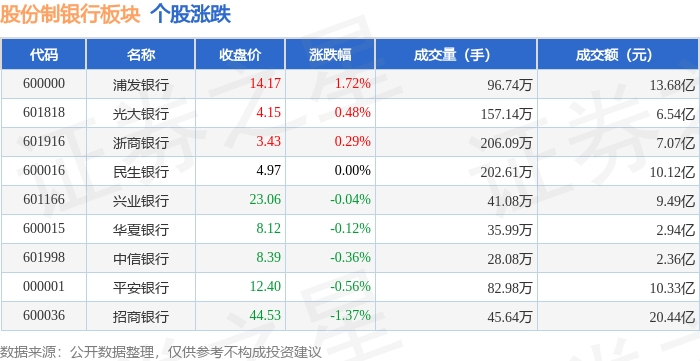
Group 1 - The banking sector experienced a decline of 0.24% on August 8, with China Merchants Bank leading the drop [1] - The Shanghai Composite Index closed at 3635.13, down 0.12%, while the Shenzhen Component Index closed at 11128.67, down 0.26% [1] - Among the listed banks, Shanghai Pudong Development Bank saw the highest increase of 1.72%, while China Merchants Bank had the largest decrease of 1.37% [1] Group 2 - The banking sector faced a net outflow of 365 million yuan from main funds, while retail investors contributed a net inflow of 363 million yuan [1] - Specific banks like Huaxia Bank and China Merchants Bank experienced significant net outflows from main funds, with China Merchants Bank seeing a net outflow of 239 million yuan [1] - Retail investors showed strong interest in several banks, with notable inflows into Huaxia Bank and China Merchants Bank, despite the overall outflow from main funds [1]

民生银行与民营火箭“六支箭”的星辰大海
Zhong Guo Jing Ji Wang· 2025-08-08 07:23
Core Insights - The commercial space industry in China is witnessing significant advancements, with multiple private rocket companies successfully launching payloads into orbit, marking a transformative period in the sector [1][2][3] - Minsheng Bank has strategically positioned itself to support these companies through tailored financial services, demonstrating a commitment to innovation and collaboration within the industry [2][3][4] Group 1: Industry Developments - The successful launch of the "Li Jian No. 1" rocket by China Aerospace Yu Hang, which delivered six satellites into orbit, highlights the capability of Chinese private rockets to handle over six tons of payload [1] - The completion of the "Tianqi Constellation" global network by Xinghe Power's "Goddess Star No. 1" signifies a major milestone in the era of interconnected devices [1] - The advancements in liquid oxygen-methane rocket technology by Blue Arrow Aerospace with the "Zhuque No. 2" rocket further showcase the progress in China's commercial space capabilities [1] Group 2: Financial Support and Strategy - Minsheng Bank has proactively engaged with the commercial space sector, providing comprehensive financial services to five out of six major private rocket companies, thus facilitating their growth and innovation [1][2] - The bank has adopted a differentiated service strategy, focusing on understanding the unique risks and opportunities within the commercial space industry, moving beyond traditional credit assessment methods [2][3] - Minsheng Bank's establishment of specialized financial branches and institutions aims to support high-tech industries and enhance its understanding of the commercial space sector [2] Group 3: Comprehensive Service Offerings - The "Minsheng Easy Innovation" service matrix offers a one-stop solution for technology companies, integrating various financial products and services tailored to their needs [4] - Minsheng Bank plays a proactive role in equity financing for private rocket companies, leveraging its network to connect them with venture capital and private equity firms [4] - The bank provides premium services to executives and employees of these companies, enhancing their overall experience and support [4] Group 4: Ecosystem Development - Minsheng Bank is expanding its financial services across the entire commercial space industry chain, from upstream suppliers to downstream satellite manufacturing and data applications [6] - The "Minsheng E-Chain" product series addresses diverse financing needs within the supply chain, utilizing transaction data for risk assessment and financial service delivery [6] - The bank's commitment to supporting the commercial space sector aligns with its mission to facilitate the realization of ambitious projects and innovations in the industry [6]
中国民生银行亮相2025中国国际金融展
Zhong Guo Jing Ji Wang· 2025-08-08 07:20
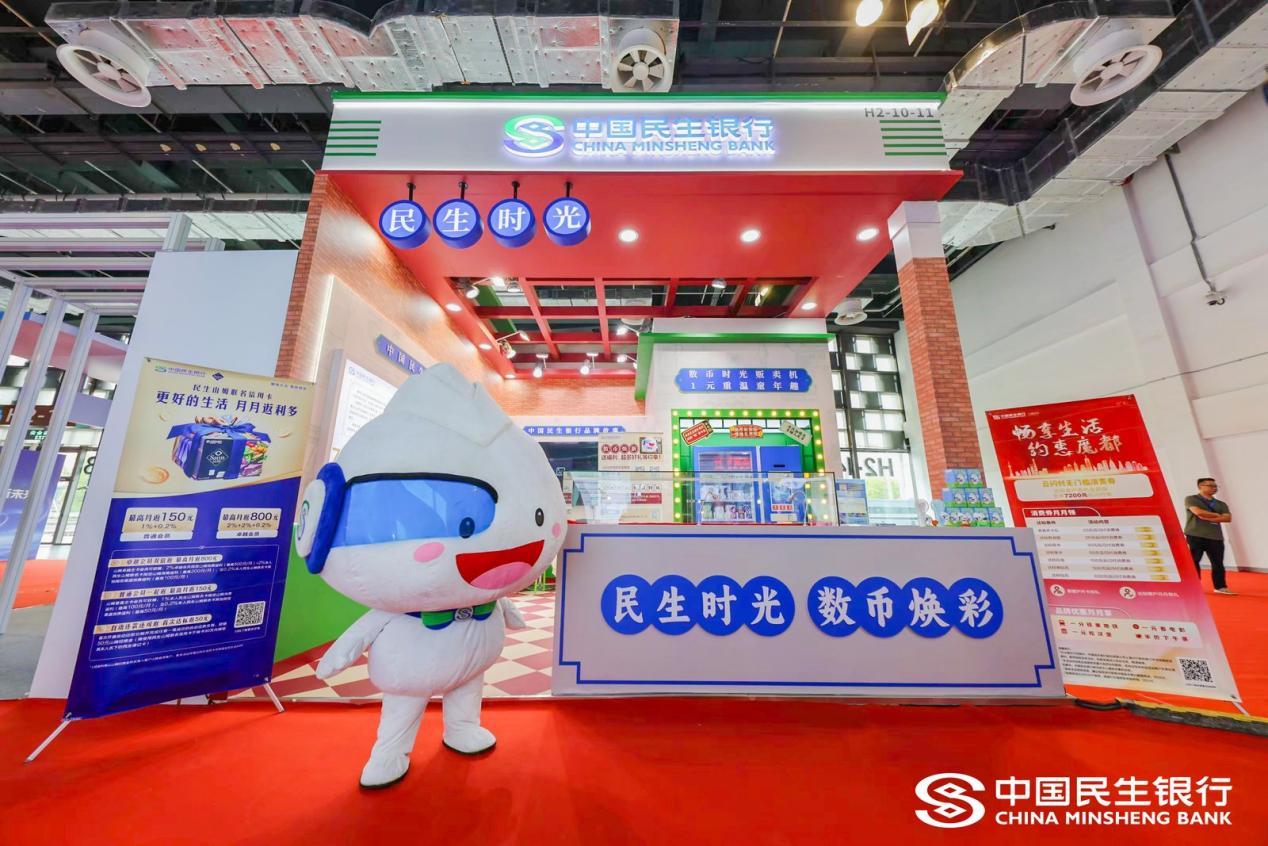
6月18日至20日,2025年中国国际金融展在上海举行。本届展会以"开放创新,科技赋能,共创金融新未来"为主题,中国民生银行作为受邀参展单位亮 相此次金融盛会。 在金融展数字人民币专区,民生银行以"民生时光 数币焕彩"为主题,打造复古国潮风格展区,通过"数币创新成果""数币品牌故事""数币时光贩卖 机""数币趣味互动"四大体验专区,全面展示该行在数字人民币领域的探索实践与创新成果。 民生银行展区凭借独特的国潮设计、沉浸式互动体验及前沿数币应用,成为数币专区焦点,吸引大量观众驻足参与。"数币时光贩卖机"前互动热 烈,"数币趣味互动"打卡不断,现场气氛高涨。同时,民生银行在数字人民币领域的实践引发同业机构、行业专家及媒体深度交流。 民生银行高度重视数字人民币试点工作。在中国人民银行有力指导下,民生银行作为数字人民币2.5层合作银行,与中国人民银行数字货币研究所和运 营机构密切合作,深度参与数字人民币建设与推广,积极开展数字人民币应用场景创新,取得了突出成果。 目前,民生银行已在数字人民币APP以及行内多个渠道为客户提供数字人民币服务,是国内首家对接互联互通平台受理数字人民币收单业务的合作银 行,是国内首家在数字人 ...