
CMBC(600016)

Search documents
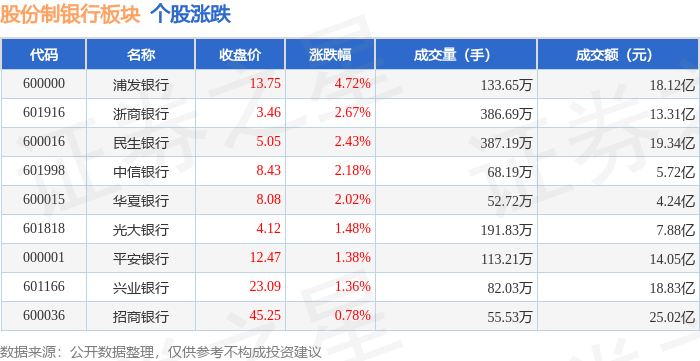
股份制银行板块8月5日涨1.86%,浦发银行领涨,主力资金净流入6.42亿元
Zheng Xing Xing Ye Ri Bao· 2025-08-05 08:37
从资金流向上来看,当日股份制银行板块主力资金净流入6.42亿元,游资资金净流出5.53亿元,散户资金 净流出8914.7万元。股份制银行板块个股资金流向见下表: 证券之星消息,8月5日股份制银行板块较上一交易日上涨1.86%,浦发银行领涨。当日上证指数报收于 3617.6,上涨0.96%。深证成指报收于11106.96,上涨0.59%。股份制银行板块个股涨跌见下表: | 代码 | 名称 | 收盘价 | 涨跌幅 | 成交量(手) | 成交额(元) | | --- | --- | --- | --- | --- | --- | | 600000 | 浦发银行 | 13.75 | 4.72% | 133.65万 | 18.12 乙 | | 601916 | 浙商银行 | 3.46 | 2.67% | 386.69万 | 13.31亿 | | 600016 | 民生银行 | 5.05 | 2.43% | 387.19万 | 19.34亿 | | 601998 | 中信银行 | 8.43 | 2.18% | 1 68.19万 | 5.72亿 | | 600015 | 华夏银行 | 8.08 | 2.02% | 52.7 ...







A股银行股集体上涨,农业银行再创历史新高
Ge Long Hui A P P· 2025-08-05 05:40
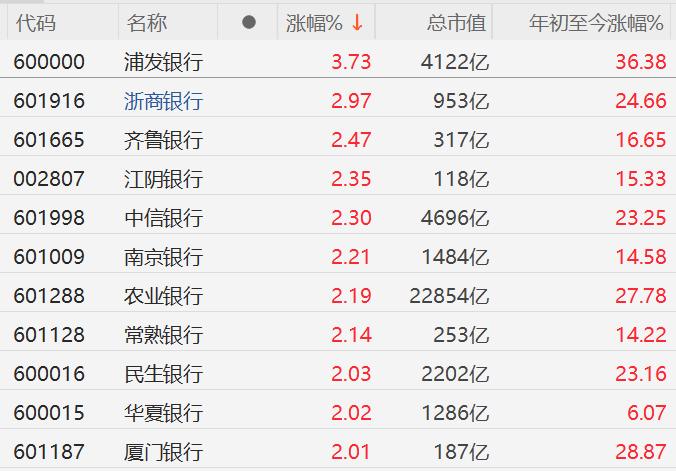
格隆汇8月5日|A股市场银行股集体上涨,其中,浦发银行涨超4%,浙商银行、齐鲁银行、江阴银 行、中信银行、南京银行、农业银行、常熟银行、民生银行、华夏银行、厦门银行涨超2%。值得注意 的是,农业银行再创历史新高。 | 代码 | 名称 | 涨幅% ↓ | 总市值 | 年初至今涨幅% | | --- | --- | --- | --- | --- | | 600000 | 浦发银行 | 3.73 | 4122亿 | 36.38 | | 601916 | 浙商银行 | 2.97 | 953亿 | 24.66 | | 601665 | 齐鲁银行 | 2.47 | 317亿 | 16.65 | | 002807 | 江阴银行 | 2.35 | 118亿 | 15.33 | | 601998 | 中信銀行 | 2.30 | 4696亿 | 23.25 | | 601009 | 南京银行 | 2.21 | 1484亿 | 14.58 | | 601288 | 农业银行 | 2.19 | 22854亿 | 27.78 | | 601128 | 常熟銀行 | 2.14 | 253亿 | 14.22 | | 600016 | 民 ...


四川金融监管局核准赵小望中国民生银行成都分行副行长任职资格
Jin Tou Wang· 2025-08-05 03:20
二、中国民生银行应要求上述核准任职资格人员严格遵守金融监管总局有关监管规定,自中国民生银行 政许可决定作出之日起3个月内到任,并将其任职文件及时抄送四川金融监管局。未在上述规定期限内 到任的,本批复文件失效,由四川金融监管局办理行政许可注销手续。 三、中国民生银行应督促上述核准任职资格人员持续学习和掌握经济金融相关法律法规,牢固树立风险 合规意识,熟悉任职岗位职责,忠实勤勉履职。 2025年7月31日,四川金融监管局发布批复称,《中国民生银行(600016)股份有限公司关于赵小望高 级管理人员任职资格许可的请示》(民银报〔2025〕171号)收悉。经审核,现批复如下: 一、核准赵小望中国民生银行股份有限公司成都分行副行长的任职资格。 未尽事项按金融监管总局有关规定办理。 ...
2025下半程:促经济增长有哪些实招?
Jin Rong Shi Bao· 2025-08-04 12:06
Group 1: Economic Overview - The global economy in 2025 is at a crossroads, influenced by trade protectionism and geopolitical tensions, particularly the "America First" policy of the Trump administration [1] - China's economy reported a stable GDP growth of 5.3% in the first half of the year, but faces challenges such as low prices and insufficient domestic demand [1][2] Group 2: Structural Analysis of Economic Growth - The GDP growth of 5.3% reflects a stable overall trend, but there is significant structural differentiation, with the secondary industry declining due to weak construction and real estate investment [2] - Exports showed unexpected resilience, partly due to progress in US-China tariff negotiations, while fixed asset investment only grew by 2.8%, contributing to economic slowdown in the second quarter [2][3] Group 3: Domestic Demand Challenges - The decline in retail sales and fixed asset investment in June highlights insufficient domestic demand, with consumer spending affected by the timing of promotional events and slow growth in income [3] - The manufacturing sector is facing challenges, with a low capacity utilization rate of 74.3% in the second quarter, indicating weak corporate expectations [3] Group 4: External Challenges and Export Outlook - Trump's tariff policy is reshaping the global industrial system, with potential trade agreements among major economies but high uncertainty due to fluctuating tariffs [4] - The export growth rate is expected to slow in the second half of the year, as US tariffs on China remain significantly higher than before Trump's presidency, leading to pressure on exports [4] Group 5: Policy Focus Areas - The policy focus will be on effectively implementing existing policies while preparing for potential new policies, particularly in consumer spending and investment [5] - Specific measures include increasing income for low- and middle-income groups, promoting service consumption, and stabilizing real estate through financial support [5][6] Group 6: Reform and Future Planning - The government aims to deepen reforms and open up the economy, with a focus on implementing significant measures and enhancing the unified national market [6] - The upcoming "15th Five-Year Plan" is expected to emphasize high-quality development and resilience in supply chains, pushing for upgrades in manufacturing towards high-end, intelligent, and green production [6]
19.67亿元主力资金今日抢筹银行板块
Zheng Quan Shi Bao Wang· 2025-08-04 08:48
沪指8月4日上涨0.66%,申万所属行业中,今日上涨的有26个,涨幅居前的行业为国防军工、机械设 备,涨幅分别为3.06%、1.93%。银行行业今日上涨0.75%。跌幅居前的行业为商贸零售、石油石化,跌 幅分别为0.46%、0.36%。 资金面上看,两市主力资金全天净流入6949.86万元,今日有11个行业主力资金净流入,国防军工行业 主力资金净流入规模居首,该行业今日上涨3.06%,全天净流入资金43.66亿元,其次是机械设备行业, 日涨幅为1.93%,净流入资金为32.65亿元。 主力资金净流出的行业有20个,计算机行业主力资金净流出规模居首,全天净流出资金24.79亿元,其 次是医药生物行业,净流出资金为16.85亿元,净流出资金较多的还有非银金融、社会服务、建筑装饰 等行业。 银行行业资金流向排名 | 代码 | 简称 | 今日涨跌幅(%) | 今日换手率(%) | 主力资金流量(万元) | | --- | --- | --- | --- | --- | | 601328 | 交通银行 | 0.66 | 0.54 | 32577.40 | | 601988 | 中国银行 | 0.54 | 0.16 | ...

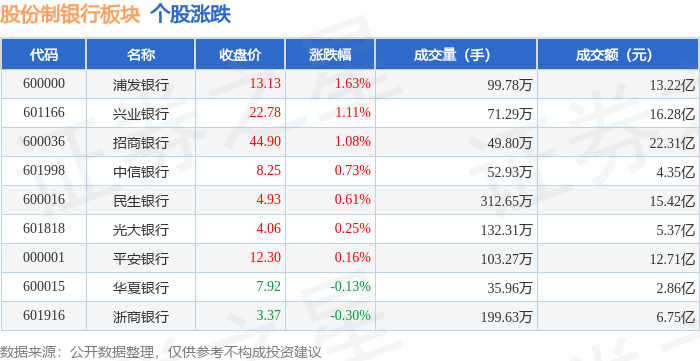
股份制银行板块8月4日涨0.88%,浦发银行领涨,主力资金净流入8.08亿元
Zheng Xing Xing Ye Ri Bao· 2025-08-04 08:30
| 代码 | 名称 | 收盘价 | 涨跌幅 | 成交量(手) | 成交额(元) | | --- | --- | --- | --- | --- | --- | | 600000 | 浦友银行 | 13.13 | 1.63% | 99.78万 | 13.22 乙 | | 601166 | 兴业银行 | 22.78 | 1.11% | 71.29万 | 16.28亿 | | 600036 | 招商银行 | 44.90 | 1.08% | 49.80万 | 22.31亿 | | 665109 | 中信银行 | 8.25 | 0.73% | 52.93万 | 4.35 Z | | 600016 | 民生银行 | 4.93 | 0.61% | 312.65万 | 15.42 乙 | | 601818 | 光大银行 | 4.06 | 0.25% | 132.31万 | 5.37亿 | | 000001 | 平安银行 | 12.30 | 0.16% | 103.27万 | 12.71亿 | | 600015 | 半夏银行 | 7.92 | -0.13% | 35.96万 | 2.86 Z | | 601916 | 浙商银行 ...


主力资金流入前20:建设工业流入5.67亿元、长城军工流入5.28亿元



Jin Rong Jie· 2025-08-04 06:55
Group 1 - The main focus of the article is on the top 20 stocks with significant capital inflow as of August 4, with notable amounts listed for each company [1] - The leading stock with the highest capital inflow is Construction Industry, attracting 567 million yuan [1] - Other notable stocks include Great Wall Military Industry with 528 million yuan and Shanhe Intelligent with 454 million yuan [1] Group 2 - The article provides a detailed list of stocks and their respective capital inflows, indicating strong investor interest in these companies [1] - The total capital inflow for the top 20 stocks reflects a trend of increased investment activity in the market [1] - The data suggests a diverse range of sectors represented among the top inflow stocks, including technology, finance, and manufacturing [1]
主力资金流入前20:长城军工流入4.88亿元、海光信息流入4.57亿元



Jin Rong Jie· 2025-08-04 02:51
截至8月4日开盘一小时,主力资金流入前20的股票分别为:长城军工(4.88亿元)、海光信息(4.57亿 元)、山河智能(4.31亿元)、航天电子(4.00亿元)、利君股份(3.28亿元)、赤峰黄金(2.53亿 元)、顺钠股份(2.37亿元)、工商银行(2.14亿元)、浙大网新(2.09亿元)、长城电工(2.04亿 元)、爱乐达(2.03亿元)、中金黄金(1.95亿元)、中国银行(1.94亿元)、神州泰岳(1.89亿元)、 光线传媒(1.70亿元)、万里马(1.65亿元)、江海股份(1.60亿元)、长盛轴承(1.55亿元)、民生银 行(1.52亿元)、圣邦股份(1.46亿元)。 作者:金股通 本文源自:金融界 ...
从3亿元应急贷到一句“陪您重建”:直击北京银行业灾后救援全行动
Jin Rong Shi Bao· 2025-08-03 22:44
Group 1 - Extreme weather in Beijing has caused significant flooding and landslides, affecting over 300,000 people and resulting in major casualties and property damage [1] - Banks in Beijing have activated emergency response mechanisms to ensure timely financial support for disaster relief and recovery efforts [1][2] - China Development Bank Beijing Branch provided an emergency loan of 300 million yuan to support disaster relief efforts [1] Group 2 - Agricultural Bank of China Beijing Branch opened a green channel for emergency funds, completing the entire process in just two and a half hours to support rescue operations [1] - Traffic Bank Beijing Branch prioritized emergency financial services for flood relief and ensured smooth processing of emergency fund requests [2] - China Bank Beijing Branch provided 400 boxes of mineral water to support rescue personnel on the front lines [2] Group 3 - Banks are actively engaging with affected communities to assess financial needs and provide comprehensive support for post-disaster recovery [3] - Industrial and Commercial Bank of China launched targeted credit products to assist residents in repairing homes affected by the disaster [3] - Agricultural Bank of China is implementing various relief policies, including loan extensions and interest reductions, to support small businesses and farmers [3][4] Group 4 - Minsheng Bank Beijing Branch is increasing online loan applications to support disaster recovery and has partnered with local agricultural financing institutions for targeted financial solutions [5] - China Bank Beijing Branch provided non-repayment loans to a severely affected ecological agriculture company to assist with cash flow issues [5][6] - Citic Bank Beijing Branch is actively reaching out to local businesses to understand their financial needs and provide necessary support [6]


量化产品夺业绩榜第一,民生银行APP高收益产品跌落“神坛”
2 1 Shi Ji Jing Ji Bao Dao· 2025-08-01 11:36
Core Viewpoint - The recent performance of the stock market has shown slight fluctuations after surpassing 3600 points, while the bond market has rebounded slightly after adjustments last week. Products with a 10% equity component, such as "fixed income + equity" products, have recently performed well [2]. Group 1: Product Performance - The "Fengli Xindong Zhixiang 1-Year Holding Period No. 4A" product, which ranks first in the performance list of the China Merchants Bank APP, has achieved an annualized return of 6.09% over the past year and 8.78% over the past month [6][10]. - This product employs quantitative strategies, including quantitative index enhancement and quantitative market neutrality, with a focus on tracking the CSI 500 index [5][11]. - In the first seven months of this year, quantitative index-enhanced public funds tracking the CSI 500 index have averaged a return of 12.23%, outperforming the index's increase of 8.74% [5]. Group 2: Risk and Return Metrics - The product scored 67 in yield performance, 78 in risk control, 20 in risk-adjusted return, and 80 in comprehensive fee rate, ranking 12th, 713th, 607th, and 534th respectively among 738 similar products [7][9]. - The product's overall score of 56 allows it to outperform 88.62% of similar products [9]. Group 3: Investment Strategy - The product maintains approximately 90% of its investments in fixed income assets, with around 10% allocated to index enhancement strategies [12][23]. - The management strategy allows for flexible adjustments between aggressive and conservative approaches based on market conditions, which is crucial for managing risks effectively [11][23]. Group 4: Market Context - The bond market has shown signs of volatility due to regulatory and liquidity factors, which may impact the returns of fixed income investments [23]. - The product's performance is influenced by stock market fluctuations, particularly during periods of significant market movement [6][23].
