China Spacesat(600118)

Search documents
通用航空ETF华夏(159230)跌4.11%,半日成交额3233.03万元
Xin Lang Cai Jing· 2026-01-15 03:42
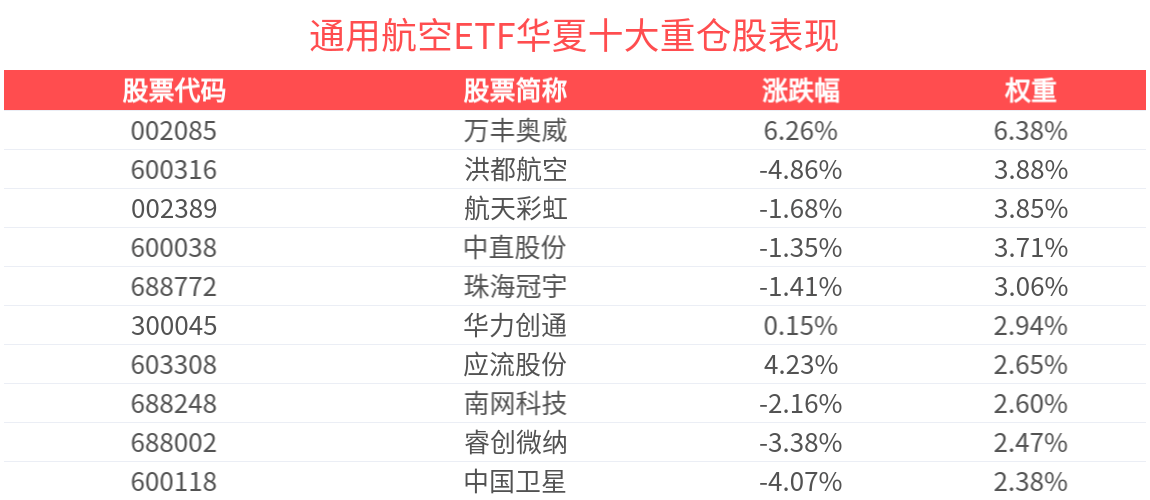
Group 1 - The General Aviation ETF Huaxia (159230) experienced a decline of 4.11%, closing at 1.399 yuan with a trading volume of 32.33 million yuan [1] - Key stocks within the General Aviation ETF include: - Wan Feng Ao Wei up by 0.52% - Hongdu Aviation up by 9.79% - Aerospace Rainbow down by 1.63% - Zhongzhichuan down by 0.03% - Zhuhai Guanyu up by 0.20% - Huali Chuantong down by 10.56% - Yingliu Co. up by 0.98% - Southern Network Technology down by 1.43% - Ruichuang Weina down by 2.90% - China Satellite down by 10.00% [1] - The performance benchmark for the General Aviation ETF Huaxia is the National General Aviation Industry Index return rate, managed by Huaxia Fund Management Co., Ltd. The fund manager is Yang Siqi [1] Group 2 - Since its establishment on May 21, 2025, the General Aviation ETF Huaxia has achieved a return of 45.65%, with a return of 26.77% over the past month [1]


中国卫星、航天电子等股批量跌停,通用航空ETF华夏(159230)跌超4%,近5日“吸金”超5亿元
Mei Ri Jing Ji Xin Wen· 2026-01-15 03:27
Core Viewpoint - The A-share market experienced a collective decline on January 15, with significant movements in various sectors, particularly in commercial aerospace and related ETFs, indicating a volatile market environment and ongoing developments in China's commercial space industry [1]. Group 1: Market Performance - The three major A-share indices fell collectively, with strong performances noted in lithium mining, phosphorus chemicals, and industrial metals [1]. - The General Aviation ETF Huaxia (159230) dropped by 4.04%, while its constituent stock Hongdu Aviation reached the daily limit up [1]. - The Aerospace ETF (159227) declined by 3.64%, with several stocks in the aerospace sector experiencing significant losses, including Zhongke Xingtou, which fell over 17% [1]. Group 2: Investment Trends - The General Aviation ETF Huaxia (159230) has seen a net inflow of funds totaling 510 million yuan over the past five days, indicating strong investor interest [1]. - The ETF tracks the National General Aviation Industry Index, focusing on low-altitude economy, covering sectors such as aviation materials, infrastructure, aircraft manufacturing, and operational services [2]. Group 3: Industry Developments - The successful completion of the suborbital flight test by the Zhongke Yuhang Lihong No. 1 vehicle marks significant progress in China's commercial space sector, particularly in reusable launch vehicle technology and cost-effective space access [1]. - Guojin Securities predicts that 2026 may become a pivotal year for China's commercial aerospace industry, shifting from thematic investment to fundamental performance-driven investment based on supply chain achievements [1]. - The industry is expected to enter a phase of order explosion driven by advancements in reusable rocket technology and the dense networking of national satellite constellations, benefiting companies involved in core areas such as rocket propulsion systems and structural components [1].


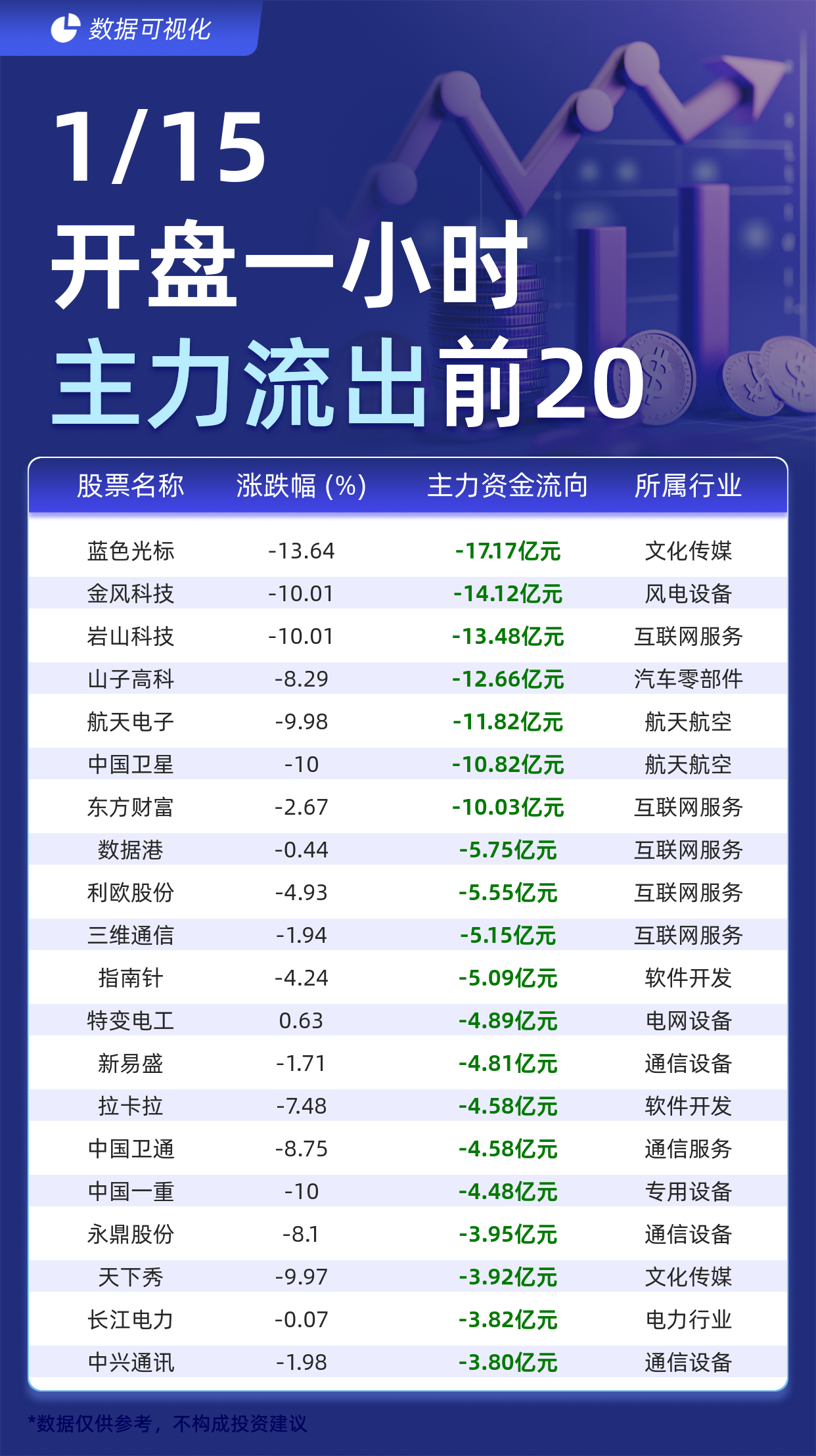
主力个股资金流出前20:蓝色光标流出17.17亿元、金风科技流出14.12亿元


Jin Rong Jie· 2026-01-15 02:47
Group 1 - The main stocks with significant capital outflows include BlueFocus (-1.717 billion), Goldwind (-1.412 billion), and Yanshan Technology (-1.348 billion) [1] - The sectors affected by the capital outflows include cultural transmission, wind power equipment, and internet services [2][3] - The largest percentage drop in stock prices was observed in BlueFocus (-13.64%) and Goldwind (-10.01%) [2] Group 2 - Other notable stocks with capital outflows include Aerospace Electronics (-1.182 billion), China Satellite (-1.082 billion), and Dongfang Fortune (-1.003 billion) [1] - The telecommunications sector also saw significant outflows, with companies like ZTE (-0.380 billion) and China Satcom (-0.458 billion) experiencing declines [3] - The overall trend indicates a bearish sentiment in the market, particularly affecting technology and aerospace sectors [2][3]

14日两融余额增加152.38亿元 计算机行业获融资净买入居首
Sou Hu Cai Jing· 2026-01-15 01:49
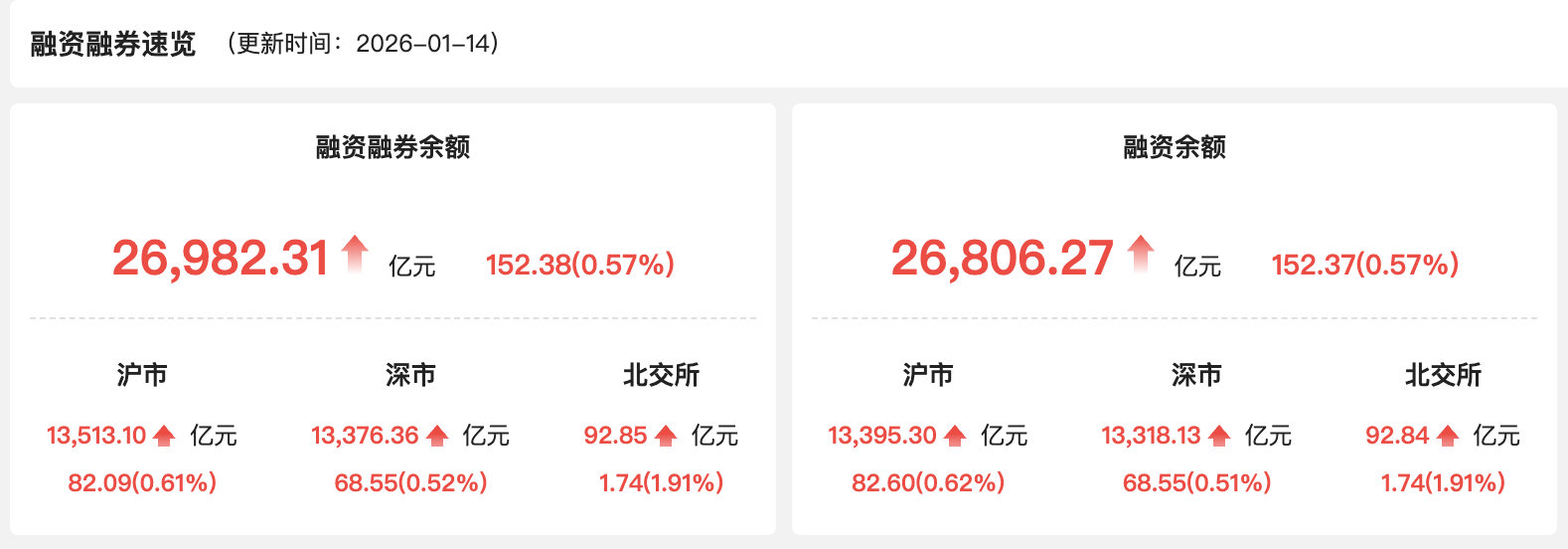
Group 1 - The total margin financing balance in A-shares reached 26,982.31 billion yuan, an increase of 15.238 billion yuan from the previous trading day, accounting for 2.60% of the A-share circulating market value [1] - The margin trading volume on the same day was 4,519.11 billion yuan, which is an increase of 46.76 billion yuan from the previous trading day, representing 11.33% of the total A-share trading volume [1] Group 2 - Among the 31 primary industries, 22 experienced net financing inflows, with the computer industry leading at a net inflow of 3.964 billion yuan [3] - Other industries with significant net financing inflows include telecommunications, public utilities, pharmaceutical biology, banking, non-bank financials, and media [3] Group 3 - A total of 87 individual stocks had net financing inflows exceeding 100 million yuan, with Changjiang Electric Power leading at a net inflow of 1.383 billion yuan [3][4] - Other notable stocks with high net financing inflows include Tebian Electric Apparatus, Zhongji Xuchuang, Huasheng Tianc, China Ping An, Yanshan Technology, China Satellite, China Merchants Bank, Shanzi Gaoke, and Bluefocus [3][4]




杠杆资金净买入前十:长江电力(13.83亿元)、特变电工(9.81亿元)
Jin Rong Jie· 2026-01-15 00:42
Core Viewpoint - The data from the Shanghai and Shenzhen stock markets on January 14 indicates significant net purchases in various stocks, highlighting investor interest in specific companies [1] Group 1: Top Stocks by Net Purchases - The top stock with the highest net purchase was Changjiang Electric Power, amounting to 1.383 billion yuan [1] - TBEA Co., Ltd. followed with a net purchase of 981 million yuan [1] - Huasheng Tiancheng saw net purchases of 783 million yuan, ranking third [1] - China Ping An had net purchases of 684 million yuan, placing it fourth [1] - China Satellite's net purchases reached 523 million yuan, securing the fifth position [1] - China Merchants Bank recorded net purchases of 511 million yuan [1] - Haiguang Information had net purchases of 432 million yuan [1] - CITIC Securities saw net purchases of 396 million yuan [1] - China Aluminum's net purchases amounted to 340 million yuan [1] - Baiwei Storage rounded out the top ten with net purchases of 326 million yuan [1]

国产航母概念下跌0.74%,主力资金净流出28股
Zheng Quan Shi Bao Wang· 2026-01-14 09:21
Group 1 - The domestic aircraft carrier concept index declined by 0.74%, ranking among the top declines in the concept sector, with notable declines in stocks such as Beidou Star, Sichuan Electronics, and Yinbang Shares [1] - Among the domestic aircraft carrier concept stocks, 10 stocks saw price increases, with Haige Communication, China First Heavy Industries, and AVIC Heavy Machinery leading the gains at 10.00%, 10.00%, and 5.85% respectively [1][2] - The domestic aircraft carrier concept experienced a net outflow of 2.947 billion yuan in main funds today, with 28 stocks seeing net outflows, and 7 stocks experiencing outflows exceeding 100 million yuan [2] Group 2 - The top net outflow stock in the domestic aircraft carrier concept was Haige Communication, with a net outflow of 1.434 billion yuan, followed by China Satellite, Yinbang Shares, and Hailanxin with net outflows of 612.8 million yuan, 442.9 million yuan, and 319.8 million yuan respectively [2][3] - The stocks with the highest net inflow in the domestic aircraft carrier concept included China First Heavy Industries, AVIC Heavy Machinery, and China Shipbuilding, with net inflows of 573.0 million yuan, 408.0 million yuan, and 6.1 million yuan respectively [2][3] - The stock performance of Haige Communication showed a significant increase of 10.00% despite the overall sector decline, indicating potential investor interest [3]


份额规模新高,通用航空ETF华夏(159230)连续11天吸金超5.6亿
Sou Hu Cai Jing· 2026-01-14 06:11
Core Viewpoint - The General Aviation ETF Huaxia (159230) has shown significant performance with a net inflow of 561 million yuan over the past 11 days, reaching a new high in total scale and net value, indicating strong investor interest in the general aviation sector [1][2]. Group 1: ETF Performance - As of January 13, 2026, the General Aviation ETF Huaxia has achieved a net value increase of 35.11% over the past six months [1]. - The ETF recorded a maximum monthly return of 16.05% since its inception, with the longest consecutive monthly gains being four months and a maximum cumulative increase of 22.84% [1]. - The average return during the months of increase is 8.78%, with a weekly profit percentage of 69.70% and a monthly profit probability of 64.75% [1]. Group 2: Market Activity - The General Aviation ETF Huaxia had a turnover rate of 17.56% during the trading session, with a transaction volume of 115 million yuan, indicating active market participation [1]. - The ETF's latest scale reached 447 million units, with a total value of 647 million yuan, both marking new highs since its establishment [1]. Group 3: Index Composition - The General Aviation ETF closely tracks the Guozheng General Aviation Industry Index, with the top ten weighted stocks accounting for 33.92% of the index [2]. - The top ten stocks in the index include Wan Feng Ao Wei, Aerospace Rainbow, and Zhongzhi Shares, among others, reflecting a diverse representation within the general aviation sector [2][3].
视频|市场回归理性 有首席被老妈科普商业航天 基金经理50万赚40万
Xin Lang Cai Jing· 2026-01-14 05:48
炒股就看金麒麟分析师研报,权威,专业,及时,全面,助您挖掘潜力主题机会! 来源:环球总财 炒股就看金麒麟分析师研报,权威,专业,及时,全面,助您挖掘潜力主题机会! 来源:环球总财 2026年开年,中国商业航天赛道率先点燃资本市场热情。商业航天热度有多高?一个段子足以说明一 切:华创首席经济学家张瑜竟然被妈妈科普了一下商业航天。有网友分享,投资了50万,近1年赚了近 40万,收益率80%。 不过,1月13日,商业航天板块结束连日大涨,迎来显著回调。本轮商业航天板块的集体跳水,被市场 普遍解读为多家上市公司密集公告下,市场降温作用的结果。 此前半个月内,受卫星互联网建设加速及多项利好政策预期的推动,资金疯狂追逐商业航天概念。然 而,随着股价脱离基本面过度上涨。1月12日晚间的公告潮成为了情绪逆转的导火索。 在这一轮炒作中,业绩与估值背离成为了一大风险点。以中国卫星为例,其超过2400倍的滚动市盈率已 严重透支了未来的业绩增长预期,业绩显示,中国卫星2024年扣非后归母净利润同比下滑近97%,暴露 了其当前股价缺乏业绩支撑。 2026年开年,中国商业航天赛道率先点燃资本市场热情。商业航天热度有多高?一个段子足以说明 ...
券商首席被妈妈科普一天商业航天!万亿赛道为何火热?
Huan Qiu Wang· 2026-01-14 05:31
Core Viewpoint - The commercial aerospace sector in China's A-share market is experiencing significant growth driven by a combination of policy support, capital influx, and technological advancements, with the market expected to reach 2.8 trillion yuan by 2025, nearly a tenfold increase from 2022 [3]. Policy and Regulation - The 2025 government work report emphasizes the construction of a technology-driven nation, launching major national science and technology projects, and enhancing the infrastructure for major technological advancements [3]. - The establishment of the Commercial Aerospace Department by the National Space Administration aims to integrate commercial aerospace into the national development framework, focusing on core technology research and development [3]. - The Shanghai Stock Exchange has introduced guidelines to facilitate the listing of commercial rocket companies on the Sci-Tech Innovation Board, opening up domestic capital markets for these enterprises [3][4]. Capital Investment - The total financing in the commercial aerospace industry is projected to reach 18.6 billion yuan in 2025, marking a 32% year-on-year increase, with significant investments from various funds [4][5]. - The secondary market is witnessing heightened activity, with over 20 listed companies issuing risk warnings related to commercial aerospace concepts, yet capital continues to flow into the sector [4]. Technological Breakthroughs - 2025 is anticipated to be a pivotal year for reusable rockets in China, with multiple models expected to undergo test flights, potentially reducing launch costs significantly [5]. - The cost of rocket launches is projected to drop from 60,000-80,000 yuan per kilogram to below $10,000, approaching the levels of SpaceX's reusable rockets [5]. Industry Structure - The commercial aerospace industry is segmented into four core areas: rocket manufacturing and launching, satellite manufacturing and operation, application services, and core supporting industries [6][7]. - The rocket manufacturing sector is characterized by competition between state-owned enterprises and private companies, while satellite production is shifting towards more efficient, assembly-line methods [6]. - The application services market is expanding, with satellite communication technologies becoming more accessible to the general public, including features in smartphones and logistics solutions [7]. Market Potential - The space economy is projected to reach a trillion-dollar market size by 2035, with significant growth expected in both traditional space industries and downstream applications enabled by space technology [8].




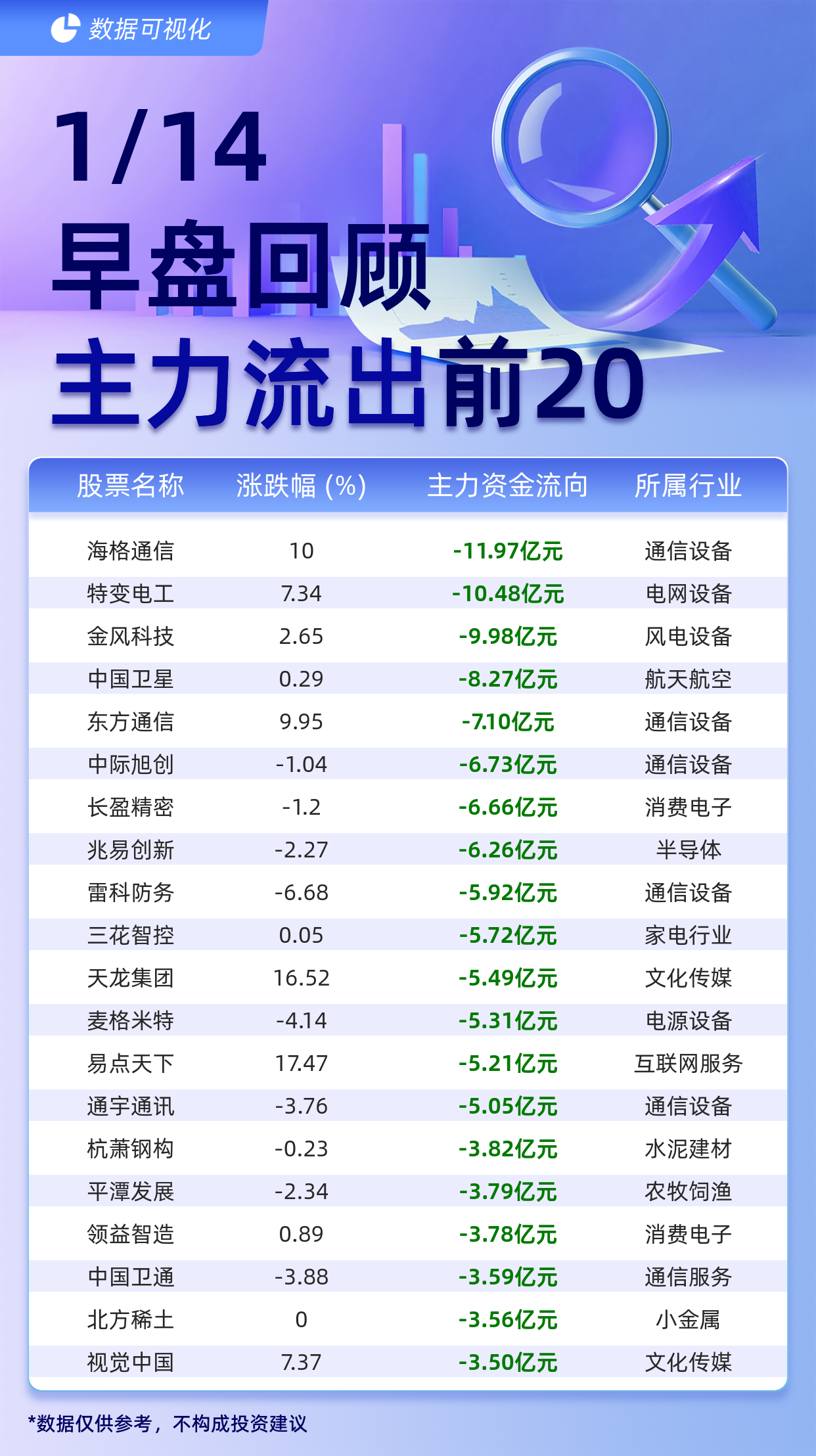
主力个股资金流出前20:海格通信流出11.97亿元、特变电工流出10.48亿元
Jin Rong Jie· 2026-01-14 04:03
Group 1 - The main stocks with significant capital outflows include Haige Communication (-1.197 billion), TBEA (-1.048 billion), and Goldwind Technology (-0.998 billion) [1][2] - Haige Communication experienced a price increase of 10%, while TBEA and Goldwind Technology saw increases of 7.34% and 2.65% respectively [2][3] - Other notable stocks with capital outflows include China Satellite (-0.827 billion), Oriental Communication (-0.710 billion), and Zhongji Xuchuang (-0.673 billion) [1][2] Group 2 - The sectors represented by the stocks with the largest capital outflows include communication equipment, power grid equipment, and wind power equipment [2][3] - Stocks like Tianlong Group and Yidian Tianxia saw significant price increases of 16.52% and 17.47% respectively, despite experiencing capital outflows of -0.549 billion and -0.521 billion [2][3] - The data indicates a mixed performance across various sectors, with some stocks showing positive price movements while still facing substantial capital outflows [1][2]