China Spacesat(600118)

Search documents
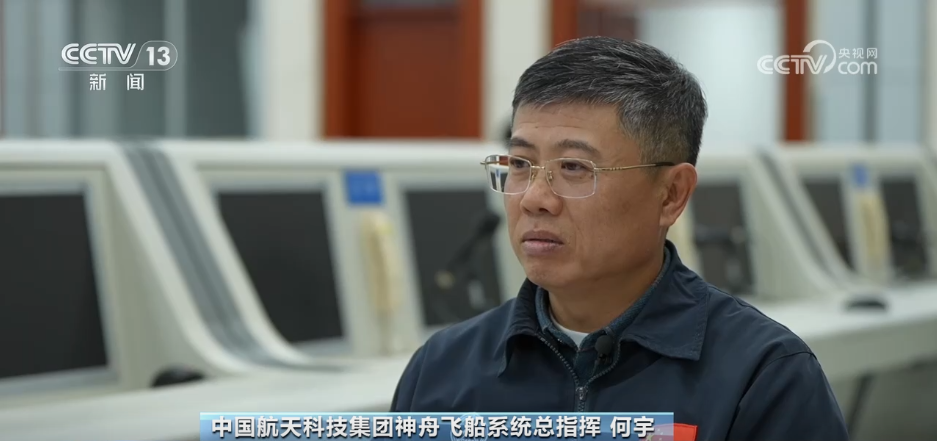
总指挥为你讲述神舟飞天20年的技术跃迁
Yang Shi Wang· 2025-11-01 10:48
Core Viewpoint - The Shenzhou-21 manned spacecraft represents a significant technological advancement in China's space program, showcasing improvements in speed, capacity, and efficiency over the past two decades [10][12][14]. Group 1: Technological Advancements - The Shenzhou-21 is the first manned spacecraft to utilize a rapid rendezvous and docking scheme, reducing the docking time from two days to 3.5 hours [9][12]. - The spacecraft's return capability has also improved, allowing for a return time of approximately 5 hours after completing three orbits, compared to the previous one-day return time [12]. - Automation and remote testing have enhanced operational efficiency, reducing the preparation cycle for two spacecraft from 56 days to 45 days [7][5]. Group 2: Capacity Enhancements - The cargo capacity for upward transport has increased by 20%, while the downward transport capacity has doubled, with the cargo space tripling compared to earlier models [14]. - The Shenzhou spacecraft is now the only spacecraft in China capable of returning to Earth, supporting a wide range of scientific experiments [14]. Group 3: Leadership and Responsibility - The role of the chief commander has evolved from focusing solely on design to encompassing comprehensive management responsibilities, including technical oversight and logistical coordination [18][20]. - The commitment to excellence and innovation remains a core principle in the development and operation of the Shenzhou spacecraft [16][20].

神舟二十一号航天员乘组顺利进驻“天宫”空间站
Yang Guang Wang· 2025-11-01 04:48
Core Points - China successfully launched the Shenzhou-21 manned spacecraft on October 31, achieving a record-fast docking with the Tianhe core module of the space station in approximately 3.5 hours [1] - The Shenzhou-21 mission marks the seventh "space rendezvous" in China's space history, with astronauts from both Shenzhou-20 and Shenzhou-21 successfully meeting in space [1] - The launch was conducted using the Long March 2F rocket from the Jiuquan Satellite Launch Center, with the spacecraft entering its designated orbit about 10 minutes post-launch [1] Group 1 - The rapid docking capability of 3.5 hours allows for year-round launch opportunities, reducing the need for mid-course orbital corrections and enhancing the ability to respond to major in-orbit failures [2] - During their stay at the space station, the Shenzhou-21 crew will conduct various experiments in fields such as space life and human research, microgravity physics, and new space technologies, along with multiple extravehicular activities [2] - Preparations for the Shenzhou-22 mission and its Long March 2F rocket have been completed, with the spacecraft in a state of readiness for emergency standby tasks [2] Group 2 - The successful completion of the Shenzhou-21 mission signifies the conclusion of China's manned space launch tasks for 2025 [3]
航天装备板块10月31日跌2.64%,中国卫星领跌,主力资金净流出5.99亿元
Zheng Xing Xing Ye Ri Bao· 2025-10-31 08:48
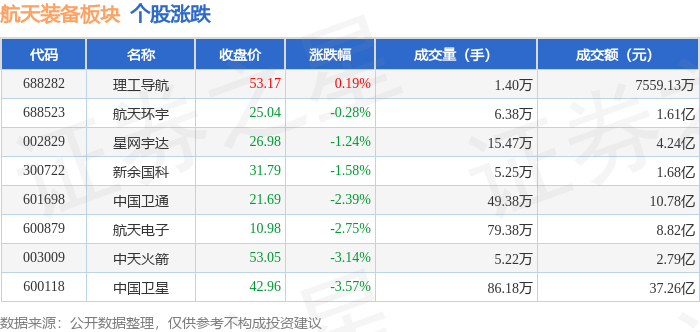
Market Overview - The aerospace equipment sector experienced a decline of 2.64% on October 31, with China Satellite leading the drop [1] - The Shanghai Composite Index closed at 3954.79, down 0.81%, while the Shenzhen Component Index closed at 13378.21, down 1.14% [1] Stock Performance - Key stocks in the aerospace equipment sector showed varied performance, with China Satellite down 3.57% to 42.96 and Aerospace Electronics down 2.75% to 10.98 [1] - The trading volume and turnover for major stocks included: - Rigong Navigation: 53.17, up 0.19%, with a turnover of 75.59 million [1] - Aerospace Huanyu: 25.04, down 0.28%, with a turnover of 161 million [1] - XW Yuda: 26.98, down 1.24%, with a turnover of 424 million [1] Capital Flow - The aerospace equipment sector saw a net outflow of 599 million from institutional investors, while retail investors had a net inflow of 654 million [1] - Detailed capital flow for specific stocks indicated significant outflows for: - China Satellite: net outflow of 229 million [2] - Aerospace Electronics: net outflow of 100 million [2] - XW Yuda: net outflow of 51 million [2] Investor Behavior - Retail investors showed a preference for certain stocks, with significant net inflows into: - New Yu Guokai: 26.53 million [2] - Aerospace Electronics: 80.89 million [2] - Conversely, institutional and speculative investors exhibited net outflows across multiple stocks, indicating a cautious sentiment in the market [2]
中国卫星股价跌5.12%,华宝基金旗下1只基金重仓,持有6.53万股浮亏损失14.89万元
Xin Lang Cai Jing· 2025-10-31 06:22
Group 1 - The core point of the news is that China Satellite experienced a decline of 5.12%, with its stock price at 42.27 yuan per share and a trading volume of 2.982 billion yuan, resulting in a total market capitalization of 49.984 billion yuan [1] - China Satellite's main business involves aerospace manufacturing and satellite applications, with revenue composition being 97.01% from aerospace manufacturing and satellite applications, 1.71% from other sources, and 1.28% from leasing income [1] Group 2 - Huabao Fund has a significant holding in China Satellite, with its Huabao National General Aviation Industry ETF (159231) holding 65,300 shares, accounting for 2.36% of the fund's net value, ranking as the tenth largest holding [2] - The estimated floating loss for the fund today is approximately 148,900 yuan [2] - The Huabao National General Aviation Industry ETF (159231) was established on April 18, 2025, with a current size of 102 million yuan and a cumulative return of 19.88% since inception [2] Group 3 - The fund managers of Huabao National General Aviation Industry ETF are Zhang Fang and Cao Xucheng, with Zhang having a tenure of 4 years and 277 days and a total asset scale of 2.66 billion yuan, achieving a best return of 68.37% and a worst return of -23.7% during his tenure [3] - Cao Xucheng has a tenure of 163 days with a total asset scale of 35.182 billion yuan, achieving a best return of 101.63% and a worst return of 7.72% during his tenure [3]
多只航天装备股三季度业绩呈明显改善态势 中国卫星应收账款增逾九成
Xin Hua Cai Jing· 2025-10-31 02:44
Core Insights - The aerospace equipment sector in A-shares has shown significant improvement in Q3 performance, indicating an industry turning point [1] Company Summaries - China Satcom reported a Q3 revenue increase of 3.52% to 632 million yuan and a net profit increase of 41.44% to 105 million yuan, with a notable reduction in year-to-date net profit decline from 55.59% in H1 to 40.58% in Q3 [1] - China Satellite's Q3 revenue surged by 177.31% to 1.782 billion yuan, with net profit soaring by 294.92% to 45.3 million yuan, marking a turnaround in year-to-date net profit growth of 200.48% [1][2] - Xinxing Yuda's Q3 revenue rose by 27.84% to 118 million yuan, with net profit increasing by 816.08% to 54.3 million yuan [3] - Aerospace Electronics experienced a Q3 revenue growth of 97.97% to 3.014 billion yuan, but net profit decreased by 88.65% to 3.5 million yuan [3] - Xinyu Guoke's Q3 revenue slightly decreased by 1.69% to 97.2 million yuan, with net profit also down by 1.04% to 21.8 million yuan, although it showed a significant decline in previous quarters [3] Financial Metrics - China Satellite's accounts receivable increased by 90.26% to 3.833 billion yuan by the end of Q3, while accounts payable rose by 23.88% to 3.775 billion yuan [2] - China Satcom's year-to-date net profit decline was significantly reduced, indicating improved operational efficiency [1]

中国卫星的前世今生:营收31.02亿行业排名第二,净利润10.69万行业第六
Xin Lang Cai Jing· 2025-10-30 10:35
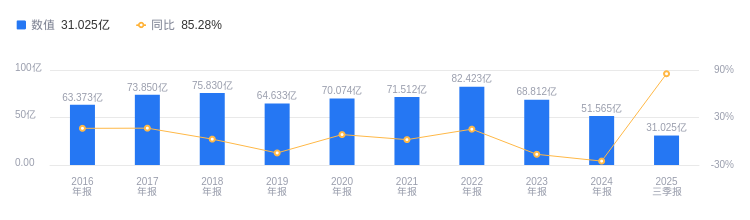
Core Viewpoint - China Satellite is a leading player in the integrated aerospace industry, focusing on aerospace manufacturing and satellite applications, with a strong export capability in complete satellite systems and ground support systems [1] Group 1: Business Performance - In Q3 2025, China Satellite reported revenue of 3.102 billion yuan, ranking 2nd in the industry, while the top competitor, Aerospace Electronics, generated 8.835 billion yuan [2] - The main business revenue from aerospace manufacturing and satellite applications was 1.281 billion yuan, accounting for 97.01% of total revenue, with other revenues contributing only 2.63 million yuan [2] - The net profit for the same period was 106.9 million yuan, placing the company 6th in the industry, with the top competitor, China Satcom, achieving a net profit of 335 million yuan [2] Group 2: Financial Ratios - As of Q3 2025, the asset-liability ratio for China Satellite was 43.53%, higher than the previous year's 40.05% and above the industry average of 31.57% [3] - The gross profit margin was reported at 9.62%, significantly lower than the previous year's 18.67% and below the industry average of 27.92% [3] Group 3: Shareholder Information - As of September 30, 2025, the number of A-share shareholders increased by 27.12% to 160,500, while the average number of shares held per shareholder decreased by 21.33% to 7,366.34 shares [5] - The second-largest shareholder is the Fortune CSI Military Industry Leader ETF, holding 13.2941 million shares, an increase of 1.9401 million shares from the previous period [5] Group 4: Management and Compensation - The president of China Satellite, Zhu Nan, received a salary of 860,000 yuan in 2024, reflecting a year-on-year increase of 10,000 yuan [4] Group 5: Market Outlook - According to CICC, China Satellite's performance in the first three quarters of 2025 met expectations, with significant improvements in Q3 due to the completion of satellite system projects and an increase in business orders [6] - The company is expected to benefit from the growing aerospace industry and has a target price of 42.16 yuan, indicating a potential upside of 5% [6]
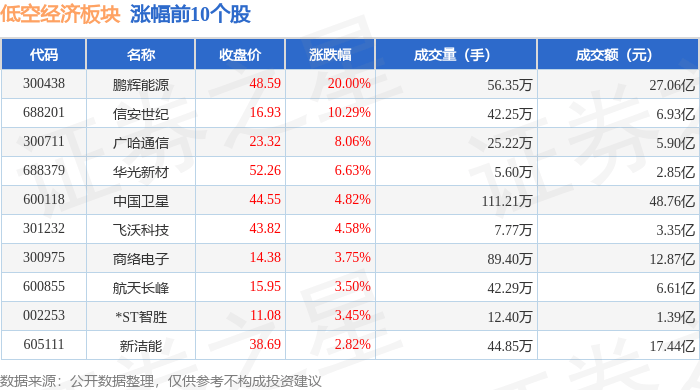
低空经济板块10月30日跌1.38%,长盈通领跌,主力资金净流出52.35亿元





Sou Hu Cai Jing· 2025-10-30 09:01
Market Overview - The low-altitude economy sector experienced a decline of 1.38% on October 30, with Changyingtong leading the drop [1] - The Shanghai Composite Index closed at 3986.9, down 0.73%, while the Shenzhen Component Index closed at 13532.13, down 1.16% [1] Top Performers - Penghui Energy (300438) saw a significant increase of 20.00%, closing at 48.59 with a trading volume of 563,500 shares and a transaction value of 2.706 billion [1] - Xinan Century (688201) rose by 10.29%, closing at 16.93 with a trading volume of 422,500 shares and a transaction value of 693 million [1] - Guangha Communication (300711) increased by 8.06%, closing at 23.32 with a trading volume of 252,200 shares and a transaction value of 590 million [1] Underperformers - Changyingdao (688143) fell by 7.93%, closing at 39.36 with a trading volume of 52,300 shares and a transaction value of 210 million [2] - Shenkai Co., Ltd. (002278) decreased by 6.33%, closing at 12.42 with a trading volume of 943,500 shares and a transaction value of 1.199 billion [2] - Fenghua Gaoke (000636) dropped by 6.11%, closing at 16.59 with a trading volume of 775,700 shares and a transaction value of 1.303 billion [2] Capital Flow - The low-altitude economy sector saw a net outflow of 5.235 billion from institutional investors, while retail investors experienced a net inflow of 4.195 billion [2] - The sector's overall capital flow indicates a mixed sentiment, with institutional investors pulling back while retail investors are actively buying [2] Individual Stock Capital Flow - Penghui Energy (300438) had a net inflow of 4.08 billion from institutional investors, while it faced a net outflow of 2.95 billion from speculative funds [3] - China Satellite (600118) recorded a net inflow of 3.54 billion from institutional investors, with a net outflow of 3.91 billion from retail investors [3] - New Clean Energy (605111) saw a net inflow of 1.41 billion from institutional investors, while retail investors had a net outflow of 1.35 billion [3]
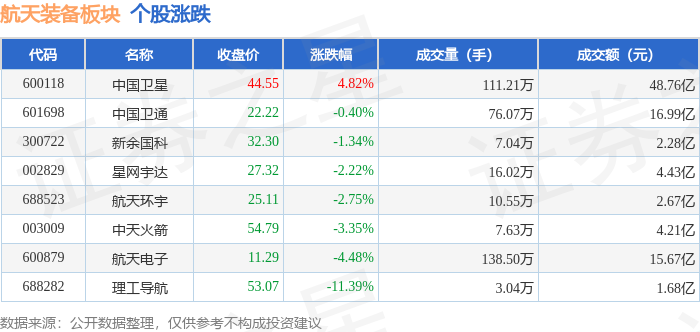
航天装备板块10月30日跌0.41%,理工导航领跌,主力资金净流入4078.29万元
Zheng Xing Xing Ye Ri Bao· 2025-10-30 08:35
Core Viewpoint - The aerospace equipment sector experienced a decline of 0.41% on October 30, with significant losses in individual stocks, particularly in the case of Ligong Navigation, which fell by 11.39% [1] Market Performance - The Shanghai Composite Index closed at 3986.9, down 0.73% - The Shenzhen Component Index closed at 13532.13, down 1.16% [1] Individual Stock Performance - China Satellite (600118) saw a closing price of 44.55, with an increase of 4.82% and a trading volume of 1.1121 million shares, totaling 487.6 million yuan - China Satcom (601698) closed at 22.22, down 0.40%, with a trading volume of 760,700 shares, totaling 1.699 billion yuan - Newyu Guoke (300722) closed at 32.30, down 1.34%, with a trading volume of 70,400 shares, totaling 22.8 million yuan - StarNet Yuda (002829) closed at 27.32, down 2.22%, with a trading volume of 160,200 shares, totaling 443 million yuan - Aerospace Huayu (688523) closed at 25.11, down 2.75%, with a trading volume of 105,500 shares, totaling 267 million yuan - Zhongtian Rocket (003009) closed at 54.79, down 3.35%, with a trading volume of 76,300 shares, totaling 421 million yuan - Aerospace Electronics (600879) closed at 11.29, down 4.48%, with a trading volume of 1.385 million shares, totaling 1.567 billion yuan - Ligong Navigation (688282) closed at 53.07, down 11.39%, with a trading volume of 30,400 shares, totaling 16.8 million yuan [1] Capital Flow Analysis - The aerospace equipment sector saw a net inflow of 40.7829 million yuan from institutional investors, while retail investors experienced a net outflow of 160 million yuan - The overall net inflow from speculative funds was 119 million yuan [1] Detailed Capital Flow for Individual Stocks - China Satellite (600118) had a net inflow of over 354 million yuan from institutional investors, while retail investors had a net outflow of 391 million yuan - Ligong Navigation (688282) experienced a net inflow of 499,150 yuan from institutional investors, but a net outflow of 1.54314 million yuan from speculative funds - Newyu Guoke (300722) had a net outflow of 22.4605 million yuan from institutional investors, but a net inflow of 26.0948 million yuan from retail investors - Aerospace Huayu (688523) saw a net outflow of 30.4828 million yuan from institutional investors, with a net inflow of 15.3996 million yuan from speculative funds - StarNet Yuda (002829) had a net outflow of 35.3566 million yuan from institutional investors, but a net inflow of 54.9708 million yuan from retail investors - Zhongtian Rocket (003009) experienced a net outflow of 39.3143 million yuan from institutional investors, with a net inflow of 26.8697 million yuan from retail investors - China Satcom (601698) had a net outflow of 40.9137 million yuan from institutional investors, but a net inflow of 62.1140 million yuan from speculative funds - Aerospace Electronics (600879) saw a net outflow of 150 million yuan from institutional investors, with a net inflow of 30.7196 million yuan from speculative funds [2]




商业航天系列二:大时代的序章,卫星互联网新机遇-国泰海通
Sou Hu Cai Jing· 2025-10-30 04:45
Core Insights - The report focuses on the development trends of the satellite internet industry, analyzing the global competitive landscape and opportunities for China, highlighting low Earth orbit (LEO) communication satellites as a core direction with significant investment value [1][2]. Group 1: Global Competition and China's Position - The competition for space resources is intensifying, with the US and China as the main competitors. As of September 2025, there are 15,621 satellites in orbit globally, with the US holding 10,490 (67.15%) and China only 951, indicating a significant gap [1][11]. - SpaceX's Starlink has over 10,000 satellites in orbit, covering more than 100 countries and regions, with 7 million active users, demonstrating a closed commercial model [1][6]. - China is accelerating its efforts with plans for the GW constellation and the Qianfan constellation, targeting over 25,000 satellite launches, with 188 satellites expected to be launched in 2024, entering a phase of intensive networking [1][2]. Group 2: Trends in Low Earth Orbit Communication Satellites - Low Earth orbit satellites are becoming the mainstream trend in the industry due to their low latency, high bandwidth, and cost-effective advantages, making up 89% of global satellites, with 73% being communication satellites [1][10]. - The implementation of direct satellite-to-phone technology is underway, with major manufacturers like Apple and Huawei deploying related features in high-end models. The Ministry of Industry and Information Technology plans for over 10 million satellite communication users by 2030 [1][2]. Group 3: Factors Driving China's Commercial Space Development - China's commercial space sector is entering a new phase driven by policies, capital, and technology. The government has classified commercial space as a strategic emerging industry, with numerous incentive policies introduced at both central and local levels [2][25]. - In 2023, over 22,000 new companies were registered in the commercial space sector, accounting for 82.4% of the total industry, indicating a strong influx of private capital [2][29]. - The launch of the Hainan commercial launch site enhances the efficiency of satellite launches, supporting the networking efforts [2][36]. Group 4: Investment Opportunities - Investment suggestions focus on three main areas: satellite internet networking and operators, satellite manufacturing companies, and core component manufacturers [2][10]. - Key components such as phased array antennas, inter-satellite laser communication, Hall-effect thrusters, and flexible solar wings are highlighted as high-value segments benefiting from industry growth [2][10].





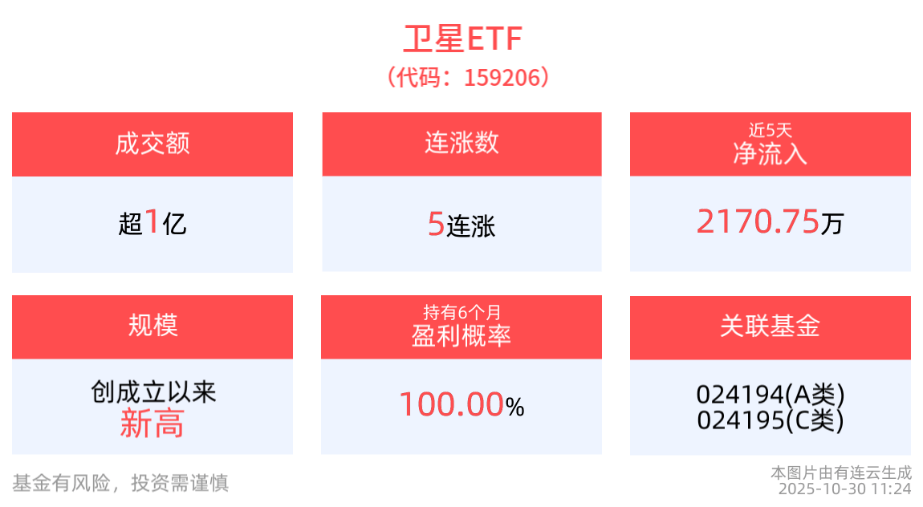
“航天强国”催化继续,卫星ETF(159206)盘中翻红,强势冲击五连涨,成分股国盾量子涨停
Sou Hu Cai Jing· 2025-10-30 03:43
Core Viewpoint - The satellite industry in China is experiencing rapid growth, driven by advancements in commercial space activities and government support, positioning it as a key area of international competition [5]. Group 1: Market Performance - As of 11:25, the Satellite ETF (159206) increased by 0.83%, with constituent stocks such as GuoDun Quantum reaching the daily limit up [3]. - Notable stock performances include: - GuoDun Quantum (688027) at 613.20, up 20.00% - Shaanxi Huada (301517) at 48.28, up 5.16% - China Satellite (600118) at 44.12, up 3.81% [4]. Group 2: Industry Developments - The Shenzhou 21 manned flight mission press conference highlighted the successful progress of various lunar mission components, including the Long March 10 rocket and the Dream Boat manned spacecraft [3]. - On October 16, a successful launch of 12 low-orbit satellite internet satellites was conducted using the Long March 8A rocket, marking a significant achievement in commercial space endeavors [3]. Group 3: Strategic Insights - Industry experts emphasize that the aerospace sector is a core frontier industry in the current international competitive landscape, with China's satellite industry rapidly advancing and benefiting related enterprises [5]. - The designation of "Aerospace Power" alongside "Manufacturing Power" indicates the strategic importance of the aerospace industry at the national level [5]. - The development of commercial space is essential for achieving the "Aerospace Power" goal, transitioning from "task-driven" to "demand-driven" activities, which will promote industry scale upgrades [5]. - The planning for satellite constellations during the 14th Five-Year Plan period anticipates a significant increase in rocket launches and satellite demand, presenting business opportunities in rocket and satellite manufacturing [5].