CBC(600132)

Search documents
食品快消巨头的下一场生存之战,已然打响
虎嗅APP· 2025-11-19 10:11
Core Viewpoint - The article emphasizes that in the food and beverage industry, "safety," "transparency," and "responsibility" have become new cornerstones of brand value, moving beyond traditional competitive advantages like taste and convenience [2]. Group 1: ESG Performance Overview - Most food companies are currently at the industry average in mainstream ESG ratings, with few leading companies such as Mengniu, Yili, Chongqing Beer, Budweiser Asia Pacific, and Ausnutria rated AA or above by MSCI [2]. - The food industry is increasingly recognizing the importance of ESG as a strategic tool for enhancing competitiveness and achieving resilient development due to regulatory pressures and consumer awareness [5]. Group 2: Environmental Dimension - Key areas of focus for environmental performance include climate change response, greenhouse gas emissions management, packaging management, water resource management, and biodiversity protection [7]. - Leading companies like Mengniu and Yili have demonstrated advanced performance in environmental disclosures, producing specialized reports on climate-related risks and sustainability [8][10]. - The complexity of the food industry's value chain presents challenges in accurately calculating greenhouse gas emissions, particularly in agricultural activities [11]. Group 3: Social Dimension - The critical performance metrics for social responsibility include product quality and safety, nutrition and health improvement, supply chain management, responsible marketing, and customer service [14]. - Food safety remains a fundamental issue for survival, with a reported overall non-compliance rate of 2.61% in food safety inspections, indicating an improving trend [16]. - Companies are increasingly adopting digital management tools for traceability and enhancing food safety management systems [16]. Group 4: Governance Dimension - Key governance performance metrics include the establishment of independent ESG committees, integration of ESG risk management into overall risk management processes, and the independence and diversity of the board [20][21]. - Companies like Mengniu have established dedicated sustainability committees within their boards, demonstrating effective oversight of ESG issues [23]. - There is a growing trend to link executive compensation to ESG performance, although this practice is still relatively rare [23]. Group 5: Industry Trends and Challenges - The food and beverage industry is moving from a basic understanding of ESG to a more nuanced and systematic approach, with leading companies building barriers through comprehensive ESG strategies [25]. - Despite advancements, many companies still face challenges in collecting and reporting Scope 3 emissions data, which is critical for comprehensive ESG assessments [13].





非白酒板块11月19日跌0.33%,*ST椰岛领跌,主力资金净流出1298.75万元
Zheng Xing Xing Ye Ri Bao· 2025-11-19 08:52
Market Overview - The non-liquor sector experienced a decline of 0.33% on the previous trading day, with *ST Yedao leading the drop [1] - The Shanghai Composite Index closed at 3946.74, up 0.18%, while the Shenzhen Component Index closed at 13080.09, unchanged [1] Stock Performance - Key stocks in the non-liquor sector showed varied performance, with Kuaijishan (601579) rising by 1.47% to a closing price of 22.76, while *ST Yedao (600238) fell by 3.60% to 6.69 [1][2] - Other notable movements included ST Xifa (000752) increasing by 1.22% and Zhangyu A (000869) rising by 0.28% [1] Trading Volume and Value - Kuaijishan recorded a trading volume of 174,100 shares, with a transaction value of approximately 3.95 million yuan [1] - The total net outflow of main funds in the non-liquor sector was 12.99 million yuan, while retail investors saw a net inflow of 9.51 million yuan [2][3] Fund Flow Analysis - Main funds showed a net outflow in several stocks, including Kuaijishan with a net outflow of 23.57 million yuan, while Zhangyu A had a net inflow of 7.98 million yuan [3] - Retail investors contributed positively to the fund flow in stocks like 百润股份 (002568), which saw a net inflow of 20.47 million yuan despite a main fund outflow [3]


加速出清行业寻底,预期先行板块启动
East Money Securities· 2025-11-19 06:56
Investment Highlights - The report indicates a clear turning point for the food and beverage industry following accelerated clearance, with expectations for leading sectors to initiate recovery [2][7] - The overall revenue for the food and beverage sector showed a slight increase of 0.2% year-on-year, while net profit decreased by 4.6% in the first three quarters of 2025 [18][20] - In Q3 2025, the sector experienced a significant decline, with revenues and net profits dropping by 4.9% and 14.6% respectively [18][20] Sector Review 1. Overall Review - The food and beverage sector faced continuous pressure and adjustments, with traditional consumption accelerating clearance while new consumption trends continued to grow [18][20] - The white liquor segment saw a revenue decline of 18.4% and a net profit decline of 22.2% in Q3 2025, indicating significant pressure on the sector [20][22] - In contrast, sectors like snacks and beverages maintained double-digit growth due to product and channel innovations [20][21] 2. White Liquor - The white liquor industry is undergoing accelerated clearance, with varying rhythms among companies. The demand has weakened, leading to noticeable declines in revenue and net profit for most companies [22][25] - High-end liquor maintained some growth, with Moutai achieving a revenue increase of 0.3% in Q3 2025, while other brands like Wuliangye saw declines exceeding 50% [23][25] - The report emphasizes the importance of supply-demand balance and pricing as key indicators for the industry's recovery [22][23] 3. Low-Alcohol Beverages and Drinks - The beer segment showed stable performance with a revenue increase of 2.0% and a net profit increase of 11.8% in the first three quarters of 2025 [21][22] - The report highlights the potential for recovery in demand for low-alcohol beverages and drinks, driven by health trends and product innovation [22][23] 4. Consumer Goods - The dairy sector is gradually stabilizing, with upstream supply clearing and downstream processing demand increasing, leading to a potential balance in the raw milk cycle [31][33] - The snack sector, particularly the konjac and oat categories, is expected to maintain high growth rates, supported by the expansion of new retail channels [31][36] - The report notes that the overall demand for dining remains weak, but specific segments like Western-style condiments and frozen baking show structural opportunities [31][33] Investment Recommendations - The report suggests focusing on companies that are early in their clearance processes and have strong brand momentum, such as Gujing Gongjiu and Luzhou Laojiao [11][12] - For low-alcohol beverages, attention is drawn to leading companies like Kweichow Moutai and Tsingtao Brewery, which are expected to benefit from demand recovery [11][12] - In the consumer goods sector, companies with strong performance and cost advantages, such as Yili and Modern Dairy, are recommended for investment [11][12]



2025年1-9月中国啤酒产量为3095.2万千升 累计增长3.7%
Chan Ye Xin Xi Wang· 2025-11-19 03:56
Core Viewpoint - The report highlights the growth of China's beer production, indicating a positive trend in the industry with a year-on-year increase in production volume. Industry Summary - As of September 2025, China's beer production reached 3.04 million kiloliters, reflecting a year-on-year growth of 3.1% [1] - From January to September 2025, the cumulative beer production in China was 30.952 million kiloliters, showing a cumulative growth of 3.7% [1] Company Summary - Listed companies in the beer industry include Zhujiang Beer (002461), Chongqing Beer (600132), Yanjing Beer (000729), Lanzhou Yellow River (000929), and Huichuan Beer (600573) [1] - The report by Zhiyan Consulting provides insights into the non-alcoholic beer market dynamics and competitive strategies from 2025 to 2031 [1]


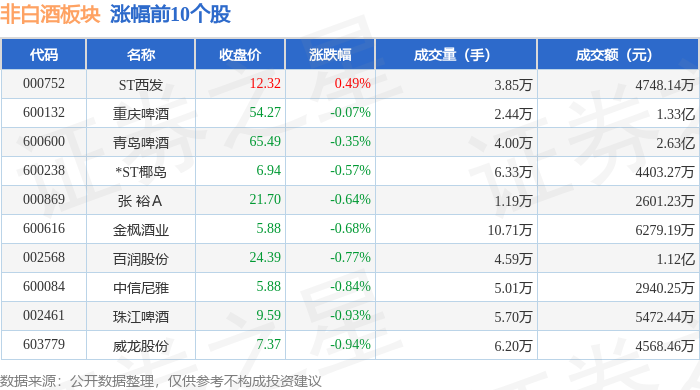
非白酒板块11月18日跌0.95%,燕京啤酒领跌,主力资金净流出1.09亿元
Zheng Xing Xing Ye Ri Bao· 2025-11-18 08:04
Market Overview - The non-liquor sector experienced a decline of 0.95% on November 18, with Yanjing Beer leading the drop [1] - The Shanghai Composite Index closed at 3939.81, down 0.81%, while the Shenzhen Component Index closed at 13080.49, down 0.92% [1] Stock Performance - Key stocks in the non-liquor sector showed varied performance, with ST Xifa closing at 12.32, up 0.49%, while other notable declines included Caijing Beer down 2.41% to 12.14 and Huichuan Beer down 2.41% to 12.15 [2] - The trading volume and turnover for selected stocks indicated significant activity, with Chongqing Beer recording a turnover of 1.33 billion and ST Xifa at 47.48 million [1][2] Capital Flow - The non-liquor sector saw a net outflow of 109 million from major funds, while retail investors contributed a net inflow of 115 million [2] - Detailed capital flow data showed that ST Xifa had a net inflow of 671,900 from major funds, while other stocks like ST Yedao experienced significant outflows [3]


增利难增收?5家头部啤酒企业掌门人揭秘破局关键
Mei Ri Jing Ji Xin Wen· 2025-11-17 14:37
Core Insights - The beer industry is experiencing a slowdown in overall growth, with companies facing challenges in increasing profits while revenues remain stagnant [2][8] - The recent "Double 11" shopping festival saw significant online sales for major beer brands, but the competitive landscape is shifting towards high-end products and diverse consumption scenarios [2][6] Group 1: Market Trends - Major beer brands like Tsingtao, Budweiser, and Yanjing dominated online sales during "Double 11," with Tsingtao's exclusive 211ml small white beer seeing a nearly 4-fold increase in sales [2] - The beer market is transitioning from a speed competition to a focus on high-end products and diverse consumption scenarios, indicating a need for innovation and adaptation [2][8] Group 2: Product Innovation - Companies are focusing on product innovation to meet changing consumer demands, with new categories like non-alcoholic and low-calorie beers gaining traction [3][9] - Carlsberg China emphasizes the importance of high-end products and fine management, while Budweiser Asia Pacific highlights the need for technological advancements in brewing processes [4][5] Group 3: Consumption Scenarios - The traditional consumption scenarios for beer are weakening, prompting companies to explore new experiences such as outdoor activities and urban street culture [6][7] - Tsingtao Beer is creating experiential venues like museums and beer gardens to enhance consumer engagement, while Carlsberg is aligning its brands with specific dining experiences [6][7] Group 4: Industry Outlook - Despite the current challenges, the long-term growth potential of the Chinese beer market remains strong, with a focus on quality and innovation [8][9] - Industry leaders stress the importance of collaboration and shared efforts to drive innovation and quality improvements across the sector [9]


食品饮料行业周报:CPI催化预期,底部价值凸显-20251117



Haitong Securities International· 2025-11-17 07:10
Investment Rating - Investment advice indicates a sector recovery catalyzed by recent CPI data, focusing on growth and supply-demand inflection points [5][16]. Core Views - The report emphasizes the importance of consumer goods growth, particularly in beverages, snacks, and food ingredients, while also highlighting structural opportunities in the baijiu sector [5][16]. - CPI data shows a positive trend with October CPI year-on-year at +0.2% and core CPI at +1.2%, indicating a recovery in domestic demand [6][16]. - The baijiu industry is undergoing accelerated clearing, with expectations for improved sales and inventory adjustments leading into 2026 [7][16]. - Consumer goods are expected to benefit from stabilization and recovery, with a focus on low valuation and high dividend stocks [8][16]. Summary by Sections Investment Recommendations - Recommended baijiu stocks include Shanxi Xinghuacun Fen Wine Factory, Gujing Distillery, and stable targets like Kweichow Moutai and Wuliangye [5][16]. - Beverage growth is highlighted with recommendations for Eastroc Beverage and Nongfu Spring, alongside low valuation stocks like China Foods and Tingyi [5][16]. - Snack and food ingredient stocks recommended include Bailong Chuangyuan, Yankershop Food, and Three Squirrels [5][16]. - Beer recommendations include Yanjing Brewery and Tsingtao Brewery, while condiment stocks like Haitian Flavoring & Food are also suggested [5][16]. Baijiu Sector Insights - The baijiu sector is experiencing a significant adjustment, with industry destocking still in progress and a focus on promotional sales for 2026 [7][16]. - Recent sales data from JD.com shows a +18% year-on-year increase in liquor sales during the Double 11 shopping festival, indicating a positive market response [7][16]. Consumer Goods Outlook - Consumer goods are expected to see growth as the mainline, with structural differentiation evident in beverages, snacks, and health products [8][16]. - The report notes that companies with product innovation and channel expansion will have growth advantages, particularly in the context of recent service and non-food price recoveries [8][16].
食品饮料行业点评:近期更新反馈:固本强基,趋时驭势
GOLDEN SUN SECURITIES· 2025-11-16 09:39
Investment Rating - The report maintains an "Accumulate" rating for the food and beverage industry, indicating a positive outlook for investment opportunities in this sector [5]. Core Insights - The food and beverage industry is experiencing a transformation driven by health-conscious consumer trends, product innovation, and channel expansion, with companies actively enhancing their product offerings and exploring overseas markets [1][9]. - In the liquor segment, the supply side is undergoing continuous changes to seek growth, while the demand side is gradually recovering, highlighting the absolute investment value in the industry [2][3]. - The beverage sector is focusing on product innovation and network expansion to uncover growth potential, with a strong emphasis on health upgrades and premiumization [4][7]. Summary by Relevant Sections Liquor Industry - **Water Well**: The company is optimizing its product matrix and plans to launch a new high-end product in 2025, focusing on brand collaboration and expanding its terminal network [2]. - **Jiu Gui Jiu**: The brand is implementing a strategic focus on brand depth and product line simplification, with expectations for improved sales performance [3]. - **She De Jiu Ye**: The company is maintaining its core strategy while expanding its product offerings, particularly in e-commerce, to drive growth [3]. Beverage Industry - **Kang Shi Fu**: The company is committed to innovation and quality, focusing on expanding its product range to meet diverse consumer needs [4]. - **Unified Enterprises**: The company is experiencing stable performance with a focus on product innovation and market expansion, particularly in the instant noodle and beverage segments [7]. - **Hua Run Beverage**: Short-term performance is under pressure due to competition, but long-term growth prospects remain strong due to the essential nature of its products [7]. Health and Wellness Trends - **Anqi Yeast**: The company is targeting over 10% revenue growth, with a focus on expanding its overseas market presence and maintaining cost advantages [9]. - **Xian Le Health**: The company is advancing its global strategy and product innovation to capture new consumer trends, with a focus on high-margin products [9]. - **Jian Yi Health**: The company is enhancing its probiotic offerings and expanding its product lines to meet evolving consumer demands [10]. Overall Market Trends - The food and beverage industry is witnessing a shift towards healthier products and innovative marketing strategies, with companies adapting to changing consumer preferences and exploring new growth avenues [1][4].


重庆啤酒(600132):重庆啤酒2025年三季报业绩点评:逆势投入,吨价增长
Changjiang Securities· 2025-11-16 08:14
Investment Rating - The investment rating for the company is "Buy" and is maintained [8]. Core Views - The company reported total revenue of 13.059 billion yuan for Q1-Q3 2025, a slight decrease of 0.03% year-on-year. The net profit attributable to shareholders was 1.241 billion yuan, down 6.83% year-on-year, while the net profit excluding non-recurring items was 1.222 billion yuan, a decrease of 6.4% year-on-year. In Q3 2025, total revenue was 4.22 billion yuan, an increase of 0.41% year-on-year, but net profit attributable to shareholders fell by 12.71% to 376 million yuan [2][6]. Summary by Sections Financial Performance - For Q1-Q3 2025, the company achieved a sales volume of 2.6681 million tons, an increase of 0.42% year-on-year, with Q3 sales volume at 867,000 tons, down 0.68% year-on-year. Revenue from high-end products increased by 1.2%, while mainstream and economy products saw declines of 1.7% and 1.2%, respectively. The company expects brands like Carlsberg and Fenghua Xueyue to perform well, driving revenue growth in high-end products [13]. Pricing and Cost Structure - The average price per ton decreased by 0.45% year-on-year for Q1-Q3 2025, but in Q3, it increased by 1.09%. The company experienced a cost reduction of 2.3% year-on-year in Q3, leading to a gross margin increase of 1.7 percentage points to 50.87%. The net profit margin decreased by 1.34 percentage points to 8.91% [13]. Brand and Market Strategy - The company is actively investing in brand development despite market challenges. It has maintained a strong brand portfolio, with notable performance from differentiated products. The company is also adapting to market demands by increasing its canned product offerings to meet consumer preferences for home consumption [13]. Earnings Forecast - The expected earnings per share (EPS) for 2025, 2026, and 2027 are projected to be 2.60 yuan, 2.74 yuan, and 2.83 yuan, respectively, with corresponding price-to-earnings (PE) ratios of 21X, 20X, and 19X. The company has a strong dividend policy, indicating a high dividend yield [13].
中高端啤酒,正在成为年轻人的“精神食粮”
3 6 Ke· 2025-11-13 12:11
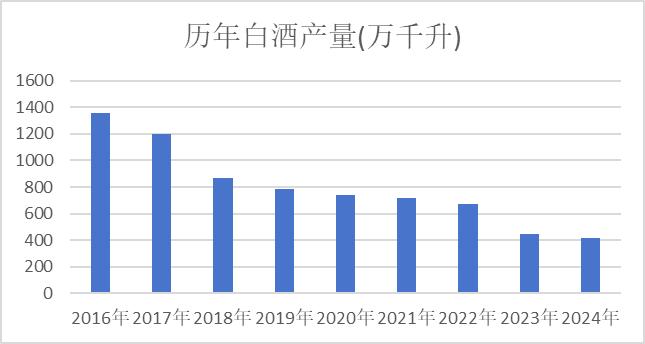
Core Insights - The overall alcohol market is experiencing a decline, with both the baijiu and beer industries facing significant challenges, including a projected 1% decrease in global beer sales in 2024 [1][9] - Despite the downturn, the high-end beer segment is witnessing growth, with high-end and super high-end beers in China and the U.S. showing positive growth rates of 1% and 2% respectively in 2024 [2][9] Industry Overview - The baijiu industry has seen a continuous decline in production, dropping from 13.58 million kiloliters in 2016 to approximately 4.14 million kiloliters in 2024, with projections indicating it may fall below 4 million kiloliters in 2025, marking a 20-year low [4][7] - High-end baijiu prices have also plummeted, with notable brands like Moutai and Wuliangye hitting record lows in wholesale prices [7][8] - The beer industry is similarly struggling, with a 0.6% decline in production for major Chinese breweries in 2024, amounting to 35.21 million kiloliters, which is about 70% of the peak production in 2013 [9] High-End Beer Growth - High-end beer is driving revenue growth for breweries, with companies like Yanjing Beer reporting that mid-to-high-end products accounted for 70.11% of their sales, achieving a revenue growth of 9.32% [9][12] - The trend towards high-end beer consumption is largely driven by younger consumers, who are increasingly willing to pay for quality and unique experiences [12][14] Consumer Behavior - A significant portion of young consumers (over 77%) prefer the concept of "quality over quantity" in their beer choices, indicating a shift in consumption patterns [13] - The younger demographic is motivated by both quality and status, viewing high-end beer as a lifestyle choice rather than just a beverage [14][15] Market Dynamics - The high-end beer market is projected to grow, with the industry’s high-end rate expected to reach 30% by 2026 [19][20] - However, not all companies are successfully transitioning to high-end products, as seen with Budweiser and Tsingtao, which have faced challenges in maintaining sales and profitability in this segment [21][22] Challenges in High-End Transition - The transition to high-end products requires strong brand recognition, effective distribution channels, and cultural resonance with consumers, which many domestic brands struggle to achieve [22][23] - The competition in the high-end market is intensifying, and companies must innovate and connect with younger consumers to succeed [18][24]