
CBC(600132)

Search documents
中国消费行业:2026 年 GCC 会议要点 -估值仍具吸引力,消费复苏迹象显现-China Consumer Sector_ 2026 GCC takeaways_ Sector valuation remains attractive with signs of consumption recovery
2026-01-26 02:50
Summary of Key Points from the Conference Call Industry Overview - **Sector**: China Consumer Sector - **Key Insights**: The sector shows signs of consumption recovery despite a near-term property market downturn. Valuation remains attractive, approximately 1 standard deviation below 10-year averages, indicating that a consumption recovery is not yet priced in [2][21]. Consumer Staples - **Baijiu**: Anticipated demand support for mid-end baijiu due to easing alcohol bans and private consumption growth. Companies are expected to accelerate channel transformations for sustainable EPS growth [3][8]. - **Beer**: Premiumization continues through product diversification and in-home channel expansion, despite on-trade softness. CR Beer expects low-single-digit volume growth in 2025, with Heineken volumes projected to grow by 20% YoY [3][8]. - **Dairy**: Liquid milk sales are expected to recover modestly in 2026, driven by marketing and innovation, despite a weak 2025. Fresh milk shows resilience with double-digit growth [3][8]. - **Freshly-Made Beverages (FMB)**: Guming is expected to maintain steady SSSG in 2026 through category expansion and dine-in growth, despite the phase-out of delivery subsidies [3][8][19]. - **Condiments**: Sequentially improving demand is expected, with Haitian focusing on multi-product categories and Jonjee anticipating a cleaner 2026 after a weak 4Q25 [3][8]. Consumer Discretionary - **Home Appliances**: Companies like Midea and Haier expect higher overseas growth compared to domestic markets in 2026. Strategies include price hikes and operational efficiencies [4][10]. - **Jewelry**: Brands with unique designs may consolidate post-VAT reform. Laopu is expected to achieve strong sales growth due to increased focus on value-added services [4][10]. - **Restaurants**: Intense competition leads to divergent strategies, with some companies lowering prices while others upgrade offerings. DPC Dash is on track for expansion despite market uncertainties [4][10]. Stock Implications - **Most Preferred Stocks**: CR Beer, Guming, MIXUE, China Foods, YUM China, among others, are highlighted as preferred investments due to their growth potential [5]. - **Least Preferred Stocks**: Companies like Swellfun, Nongfu, and Gree are noted as less favorable due to various challenges [5]. Key Risks - Risks include demand recovery uncertainties, cost inflation or deflation, and changes in the competitive landscape. These factors could significantly impact the consumer sector's performance [21]. Additional Insights - **Pet Food**: The industry is shifting towards online sales, with over 85% of sales occurring digitally. Competition is intensifying, pushing brands towards innovation and product differentiation [13]. - **Snack Sector**: Rapid category diversification and channel restructuring are creating growth opportunities, particularly through snack discounters [9][12]. This summary encapsulates the essential insights and projections from the conference call, providing a comprehensive overview of the current state and future outlook of the China consumer sector.





湖北和广东调研反馈、周观点:啤酒推新蓄力,烘焙旺季稳健-20260125
GOLDEN SUN SECURITIES· 2026-01-25 11:22
Investment Rating - The report maintains an "Accumulate" rating for the food and beverage industry [5] Core Insights - The upcoming Spring Festival is expected to boost sales in the liquor sector, with Moutai leading the industry towards an unexpected improvement. Short-term focus should be on the demand for the Spring Festival, while medium-term investments should target leading brands across various price segments [1] - In the beer segment, new product launches are being prepared, with a focus on high-growth channels and consumer trends towards personalized and diversified consumption [2] - The baking sector is showing stable performance, with companies like Lihigh Foods preparing for the sales peak and benefiting from favorable policies regarding cream products [3] Summary by Relevant Sections Liquor Sector - The Spring Festival is driving demand, with Moutai expected to lead the market. Key short-term stocks include Guizhou Moutai, Guo Jiu Gong Jiu, and others, while medium-term focus should be on Wuliangye and Shanxi Fenjiu [1] Beer Sector - Current beer sales are in a low season, but new product launches and high growth in instant retail channels are promising. Companies like Chongqing Beer are launching new 1L cans to meet consumer preferences [2] Food Sector - Lihigh Foods is preparing for the sales peak with a focus on quality over quantity, while Anqi Yeast is benefiting from declining sugarcane prices, enhancing profit margins [3] - Yizhi Konjac is experiencing rapid demand growth, with a stable supply chain and product innovation driving its market position [4]




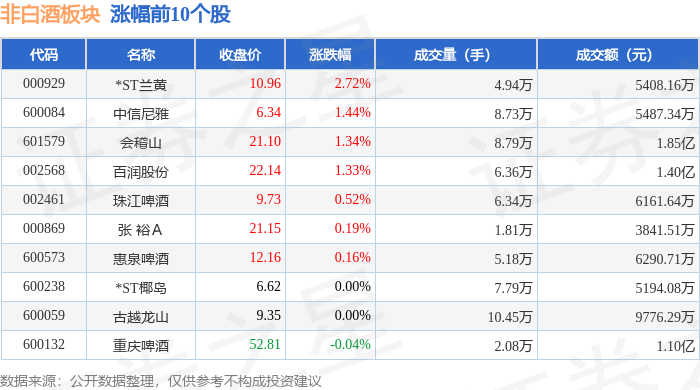
非白酒板块1月23日涨0.18%,*ST兰黄领涨,主力资金净流出2353.25万元
Zheng Xing Xing Ye Ri Bao· 2026-01-23 09:04
Core Viewpoint - The non-liquor sector experienced a slight increase of 0.18% on January 23, with *ST Lanhuang leading the gains, while the overall market indices also showed positive movement [1]. Group 1: Market Performance - The Shanghai Composite Index closed at 4136.16, up by 0.33% [1]. - The Shenzhen Component Index closed at 14439.66, up by 0.79% [1]. - The non-liquor sector stocks showed varied performance, with *ST Lanhuang rising by 2.72% to a closing price of 10.96 [1]. Group 2: Stock Performance - The top performers in the non-liquor sector included: - *ST Lanhuang: 10.96, +2.72%, trading volume of 49,400 shares, turnover of 54.08 million [1]. - Zhongxin Niya: 6.34, +1.44%, trading volume of 87,300 shares, turnover of 54.87 million [1]. - Huijuan Beer: 12.16, +0.16%, trading volume of 51,800 shares, turnover of 62.91 million [1]. - Conversely, stocks like Weilang Co. and ST Xifa saw declines of 2.12% and 1.88%, respectively [2]. Group 3: Capital Flow - The non-liquor sector experienced a net outflow of 23.53 million from institutional funds and 36.39 million from speculative funds, while retail investors contributed a net inflow of 59.92 million [2]. - Notable capital flows included: - Qingdao Beer: -35.13 million from institutional funds, with a retail outflow of -49.91 million [3]. - *ST Yedao: +5.45 million from institutional funds, with a retail inflow of +1.50 million [3].





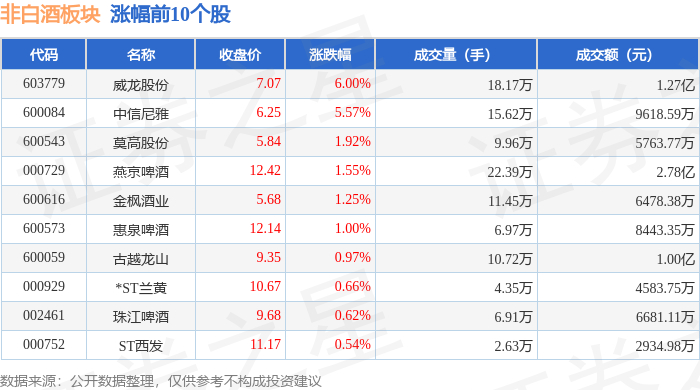
非白酒板块1月22日涨0.72%,威龙股份领涨,主力资金净流出1821.8万元
Zheng Xing Xing Ye Ri Bao· 2026-01-22 09:02
Core Viewpoint - The non-baijiu sector experienced a 0.72% increase on January 22, with Weilong Co., Ltd. leading the gains, while the Shanghai Composite Index rose by 0.14% and the Shenzhen Component Index increased by 0.5% [1] Group 1: Market Performance - The closing price of Weilong Co., Ltd. was 7.07, with a rise of 6.00% and a trading volume of 181,700 shares, amounting to a transaction value of 127 million yuan [1] - Other notable performers included CITIC Neya with a closing price of 6.25, up 5.57%, and Mogaoguan Co. at 5.84, up 1.92% [1] - The overall trading volume in the non-baijiu sector showed varied performance, with some stocks like Feike Beer and Jinfeng Wine also recording positive gains [1] Group 2: Capital Flow - The non-baijiu sector saw a net outflow of 18.218 million yuan from institutional investors and 35.8685 million yuan from retail investors, while there was a net inflow of 54.0864 million yuan from individual investors [2] - The capital flow data indicates that while institutional and speculative funds withdrew, retail investors were actively buying into the sector [2] Group 3: Individual Stock Analysis - Chongqing Beer experienced a net outflow of 16.9419 million yuan from institutional investors, while retail investors contributed a net inflow of 1.2597 million yuan [3] - Weilong Co., Ltd. had a net inflow of 14.4287 million yuan from institutional investors, but faced a net outflow of 1.19562 million yuan from retail investors [3] - Qingdao Beer saw a net inflow of 11.5279 million yuan from institutional investors, indicating strong institutional interest despite retail outflows [3]


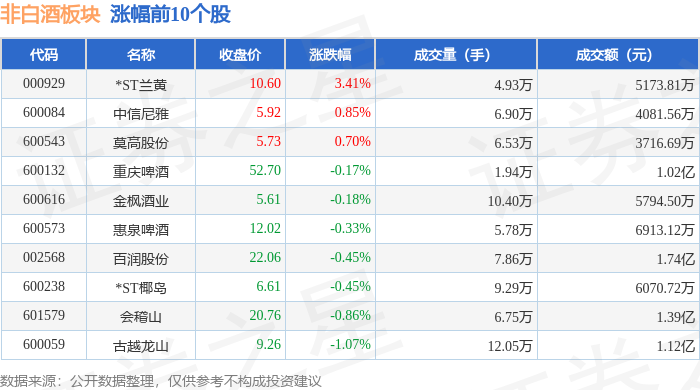
非白酒板块1月21日跌0.99%,燕京啤酒领跌,主力资金净流出9345.66万元
Zheng Xing Xing Ye Ri Bao· 2026-01-21 08:53
Core Viewpoint - The non-liquor sector experienced a decline of 0.99% on January 21, with Yanjing Beer leading the drop, while the Shanghai Composite Index rose by 0.08% and the Shenzhen Component Index increased by 0.7% [1] Group 1: Market Performance - The non-liquor sector's stocks showed mixed performance, with notable declines in several companies, including Chongqing Beer down by 0.17% and Jinfeng Wine down by 0.18% [1] - The closing prices and percentage changes of key stocks in the non-liquor sector were detailed, highlighting the overall downward trend [1] Group 2: Trading Volume and Value - The trading volume and value for various stocks in the non-liquor sector were reported, with ST Lanhua showing a significant increase of 3.41% in closing price and a trading volume of 49,300 hands, amounting to 51.73 million yuan [1] - The total trading volume and value for the non-liquor sector indicated active trading despite the overall decline [2] Group 3: Capital Flow - The non-liquor sector saw a net outflow of 93.45 million yuan from main funds, while retail investors contributed a net inflow of 28.66 million yuan [2] - The capital flow data revealed that retail investors were more active in the market compared to institutional investors, with specific stocks like Guyue Longshan experiencing significant retail inflows [3]


食品饮料行业2026年投资策略:白酒有望调整结束,大众品优选个股
Southwest Securities· 2026-01-20 09:16
Core Insights - The report indicates that the adjustment period for high-end liquor is expected to end, highlighting the long-term investment value in this sector. The price of mainstream liquor has decreased from approximately 2200 yuan around the Spring Festival in 2025 to about 1560 yuan currently, with a notable decline since June [4][30][32] - The beer industry is anticipated to benefit from a low base effect in 2026, with emerging retail channels and government consumption stimulus policies expected to drive recovery [5][42] - The dairy industry is currently in a transitional phase, with low milk prices expected to rebound as demand improves and supply stabilizes. The long-term growth potential remains strong due to ongoing consumption upgrades [5][60][63] - The condiment sector is projected to benefit from a gradual recovery in restaurant consumption, with both B2B and B2C channels expected to see improved sales as consumer spending recovers [5][79] Liquor Industry - High-end liquor is expected to stabilize after a period of adjustment, with long-term investment value becoming more apparent. The market share of premium liquor brands continues to rise, and the consumption upgrade trend remains intact despite short-term impacts [4][30][34] - The competition in the mid-range liquor segment has intensified, with brands experiencing varying levels of performance due to market pressures. The demand for mid-range products has been notably affected by weak business consumption [36][39] - Inventory management is crucial, with manufacturers actively controlling supply to maintain price stability. The introduction of information systems has improved inventory management capabilities [40][39] Beer Industry - The beer market is expected to recover due to a low base effect from 2025, with national leaders likely to benefit significantly. The rise of instant retail channels is also anticipated to drive growth in non-on-premise beer sales [42][43] - The industry is entering a mature phase, with a focus on premiumization and product structure upgrades. The market share of high-end products is increasing, reflecting a shift in consumer preferences [47][50] - Cost stability is expected in 2026, with barley prices remaining low and contributing to profit margins. The overall cost structure is anticipated to support profitability in the beer sector [51][53] Dairy Industry - The dairy sector is currently experiencing a down cycle in milk prices, but a rebound is expected as demand improves and supply stabilizes. The long-term growth potential remains strong due to increasing consumer preferences for high-quality dairy products [60][63] - The population base in China supports the demand for dairy products, with significant growth potential in rural areas where consumption is currently lower compared to urban areas [66][70] - The industry is witnessing a shift towards high-quality growth, with leading companies focusing on improving profitability through better cost management and efficiency [60][77] Condiment Industry - The condiment sector is expected to benefit from a gradual recovery in restaurant consumption, with B2B channels likely to see significant improvements as consumer spending increases [79][84] - The industry has shown resilience, with a stable growth rate over the past five years. The market size for condiments has surpassed 650 billion yuan, driven by rising consumer demand and changing eating habits [83][84] - Cost advantages are anticipated in 2026, with raw material prices remaining low, which will help maintain stable growth in the condiment sector [79][80]

啤酒概念涨1.52%,主力资金净流入14股
Zheng Quan Shi Bao Wang· 2026-01-20 08:49
Group 1 - The beer concept index rose by 1.52%, ranking 8th among concept sectors, with 18 stocks increasing in value, including Hongmian Co., HeBai Group, and Jiamei Packaging reaching the daily limit [1] - Leading gainers in the beer sector included Haoxiangni, Kaimeteqi, and Aoruijin, with respective increases of 5.77%, 5.31%, and 3.76% [1] - The stocks with the largest declines were Zhuhai Zhongfu, *ST Lanhua, and Pinwo Food, which fell by 3.18%, 2.94%, and 1.94% respectively [1] Group 2 - The beer concept sector saw a net inflow of 828 million yuan, with 14 stocks receiving net inflows, and 5 stocks exceeding 50 million yuan in net inflow [2] - Kaimeteqi led the net inflow with 254 million yuan, followed by Hongmian Co., Luzhou Laojiao, and HeBai Group with net inflows of 167 million yuan, 164 million yuan, and 130 million yuan respectively [2] Group 3 - In terms of net inflow ratios, Hongmian Co., HeBai Group, and Chongqing Beer had the highest ratios at 32.90%, 15.07%, and 13.17% respectively [3] - The top stocks in the beer concept by net inflow included Kaimeteqi with a 5.31% increase and a turnover rate of 16.50%, and Hongmian Co. with a 10.13% increase and a turnover rate of 9.38% [3][4]


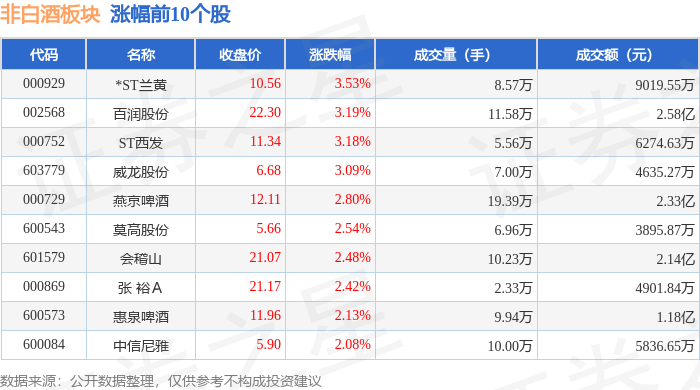
非白酒板块1月19日涨1.82%,*ST兰黄领涨,主力资金净流入1912.61万元
Zheng Xing Xing Ye Ri Bao· 2026-01-19 08:52
Market Performance - The non-liquor sector increased by 1.82% compared to the previous trading day, with *ST Lanhua leading the gains [1] - The Shanghai Composite Index closed at 4114.0, up 0.29%, while the Shenzhen Component Index closed at 14294.05, up 0.09% [1] Stock Highlights - The top-performing stocks in the non-liquor sector included: - *ST Lanhua: Closed at 10.56, up 3.53% with a trading volume of 85,700 shares and a turnover of 90.20 million yuan [1] - Zhirun Co.: Closed at 22.30, up 3.19% with a trading volume of 115,800 shares and a turnover of 258 million yuan [1] - ST Xifa: Closed at 11.34, up 3.18% with a trading volume of 55,600 shares and a turnover of 62.75 million yuan [1] Capital Flow - The non-liquor sector saw a net inflow of 19.12 million yuan from institutional investors, while retail investors contributed a net inflow of 25.07 million yuan [1] - Retail investors experienced a net outflow of 44.20 million yuan from speculative funds [1] Individual Stock Capital Flow - Key stocks with significant capital flow included: - Huaiqi Mountain: Net inflow of 13.72 million yuan from institutional investors, with a net outflow of 15.01 million yuan from speculative funds [2] - Xianjing Beer: Net inflow of 13.16 million yuan from institutional investors, with a net outflow of 29.92 million yuan from speculative funds [2] - ST Xifa: Net inflow of 12.87 million yuan from institutional investors, with a net outflow of 5.68 million yuan from speculative funds [2]


【转|太平洋食饮-26年度策略】底部向阳,寻找结构性亮点
远峰电子· 2026-01-18 11:38
Overall Sector Review - The food and beverage sector significantly underperformed the market, with a year-to-date decline of -0.62%, lagging behind the Shanghai Composite Index by 15.0 percentage points [2] - The sector experienced a deep correction after an initial rebound driven by expectations of consumption recovery and supportive policies, but the actual recovery rate was lower than anticipated, leading to a consensus on weak domestic demand [2] Subsector Performance - The snack sector outperformed with a year-to-date increase of 28.88%, driven by channel expansion and a revenue growth rate of 30.97% in the first three quarters [4] - Soft drinks also showed resilience with a 10.11% stock price increase, benefiting from strong travel demand and low-cost, high-frequency consumption [4] - The restaurant chain sector saw a rebound with gains of approximately 10.34% and 10.29% for pre-processed and baked goods, respectively [4] - The liquor sector, particularly high-end liquor, faced challenges with weaker sales and declining prices, while beer performance was supported but affected by high-end market constraints [4] Investment Insights - The sector is under pressure from deflationary trends and a weak recovery, with consumer confidence remaining low, indicating a shift to a "new normal" of low growth [8] - High-end consumption has shown slight recovery due to stock market wealth effects, but sustainability remains a concern [9] - The food and beverage sector's valuation is at historical lows, with a current PE (TTM) of 21.9X, indicating potential investment opportunities in undervalued segments [12] Fund Holdings - As of Q3 2025, the food and beverage sector's fund holdings decreased to 6.38%, nearing levels seen in 2016, with the liquor segment comprising 5.52% of this [14] - Fund holdings in the liquor sector increased for certain subsectors, including white liquor and seasoning products, while others saw declines [16] Long-term Trends - The liquor industry is undergoing its longest adjustment period since 2003, with significant price corrections and a potential bottoming out of valuations [21] - The white liquor sector has underperformed the market with a year-to-date return of -4.87%, reflecting weak demand and a divergence from broader market trends [24] - The third quarter of 2025 saw a significant decline in revenue and net profit for the white liquor sector, indicating a deep adjustment phase [27] Pricing Dynamics - The white liquor market is experiencing a general decline in prices, particularly in high-end segments, while lower price segments show resilience [29] - The average price of high-end products like Moutai has dropped significantly, while mid-range and lower-range products have maintained stability or slight increases [31] Investment Recommendations - The white liquor sector is advised to focus on inventory reduction and demand recovery, with a preference for leading brands that can maintain pricing power and product stability [32]



重庆嘉威撤诉,重庆啤酒合同纠纷案终结
Xin Lang Cai Jing· 2026-01-16 02:55
Core Viewpoint - The legal dispute between Chongqing Beer and its associate company Chongqing Jiawei has been resolved, with Chongqing Jiawei withdrawing its lawsuit following a mediation agreement, which will not significantly impact the company's profits in the current or future periods [1][3]. Group 1: Legal Proceedings - Chongqing Jiawei filed a lawsuit against Chongqing Beer in October 2023, claiming contract violations and seeking compensation for losses, resulting in a court ruling that ordered Chongqing Beer to pay 353 million yuan [4]. - The lawsuit was officially terminated after Chongqing Jiawei withdrew its complaint, adhering to a mediation agreement reached in the Chongqing High People's Court [1][3]. - In December 2025, Chongqing Beer announced plans to settle the dispute by paying 100 million yuan as part of the mediation agreement [2][4]. Group 2: Company Background - Chongqing Jiawei is an associate company of Chongqing Beer, in which Chongqing Beer holds a 33% indirect stake [4]. - The two companies entered into a 20-year exclusive sales agreement in 2009, allowing only Chongqing Jiawei to produce the "Shancheng" brand beer, which must be sold exclusively through Chongqing Beer [4].