
CBC(600132)

Search documents
贵州“十五五”拟优化白酒结构;茅台不“唯指标论”|观酒周报
2 1 Shi Ji Jing Ji Bao Dao· 2025-12-01 06:08
Group 1: Industry Overview - The liquor industry is entering a year-end summary and planning phase as the year comes to a close [1] - Guizhou's "14th Five-Year Plan" aims to consolidate the sauce-flavored liquor industry cluster and optimize product structure and marketing strategies, targeting a production value of 160 billion yuan for the liquor industry in 2024 [2] - The beer tasting committee's selection event attracted 384 participants, highlighting the growing importance of sensory evaluation in the beer industry [3][4] Group 2: Company Developments - Moutai's new leader, Chen Hua, expressed confidence in the liquor industry's potential, emphasizing the importance of quality over quantity and a focus on consumer needs [5][6] - Jiuzi Jiu and Shenzhen Airlines signed a strategic cooperation agreement to enhance brand collaboration and customer engagement [11] - Qingdao Beer plans to invest up to 10 billion yuan in financial products over the next 12 months, indicating a strategic move to manage its financial resources [10] Group 3: Market Trends - The low-alcohol fruit juice wine brand "Guoli Fang" has achieved double-digit growth for 26 consecutive months, indicating a strong market demand for innovative products [9] - The 2026 Chengdu Spring Sugar and Wine Fair is set to be the largest ever, with an exhibition area of 325,000 square meters, reflecting the industry's growth and interest [17] - Wuliangye continues its collaboration with CCTV for major events, reinforcing its brand presence in the market [8] Group 4: Product Innovations - Laobai Gan Jiu is launching new products targeting younger consumers, including lemon and dried tangerine peel wines, to adapt to changing market demands [13][14] - Moutai has introduced new products, Moutai Prince Wine (Sauce Color) and Moutai Prince Wine (Black Gold), aimed at enhancing market competitiveness [19][20]





重庆啤酒20251128
2025-12-01 00:49
Summary of the Conference Call for Chongqing Beer Industry Overview - In the first ten months of 2025, China's beer sales remained flat compared to the previous year, with expectations to maintain this level for the entire year due to a contraction in on-premise dining and entertainment channels [2][4][17] - The beer industry exhibits distinct seasonal characteristics, with peak consumption typically starting in March for southern markets and April for northern markets [4] Company Performance - As of Q3 2025, Chongqing Beer reported that on-premise sales accounted for approximately 44% of total sales, while off-premise sales made up 56%, indicating a shift towards non-on-premise channels [2][6] - The overall market share (冠化率) of Chongqing Beer exceeded 29% in Q3 2025, up from 18% in 2019, although still below the national average [2][9] - The company has seen significant growth in its Uusu beer brand, driven by brand reinforcement and increased market investment, with new products like Uusu White Beer and 1-liter cans contributing to this growth [2][10] Strategic Focus - Chongqing Beer is focusing on enhancing its non-on-premise channel strategies to adapt to the slow recovery of on-premise consumption [2][7] - The company plans to launch 8 new 1-liter canned products in 2025, aiming to capture the 8-10 RMB price range to improve average selling price (ASP) and consumer demographics [2][12] - The company is also exploring new beverage lines, such as water and tea drinks, to improve capacity utilization and gross margins [18] Financial Outlook - Cost savings are expected in 2026, but the contribution to gross margin is anticipated to be less significant than in 2025 [3][15] - The company maintains a conservative outlook for Q2 2026, expecting sales volume and pricing to be on par with 2025 or slightly improved [3][17] Market Strategy - Chongqing Beer aims to implement different strategies in high-share markets to enhance profitability while being flexible in competitive markets to optimize resource allocation [8] - The company is committed to increasing its presence in the mid-to-high-end beer market, with plans to introduce more premium products in 2026 [21] Challenges and Opportunities - The company acknowledges the challenges posed by the fragmented market and the need for distributors to focus on non-on-premise channel development [7] - Chongqing Beer is leveraging channel transformation and product innovation to find growth opportunities in a stagnant market, including the introduction of new demand-driven products [19] Conclusion - Chongqing Beer is navigating a challenging market environment with a focus on strategic channel shifts, product innovation, and cost management to sustain growth and profitability in the coming years [20]
重庆啤酒总裁李志刚:把握消费场景需求 谋划业绩增长新篇
Zhong Guo Zheng Quan Bao· 2025-11-30 22:27
Core Viewpoint - The Chinese beer industry is undergoing structural adjustments and a transformation in consumer logic, with Chongqing Beer exploring a path that balances local culture and global vision through a dual strategy of local and international brands [2][4]. Product and Channel Transformation - Chongqing Beer has focused on continuous upgrades in product structure and strategic reshaping of channel resources, responding to the slowing growth of the beer industry by innovating in product offerings and channel strategies [2][3]. - The company has launched approximately 30 new products this year, including craft beers, tea beers, and low-alcohol options, while also expanding into non-beer categories like fruit drinks and energy drinks [3]. - The shift towards non-on-premise channels has seen over half of the company's sales coming from these channels, with partnerships established with platforms like Meituan and JD Daojia to enhance distribution [3]. Local and International Brand Synergy - The combination of local and international brands is a key competitive advantage for Chongqing Beer, with local brands accounting for over 70% of total sales, particularly in base markets like Chongqing [4][5]. - Local brands are deeply connected to regional culture, while international brands bring a sense of fashion and vitality, allowing for complementary growth and channel synergy [5][6]. Geographic Expansion and Category Diversification - Chongqing Beer plans to continue its "big city strategy" to enhance its presence in high-potential markets, particularly in South China, where local production has been established to reduce logistics costs [6][7]. - The company aims to upgrade its product structure and accelerate its expansion into non-beer categories, focusing on deeper consumer engagement and continuous iteration of new products [7]. Digitalization and Operational Efficiency - The company emphasizes the role of digital tools in enhancing channel efficiency, aiming for better inventory management and market insights through data optimization [7]. - Continuous iteration is highlighted as a crucial strategy for responding to competition from new beverage brands and the entry of liquor companies into the beer market, with a focus on rich product offerings and efficient channels [7].

把握消费场景需求 谋划业绩增长新篇
Zhong Guo Zheng Quan Bao· 2025-11-30 22:22
Core Insights - The Chinese beer industry is undergoing structural adjustments and a transformation in consumer logic, with companies like Chongqing Beer exploring a dual strategy of local and international brand integration to adapt to these changes [1][4] Group 1: Company Performance - Chongqing Beer reported a sales volume of 2.6681 million kiloliters and revenue of 13.059 billion yuan in the first three quarters of 2025, with an operating profit of 3.233 billion yuan [1] - The company's president emphasized that the stable performance is attributed to continuous optimization in product structure, channel focus, and brand combination [1] Group 2: Product and Channel Innovation - The company is focusing on two main areas for innovation: continuous upgrading of product structure and strategic reshaping of channel resources [2] - Chongqing Beer has launched approximately 30 new products this year, including craft beers, tea beers, and low-alcohol beers, while also expanding into non-beer categories like fruit drinks and energy drinks [2][5] - The company is shifting resources towards non-on-premise channels, with over half of its sales now coming from these channels, and has partnered with various instant retail platforms [2] Group 3: Brand Strategy - Chongqing Beer's competitive advantage lies in its combination of local and international brands, with local brands accounting for over 70% of total sales [3] - The local brand "Wusu Beer" has become a representative national brand, while "Chongqing Beer" has established a strong presence in regional markets [3] Group 4: Future Outlook - The company anticipates that the Chinese beer market will continue to grow, shifting from quantity-driven growth to quality-driven growth [4] - Chongqing Beer plans to enhance its geographical presence, upgrade its brands, and optimize its channels to achieve sustainable and quality growth [4][5] - The company is also focusing on digitalization to improve channel efficiency and market responsiveness [5]
重庆啤酒总裁李志刚: 把握消费场景需求 谋划业绩增长新篇
Zhong Guo Zheng Quan Bao· 2025-11-30 20:27
Core Insights - The Chinese beer industry is undergoing structural adjustments and a transformation in consumer logic, with companies like Chongqing Beer exploring a dual strategy of local and international branding to adapt to these changes [1][3] Product and Channel Transformation - Chongqing Beer is focusing on product structure upgrades and strategic channel resource reallocation to address the slowing growth in the beer industry [2] - The company has launched approximately 30 new products this year, including craft beers and non-beer beverages, to capture evolving consumer preferences [2] - Non-on-premise channel sales now account for over half of the company's total sales, with partnerships established with major instant retail platforms [2] Local and International Brand Synergy - The combination of local and international brands is a key competitive advantage for Chongqing Beer, with local brands accounting for over 70% of total sales [3] - The company’s local brands, such as "Wusu Beer" and "Chongqing Beer," dominate the market share in their respective regions, enhancing brand recognition and consumer loyalty [3] Geographic Expansion and Efficiency Improvement - Chongqing Beer plans to continue its "big city strategy" to deepen its market presence in high-potential areas, particularly in South China [4] - The establishment of the Foshan brewery has improved supply chain efficiency and reduced logistics costs, supporting the company's growth in the Greater Bay Area [4] Brand and Category Development - The company aims to upgrade its product structure and expand into non-beer categories to meet diverse consumer demands [5] - Emphasis is placed on continuous iteration and gradual market penetration rather than seeking immediate blockbuster products [5] Digitalization and Operational Efficiency - The company is leveraging digital tools to enhance channel efficiency, optimize inventory management, and improve market responsiveness [5] - Continuous iteration is highlighted as a crucial strategy to navigate competition from new beverage brands and adapt to changing consumer preferences [5]
非白酒板块11月26日涨0%,会稽山领涨,主力资金净流入1435.5万元
Zheng Xing Xing Ye Ri Bao· 2025-11-26 09:05
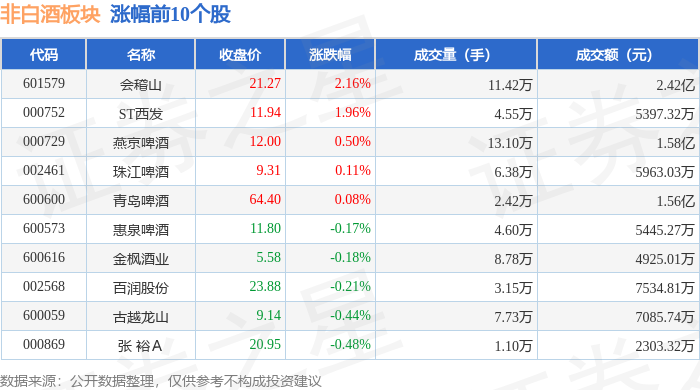
Market Overview - The non-baijiu sector experienced a slight increase of 0.0% on the trading day, with Kuaijishan leading the gains [1] - The Shanghai Composite Index closed at 3864.18, down 0.15%, while the Shenzhen Component Index closed at 12907.83, up 1.02% [1] Stock Performance - Kuaijishan (601579) closed at 21.27, up 2.16% with a trading volume of 114,200 shares and a turnover of 242 million yuan [1] - ST Xifa (000752) closed at 11.94, up 1.96% with a trading volume of 45,500 shares and a turnover of 53.97 million yuan [1] - Cangliang Beer (000729) closed at 12.00, up 0.50% with a trading volume of 131,000 shares and a turnover of 158 million yuan [1] - Other notable stocks include Zhujiang Beer (002461) with a slight increase of 0.11% and Huichuan Beer (600573) with a minor decrease of 0.17% [1] Capital Flow - The non-baijiu sector saw a net inflow of 14.35 million yuan from institutional investors, while retail investors experienced a net outflow of 62.28 million yuan [2] - The overall capital flow indicates a mixed sentiment among different investor types, with institutional and speculative funds showing net inflows while retail investors withdrew funds [2][3] Individual Stock Capital Flow - Kuaijishan had a net inflow of 6.97 million yuan from institutional investors, while retail investors had a net outflow of 11.81 million yuan [3] - Chongqing Beer (600132) saw a net inflow of 5.78 million yuan from institutional investors but a significant outflow of 15.45 million yuan from retail investors [3] - ST Xifa (000752) had a net inflow of 4.64 million yuan from institutional investors, with retail investors also withdrawing funds [3]


重庆啤酒(600132) - 重庆啤酒股份有限公司2025年第二次临时股东会会议资料
2025-11-26 09:00
重庆啤酒股份有限公司 二零二五年第二次临时股东会 会议资料 二零二五年十二月四日 股东会会议须知 尊敬的股东及股东代表: 您好! 欢迎参加重庆啤酒股份有限公司 2025 年第二次临时股东会。为保证本次会议的顺利 进行,以下事项希望得到您的配合和支持。 一、董事会以维护全体股东的合法权益、维持大会正常秩序和提高议事效率为原则, 认真履行《公司章程》规定的职责,做好召集、召开股东会的各项工作。 二、股东参加股东会依法享有发言权、质询权、表决权等权利。股东参加股东会, 应认真履行其法定权利和义务,不得侵犯其他股东的权益,不得扰乱大会的正常秩序。 三、大会设立秘书处,具体负责大会有关程序方面的事宜。 四、参加会议的基本情况 网络投票时间为:2025 年 12 月 4 日(星期四)上午 9:30-11:30,下午 13:00-15:00。 五、投票表决的有关事宜 1、出席本次现场会议的股东或股东委托代理人和参加网络投票的股东,按其所代表 的有表决权股份数额行使表决权,每一股份享有一票表决权。 2、参加本次会议的公司股东只能选择现场投票和网络投票表决方式中的一种。同一 表决权出现重复表决的以第一次投票结果为准。本次会议采 ...
国家级啤酒评酒委员换届选拔首次落地重庆
Ren Min Wang· 2025-11-25 13:36
【中国国际啤酒网】11月23-25日,由中国酒业协会主办、重庆啤酒股份有限公司支持的第八届国 家级啤酒评酒委员换届选拔在重庆南坪会展中心会议中心举行,384名来自全国各地的啤酒品评高手齐 聚一堂。中国酒业协会秘书长何勇表示,这是该项选拔活动首次在渝举办,旨在借助重庆成熟的啤酒产 业基础和多样饮食文化,进一步丰富中国啤酒感官评价体系。 中国啤酒品评最高水平赛事 持续加大在品评领域投入 重啤派出76名品评员参考 在为期三天的选拔活动,参赛选手将经历严格的理论考试和感官品评测试。考核内容涵盖啤酒风味 特征识别、品质缺陷诊断、啤酒风格判断等多个方面,全面评估选手的专业素养和实践能力。 考完当即出结果 前20名获评首席评酒委员 对于专业选手,何勇说,最难的应该是复合风味识别。他介绍说,仪器能够检测出来的风味物质有 3000多种,人的味觉能够识别的有200多种,而考试会在基酒中加2-4种风味,要求品评员一一识别出 来,识别错误不得分,多识别倒扣分。"风味物质加的量可以说是微乎其乎,比如每一升啤酒只加1-2毫 克。" 与往届考试不同的是,此次考试将在25日考完当天出结果。"这也是开展这项选拔以来,首次在考 试结束后1小时出 ...
食品饮料行业双周报:CPI同比转正,食饮板块预期修复-20251124
Guoyuan Securities· 2025-11-24 02:43
Investment Rating - The report maintains a "Recommended" investment rating for the food and beverage industry [4] Core Insights - The food and beverage sector in A-shares has shown a 1.34% increase over the past two weeks, outperforming major indices such as the Shanghai Composite Index by 5.41 percentage points [12] - The Consumer Price Index (CPI) turned positive in October, with a year-on-year increase of 0.2%, indicating a potential recovery in consumer sentiment [3][62] - The report highlights a structural shift in dairy imports towards high-value products, driven by changing consumer preferences for low-fat, high-protein, and organic options [7][62] Summary by Sections 1. Market Review - A-shares in the food and beverage industry rose by 1.34% from November 10 to November 21, outperforming the Shanghai Composite Index by 5.41 percentage points [12] - Within the sector, dairy (+6.67%), processed foods (+2.60%), and liquor (+2.52%) saw the highest gains, while soft drinks (-4.27%), health products (-2.25%), and snacks (-1.02%) experienced declines [12] 2. Key Data Tracking - The average price of fresh milk in major production areas is 3.03 yuan/kg, down 2.9% year-on-year [39] - The national market price for pork is 23.13 yuan/kg, reflecting a year-on-year decrease of 19.7% [44] - The price of PET (water bottle grade) is 6,100 yuan/ton, down 3.9% year-on-year [44] 3. Key Events Tracking - The October CPI data showed a year-on-year increase of 0.2%, with food prices decreasing by 2.9% [3][62] - Retail sales in October grew by 2.9% year-on-year, with significant increases in the sales of grain, oil, and beverages [3][62] - Dairy imports have returned to positive growth, driven by strong demand for high-end products [7][62] 4. Important Company Announcements - Yili Group plans to maintain a cash dividend payout ratio of no less than 75% over the next three years [63] - Huangtai Liquor's major shareholder intends to increase their stake in the company through market purchases [63] 5. Investment Recommendations - For liquor, focus on high-end brands with strong market positions such as Kweichow Moutai and Wuliangye [8][65] - In the consumer goods sector, consider companies in the snack and energy drink markets, as well as those benefiting from the recovery of the dairy and restaurant supply chains [8][65]



涉中国香港、新加坡和马来西亚市场,嘉士伯回应出售部分亚洲业务
Xin Lang Cai Jing· 2025-11-20 12:01
Core Viewpoint - Carlsberg is considering selling part of its Asian business, with Sapporo Brewery as a potential buyer, but the deal may not proceed if key terms are not agreed upon [1] Group 1: Potential Transaction - Sapporo Brewery has established a business partnership with Carlsberg in 2023, focusing on production and sales in Hong Kong, Singapore, and Malaysia [1] - If the transaction occurs, Sapporo could leverage Carlsberg's distribution network in Asia, aligning with its strategy to strengthen its core beer business [1] Group 2: Financial Performance - Carlsberg is facing growth pressure in the Chinese market, with a slight decline of 2% expected in the overall beer market [1] - In Q3, Chongqing Brewery reported revenue of 4.22 billion yuan, a year-on-year increase of 0.41%, but net profit decreased by 12.71% to 376 million yuan [1] - For the first three quarters of 2023, Chongqing Brewery's revenue was 13.06 billion yuan, a slight decrease of 0.03%, and net profit was 1.24 billion yuan, down 6.83% [2] Group 3: Strategic Initiatives - Carlsberg is actively expanding non-current drinking channels, enhancing its premium strategy, and increasing investment in innovative products [3] - Chongqing Brewery has introduced several new products, including "Ushu Craft Red Robe Beer" and "Dali Craft," to boost market share in canned products [3] - Carlsberg's CEO noted an 8% growth in its premium market segment, largely driven by growth in China [3] Group 4: Market Dynamics - Despite a 1.18% increase in revenue from high-end products, mainstream and economy products saw declines of 1.66% and 1.21%, respectively, leading to only a slight overall increase in main business revenue [4] - Chongqing Brewery is accelerating its entry into non-beer categories to meet diverse consumer demands, particularly in dining [4] - Carlsberg is strengthening its brand association with football, having established partnerships with both European and local Chinese football events [4] - Looking ahead to Q4, Carlsberg anticipates a slight decline in the overall Chinese beer market but expects positive sales growth in its own operations [4]
