YANKUANG ENERGY(600188)

Search documents
煤炭行业基金持仓 2025Q4 季报总结:Q4 基金持仓持续回升,板块拐点确认
GUOTAI HAITONG SECURITIES· 2026-01-30 05:36
Investment Rating - The report assigns an "Overweight" rating to the coal industry [5][27]. Core Insights - The coal sector's fund holdings have rebounded from historical lows, confirming the cyclical bottom in Q2 2025, with a reversal in the supply-demand dynamics now evident [3][5]. - The report recommends core stocks such as China Shenhua, Shaanxi Coal, and China Coal Energy, while also suggesting continued investment in Yanzhou Coal and Jinneng Holding [5][6]. Summary by Sections Fund Holdings - As of Q4 2025, the coal sector's fund holdings increased by 0.03% to 0.61%, with the top ten coal stocks' market value ratio rising from 0.49% in Q3 to 0.53% [5][9]. - The number of coal stocks in the top ten holdings decreased from 26 in Q3 2025 to 22 in Q4 2025, indicating a higher allocation to industry leaders with strong profit certainty [5][9]. Major Holdings - The top five coal stocks held by funds are China Shenhua (0.58%), Shaanxi Coal (1.70%), Yanzhou Coal (2.93%), Lu'an Environmental Energy (5.86%), and China Coal Energy (1.60%) [9][12]. - Notable increases in holdings were observed in Shanxi Coal International (5.00%), Pingmei Shenma (4.82%), and Hengyuan Coal Power (2.44%) [13]. Market Performance - The coal industry index outperformed the CSI 300 index in Q4 2025, indicating a positive market trend for coal stocks [6][18]. - The report highlights significant changes in holdings by the Shanghai-Hong Kong Stock Connect, with increased stakes in Jiangxi Tungsten, Zhengzhou Coal, and Kailuan Energy [13][14]. Valuation Metrics - The report provides valuation metrics for key coal companies, with China Shenhua's estimated PE ratio for 2025 at 15.50 and for 2026 at 14.62, indicating a favorable investment outlook [21][22].





煤炭行业热点事件复盘及投资策略系列深度:产能预计收紧、进口预期收缩,看好旺季煤价反弹
Shenwan Hongyuan Securities· 2026-01-29 14:41
Core Insights - The coal industry is undergoing a significant restructuring on the supply side, with policies aimed at controlling coal consumption in power generation and coal-to-gas projects, leading to a tighter supply environment. The emphasis on high-quality and compliant production capacity is expected to increase [4][6][10] - Demand for coal remains stable, driven by resilient electricity consumption and growth in the coal chemical sector, particularly in coal-to-oil and coal-to-olefins projects. Overall coal demand is projected to see slight growth in 2026 [4][6][10] - Investment recommendations include focusing on growth-oriented companies such as TBEA, Jinkong Coal, Huayang Co., Xinjie Energy, Huaihe Energy, and Yancoal Energy, as well as stable dividend-paying companies like China Shenhua, Shaanxi Coal, and China Coal Energy [4][10] - Contrary to common perceptions, the report argues that coal will maintain its strategic importance in energy supply, with a robust demand foundation supporting the industry's fundamentals. The cash-generating nature of the coal sector is expected to strengthen, with coal prices likely to remain at reasonable high levels, enhancing profitability and dividend capacity [4][10] Supply Side Analysis - The domestic coal production growth rate is slowing, with December 2025 coal production at 4.37 million tons, a year-on-year decrease of 1.0%. The overall production for 2025 is projected at 48.32 billion tons, a 1.2% increase year-on-year [22][24] - The report highlights that the supply-demand balance is tightening, with significant policy changes and production adjustments in key coal-producing regions [4][6][10] Demand Side Analysis - Industrial coal demand is showing a steady increase, while thermal power demand is experiencing temporary pressure. The chemical sector is emerging as a new growth driver, with coal consumption in chemical industries growing by 7% year-on-year in December [4][10] - The report indicates that the overall coal consumption is expected to stabilize and achieve slight growth in 2026, supported by ongoing electricity demand [4][10] Key Events and Policy Changes - Recent policy changes include the implementation of stricter safety regulations and the introduction of export tariffs by Indonesia, which are expected to impact global coal supply dynamics [6][10] - The report notes the establishment of a new coal transportation base in Guazhou, which is expected to enhance coal distribution efficiency and support national energy security [6][10] Price Dynamics - The seasonal adjustment of national railway freight rates is expected to influence coal price volatility, with price movements likely to accelerate during periods of freight rate adjustments [10] - The report anticipates that coal prices will rebound, particularly in the peak demand season, driven by improved demand and operational conditions [10]


煤炭开采板块1月29日涨0.45%,郑州煤电领涨,主力资金净流出4.75亿元
Zheng Xing Xing Ye Ri Bao· 2026-01-29 09:00
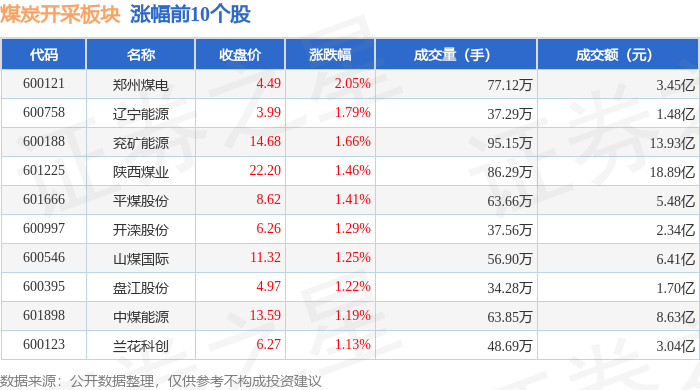
Group 1 - The coal mining sector increased by 0.45% on January 29, with Zhengzhou Coal Power leading the gains [1] - The Shanghai Composite Index closed at 4157.98, up 0.16%, while the Shenzhen Component Index closed at 14300.08, down 0.3% [1] - Key stocks in the coal mining sector showed various performance metrics, with Zhengzhou Coal Power closing at 4.49, up 2.05%, and trading volume of 771,200 shares [1] Group 2 - The coal mining sector experienced a net outflow of 475 million yuan from major funds, while retail investors saw a net inflow of 444 million yuan [2] - The table of individual stock performances indicates significant variations in trading volumes and price changes, with Jiangxi Tungsten Equipment showing the largest decline at -7.07% [2] - The overall market sentiment in the coal mining sector reflects mixed investor behavior, with major funds withdrawing while retail investors are actively buying [3]


小红日报|红利风格爆发,标普A股红利ETF华宝(562060)标的指数收涨0.68%
Xin Lang Cai Jing· 2026-01-29 01:27
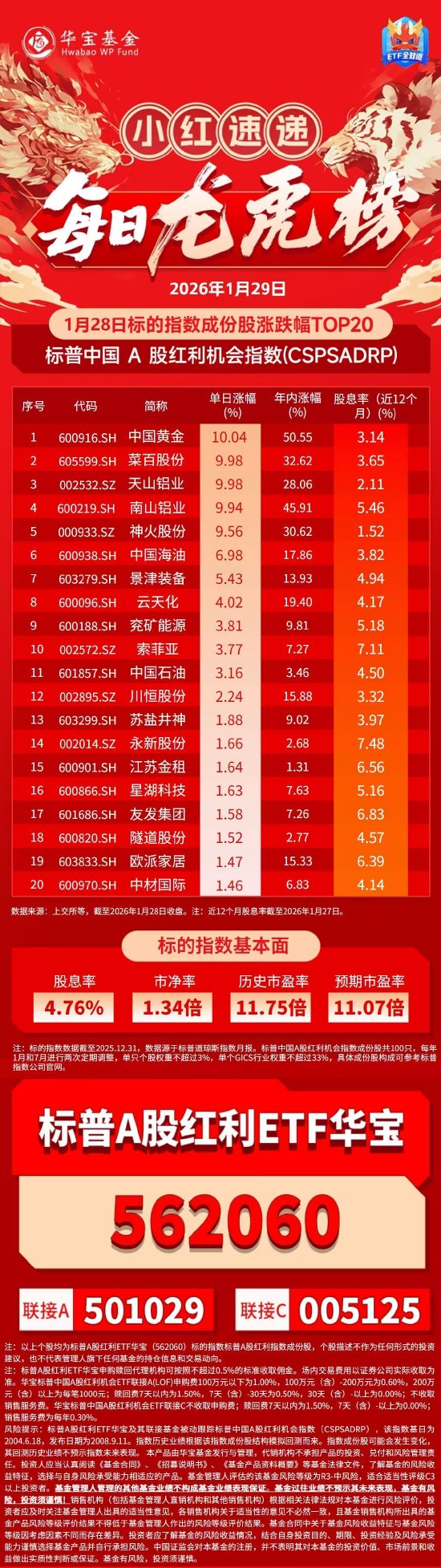
Group 1 - The article presents the top 20 stocks in the S&P China A-Share Dividend Opportunity Index (CSPSADRP) based on their daily and year-to-date performance as of January 28, 2026 [1][6] - China Gold (600916.SH) leads with a daily increase of 10.04% and a year-to-date increase of 50.55%, with a dividend yield of 3.14% [1][6] - Other notable performers include Cai Zi Co. (605599.SH) and Tianshan Aluminum (002532.SZ), both showing daily increases of 9.98% and year-to-date increases of 32.62% and 28.06%, respectively [1][6] Group 2 - The list includes various sectors, with significant representation from the aluminum industry, including Nanshan Aluminum (600219.SH) with a daily increase of 9.94% and a year-to-date increase of 45.91% [1][6] - The energy sector is also highlighted, with Yanzhou Coal (600188.SH) showing a daily increase of 3.81% and a year-to-date increase of 9.81% [1][6] - The data indicates a strong performance across multiple sectors, suggesting potential investment opportunities in these stocks [1][6]



兖矿能源股价涨5.03%,华夏基金旗下1只基金位居十大流通股东,持有1642.66万股浮盈赚取1149.86万元
Xin Lang Cai Jing· 2026-01-28 06:33
截至发稿,赵宗庭累计任职时间8年289天,现任基金资产总规模3569.66亿元,任职期间最佳基金回报 122.37%, 任职期间最差基金回报-32.63%。 1月28日,兖矿能源涨5.03%,截至发稿,报14.61元/股,成交9.27亿元,换手率1.10%,总市值1466.48 亿元。 声明:市场有风险,投资需谨慎。 本文基于第三方数据库自动发布,任何在本文出现的信息(包括但 不限于个股、评论、预测、图表、指标、理论、任何形式的表述等)均只作为参考,不构成个人投资建 议。受限于第三方数据库质量等问题,我们无法对数据的真实性及完整性进行分辨或核验,因此本文内 容可能出现不准确、不完整、误导性的内容或信息,具体以公司公告为准。如有疑问,请联系 biz@staff.sina.com.cn。 资料显示,兖矿能源集团股份有限公司位于山东省邹城市凫山南路949号,成立日期1997年9月25日,上 市日期1998年7月1日,公司主营业务涉及煤炭开采、洗选加工、销售和煤炭铁路运输,煤化工及电力业 务等。主营业务收入构成为:煤炭业务58.09%,煤化工及电力22.48%,非煤炭贸易及物流12.29%,未 分配项目5.47%,矿 ...
煤炭股午后走强 煤价上涨叠加企业降本支撑业绩改善 板块有望走出春季行情
Zhi Tong Cai Jing· 2026-01-28 05:54
浙商证券(601878)指出,展望"十五五",全球焦煤供弱需强,供需格局逆转,产量下降,需求向上, 价格有望抬升,叠加成本下行,预计业绩显著改善;焦煤产能刚性,若价格上涨供给难增,价格弹性较 大。年初至今,焦煤价格较2025年一季度均价高269元/吨,焦煤企业成本逐步下行至低位,预计一季度 业绩显著改善。优质主焦煤公司单位产品净利润远低于动力煤公司,未体现焦煤资源的稀缺性。 煤炭股午后走强,截至发稿,中国秦发(00866)涨11.68%,报4.11港元;力量发展(01277)涨8.18%,报 1.72港元;兖矿能源(600188)(01171)涨4.25%,报11.52港元;中国神华(601088)(01088)涨3.62%, 报43.54港元;中煤能源(601898)(01898)涨3.27%,报11.38港元。 华源证券发布研报称,2023年以来,煤价呈现季度阶梯性中枢下行走势,2025Q3是除2023Q4之外,少 有的煤炭均价环比回升(基于秦港5500大卡动力煤平仓价)财报季,在煤价中枢上行背景下,预计2025Q4 板块有望实现业绩延续环比回升,2026Q1煤炭板块有望走出春季行情。供需上,2026年1 ...
华源证券:均价回升煤企业绩或环比续增 供给政策持续煤价弹性可期
智通财经网· 2026-01-27 06:25
Core Viewpoint - The coal market is expected to see a recovery in performance in Q4 2025, driven by rising coal prices and a favorable supply-demand balance, with potential for a spring rally in Q1 2026 [1][7]. Price Trends - The average price of Qinhuangdao 5500 kcal thermal coal increased from 672 CNY/ton in Q3 2025 to 765 CNY/ton in Q4 2025, marking a 13.8% increase [3]. - In Q4 2025, the price fluctuated significantly, peaking at 834 CNY/ton before dropping to a low of 670 CNY/ton, yet still achieving a notable average increase [2]. Profitability Outlook - The profitability of coal companies is expected to improve, with thermal coal prices rising and coking coal prices also showing significant increases, particularly in long-term contracts [4]. - The average price for coking coal at Jing Tang Port rose to 1726 CNY/ton in Q4 2025, a 10.5% increase from Q3 [4]. Production Dynamics - The "overproduction check" policy has led to a mixed production performance among listed coal companies, with some reporting declines while others saw increases in output [5]. - Major coal producers like China Shenhua and China Coal Energy reported production decreases of 5.0% and 2.1% respectively, while Shaanxi Coal and Yanzhou Coal Energy reported increases of 3.6% and 1.0% [5]. Cost Management - Cost control remains a priority for coal companies, with strategies shifting from volume-driven to cost-focused approaches due to previous low coal prices [6]. - Despite a slight increase in costs expected in Q4 due to rising coal prices and year-end expense settlements, companies have managed to maintain a focus on cost efficiency [6]. Future Supply and Demand - The exit of certain coal supply capacities is anticipated to significantly improve the coal supply-demand balance, with a potential reduction of around 100 million tons if implemented nationwide [8]. - This policy aligns with previous market predictions and is expected to lead to a notable reduction in coal inventories, enhancing price elasticity in 2026 [8]. Investment Recommendations - Companies to watch include stable large-cap thermal coal firms such as China Shenhua, China Coal Energy, and Shaanxi Coal, as well as high-elasticity coal firms like Yanzhou Coal Energy and Jin Coal Industry [9].

25Q4煤炭行业基金持仓分析:基金持仓环比小幅提升,但仍处于较低水平
Guolian Minsheng Securities· 2026-01-26 15:03
Investment Rating - The report maintains a "Recommended" rating for the coal industry, indicating a positive outlook for the sector [2][3]. Core Insights - The report highlights a slight increase in fund holdings in the coal sector, with total market value rising to 6.874 billion yuan in Q4 2025, up 12.13% from Q3 2025, but still at a low level compared to historical data [9]. - The report notes that the coal sector's fund holding ratio is at its lowest in three years, suggesting low investment crowding in the sector [9]. - Key companies such as China Shenhua and Zhongmei Energy are favored by funds, with significant increases in holdings for Yancoal Energy and Shanxi Coal International [9]. - Short-term supply tightening and ongoing replenishment demand are expected to stabilize and potentially rebound coal prices, projected to fluctuate between 750-1000 yuan per ton [9]. - The report recommends focusing on companies with high spot market elasticity, such as Jinko Coal Industry and Shanxi Coal International, as well as industry leaders like China Shenhua and Shaanxi Coal Industry [9]. Summary by Sections Fund Holdings Analysis - Fund holdings in coal stocks increased to 6.874 billion yuan in Q4 2025, a 12.13% rise from Q3 2025, with a holding ratio of approximately 0.36% of total fund holdings [9]. - The report identifies the top five companies by fund holdings, including China Shenhua and Shaanxi Coal Industry, with notable increases in holdings for Yancoal Energy and Shanxi Coal International [9]. Price Outlook - The report anticipates that coal prices will stabilize and rebound due to supply constraints and replenishment needs, with a seasonal fluctuation expected between 750-1000 yuan per ton [9]. - The analysis indicates that the coal industry is likely to return to a state of basic supply-demand balance in 2023-2024, driven by production cuts and regulatory normalization [9].


煤炭行业今日涨2.07%,主力资金净流入4.50亿元
Zheng Quan Shi Bao Wang· 2026-01-26 09:25
Market Overview - The Shanghai Composite Index fell by 0.09% on January 26, with 10 industries experiencing gains, led by non-ferrous metals and petroleum & petrochemicals, which rose by 4.57% and 3.18% respectively. The coal industry ranked third in terms of gains [1] - The defense and military industry and the automotive sector saw the largest declines, with drops of 4.47% and 2.31% respectively [1] Capital Flow Analysis - The main capital outflow from the two markets totaled 114.32 billion yuan, with six industries seeing net inflows. The non-bank financial sector led with a net inflow of 3.493 billion yuan and a daily increase of 0.79%, followed by the pharmaceutical and biological industry, which had a net inflow of 2.839 billion yuan and a daily increase of 0.29% [1] - A total of 25 industries experienced net capital outflows, with the electronics sector leading at a net outflow of 27.721 billion yuan, followed by the power equipment sector with a net outflow of 20.306 billion yuan. Other sectors with significant outflows included defense and military, machinery, and automotive [1] Coal Industry Performance - The coal industry rose by 2.07% with a net capital inflow of 450 million yuan, comprising 37 stocks, of which 28 increased and 9 decreased. Among the stocks with net inflows, 20 saw capital inflows exceeding 30 million yuan, with China Shenhua leading at 169 million yuan, followed by Shaanxi Coal and Huayang Co., which had inflows of 157 million yuan and 77.425 million yuan respectively [2] - The stocks with the largest capital outflows included Zhengzhou Coal Power, Electric Power Energy, and Yongtai Energy, with outflows of 45.022 million yuan, 42.177 million yuan, and 29.549 million yuan respectively [2][3]
兖矿能源董秘黄霄龙:多产业协同跳出煤炭周期波动
Da Zhong Ri Bao· 2026-01-26 09:11
Core Viewpoint - The article discusses the significant transformation and structural adjustments in China's energy sector, particularly focusing on Yanzhou Coal Mining Company Limited (Yankuang Energy), which has undergone a systematic change over the past five years, achieving substantial growth in scale and efficiency [2]. Group 1: Strategic Transformation - Yankuang Energy's development trajectory over the past five years can be summarized by three keywords: strategic transformation, resource aggregation, and international development [2]. - The company has established five major industrial layouts: mining, high-end chemical new materials, new energy, high-end equipment manufacturing, and smart logistics, breaking away from a single coal enterprise model [2][3]. Group 2: Resource Aggregation and Internationalization - Since the restructuring with Shandong Energy Group in 2020, Yankuang Energy has completed significant strategic mergers and acquisitions, adding approximately 32 billion tons of resource volume and 3.6 billion tons of recoverable reserves over five years [3]. - The company is the only domestic energy enterprise listed in six locations globally, including Shanghai, Hong Kong, New York, Sydney, Frankfurt, and Munich, which has facilitated a unique international governance system and operational stability [3]. Group 3: Financial Performance - Key financial metrics have shown significant changes: total assets increased from 258.9 billion yuan at the end of 2020 to 358.6 billion yuan by the end of 2024, a growth of 38.5%; net assets grew by 52.7% [4]. - The net profit attributable to shareholders rose from 7.1 billion yuan in 2020 to 14.4 billion yuan in 2024, totaling 88.72 billion yuan over five years [4]. Group 4: Industry Resilience and Strategic Decisions - The most critical strategic decision was the establishment of a "five major industries" ecosystem, which allows the company to escape the cyclical nature of the coal industry and pursue a path of multi-industry collaboration and sustainable development [6]. - The company has implemented a proactive approach to industry cycle fluctuations, utilizing a combination of strategies to maintain profitability and operational efficiency [7]. Group 5: Future Directions and Goals - For the "15th Five-Year Plan," the core direction is to cultivate new productive forces, focusing on a new development model and governance structure [10]. - By 2030, the company aims to achieve a coal production target of over 300 million tons and ensure that high-end chemical new materials account for over 70% of its portfolio [11]. Group 6: Technological Innovation and Competitive Advantage - The core competitive advantage of Yankuang Energy lies in its systematic capabilities formed by professional accumulation, capital operation, and international development [9]. - The company has established a "3+N" high-end innovation platform, implementing 170 technology projects, achieving world-leading levels in deep mining and intelligent mining construction [9]. Group 7: Commitment to Sustainability - Yankuang Energy is committed to green transformation, with goals to exceed 10 million kilowatts of new energy installed capacity by 2030 and to develop multiple green intelligent mines and "zero-carbon parks" [11]. - The company is also exploring integrated solutions for wind, solar, and hydrogen storage, aiming to enhance its sustainability efforts [11]. Group 8: Information Disclosure and Investor Relations - The company has upgraded its information disclosure practices from compliance to value transmission, significantly enhancing transparency and investor relations [12][13]. - Yankuang Energy has established a proactive investor management model, engaging in over 200 communication activities annually to foster a better understanding of its value among investors [13].