
WOLONG ELECTRIC(600580)

Search documents
中国人形机器人与电动车供应链考察要点-China humanoid robot & EV supply chain tour takeaways
2026-01-29 10:59
Summary of Conference Call Notes Industry Overview Humanoid Robot and EV Supply Chain - The conference focused on the China humanoid robot and EV supply chain sector, with meetings held from January 19-22, 2026, involving various companies in the robotics and automotive sectors [1] - Major component suppliers are preparing for the debut of Tesla's Optimus Gen 3 in the first half of 2026, with batch shipments expected in the second half of 2026 [1] - Suppliers for Unitree's humanoid robot anticipate significant year-over-year shipment growth in 2026, leading to over 100% growth in humanoid robot-related sales [1] - Key component manufacturers are increasing production capacity and expect cost reductions through mass production and product standardization [1] Auto/EV OEMs & Supply Chain Sales Trends and Cost Pressures - Weak auto and EV sales trends are continuing into January 2026, attributed to cuts in EV purchase tax subsidies and incomplete trade-in subsidies [2] - Chery plans to launch new models post-Lunar New Year in February 2026 [2] - BOM (bill of materials) costs for EV models are estimated to increase by approximately RMB4,500-5,000 due to rising prices of lithium carbonate, memory, copper, and aluminum [2] - Seyond expects price reductions in LiDAR, which may alleviate some cost pressures for OEMs [2] Battery Sector Growth and Cost Management - CALB and Gotion are targeting over 50% year-over-year shipment growth, aiming for 180 GWh and 150 GWh respectively in 2026, driven by ESS demand and electrification of commercial vehicles [3] - Both companies plan to expand their effective capacities to 200 GWh by 2026 [3] - Upstream cost pressures from lithium carbonate and LiPF6 are expected to be partially passed through to customers, with ESS customers more likely to accept price hikes than EV customers [3] Company-Specific Insights Wolong Electric - Anticipates humanoid robot-related revenue to double year-over-year in 2026, with a projected revenue of around RMB100 million from humanoid robots in 2025 [8] - The company is investing in a data collection center for humanoid robots, focusing on motion capture [8] ZD Leader - Expects humanoid robot-related revenue to increase from RMB50 million in 2025 to over RMB100 million in 2026, driven by orders from a leading local robot maker [9] - The average selling price of its planetary reducers is expected to decline in the long term [9] Changsheng Bearing - Currently, humanoid robot-related revenue accounts for less than 1% of total revenue, but significant growth is expected [10] - Management anticipates a 20% CAGR in the auto industry, supported by rising content value and market share gains [10] Precision Tsugami China - Achieved over 15,000 unit shipments of machine tools in 2025, with a revenue of over RMB5 billion [11] - Management expects over 10% year-over-year shipment growth in 2026, driven by demand from various sectors [11] Seyond - Projects over 1 million units of LiDAR shipments in 2026, with a focus on ADAS products [13] - Expects average selling prices to drop but gross profit margins to improve due to economies of scale [13] Inovance - Expects continued recovery in the factory automation sector, with strong demand from the battery and 3C sectors [14] - New businesses in robotics and industrial software are anticipated to drive long-term growth [15][16] Hengli Hydraulic - Aims for 20-30% revenue growth in 2026, with significant contributions from its partnership with Caterpillar [17] - Targets RMB300-500 million in sales from screw and linear guide business in 2026 [18] CALB - Targets over 180 GWh in battery shipments for 2026, with a focus on mid-to-high-end EV models [19] - Plans to increase production capacity to 200 GWh by 2026 and expects to pass through lithium carbonate price hikes to customers [20][21] JAC - Expects a net loss of RMB1.68 billion in 2025 but aims for 50,000 units shipment for its Maextro brand in 2026 [23] - The Maextro brand is expected to improve profitability in 2026 due to rising capacity utilization [23] Gotion Hi-Tech - Targets 150 GWh in battery shipments for 2026, with significant expansion in production capacity planned [27][28] Chery - Aims for 3 million units in volume sales for 2026, with a 50% penetration rate for EV sales [30] - Expects stable net profit per vehicle despite BOM cost increases [31] Bethel - Projects over 20% revenue growth in 2026, with a focus on new product introductions [32] - Anticipates relatively weak customer orders in the first quarter of 2026 [32] Conclusion - The conference highlighted significant growth opportunities in the humanoid robot and EV sectors, with various companies preparing for increased demand and addressing cost pressures through strategic planning and partnerships.



首轮淘汰赛已开始!大摩:人形机器人进入“拼刺刀”的量产期,PPT玩家正在出局
Hua Er Jie Jian Wen· 2026-01-29 06:06
Core Insights - Morgan Stanley warns that the humanoid robot industry in China has transitioned from the PPT presentation phase to a competitive mass production phase [1] - The gap between industry leaders and laggards is rapidly widening, indicating an imminent first round of industry reshuffling [1] Group 1: Market Outlook - All surveyed manufacturers are optimistic about shipment volumes for 2026, with one leading domestic manufacturer expecting to exceed 5,000 units in 2025 and achieve several times that in 2026 [2] - Specific targets include: Fourier aiming for 2,000 units (up from 400-500 in 2025), MagicBot over 1,000 units, and Kepler 300 units (up from 70-80 in 2025) [2] - Key support for these numbers comes from government-backed projects, with most manufacturers having records of shipments to data collection centers or receiving government support [2] Group 2: Differentiation in Capabilities - A decisive difference in task capabilities and execution efficiency has emerged among manufacturers, with the industry expected to move beyond video demonstrations by 2025 [3] - The ability to complete the closed loop from actual deployment to iterative improvement is critical, including model optimization, task capability enhancement, and cost control [3] - Lagging startups may find it increasingly difficult to catch up during the industry's acceleration phase, with the first round of reshuffling likely to occur soon [3] Group 3: Component Supplier Dynamics - The market for component suppliers shows a clear advantage for leaders with stronger technical capabilities and mass production abilities, leading to higher penetration rates among leading manufacturers [4] - Suppliers are shifting from single component competition to module-level product supply, aiming to reduce integration complexity and improve consistency and quality control [4] - Overseas expansion is becoming a key focus, with leading domestic manufacturers only contributing a "single-digit" percentage to overseas sales last year, but expecting stronger growth in international business this year [4] Group 4: Application Scenarios - Manufacturers are exploring repeatable and scalable application cases across various scenarios, including industrial, retail, medical, logistics, and guidance/display [5] - The expected trajectory is gradual development driven by human-machine collaboration, rather than rapid, unified breakthroughs [5] - Leading manufacturers anticipate that one-third of 2026 shipments will come from entertainment/commercial services, one-third from industrial/data collection, and the remainder from R&D [5]


首轮“淘汰赛”已开始!大摩宣告:人形机器人进入“拼刺刀”的量产期,PPT玩家正在出局
Hua Er Jie Jian Wen· 2026-01-29 05:50
Core Insights - Morgan Stanley warns that the humanoid robot industry in China has transitioned from the PPT presentation stage to a competitive mass production phase [1] - The gap between industry leaders and laggards is rapidly widening, indicating an impending first round of industry reshuffling [1] Group 1: Market Outlook - All surveyed manufacturers are optimistic about shipment volumes for 2026, with one leading domestic manufacturer expecting over 5,000 units in 2025 and several times that in 2026 [2] - Specific targets include: Fourier aiming for 2,000 units (up from 400-500 in 2025), MagicBot over 1,000 units, and Kepler 300 units (up from 70-80 in 2025) [2] - Component suppliers like Hengli Hydraulic and Slin Technology are preparing capacity based on North American manufacturers' production plans, aiming for 1,000 units per week by July 2026, increasing to 2,500 units by year-end [2] Group 2: Differentiation in Capabilities - A decisive difference in task capabilities and execution efficiency has emerged among manufacturers, with the industry expected to move beyond video demonstrations by 2025 [3] - The ability to complete the feedback loop from deployment to iterative improvement is critical, including model optimization and cost control [3] - Lagging startups may struggle to catch up during the industry's acceleration phase, with a first round of reshuffling likely to occur soon [3] Group 3: Component Supplier Dynamics - The market for component suppliers shows a clear advantage for leaders with stronger technical capabilities and mass production abilities [4] - Suppliers are shifting from single component competition to module-level product offerings, which helps clients reduce integration complexity and improve quality control [4] - Overseas expansion is becoming a key focus, with leading domestic manufacturers only contributing a single-digit percentage to overseas sales last year [4] Group 4: Application Scenarios - Manufacturers are exploring repeatable and scalable application cases across various sectors, including industrial, retail, medical, and logistics [5] - A gradual development trajectory is anticipated, driven by human-machine collaboration rather than rapid universal breakthroughs [5] - Leading manufacturers expect one-third of 2026 shipments to come from entertainment/commercial services, another third from industrial/data collection, and the remainder from R&D [5]
新能源+AI周报(第40期20260118-20260124):储能量价齐升,太空、AI主题延续-20260126
Tai Ping Yang Zheng Quan· 2026-01-26 15:01
Investment Rating - The report does not provide specific investment ratings for the industry sectors mentioned [2]. Core Insights - The overall industry strategy focuses on the simultaneous rise in energy storage volume and price, with ongoing themes in space and AI [3]. - The new energy vehicle supply chain is entering an upward cycle, benefiting companies like CATL and EVE Energy due to the electrification upgrade and optimization of energy storage patterns [3]. - By the end of December 2025, China's electric vehicle charging infrastructure is expected to reach 20.092 million units, a year-on-year increase of 49.7% [3]. - Global energy storage battery shipments are projected to reach 640 GWh in 2025, a year-on-year increase of 82.9%, with CATL maintaining a leading position [3][25]. - The solid-state battery sector is entering a critical phase of engineering and industrialization, with companies like Xiamen Tungsten and Peking University Technology benefiting [4]. Summary by Sections Energy Storage and New Energy - The energy storage trend continues to improve, with companies like Sungrow Power and Huaneng Power benefiting from a significant increase in domestic procurement, which exceeded 100 GWh for the first time [5]. - The average price of lithium battery storage systems has rebounded by 6.39% to 0.5226 yuan/Wh [5]. - AI expansion and global grid upgrades are driving demand for power equipment, benefiting companies like TBEA and Sanyuan Electric [5]. Lithium Carbonate and Battery Materials - The supply and demand for lithium carbonate are exceeding expectations, with companies like Salt Lake Potash and Hunan Youneng benefiting from favorable market conditions [4]. - The cost of phosphoric iron lithium cathode materials has increased, with processing fees rising by 318.7 yuan/ton compared to November averages [4][27]. AI and Robotics in New Energy - The integration of AI and humanoid robots in the new energy sector is gaining traction, with companies like Zhejiang Rongtai and Keda Li benefiting from advancements in robotics [7]. - Tesla's shift towards becoming a robotics company is expected to create new growth cycles, with significant implications for the automotive industry [7][26]. Market Trends and Projections - The report highlights that the global energy storage battery shipment is expected to reach 1,090 GWh in 2026, a year-on-year increase of 70% [25]. - The market for commercial energy storage products is evolving, with larger capacity batteries becoming mainstream and driving innovation in the sector [29].




卧龙电驱股价跌5.02%,工银瑞信基金旗下1只基金重仓,持有4.08万股浮亏损失9.63万元
Xin Lang Cai Jing· 2026-01-26 06:04
Group 1 - The core point of the news is that Wolong Electric Drive experienced a decline of 5.02% in its stock price, reaching 44.64 CNY per share, with a trading volume of 3.099 billion CNY and a turnover rate of 4.34%, resulting in a total market capitalization of 69.733 billion CNY [1] - Wolong Electric Drive Group Co., Ltd. is based in Shaoxing, Zhejiang Province, and was established on October 21, 1998, with its listing date on June 6, 2002. The company specializes in electric motors and controls, power batteries, and photovoltaic energy storage [1] - The revenue composition of Wolong Electric Drive includes: industrial motors and drives (55.80%), daily-use motors and controls (24.21%), wind-solar hydrogen storage (7.64%), electric transportation (4.97%), and other segments (4.96% and 2.41%) [1] Group 2 - From the perspective of major fund holdings, one fund under ICBC Credit Suisse has a significant position in Wolong Electric Drive. The CSI 500 ETF (510530) increased its holdings by 2,100 shares in the fourth quarter, totaling 40,800 shares, which represents 0.53% of the fund's net value, ranking it as the eighth largest holding [2] - The CSI 500 ETF (510530) was established on October 17, 2019, with a current scale of 377 million CNY. Year-to-date returns are 15.08%, ranking 651 out of 5,580 in its category; the one-year return is 58.28%, ranking 1,013 out of 4,271; and since inception, the return is 80.39% [2] Group 3 - The fund manager of the CSI 500 ETF (510530) is Liu Zihao, who has been in the position for 2 years and 291 days. The total asset scale during his tenure is 3.657 billion CNY, with the best fund return being 105.4% and the worst being -2.47% [3]
机器人行业点评报告:机器人密集资本化,产业化有望迎来加速
Shenwan Hongyuan Securities· 2026-01-20 13:45
Investment Rating - The report rates the robotics industry as "Overweight," indicating a positive outlook for the sector compared to the overall market performance [2][8]. Core Insights - The robotics industry is currently experiencing a phase of intensive capitalization, with leading companies preparing for IPOs and existing firms leveraging differentiated capital platforms for expansion. This trend is driven by the industry's transition from zero to one, requiring significant capital for operations, and the favorable regulatory environment creating an optimal window for capitalization over the next 1 to 2 years [2]. - The commercialization of robotics is accelerating, with increased capital expenditure expected to catalyze the development of funding, R&D, industrialization, and application scenarios. The report outlines three stages of commercialization: industrial use, commercial use, and ultimately household use [2]. - Key segments benefiting from the 2026 industrialization of robotics include: 1. The robotics body segment, where leading companies are expected to catalyze market growth through IPOs [2]. 2. The robotics components and modules segment, supported by manufacturing companies in regions like the Yangtze River Delta and Pearl River Delta [2]. 3. The soft technology segment, which may see mergers and acquisitions involving quality startups and unicorns [2]. 4. The application segment, where companies with strong customer loyalty and viable scenarios are likely to launch successful products in collaboration with established robotics firms [2]. Summary by Sections - **Capitalization Phase**: The robotics industry is in a critical phase of capitalization, with numerous companies preparing for public offerings and leveraging existing platforms for growth [2]. - **Commercialization Stages**: The report identifies three stages of robotics commercialization, emphasizing the need for capital and policy support to transition from industrial to household applications [2]. - **Beneficial Segments**: The report highlights four key segments poised for growth, including robotics body, components, soft technology, and applications, each with unique investment opportunities [2]. - **Investment Opportunities**: Recommended stocks include leading companies such as Hengli Hydraulic, Zhejiang Rongtai, and others, indicating a focus on both core and domestic chains within the robotics sector [2].


电机板块1月20日跌0.48%,湘电股份领跌,主力资金净流出4.33亿元
Zheng Xing Xing Ye Ri Bao· 2026-01-20 08:56
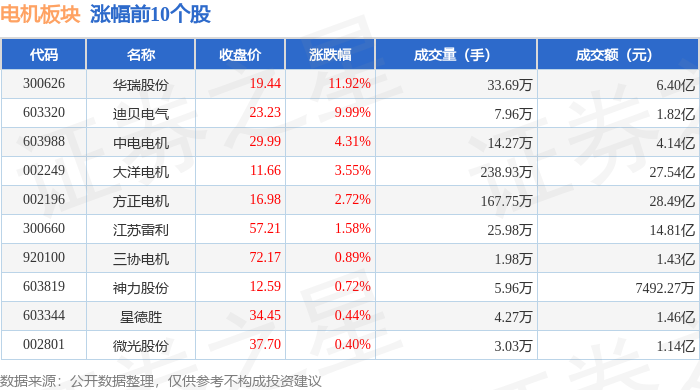
Market Overview - The electric motor sector experienced a decline of 0.48% on the previous trading day, with Xiangdian Co. leading the losses [1] - The Shanghai Composite Index closed at 4113.65, down 0.01%, while the Shenzhen Component Index closed at 14155.63, down 0.97% [1] Stock Performance - Notable gainers in the electric motor sector included: - Huari Co. (300626) with a closing price of 19.44, up 11.92% and a trading volume of 336,900 shares, totaling 640 million yuan [1] - Dibei Electric (603320) closed at 23.23, up 9.99% with a trading volume of 79,600 shares, totaling 182 million yuan [1] - Zhongdian Electric (603988) closed at 29.99, up 4.31% with a trading volume of 142,700 shares, totaling 414 million yuan [1] - Conversely, the following companies faced declines: - Xiangdian Co. (600416) closed at 16.13, down 2.66% with a trading volume of 422,400 shares, totaling 684 million yuan [2] - Wolong Electric (600580) closed at 47.26, down 2.40% with a trading volume of 860,700 shares, totaling 4.113 billion yuan [2] - Zhaowei Electromechanical (003021) closed at 129.75, down 2.15% with a trading volume of 66,700 shares, totaling 873 million yuan [2] Capital Flow - The electric motor sector saw a net outflow of 433 million yuan from institutional investors, while retail investors contributed a net inflow of 24.18 million yuan [2] - Notable capital flows included: - Dayang Electric (002249) with a net inflow of 126 million yuan from institutional investors, but a net outflow of 20.6 million yuan from retail investors [3] - Fangzheng Electric (002196) had a net inflow of 57.39 million yuan from institutional investors and a net outflow of 10.6 million yuan from retail investors [3] - Jiangsu Leili (300660) experienced a net inflow of 47.17 million yuan from institutional investors, but a significant net outflow of 85.81 million yuan from retail investors [3]


新兴产业行业周报:商业航天发展步入快车道 重视人形机器人产业趋势
Xin Lang Cai Jing· 2026-01-20 06:39
Market Overview - A-share major indices showed a significant rebound this week, with the weekly performance of the indices as follows: CSI 300 at -0.57%, ChiNext 300 at 1.39%, STAR 50 at 2.58%, CSI 500 at 2.18%, CSI 1000 at 1.27%, and the humanoid robot index at 1.48%, with the STAR 50 showing the most notable recovery [1] Recent Events and Highlights - China applied to the International Telecommunication Union (ITU) for frequency resources for over 200,000 satellites, with more than 190,000 satellites coming from the newly established Radio Innovation Institute. Experts are optimistic about the institute's role in integrating industry resources and leveraging China's large market to accelerate its industry to catch up with SpaceX [2] Current Perspectives - The establishment of the humanoid robot and embodied intelligence standardization technical committee by the Ministry of Industry and Information Technology is viewed positively for the humanoid robot industry chain, with related companies including Hengshuai Co., Junpu Intelligent, Anpeilong, Keda Li, Lens Technology, Changying Precision, Sanhua Intelligent Control, Fengmao Co., Top Group, and Wuzhou Xinchun [3] - Guangdong has launched its first provincial-level drone governance system, creating a drone resource pool and a provincial management platform to build a "one network for unified flight" service ecosystem, with related companies including Xindong Link, Wanfeng Aowei, Wolong Electric Drive, and Zongshen Power [3] - The China Academy of Information and Communications Technology's Tair System Laboratory recently issued a liquid cooling capability testing report and certificate to Shenzhen Invech Technology Co., indicating that AI data center construction is expected to drive demand for liquid cooling equipment, with related companies including Invech, Nanfeng Co., Chuanrun Co., and Bojie Co. [3] - China's application to the ITU for over 200,000 satellites coincides with the U.S. Federal Communications Commission granting SpaceX significant authorization to build, deploy, and operate an additional 7,500 second-generation Starlink satellites, with related companies including Superjet Co., Xindong Link, Guoji Precision, and Electric Science Digital [3]


双融日报-20260119
Huaxin Securities· 2026-01-19 01:27
Core Insights - The report indicates a "relatively hot" market sentiment with a score of 70, suggesting a positive outlook for the market in the near term [6][9]. - Key investment themes identified include robotics, banking, and retail, each with specific growth drivers and related stocks [6]. Group 1: Robotics Sector - The robotics theme is bolstered by the release of the "Hangzhou Intelligent Robot 'Strong Chain and Supplement Chain' Action Plan (2026-2027)", aimed at enhancing the competitiveness of the local robotics industry, particularly in embodied intelligence [6]. - Related stocks in this sector include Sanhua Intelligent Control (002050) and Wolong Electric Drive (600580) [6]. Group 2: Banking Sector - Banking stocks are highlighted for their high dividend characteristics, with the CSI Bank Index yielding 6.02%, significantly above the 10-year government bond yield [6]. - In a slowing economy with increased market volatility, banking stocks are positioned as important investment options for long-term funds such as insurance and social security [6]. - Key banking stocks mentioned are Agricultural Bank of China (601288) and Ningbo Bank (002142) [6]. Group 3: Retail Sector - The national business work conference held from January 10 to 11 set the tone for consumer stimulation and market development in 2026, emphasizing actions to boost consumption and innovate in the retail sector [6]. - The report notes initiatives like trade-in programs and the creation of the "Buy in China" brand, which are expected to inject long-term growth momentum into the industry [6]. - Relevant retail stocks include Yonghui Supermarket (601933) and Wangfujing (600859) [6].





市监局发布稀土再生利用国标,稀土ETF嘉实(516150)一键布局国内稀土产业链机遇
Xin Lang Cai Jing· 2026-01-16 03:21
Group 1 - The core viewpoint of the news highlights the positive performance of the rare earth sector, with the China Rare Earth Industry Index rising by 0.28% and several key stocks showing significant gains, such as Xiamen Tungsten rising by 5.35% [1] - The market regulatory authority has approved a series of national standards aimed at supporting the development of emerging fields, including standards for industrial internet platforms and digital supply chains, which will enhance the resilience of the industry chain [1] - The first quarter price of rare earth concentrate announced by Baotou Steel is 26,834 yuan/ton excluding tax, with a price adjustment of 536.68 yuan/ton for every 1% change in REO content, indicating a structured pricing mechanism in the rare earth market [2] Group 2 - The top ten weighted stocks in the China Rare Earth Industry Index account for 60.4% of the index, with notable companies including Northern Rare Earth, Jin Feng Technology, and Baotou Steel, reflecting the concentration of market power within a few key players [2] - The rare earth ETF managed by Harvest closely tracks the China Rare Earth Industry Index, providing a convenient investment tool for exposure to the domestic rare earth industry chain [3] - Investors can also access rare earth investment opportunities through the Harvest Rare Earth ETF linked fund, further facilitating investment in this sector [4]


