
HACL(600598)

Search documents
土壤“体检”定制“肥方”
Xin Lang Cai Jing· 2026-01-13 22:56
Core Viewpoint - The company is transforming agricultural practices from "experience-based planting" to "data-driven farming" by implementing a comprehensive approach to fertilizer management and soil analysis for the 2026 spring planting season [1][2] Group 1: Fertilizer Management and Technology - The company has developed a personalized fertilization recommendation card for farmers, enhancing their confidence in the upcoming planting season [1] - In the previous autumn harvest, the company's technicians collected 800 soil samples and conducted standardized processing and precise testing to identify nutrient deficiencies in the soil [1] - A digital model of soil nutrients was created, allowing for the optimal ratio of nitrogen, phosphorus, and potassium to be determined, resulting in over 2,800 tailored fertilization recommendations for farmers [1] Group 2: Historical Context and Impact - The company has been implementing soil testing and fertilization technology since 2007, achieving nearly 20 years of experience in this field [2] - The standardized and rational application of this technology has led to a reduction of 1 to 3 kilograms of fertilizer per acre for farmers, with an average increase of 3% in rice yield per acre [2] - The integration of digital management with fertilization practices has created an intelligent connection across the entire process from fertilization to storage, enhancing agricultural production efficiency and providing dual support for rice yield and farmer income [2]

精准服务粮食变现
Xin Lang Cai Jing· 2026-01-13 22:56
Group 1 - The core viewpoint of the article highlights the proactive measures taken by Beidahuang Agricultural Co., Ltd. to enhance grain sales and support farmers in realizing their income from grain production [1][2] - The company has implemented a series of precise initiatives, including optimizing service connections, expanding sales channels, and strengthening quality assurance, which have effectively accelerated the grain sales process [1] - Farmers have expressed satisfaction with the company's support, noting the efficient guidance on grain storage and the transparent pricing and quick payment processes, which have alleviated their concerns during the selling process [1] Group 2 - Moving forward, the company plans to continuously improve its full-chain service system from production to storage and sales, aiming to establish a stable and efficient grain production and sales connection mechanism [2] - The company is committed to helping farmers produce high-quality grain while ensuring they receive good prices and returns, thereby solidifying the foundation of grain production and injecting strong momentum into the company's high-quality development [2]
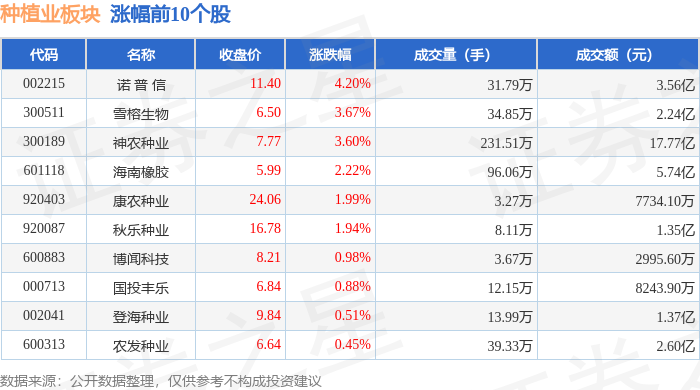
种植业板块1月12日涨0.03%,诺普信领涨,主力资金净流出8228万元
Zheng Xing Xing Ye Ri Bao· 2026-01-12 09:00
Market Overview - The planting industry sector increased by 0.03% on January 12, with Nopson leading the gains [1] - The Shanghai Composite Index closed at 4165.29, up by 1.09%, while the Shenzhen Component Index closed at 14366.91, up by 1.75% [1] Top Performers - Nopson (002215) closed at 11.40, with a rise of 4.20% and a trading volume of 317,900 shares, amounting to a transaction value of 356 million yuan [1] - Xuerong Biological (300511) closed at 6.50, up by 3.67%, with a trading volume of 348,500 shares and a transaction value of 224 million yuan [1] - Shennong Seed Industry (300189) closed at 7.77, increasing by 3.60%, with a trading volume of 2,315,100 shares and a transaction value of 1.777 billion yuan [1] Underperformers - Zhongxing Junye (002772) saw a significant decline of 10.01%, closing at 14.83, with a trading volume of 337,700 shares and a transaction value of 51.2 million yuan [2] - Hualv Biological (300970) decreased by 2.98%, closing at 20.50, with a trading volume of 71,500 shares and a transaction value of 148 million yuan [2] - Jingyin High-Tech (300087) fell by 2.79%, closing at 10.46, with a trading volume of 565,900 shares and a transaction value of 592 million yuan [2] Capital Flow - The planting industry sector experienced a net outflow of 82.28 million yuan from main funds, while retail funds saw a net inflow of 99.07 million yuan [2] - The net outflow from retail investors amounted to 16.79 million yuan [2] Individual Stock Capital Flow - Shennong Seed Industry (300189) had a net inflow of 32.24 million yuan from main funds, with a retail net outflow of 10.3 million yuan [3] - Hainan Rubber (601118) saw a net inflow of 26.82 million yuan from main funds, but a net outflow of 25.71 million yuan from retail funds [3] - Nopson (002215) had a net inflow of 18.02 million yuan from main funds, with a retail net outflow of 3.20 million yuan [3]


农业种植板块走弱,众兴菌业触及跌停
2 1 Shi Ji Jing Ji Bao Dao· 2026-01-12 02:30
Group 1 - The agricultural planting sector is experiencing a downturn, with multiple companies facing significant declines [1] - Zhongxing Junye has hit the daily limit down, indicating severe market pressure [1] - Other companies such as Wancheng Group, Quanyin High-Tech, Hualv Biological, Honghui Fruits and Vegetables, Beidahuang, and Dunhuang Seed Industry are also seeing declines in their stock prices [1]


东方证券农林牧渔行业周报(20260105-20260111):12月猪企出栏延续增量降重-20260110
Orient Securities· 2026-01-10 14:56
Investment Rating - The report maintains a "Positive" investment rating for the agricultural industry [5] Core Insights - The report highlights a structural shortage in the pig market, with expectations for a price turning point in Q2 2026 due to ongoing capacity reduction and favorable policies [3][9] - The report emphasizes the potential for long-term performance improvement in the pig farming sector, driven by policy and market forces [3][9] Summary by Sections Investment Recommendations - The report recommends focusing on the pig farming sector, anticipating a price recovery in Q2 2026, with suggested stocks including Muyuan Foods (002714, Buy), Wens Foodstuff Group (300498, Buy), and Shennong Group (605296, Not Rated) [3] - It also suggests looking at the animal health sector, which may benefit from profit transmission down the supply chain, with recommended stocks including Haida Group (002311, Buy) and Reap Bio (300119, Not Rated) [3] - In the planting chain, the report notes a confirmed upward trend in grain prices, highlighting investment opportunities in large-scale planting, with suggested stocks including Suqian Agricultural Development (601952, Not Rated) and Beidahuang (600598, Not Rated) [3] - The pet food sector is also highlighted, with growth driven by increasing domestic brand recognition and overseas market expansion, recommending stocks such as Guibao Pet (301498, Not Rated) and Zhongchong Co. (002891, Not Rated) [3] Industry Fundamentals - The report indicates that December saw a continued increase in pig output, with 13 listed pig companies collectively reporting an output of 18.72 million heads, a month-on-month increase of 7.11% and a year-on-year increase of 6.8% [13] - The average selling price for pigs in December remained low, with a range from 10.66 yuan/kg to 12.54 yuan/kg, and an overall average around 11.5 yuan/kg [15] - The average weight of pigs sold in December was 124.85 kg, reflecting a decrease of 1.8 kg from the previous month, indicating a trend of accelerated inventory reduction [15][16] Market Trends - The report notes that the natural rubber market is experiencing price strength, with futures prices reaching 16,030 yuan/ton, a week-on-week increase of 2.72% [47] - The report also highlights a stable upward trend in grain prices, with corn and wheat prices showing slight declines while soybean meal prices have increased [37]





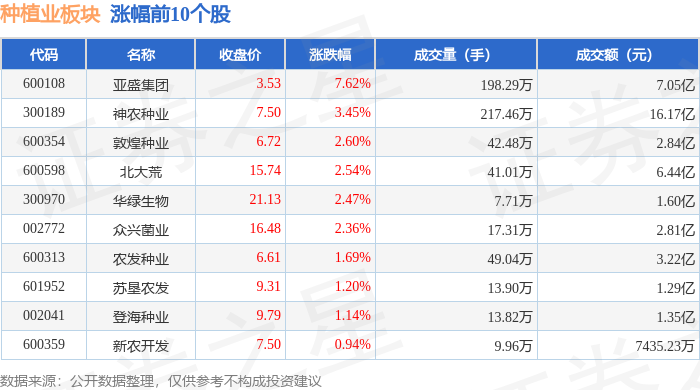
种植业板块1月9日涨0.78%,亚盛集团领涨,主力资金净流入1.6亿元
Zheng Xing Xing Ye Ri Bao· 2026-01-09 08:52
Group 1 - The planting industry sector increased by 0.78% on January 9, with Yasheng Group leading the gains [1] - The Shanghai Composite Index closed at 4120.43, up 0.92%, while the Shenzhen Component Index closed at 14120.15, up 1.15% [1] - Yasheng Group's stock price rose by 7.62% to 3.53, with a trading volume of 1.9829 million shares and a transaction value of 705 million yuan [1] Group 2 - The planting industry sector saw a net inflow of 160 million yuan from main funds, while retail investors experienced a net outflow of 177 million yuan [2] - The stock of Jingyin Gaoke decreased by 7.96% to 10.76, with a trading volume of 946,100 shares and a transaction value of 102.5 million yuan [2] - The stock of Shennong Seed Industry increased by 3.45% to 7.50, with a trading volume of 2.1746 million shares and a transaction value of 1.617 billion yuan [2] Group 3 - Yasheng Group had a net inflow of 1.13 billion yuan from main funds, representing 16.05% of its total trading [3] - Jingyin Gaoke experienced a net outflow of 75.64 million yuan from retail investors, accounting for 7.38% of its total trading [3] - Shennong Seed Industry had a net inflow of 35.56 million yuan from main funds, while retail investors saw a net outflow of 101 million yuan [3]


14名央企领导职务调整




新华网财经· 2026-01-08 13:32
Group 1 - Zhao Dianlong appointed as Deputy Secretary of the Party Committee and Director of China Railway Engineering Group Co., Ltd., nominated as the candidate for General Manager of the company, and relieved of his position as a member of the Standing Committee of the Party Committee of China Railway Construction Group Co., Ltd. [1] - Chen Zhiming appointed as Deputy Secretary of the Party Committee of China Railway Construction Group Co., Ltd. [2] - Sun Liqiang appointed as a member of the Standing Committee of the Party Committee of China Railway Construction Group Co., Ltd. [3] Group 2 - Lin Cunzeng appointed as Deputy Secretary of the Party Committee and Director of China Steel Research Group Co., Ltd., nominated as the candidate for General Manager of the company, and relieved of his position as a member of the Standing Committee of the Party Committee of China CRRC Group Co., Ltd. [4] - Zhao Tao appointed as a member of the Standing Committee of the Party Committee of China Chemical Engineering Group Co., Ltd. [5] Group 3 - Liu Xueshi no longer serves as Chief Accountant of China Guoxin Holdings Limited, retiring from the position. [6] Group 4 - Zhang Zhenga appointed as an external director of China Chengtong Holdings Group Co., Ltd., while Ma Liangjie is no longer an external director of the company. [7] - Wu Aihong appointed as an external director of China International Technology and Intelligence Cooperation Group Co., Ltd. [8] - Zhu Ze appointed as an external director of China Agricultural Development Group Co., Ltd., while Yang Youhong is no longer an external director of the company. [9] - Huang Xudan appointed as an external director of China Forestry Group Co., Ltd. [10] - Tan Xinghui appointed as an external director of China Poly Group Co., Ltd., while Guo Jianxin is no longer an external director of the company. [11]

北大荒涨2.05%,成交额3.06亿元,主力资金净流入169.68万元
Xin Lang Zheng Quan· 2026-01-07 03:33
Core Viewpoint - The stock of Beidahuang Agricultural Company has shown a positive trend with a 2.05% increase on January 7, 2025, reaching a price of 15.45 yuan per share, with significant trading volume and market capitalization [1] Company Overview - Beidahuang Agricultural Company, established on November 27, 1998, and listed on March 29, 2002, is located in Harbin, Heilongjiang Province. Its main business includes land leasing, cultivation and sales of crops such as grains, beans, and oilseeds, agricultural technology services, and real estate development [1] - The revenue composition of the company is as follows: land leasing fees (62.16%), agricultural material sales (33.85%), other goods and services (1.96%), agricultural product sales (1.21%), agricultural service sales (0.62%), asset leasing (0.19%), and livestock product sales (0.01%) [1] Financial Performance - For the period from January to September 2025, Beidahuang reported an operating income of 4.108 billion yuan, a year-on-year decrease of 5.73%, while the net profit attributable to shareholders increased by 0.70% to 1.357 billion yuan [2] - The company has distributed a total of 11.157 billion yuan in dividends since its A-share listing, with 2.507 billion yuan distributed over the past three years [3] Shareholder Structure - As of September 30, 2025, the number of shareholders for Beidahuang was 104,500, a decrease of 10.26% from the previous period. The average circulating shares per person increased by 11.43% to 17,013 shares [2] - The top ten circulating shareholders include Hong Kong Central Clearing Limited, holding 13.9947 million shares (a decrease of 1.3577 million shares), and Southern CSI 500 ETF, holding 10.3573 million shares (a decrease of 0.2139 million shares) [3]
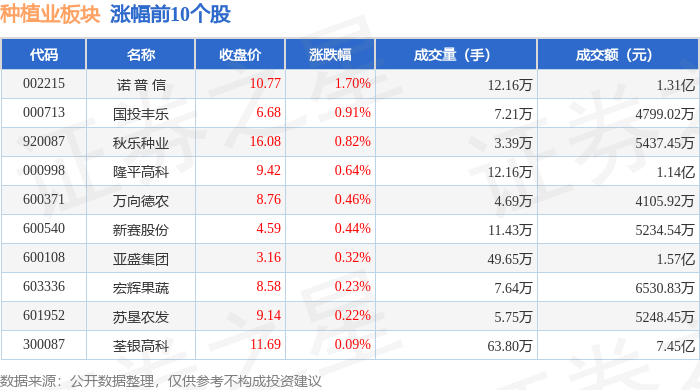
种植业板块1月5日跌0.78%,神农种业领跌,主力资金净流出3650.51万元
Zheng Xing Xing Ye Ri Bao· 2026-01-05 09:02
Market Overview - The planting industry sector declined by 0.78% on January 5, with Shennong Agricultural Technology leading the decline [1] - The Shanghai Composite Index closed at 4023.42, up 1.38%, while the Shenzhen Component Index closed at 13828.63, up 2.24% [1] Stock Performance - Notable gainers in the planting sector included: - Noposion: Closed at 10.77, up 1.70% with a trading volume of 121,600 shares and a turnover of 131 million yuan [1] - Guotou Fengle: Closed at 6.68, up 0.91% with a trading volume of 72,100 shares and a turnover of 47.99 million yuan [1] - Qiu Le Seed Industry: Closed at 16.08, up 0.82% with a trading volume of 33,900 shares and a turnover of 54.37 million yuan [1] - Shennong Agricultural Technology was the biggest loser, closing at 7.07, down 4.97% with a trading volume of 2,384,300 shares and a turnover of 1.677 billion yuan [2] Capital Flow - The planting industry sector experienced a net outflow of 36.51 million yuan from institutional funds, while retail investors saw a net inflow of 80.96 million yuan [2] - The capital flow for specific stocks showed: - Qianyuan High-Tech: Net inflow of 55.91 million yuan from institutional funds, but a net outflow of 46.12 million yuan from speculative funds [3] - Hainan Rubber: Net inflow of 16.70 million yuan from institutional funds, with a net outflow of 3.07 million yuan from retail investors [3] - Yasheng Group: Net inflow of 15.96 million yuan from institutional funds, with a significant net outflow from retail investors [3]


东方证券农林牧渔行业周报(20251229-20260104):年底猪价延续偏强,关注补库进程影响-20260104
Orient Securities· 2026-01-04 05:30
Investment Rating - The industry investment rating is "Positive" and is maintained [5] Core Viewpoints - The pig farming sector is expected to benefit from recent policies and market dynamics that promote capacity reduction, leading to a potential price turning point in Q2 2026, with long-term performance improvements anticipated for related stocks [3][43] - The structural growth trend in the post-cycle sector continues, with profits likely to gradually transmit downstream if the current round of pig capacity reduction proceeds smoothly, benefiting the animal health sector [3] - The planting chain shows a confirmed upward trend in grain prices, indicating favorable fundamentals for planting and seed industries, highlighting significant investment opportunities [3] - The pet food sector is experiencing growth and price increase logic, with continuous recognition of domestic brands and sustained growth of leading companies [3] Summary by Sections Pig Farming - The average price of live pigs as of December 31 was 12.76 yuan/kg, a week-on-week increase of 10.38%, while the average price of 15 kg piglets was 19.44 yuan/kg, up 2.21% week-on-week [12][51] - The supply side shows a widening price gap for fattened pigs, supporting price increases, while demand is boosted by consumption expectations during the New Year holiday [12][17] Poultry - The price of white feather broilers increased to 7.82 yuan/kg, up 6.39% week-on-week, and chick prices rose to 3.59 yuan/chick, up 1.7% week-on-week [17][51] - The supply of meat chickens has increased, leading to a more relaxed market supply, while demand has weakened due to some slaughterhouses reducing operations [17] Feed Sector - The prices of corn, wheat, and soybean meal have risen, with corn averaging 2351.57 yuan/ton, up 0.57% week-on-week, and soybean meal at 3172.29 yuan/ton, up 0.96% week-on-week [27][51] - Increased selling enthusiasm among farmers is noted, although the pace of supply remains slow [27] Major Agricultural Products - The domestic natural rubber futures price was 15605 yuan/ton as of December 31, down 0.29% week-on-week, with inventory levels increasing [38][51] - The current down cycle for sugar prices continues, with no significant recovery expected [39]