HST(600817)

Search documents
宇通重工(600817) - 第十二届董事会第十一次会议决议公告
2026-02-05 11:00
证券代码:600817 证券简称:宇通重工 编号:临 2026-001 宇通重工股份有限公司 第十二届董事会第十一次会议决议公告 本公司董事会及全体董事保证本公告内容不存在任何虚假记载、误导性陈述 或者重大遗漏,并对其内容的真实性、准确性和完整性承担法律责任。 宇通重工股份有限公司(以下简称"公司")第十二届董事会 第十一次会议于 2026 年 2 月 4 日以邮件方式发出通知,2026 年 2 月 5 日以现场结合通讯方式召开,应参会董事 9 名,实际参会 9 名。会议由董事长晁莉红女士主持,董事会秘书列席会议。会议 表决方式符合公司章程及有关法律法规的规定。 会议审议并通过了以下议题: 1、7 票同意,0 票反对,0 票弃权;审议通过了《关于<公司 2026 年限制性股票激励计划(草案)>及其摘要的议案》。 详见公司在上海证券交易所网站(www.sse.com.cn)上披露的 《公司 2026 年限制性股票激励计划(草案)》《公司 2026 年限制 性股票激励计划(草案)摘要公告》。 关联董事胡文波先生、楚义轩先生回避表决。 本议案已经董事会薪酬与考核委员会审议通过。 本议案将提交公司股东会审议。 2、7 ...
宇通重工(600817) - 董事会薪酬与考核委员会关于公司2026年股票期权激励计划相关事项的核查意见
2026-02-05 11:00
董事会薪酬与考核委员会 关于公司 2026 年股票期权激励计划相关事项的核查意见 宇通重工股份有限公司(以下简称"公司")第十二届董事会薪 酬与考核委员会根据《中华人民共和国公司法》(以下简称"《公司 法》")、《中华人民共和国证券法》(以下简称"《证券法》")、 《上市公司股权激励管理办法》(以下简称"《管理办法》")等相 关法律、法规和规范性文件以及《公司章程》的有关规定,对公司《2026 年股票期权激励计划(草案)》(以下简称"《激励计划(草案)》")、 《2026 年股票期权激励计划实施考核管理办法》(以下简称"《考核 管理办法》")以及《2026 年股票期权激励计划激励对象名单》进行 了仔细阅读和审核,对公司 2026 年股票期权激励计划(以下简称"本 激励计划")相关事项发表核查意见如下: (一)公司不存在《管理办法》等法律、法规规定的禁止实施股 权激励计划的情形,包括: 宇通重工股份有限公司 1、最近一个会计年度财务会计报告被注册会计师出具否定意见 或者无法表示意见的审计报告; 2、最近一个会计年度财务报告内部控制被注册会计师出具否定 意见或无法表示意见的审计报告; 3、上市后最近 36 个月内 ...
宇通重工(600817) - 董事会薪酬与考核委员会关于公司2026年限制性股票激励计划相关事项的核查意见
2026-02-05 11:00
关于公司 2026 年限制性股票激励计划相关事项的核查意见 宇通重工股份有限公司(以下简称"公司")第十二届董事会薪 酬与考核委员会根据《中华人民共和国公司法》《中华人民共和国证 券法》《上市公司股权激励管理办法》等相关法律、法规和规范性文 件以及《公司章程》的有关规定,对《公司 2026 年限制性股票激励 计划(草案)》(以下简称"《激励计划(草案)》")、《公司 2026 年限制性股票激励计划实施考核管理办法》(以下简称"《考核 管理办法》")以及《公司 2026 年限制性股票激励计划激励对象名 单》进行了仔细阅读和审核,现发表核查意见如下: (一)《激励计划(草案)》的内容符合《中华人民共和国公司 法》《中华人民共和国证券法》《上市公司股权激励管理办法》等有 关法律、法规和规范性文件以及《公司章程》的有关规定,履行了相 关的法定程序,有利于公司的持续发展,不存在损害公司及全体股东 利益的情形。 (二)《考核管理办法》的内容符合《中华人民共和国公司法》 《中华人民共和国证券法》《上市公司股权激励管理办法》等有关法 律、法规和规范性文件以及《公司章程》的有关规定以及公司的实际 情况,能保证公司限制性股票激励 ...
宇通重工拟授出不超676万份股票期权 行权价为10.45元/股
Zhi Tong Cai Jing· 2026-02-05 10:52
宇通重工(600817)(600817.SH)披露2026年股票期权激励计划(草案),公司激励计划授予股票期权总额 不超过676万份,行权价格为10.45元/股。激励对象不超过136人。本激励计划的有效期为自股票期权授 予之日起至激励对象获授的股票期权全部行权或注销之日止,最长不超过36个月。 ...
宇通重工:2月5日召开董事会会议
Mei Ri Jing Ji Xin Wen· 2026-02-05 10:50
(记者 曾健辉) 每经头条(nbdtoutiao)——仅老年独居者就数千万,谁能帮他们从容老去?意定监护在国内诞生已14 年,距全面落地还差"最后一公里" 每经AI快讯,宇通重工2月5日晚间发布公告称,公司第十二届第十一次董事会会议于2026年2月5日以 现场结合通讯方式召开。会议审议了《关于择机召开2026年第一次临时股东会的议案》等文件。 ...
宇通重工(600817.SH)拟授出不超676万份股票期权 行权价为10.45元/股
智通财经网· 2026-02-05 10:48
Core Viewpoint - Yutong Heavy Industry (600817.SH) has disclosed a draft for its 2026 stock option incentive plan, which aims to motivate employees through stock options [1] Group 1: Stock Option Details - The total number of stock options to be granted under the incentive plan does not exceed 6.76 million [1] - The exercise price for the stock options is set at 10.45 yuan per share [1] - The plan targets no more than 136 individuals as incentive recipients [1] Group 2: Plan Duration - The effective period of the incentive plan lasts from the date of stock option grant until all options are exercised or canceled, with a maximum duration of 36 months [1]
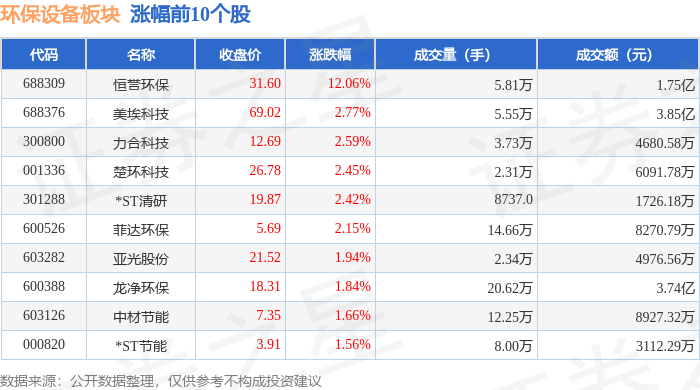
环保设备板块1月30日涨0.09%,恒誉环保领涨,主力资金净流出1.24亿元
Zheng Xing Xing Ye Ri Bao· 2026-01-30 09:00
Market Overview - On January 30, the environmental equipment sector rose by 0.09% compared to the previous trading day, with Hengyu Environmental leading the gains [1] - The Shanghai Composite Index closed at 4117.95, down 0.96%, while the Shenzhen Component Index closed at 14205.89, down 0.66% [1] Stock Performance - Hengying Environmental (688309) closed at 31.60, up 12.06% with a trading volume of 58,100 shares and a transaction value of 175 million yuan [1] - Other notable performers included Meiyu Technology (688376) with a closing price of 69.02, up 2.77%, and Lihua Technology (300800) at 12.69, up 2.59% [1] - The table of stock performance shows various companies in the environmental equipment sector with their respective closing prices, percentage changes, trading volumes, and transaction values [1] Capital Flow - The environmental equipment sector experienced a net outflow of 124 million yuan from institutional investors, while retail investors saw a net inflow of 151 million yuan [2] - The capital flow table indicates the net inflow and outflow for various stocks within the sector, highlighting the dynamics between institutional and retail investors [2][3] Individual Stock Analysis - Yinfeng Environment (000967) had a net inflow of 28.08 million yuan from institutional investors, while Hengying Environmental (688309) saw a net inflow of 18.60 million yuan [3] - Conversely, Huahong Technology (002645) faced a significant decline of 10.00%, with a trading volume of 323,900 shares and a transaction value of 507 million yuan [2][3]




2025 年环卫装备总结:全年销量重回正增长,看好化债+降碳政策下新能源环卫装备发展
Changjiang Securities· 2026-01-30 08:31
Investment Rating - The report maintains a "Positive" investment rating for the industry [11] Core Insights - The sales volume of sanitation equipment in 2025 is projected to reach 79,000 units, representing a year-on-year growth of 11.5%, marking the first year of positive growth since 2021. Notably, sales of new energy sanitation vehicles are expected to increase by 76.8%, with a cumulative penetration rate of approximately 21.7% [3][6][18] - The recovery in sales is primarily attributed to the advancement of national debt reduction policies, which are expected to further enhance the demand for sanitation equipment. Additionally, the "14th Five-Year Plan" carbon reduction policies are anticipated to drive the penetration and economic viability of new energy sanitation equipment [3][8][9] Summary by Sections Overview - In 2025, the sanitation equipment sales are expected to grow by 11.5%, with new energy sanitation vehicles experiencing a significant increase of 76.8%. The total sales volume is projected at 79,000 units, with December alone seeing a sales figure of 10,064 units, a 45.2% increase year-on-year [6][18][21] Market Structure - The market concentration for sanitation equipment in 2025 is indicated by a CR10 of 55.4%, a decrease from 58.6% in 2024. Major players include Yingfeng Environment with a market share of 17.0%, Yutong with 3.9%, and Fulongma with 3.8%. In the new energy segment, the CR10 is higher at 67.7%, with Yingfeng Environment leading at 30.6% [7][26][30] Electrification - The penetration rate of electric sanitation equipment in pilot cities is expected to reach approximately 31.6% in 2025. Excluding Xiong'an New Area, pilot cities are projected to account for 36.2% of total sales, with cities like Zhengzhou and Shenzhen showing significant electric penetration rates of 57.3% and 48.9% respectively [7][33][34] Marginal Changes - The effects of debt reduction are gradually being transmitted, with expectations for further increases in sanitation equipment sales in 2026. The core reason for the recovery in 2025 sales is attributed to the easing of local government financial pressures due to debt reduction policies [8][9] - New energy sanitation equipment is expected to benefit from carbon reduction policies, with significant reductions in emissions compared to traditional fuel vehicles, enhancing its attractiveness in the market [8][9][21] Investment Logic - The growth rate of the sanitation equipment industry is primarily constrained by local fiscal and policy conditions. The dual logic of reduced local fiscal pressure from debt reduction and increased penetration of new energy sanitation vehicles driven by carbon reduction policies presents a favorable outlook for the industry [9][12]

机构今日买入等动力新科20股,卖出中国铀业3.4亿元


3 6 Ke· 2026-01-27 11:42
盘后数据显示,1月27日龙虎榜中,共47只个股出现了机构的身影,有20只股票呈现机构净买入,27只 股票呈现机构净卖出。当天机构净买入前三的股票分别是动力新科、宏景科技、协鑫集成,净买入金额 分别是2.81亿元、2.31亿元、2.18亿元。当天机构净卖出前三的股票分别是中国铀业、拉普拉斯、天奇 股份,净流出金额分别是3.4亿元、2.45亿元、1.89亿元。(第一财经) ...
环保行业跟踪周报:关注矿山绿电和再生战略资源,垃圾焚烧出海新成长启航-20260126
Soochow Securities· 2026-01-26 08:14
Investment Rating - The report maintains an "Overweight" rating for the environmental protection industry [1] Core Insights - The report emphasizes the growth potential in waste incineration and the opportunities for companies to expand overseas, particularly in Southeast Asia and India, where there is a projected increase in waste incineration capacity [10][15] - The report highlights the significant increase in sales of new energy sanitation vehicles and the growth of unmanned sanitation projects, indicating a shift towards automation and electrification in the industry [17][20] - The 2026 strategy focuses on the dual drivers of value and growth, emphasizing the importance of marketization and efficiency improvements in the environmental sector [24][28] Industry Trends - Waste Incineration Growth: The report estimates a potential increase of approximately 500,000 tons/day in waste incineration capacity in ASEAN countries and India, corresponding to an investment scale of about 250 billion yuan [10] - Unmanned Sanitation Equipment: In 2025, the total amount of contracts for unmanned sanitation projects exceeded 12.6 billion yuan, with a year-on-year increase of over 150% [17] - New Energy Sanitation Vehicles: Sales of new energy sanitation vehicles increased by 70.9% in 2025, with a penetration rate of 21.11%, reflecting a growing trend towards electrification in the sanitation sector [20][30] Company Recommendations - Key companies recommended for investment include Longjing Environmental, Gao Neng Environment, Sains, and others, focusing on their growth potential in both domestic and international markets [4][15] - The report suggests that companies like Weiming Environmental and Sanfeng Environment are expected to benefit significantly from overseas expansion and high-value projects [15][24] - The report also highlights the importance of dividend increases and return on equity (ROE) improvements for companies such as Huanlan Environment and Green Power [15][24] Market Dynamics - The report notes that the profitability of waste incineration projects in Indonesia is significantly higher than in China due to favorable pricing and operational conditions [12][15] - The report indicates that the market for lithium battery recycling is improving, with rising metal prices and better margins for recycling projects [38][39]