
NJBK(601009)

Search documents
260万银行人,半年平均薪酬“曝光”,5家月薪超4.5万
Zhong Guo Ji Jin Bao· 2025-08-30 12:41
Core Insights - The average salary for bank employees in the first half of 2025 has slightly increased compared to the same period in 2024, with an average salary of 18.1 million yuan and an average monthly salary of 3.02 million yuan, reflecting a rise of approximately 1,300 yuan [2][4] - The salary trends show a balanced distribution, with about half of the banks increasing salaries while the other half decreased them [1][2] Salary Overview - The average monthly salary for major banks such as China Merchants Bank, Nanjing Bank, Ningbo Bank, Industrial Bank, and Beijing Bank exceeded 45,000 yuan in the first half of 2025 [1][2] - Specific monthly salaries for leading banks are as follows: China Merchants Bank at 50,500 yuan, Nanjing Bank at 48,200 yuan, and both Ningbo Bank and Industrial Bank at 45,400 yuan [2][3] Salary Changes - The salary changes for various banks from the first half of 2024 to the first half of 2025 are as follows: - China Merchants Bank: decreased by 700 yuan - Nanjing Bank: increased by 1,700 yuan - Ningbo Bank: increased by 4,100 yuan - Industrial Bank: decreased by 1,800 yuan - Beijing Bank: increased by 2,300 yuan [3] Employment and Compensation Strategy - The six major state-owned banks employ approximately 1.84 million people, accounting for over 70% of the total workforce in the banking sector [5] - State-owned banks are focusing on salary policies that favor grassroots employees, with initiatives to enhance compensation for those in county-level positions [5]






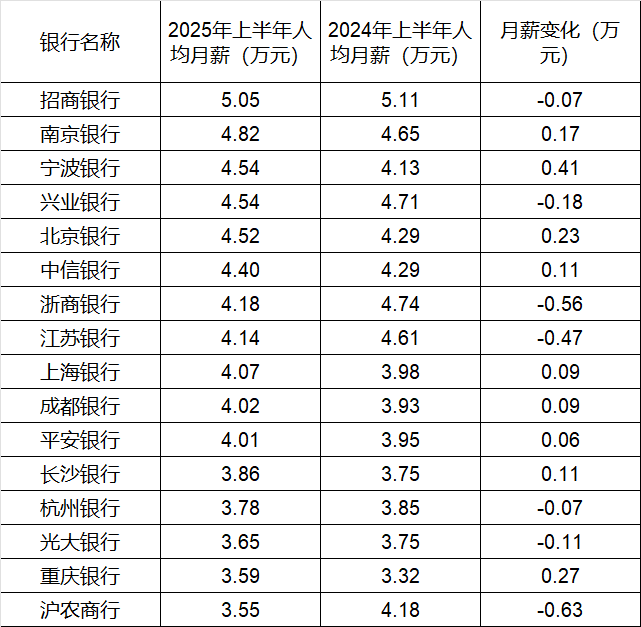
260万银行人,半年平均薪酬“曝光”,5家月薪超4.5万
中国基金报· 2025-08-30 12:39
Core Viewpoint - The average salary of bank employees in China has slightly increased in the first half of 2025 compared to the same period in 2024, with a notable number of banks experiencing salary increases while others saw declines [2][4]. Salary Overview - The average salary for 2.6 million bank employees in the first half of 2025 is approximately 181,000 yuan, translating to an average monthly salary of 30,200 yuan, which is an increase of about 1,300 yuan from the previous year [5]. - The average salary for the first half of 2024 was lower, with a decrease of over 5,000 yuan compared to the first half of 2023 [4]. Leading Banks in Salary - Joint-stock banks and city commercial banks lead in average salary levels, with several banks reporting average monthly salaries exceeding 45,000 yuan in the first half of 2025 [3]. - Specific banks with high average monthly salaries include: - China Merchants Bank: 50,500 yuan - Nanjing Bank: 48,200 yuan - Ningbo Bank: 45,400 yuan - Industrial Bank: 45,400 yuan - Beijing Bank: 45,200 yuan [5][6]. State-Owned Banks Salary Comparison - Among the six major state-owned banks, the average monthly salaries are significantly lower, with: - Bank of China: 28,200 yuan - Bank of Communications: 27,500 yuan - Industrial and Commercial Bank of China: 26,300 yuan - China Construction Bank: 26,200 yuan - Agricultural Bank of China: 25,200 yuan - Postal Savings Bank: 24,900 yuan [7][8]. Salary Policy Trends - Major state-owned banks are focusing on salary policies that favor grassroots employees, aiming to enhance talent development in county-level branches and improve employee engagement [10][11].


上海大消息!20多家银行宣布:调整
Zhong Guo Ji Jin Bao· 2025-08-30 01:53
Core Viewpoint - Shanghai's new housing policy has led to a reduction in mortgage rates for existing loans and a minimum rate of 3.09% for new second-home loans, aligning them with first-home rates [1][3]. Group 1: New Mortgage Rates - The new policy eliminates the distinction between first and second home mortgage rates in Shanghai, with the specific rate determined by the market rate pricing mechanism and individual bank conditions [2][10]. - The minimum mortgage rate for new second-home loans in Shanghai is set at 3.09%, which is consistent with the first-home loan rate [3][2]. Group 2: Existing Mortgage Adjustments - Existing mortgage rates can be adjusted for eligible borrowers, particularly if their current rate exceeds the national average by more than 30 basis points [4][11]. - For example, a second-home loan with a current rate of 3.45% could potentially be reduced to 3.36% [6][4]. - The adjustment process will not incur any fees and will begin on September 1, 2025 [7][14]. Group 3: Implementation and Communication - Banks in Shanghai, including major institutions like ICBC and Bank of China, have issued announcements regarding the new mortgage rate adjustments [1][9]. - Borrowers can check their eligibility for rate adjustments through their respective banks starting September 1, 2025 [12][13].





沪上银行集体调整房贷利率 9月1日起可进行线上查询
Huan Qiu Wang· 2025-08-30 00:49
Core Viewpoint - The new housing loan policy in Shanghai aims to optimize the pricing mechanism for commercial personal housing loans, impacting both new and existing loans [1][3] Group 1: Policy Adjustments - The first major adjustment is the elimination of the interest rate difference between first and second home loans, with future rates determined by the market rate pricing self-discipline mechanism in Shanghai [3] - The second adjustment expands the scope for interest rate adjustments on existing housing loans, allowing borrowers to apply for a reduction in the additional interest rate if it exceeds the average new loan rate by 30 basis points [3] Group 2: Implementation Details - The new policy will take effect from September 1, allowing borrowers to check their loan eligibility for interest rate reductions through online banking channels [3] - The People's Bank of China has set a reference benchmark, with the weighted average interest rate for new commercial personal housing loans at 3.09% for the second quarter of 2025 [3]


红包雨来了!8家上市银行拟中期分红超200亿元
Guo Ji Jin Rong Bao· 2025-08-29 15:18
Core Viewpoint - The mid-term dividend plans for listed banks in A-shares for 2025 have been announced, indicating a positive trend in the banking sector's profitability and dividend distribution capacity [1][3][8] Summary by Category Dividend Announcements - As of August 29, 2023, eight A-share listed banks have disclosed their mid-term dividend amounts and ratios, with a total dividend amount exceeding 20 billion yuan [1][3] - China CITIC Bank announced the largest mid-term dividend of 10.461 billion yuan, distributing 1.88 yuan per 10 shares, which accounts for 30.70% of its net profit attributable to ordinary shareholders [3][4] - Shanghai Bank and Huaxia Bank have also increased their dividend ratios compared to last year, with Shanghai Bank at 32.22% and a total dividend of approximately 4.263 billion yuan, while Huaxia Bank plans to distribute 1.591 billion yuan at a ratio of 15.18% [3][4] First-Time Dividends - Four banks, including Changshu Bank, Ningbo Bank, Su Nong Bank, and Zhangjiagang Bank, are implementing their first mid-term dividends [1][3] - Changshu Bank will distribute 0.15 yuan per share, totaling 0.497 billion yuan, which is 25.27% of its net profit [4] - Ningbo Bank plans to distribute 3 yuan per 10 shares, amounting to 1.981 billion yuan, representing 13.41% of its net profit [4] Future Dividend Trends - Experts suggest that the ongoing economic recovery will enhance the overall operating environment for banks, potentially leading to increased profitability and higher dividends in the future [1][7] - Regulatory emphasis on improving dividend levels is expected to support this trend, particularly for state-owned banks, which can bolster market confidence through substantial dividends [7][8] - Long-term dividend sustainability appears strong, as banks are improving their profitability and asset quality, reducing reliance on external financing for capital [8]





上海多家银行房贷细则落地,新增二套房利率最低3.09%
2 1 Shi Ji Jing Ji Bao Dao· 2025-08-29 13:27
Core Viewpoint - Shanghai's housing market has introduced new mortgage interest rate pricing mechanisms, eliminating the distinction between first and second home loans, aiming to optimize the real estate policy and stimulate market activity [2][3]. Group 1: New Mortgage Policies - Multiple banks in Shanghai have released announcements regarding the optimization of commercial personal housing loan interest rate pricing mechanisms, aligning with the recent government notification [2]. - The new policy states that the specific interest rate for each customer's commercial personal housing loan will be determined based on the Shanghai market interest rate pricing self-discipline mechanism, along with the bank's operational status and customer risk profile [2][4]. Group 2: Existing Loan Adjustments - For existing loans, banks will continue to follow the previous year's guidelines, allowing adjustments for certain second home loans that exceed the average interest rate of newly issued loans by more than 30 basis points [3]. - The weighted average interest rate for newly issued commercial personal housing loans in China was reported at 3.09% for Q2 2025, a decrease of 2 basis points from Q1, indicating potential for lower rates for second home loans in Shanghai [3][4]. Group 3: Regulatory Framework - The central bank's adjustments include four main points, notably the removal of the distinction between first and second home loan interest rates and the emphasis on banks to adhere to market conditions and government regulations [3][4]. - Banks are required to ensure compliance with the new policies, providing adequate communication and support to borrowers regarding their rights and the implications of the new interest rate structures [4].


南京银行(601009):2025年半年报点评:营收业绩增长提速,“双U”发展曲线巩固
EBSCN· 2025-08-29 12:42
Investment Rating - The report maintains a "Buy" rating for Nanjing Bank (601009.SH) with a current price of 11.12 CNY [1]. Core Views - Nanjing Bank's revenue and profit growth have accelerated, with a "double U" development curve solidifying [4]. - The bank achieved an operating income of 28.5 billion CNY in the first half of 2025, representing an 8.6% year-on-year increase, and a net profit attributable to shareholders of 12.6 billion CNY, up 8.8% year-on-year [3][4]. - The annualized weighted average return on equity (ROE) for the first half of the year was 15.3%, a decrease of 0.6 percentage points year-on-year [3]. Revenue and Profit Growth - Revenue and profit growth rates for the first half of 2025 were 8.6%, 9.6%, and 8.8% respectively, showing improvements compared to the first quarter [4]. - The net interest income and non-interest income growth rates were 22.1% and -4.3%, respectively, with net interest income maintaining double-digit growth [4]. Asset and Loan Growth - As of the end of Q2 2025, the growth rates for interest-earning assets and loans were 26.7% and 15%, respectively, indicating a steady increase in scale [5]. - The bank added 130.8 billion CNY in loans during the first half of the year, with significant contributions from corporate and retail loans [5]. Deposit Growth - Deposits increased steadily, with a year-on-year growth rate of 16% as of the end of Q2 2025 [6]. - The bank added 149.4 billion CNY in deposits in the first half of the year, with a notable increase in both fixed and current deposits [6]. Net Interest Margin (NIM) - The NIM for the first half of the year was 1.86%, a slight decrease of 8 basis points compared to 2024 [7][8]. - The bank's interest-earning asset yield and loan yield were 3.72% and 4.56%, respectively, both down from 2024 [7]. Non-Interest Income - Non-interest income for the first half of the year was 12.8 billion CNY, reflecting a year-on-year decline of 4.3%, but the negative growth rate narrowed compared to Q1 [9]. Asset Quality - The non-performing loan (NPL) ratio remained low at 0.82% as of the end of Q2 2025, with a coverage ratio of 312% [10]. - The bank's risk compensation ability remains strong, with a slight decrease in the provision coverage ratio [10]. Capital Adequacy - As of the end of Q2 2025, the core Tier 1 capital ratio was 9.5%, indicating an increase from the previous quarter [11]. - Major shareholders have shown confidence in the bank's future by increasing their holdings [11]. Profit Forecast and Valuation - The report forecasts net profits for 2025-2027 to be 22.15 billion, 23.58 billion, and 24.50 billion CNY, respectively [12]. - The adjusted earnings per share (EPS) estimates for 2025-2027 are 1.79, 1.91, and 1.98 CNY, with corresponding price-to-book (PB) and price-to-earnings (PE) ratios indicating attractive valuations [12][13].
上海多家银行房贷细则落地,新增二套房利率最低3.09%
21世纪经济报道· 2025-08-29 12:42
Core Viewpoint - The article discusses the recent adjustments to the housing loan interest rate pricing mechanism in Shanghai, which aims to optimize the real estate policy and enhance market stability [2][4]. Group 1: New Housing Loan Policies - The new pricing mechanism for commercial personal housing loans no longer distinguishes between first and second homes, allowing for a more unified approach to interest rates [3][4]. - The specific interest rate for each customer's loan will be determined based on the Shanghai market interest rate pricing self-discipline mechanism, along with the bank's operational conditions and customer risk profiles [3][4]. Group 2: Existing Housing Loan Adjustments - Existing housing loans will continue to follow the guidelines established in October of the previous year, allowing for adjustments in the interest rates of certain second-home loans based on market conditions [3][4]. - If the interest rate increase for existing loans exceeds 30 basis points above the average rate of newly issued loans, borrowers can apply for a rate adjustment [3][4]. Group 3: Market Context and Implications - As of July, the weighted average interest rate for newly issued commercial personal housing loans in China was 3.09%, a slight decrease from the previous quarter, while the 5-year LPR was 3.5% [3]. - For second-home owners in Shanghai, applying for a loan after September 1 could result in a minimum interest rate of 3.09%, aligning with first-home rates, while existing loans at 3.45% could potentially be reduced to 3.36% [3].
上海多家银行房贷利率细则落地 新增二套房贷利率最低3.09%
Xin Lang Cai Jing· 2025-08-29 12:13
8月25日上海市六部门联合印发《关于优化调整本市房地产政策措施的通知》。8月29日晚间,有中国银 行、农业银行、建设银行、招商银行、平安银行、光大银行、北京银行、江苏银行、南京银行等多家银 行上海市分行通过官方微信公众号发布《关于优化调整商业性个人住房贷款利率定价机制的公告》,各 家银行《公告》内容一致。新增方面,在利率定价机制安排上,各行不再区分首套住房和二套住房。每 位客户商业性个人住房贷款的具体利率水平,将根据上海市市场利率定价自律机制要求,并结合本行经 营状况、客户风险状况等因素合理确定。对于上海二套房业主来说,如果在9月1日以后申请房贷,最低 利率有望达到3.09%,与首套房房贷利率保持一致。而存量房贷利率为3.45%的二套房贷款可申请降低 房贷利率至3.36%。这与人民银行上海市分行此前发布的调整要求相一致。(21财经) ...
新增二套房贷利率最低3.09%!上海多家银行房贷利率细则落地
2 1 Shi Ji Jing Ji Bao Dao· 2025-08-29 11:46
Core Viewpoint - Shanghai's housing market has introduced new mortgage interest rate pricing mechanisms, eliminating the distinction between first and second home loans, aiming to optimize the real estate policy in the city [1][4]. Group 1: New Mortgage Policies - The new mortgage interest rate pricing mechanism will no longer differentiate between first and second homes, with rates determined based on the Shanghai market interest rate self-discipline mechanism and individual bank conditions [2][4]. - For new loans, the specific interest rate will be set according to market conditions and customer risk profiles [2][4]. Group 2: Existing Loan Adjustments - Existing loan policies will continue to follow the adjustments made in October of the previous year, allowing for the adjustment of interest rates on certain second home loans if they exceed the average new loan rate by 30 basis points [2][3]. - The minimum interest rate for second home loans applied after September 1 is expected to align with the first home loan rate at 3.09%, while existing loans at 3.45% could be reduced to 3.36% [3]. Group 3: Regulatory Framework - The central bank's adjustments include guidelines for banks to ensure compliance with market order and to provide clear communication regarding the new policies to borrowers [4]. - Banks are expected to enhance their pricing autonomy while maintaining consistency in mortgage pricing across the sector [4].