
SA(601021)

Search documents
春秋航空涨2.03%,成交额2.59亿元,主力资金净流入2246.23万元
Xin Lang Zheng Quan· 2025-10-20 03:04
Core Viewpoint - Spring Airlines' stock price has shown a slight decline of 2.88% year-to-date, but has recently experienced a rebound with a 6.24% increase over the past five trading days, indicating potential recovery in investor sentiment [2]. Financial Performance - For the first half of 2025, Spring Airlines reported a revenue of 10.304 billion yuan, reflecting a year-on-year growth of 4.35%. However, the net profit attributable to shareholders decreased by 14.11% to 1.169 billion yuan [2]. - Cumulatively, since its A-share listing, Spring Airlines has distributed a total of 2.83 billion yuan in dividends, with 1.899 billion yuan distributed over the past three years [3]. Stock Market Activity - On October 20, Spring Airlines' stock rose by 2.03%, reaching 54.80 yuan per share, with a trading volume of 259 million yuan and a turnover rate of 0.49%, resulting in a total market capitalization of 53.613 billion yuan [1]. - The net inflow of main funds was 22.4623 million yuan, with significant buying activity from large orders, indicating strong interest from institutional investors [1]. Shareholder Structure - As of June 30, 2025, the number of shareholders for Spring Airlines was 21,000, a decrease of 7.43% from the previous period, while the average circulating shares per person increased by 8.02% to 46,551 shares [2]. - The second-largest circulating shareholder is Hong Kong Central Clearing Limited, holding 22.713 million shares, an increase of 545,500 shares from the previous period [3].

中泰证券:新航季航空供给约束仍强 把握格局优化新机遇
智通财经网· 2025-10-19 23:38
Core Viewpoint - The report from Zhongtai Securities indicates a downward trend in the total flight schedule volume for domestic airlines in the 2025 winter-spring season, both year-on-year and month-on-month, suggesting a potential for price recovery due to supply constraints and high load factors [1][2]. Group 1: Seasonal Overview - The total flight schedule volume for domestic airlines in the 2025 winter-spring season shows a year-on-year decrease of 2% and a month-on-month decrease of 3%, while still being 15% higher than the 2019 winter-spring season [2]. - International flight schedule volume has limited growth, with a 2% increase compared to the 2024 winter-spring season, reaching 75% of the 2019 levels [2]. - The planned schedule volume for domestic airlines in Asia, Europe, Oceania, the Middle East, North America, and Africa has recovered to 79%, 126%, 81%, 171%, 26%, and 267% of the 2019 levels, respectively [2]. Group 2: Domestic Route Dynamics - The overall flight schedule volume is declining, with only five-tier cities showing significant growth, which increased by 4.6% [3]. - The Civil Aviation Administration has limited the release of flight slots in first-tier cities, leading to stable schedule volumes in these areas [3]. - Airlines are likely reducing schedules in less profitable lower-tier cities while increasing flights in five-tier cities, particularly in Xinjiang due to favorable subsidy policies [3][4]. Group 3: Competitive Landscape - Major airlines are reducing their presence in lower-tier markets, which may enhance their revenue quality; for instance, Air China, China Eastern Airlines, and China Southern Airlines have decreased their schedule volumes in lower-tier cities by 3%, 5%, and 4%, respectively [5]. - The proportion of core city flight schedules for major airlines is significant, with Air China at 82%, China Eastern at 80%, and Spring Airlines at 74% [5]. - Huaxia Airlines is increasing its schedule volume by 5.2%, primarily in second and five-tier cities, benefiting from recovery in capacity and subsidies [6]. Group 4: Strategic Investments - Spring Airlines and Hainan Airlines are focusing on increasing their flight schedules in second to five-tier cities, with Spring Airlines showing growth rates of 6.27% to 31.46% across various city tiers [7]. - Hainan Airlines is also increasing its flight schedules in first, second, and five-tier cities, indicating a dual benefit from demand and subsidy policies [7].





每周股票复盘:XD春秋航(601021)春秋航空9月国际运力增32.75%
Sou Hu Cai Jing· 2025-10-18 19:04
Core Viewpoint - Spring Airlines (XD春秋航) has shown a positive trend in its stock price and operational metrics, indicating growth potential in the airline sector despite some fluctuations in passenger and cargo metrics [1][2][3]. Group 1: Stock Performance - As of October 17, 2025, Spring Airlines' stock closed at 53.71 CNY, up 1.44% from the previous week [1]. - The stock reached a peak price of 54.24 CNY during the week and a low of 51.6 CNY on October 13 [1]. - The company's total market capitalization is 52.546 billion CNY, ranking 6th in the aviation and airport sector and 310th among all A-shares [1]. Group 2: Operational Metrics - In September 2025, Spring Airlines operated 134 Airbus A320 aircraft with no new additions [2]. - The available ton-kilometers decreased by 10.69% month-on-month but increased by 32.25% year-on-year, with international capacity growing by 32.75% year-on-year [2]. - Passenger turnover was 483,492.09 million kilometers, showing a 12.64% decrease month-on-month but a 22.87% increase year-on-year [2]. - Total passenger numbers reached 2.7763 million, down 13.19% month-on-month but up 24.34% year-on-year, with international passenger numbers increasing by 31.99% year-on-year [2]. - The passenger load factor was 91.84%, up 1.32 percentage points year-on-year [2][5]. Group 3: Cargo Metrics - The cargo and mail transport volume was 9,544.11 tons, reflecting a 25.87% increase month-on-month and a 20.83% increase year-on-year [3][5]. - The comprehensive load factor was 81.01%, down 6.10 percentage points year-on-year [4].
信达证券:航司客座率高位、票价持续回正 看好四季度出行回暖
智通财经网· 2025-10-17 09:37
Core Viewpoint - The airline industry is experiencing a low growth rate in domestic capacity while focusing on increasing international routes, leading to a tight supply situation and high passenger load factors [1][2][5]. Supply and Demand - Domestic airline capacity growth is below 3%, with a significant focus on international routes, resulting in a tight supply [1][2]. - Passenger load factors remain high, with improvements compared to both the previous year and 2019, particularly in domestic routes [1][3]. - Domestic turnover volume has shown steady growth, while international turnover volume has significantly increased, nearly returning to 2019 levels [1][5]. Pricing - During the National Day and Mid-Autumn Festival holidays, the industry saw a positive year-on-year change in ticket prices, with October prices continuing to show strength [2][3]. - The average domestic ticket price from the beginning of 2025 until mid-October was 861 yuan, down 7.9% year-on-year, while the average ticket price during the holiday period was 942 yuan, down 1.5% year-on-year [3]. - Recent weeks have shown a trend of increasing ticket prices, with a 4.9% year-on-year increase in the latest week [3]. Fuel and Exchange Rates - The average price of aviation fuel in October was 5572 yuan per ton, a slight decrease of 0.1% year-on-year [4]. - The Chinese yuan has appreciated against the US dollar since the beginning of 2025, which may impact operational costs for airlines [4]. Fleet Expansion - In September, Air China had the highest net increase in aircraft, adding 5 planes, while other airlines also showed varying levels of fleet growth [6][7]. - From January to September 2025, several airlines, including Spring Airlines, showed positive growth in domestic capacity, with Spring Airlines leading at a 6.4% increase [5][7]. Investment Focus - Investors are advised to pay attention to key airlines such as China Southern Airlines, China Eastern Airlines, Air China, Spring Airlines, and Juneyao Airlines for potential investment opportunities [8].


航空机场9月数据点评:客座率整体维持较高水平,国际线同比提升明显
Dongxing Securities· 2025-10-17 09:27
Investment Rating - The industry investment rating is "Positive" [6] Core Insights - The overall passenger load factor in September remained high, with significant year-on-year improvements in international routes [1][4] - Domestic capacity growth was modest at approximately 2.2% year-on-year, while there was a notable decrease of about 15.7% compared to August [2][16] - The implementation of the self-discipline convention by the China Air Transport Association is expected to help stabilize the market and improve profitability [5] Summary by Sections 1. Industry Overview - The passenger load factor for listed airlines increased by approximately 2.1 percentage points year-on-year, while it decreased by 1.0 percentage point compared to August [3][34] - Eastern Airlines showed the most aggressive improvement in load factor, with a year-on-year increase of 3.3% in September [48] 2. Domestic Route Capacity - Domestic airlines maintained a low growth rate in capacity, with a year-on-year increase of about 2.2% and a month-on-month decrease of approximately 15.7% [2][16] - The competitive landscape is shifting towards lower price segments, necessitating cost efficiency improvements for airlines [2][18] 3. Domestic Route Load Factor - The overall load factor for domestic routes remained high, with a year-on-year increase of about 2.1 percentage points [34][42] - Major airlines like Eastern Airlines and Air China reported significant year-on-year load factor improvements of 3.3% and 3.0%, respectively [48][39] 4. International Route Capacity - International route capacity for listed airlines increased by approximately 9.4% year-on-year, while it decreased by about 9.5% compared to August [4][54] - The load factor for international routes improved by approximately 3.5 percentage points year-on-year, indicating a strong recovery compared to last year [4][60] 5. Airport Throughput - Major airports such as Shanghai, Beijing, and Shenzhen reported year-on-year growth in international passenger throughput of 19%, 13%, and 15%, respectively [68][74] - Overall, international passenger throughput growth rates are stabilizing as the industry moves into the latter half of the year [68][72]
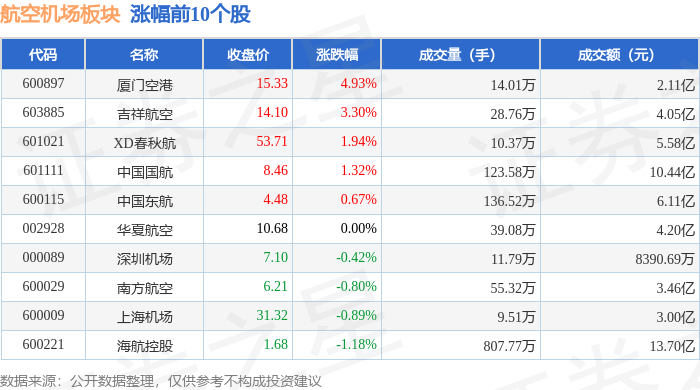
航空机场板块10月17日涨0.17%,厦门空港领涨,主力资金净流入1.75亿元
Zheng Xing Xing Ye Ri Bao· 2025-10-17 08:31
Core Insights - The aviation and airport sector experienced a slight increase of 0.17% on October 17, with Xiamen Airport leading the gains [1] - The Shanghai Composite Index closed at 3839.76, down 1.95%, while the Shenzhen Component Index closed at 12688.94, down 3.04% [1] Stock Performance - Xiamen Airport (600897) closed at 15.33, up 4.93% with a trading volume of 140,100 shares and a turnover of 211 million yuan [1] - Other notable performers include: - 吉祥航空 (603885) at 14.10, up 3.30% [1] - 中国国航 (601111) at 8.46, up 1.32% [1] - 中国东航 (600115) at 4.48, up 0.67% [1] - Conversely, 深圳机场 (000089) closed at 7.10, down 0.42% [1] Capital Flow - The aviation and airport sector saw a net inflow of 175 million yuan from institutional investors, while retail investors experienced a net outflow of 195 million yuan [2] - The detailed capital flow for key stocks includes: - 中国国航 (601111) with a net inflow of 14.4 million yuan from institutional investors [3] - 吉祥航空 (603885) with a net inflow of 64.3 million yuan from institutional investors [3] - 海航控股 (600221) had a net outflow of 54.3 million yuan from retail investors [3]





国盛证券:航司客运量增长、票价修复 关注公商务出行需求及国际航班恢复情况
Zhi Tong Cai Jing· 2025-10-17 07:33
Core Insights - The aviation industry is experiencing a steady increase in flight execution volume and passenger load factors, indicating a recovery in demand and potential for profitability improvement [1][2][5] Flight Volume and Passenger Load Factors - As of October 14, 2025, the daily flight execution volume in civil aviation is 15,539 flights, a 3.73% increase from 14,980 flights in the same period of 2024 [1][2] - Passenger load factors for July to September 2025 are 84.5%, 87.5%, and 85.8%, all exceeding the levels from the same period in 2019 [1][2] - The average passenger load factor for the three major airlines in September 2025 is 85.7%, up 5 percentage points from 2019 [2] Ticket Price Recovery - The average domestic economy class ticket price in September 2025 is 697 yuan, a 0.6% increase year-on-year, and a recovery from a 5% decrease compared to September 2019 [2] - During the National Day and Mid-Autumn Festival holiday, the average domestic economy class ticket price is 849 yuan, reflecting a 0.3% increase year-on-year and a recovery from a 1.4% decrease compared to the same holiday in 2019 [2] International and Domestic Flight Growth - The average daily execution volume of international flights and flights to Hong Kong, Macau, and Taiwan is 2,154 flights, a significant increase of 16.70% year-on-year [3] - Domestic flight execution volume averages 13,885 flights per day, a 1.91% increase year-on-year [3] - By June 2025, international flight volumes have recovered to 88% of the levels seen in the same period of 2019 [3] Supply Constraints and Future Outlook - Global aircraft manufacturers are facing significant supply chain disruptions, leading to a slowdown in aircraft deliveries, with Boeing and Airbus expected to deliver 348 and 766 aircraft in 2024, respectively [4] - The expansion of aviation capacity is expected to remain constrained due to regulatory challenges and the aging fleet [4] Oil Price Trends and Competitive Landscape - International oil prices have been on a downward trend in 2025, which is beneficial for airline profitability due to reduced fuel costs [5] - The "anti-involution" policy initiated in June 2025 aims to address the issue of continuously declining ticket prices, with expectations for price recovery in the aviation sector [5] Investment Recommendations - The combination of low supply growth, recovering demand, and decreasing oil prices suggests a favorable environment for ticket price recovery and airline profitability [6] - Continuous monitoring of demand recovery, particularly in business travel and international flight resumption, is advised [6] - Recommended stocks for investment include Huaxia Airlines, Air China, China Eastern Airlines, China Southern Airlines, Juneyao Airlines, and Spring Airlines [6]
航空运输月度专题:客座率高位、票价持续回正,看好四季度出行回暖-20251017
Xinda Securities· 2025-10-17 07:24
Investment Rating - The investment rating for the airline transportation industry is "Positive" [2]. Core Viewpoints - The industry has maintained a high passenger load factor since the beginning of 2025, with domestic airlines focusing on low growth in capacity while increasing investment in international routes. The supply remains tight with a net fleet growth rate below 3%. The passenger load factor has improved year-on-year and compared to the same period in 2019, particularly in domestic routes. Domestic turnover has shown steady growth, while international turnover has significantly recovered to 2019 levels. Ticket prices have turned positive during the National Day and Mid-Autumn Festival holidays, with demand remaining robust. The fourth quarter is expected to see improvements in year-on-year comparisons due to a low base from the previous year, which will support the recovery of unit revenue for airlines [12][13][36]. Summary by Sections Investment Suggestions - The report suggests focusing on airlines such as China Southern Airlines, China Eastern Airlines, Air China, Spring Airlines, and Juneyao Airlines due to the expected recovery in unit revenue and profitability [13][36]. Passenger Load Factor and Ticket Prices - The passenger load factor remains high, with the industry achieving a load factor of 87.5% in August 2025, up 0.6 percentage points year-on-year and 0.9 percentage points compared to 2019. Domestic turnover increased by 3.5% year-on-year, while international and regional routes have recovered to 100.4% of 2019 levels [15][19]. - Ticket prices have shown a positive trend, with the average domestic ticket price reaching 942 RMB during the National Day holiday, reflecting a year-on-year decrease of only 1.5%. The average ticket price for early October 2025 was up 2.2% year-on-year [4][23]. Oil Prices and Exchange Rates - The average aviation fuel price in October 2025 was 5572 RMB per ton, a slight decrease of 0.1% year-on-year. The Brent crude oil price has also decreased, with an average of 64.25 USD per barrel in October, down 16.7% year-on-year. The Chinese Yuan has appreciated against the US Dollar, with the exchange rate at 7.0968 RMB per USD as of October 16, 2025 [5][36][40]. Airline Operations and Fleet Growth - Airlines have continued to invest in international capacity, with domestic and international passenger load factors remaining high. In September 2025, the domestic load factor for major airlines showed significant year-on-year increases, with China Eastern Airlines leading with a 3.4 percentage point increase compared to 2019 [41][44]. - In terms of fleet growth, Air China had the highest net increase in aircraft in September 2025, adding 5 aircraft, while other airlines also showed modest growth [6][41].

航司运力运量持续增长,有望迎来行业黄金时代:航空行业9月数据点评
Shenwan Hongyuan Securities· 2025-10-16 14:29
Investment Rating - The investment rating for the aviation industry is "Outperform" [7]. Core Views - The aviation industry is experiencing a golden era with continuous growth in capacity and passenger volume, driven by a recovery in demand and increased operational efficiency among airlines [4][6]. - Airlines are increasing capacity deployment, with passenger turnover growth outpacing capacity growth, indicating strong demand recovery [4]. - The report highlights that the average aircraft utilization rate has improved, with wide-body aircraft averaging 9.0 hours and narrow-body aircraft at 7.9 hours per day [4]. Summary by Sections Industry Overview - In September 2025, civil aviation passenger transport volume reached approximately 62.7 million, a year-on-year increase of 4.6% compared to 2024 [4]. - Domestic capacity increased by 1.0% year-on-year, while domestic passenger flow grew by 3.6% [4]. Airline Performance - Major airlines reported varying growth rates in capacity (ASK) and passenger turnover (RPK): - Air China: ASK +1%, RPK +6% - China Eastern Airlines: ASK +4%, RPK +9% - Southern Airlines: ASK +4%, RPK +5% - Spring Airlines: ASK +21%, RPK +23% - Hainan Airlines: ASK +6%, RPK +7% [4][5]. Domestic Market - The domestic market shows a balanced growth in supply and demand, with Spring Airlines experiencing significant growth in both capacity and passenger volume [4]. - The report indicates that the overall ASK and RPK for major airlines have shown modest growth compared to 2024, with some airlines like Spring Airlines showing substantial increases [5]. International Market - The international flight market is recovering, with airlines like Spring Airlines and China Eastern Airlines exceeding pre-pandemic levels in terms of capacity and passenger turnover [4]. - The report notes that international flights have seen a significant recovery, with the number of flights reaching 85.7% of the levels seen in 2019 [4]. Investment Recommendations - The report recommends focusing on the aviation sector due to strong supply-side logic and elastic demand, with potential for significant performance improvement in airlines [4]. - Specific airlines recommended for investment include China Eastern Airlines, Hainan Airlines, Air China, Southern Airlines, Spring Airlines, and Cathay Pacific [4].

中金:近期航空需求具有较强韧性 行业内“反内卷”意识逐渐加强
智通财经网· 2025-10-16 09:04
Core Viewpoint - The aviation industry is experiencing a tightening supply-demand structure during the off-peak season, leading to an increase in ticket prices, driven by a recovery in domestic travel demand and improved supply dynamics [1][3][4]. Group 1: Demand and Pricing - Domestic business travel passenger volume has been steadily increasing since June, contributing to overall industry demand growth and higher ticket prices, as business travelers are less price-sensitive and often choose premium seating [2]. - Since the "Eleventh" holiday, domestic ticket prices have shown a year-on-year increase, reversing the decline seen in the first three quarters of the year, indicating a sustainable upward trend in pricing due to improved supply-demand conditions [1][4]. Group 2: Supply Dynamics - In September, as the aviation industry enters the off-peak season, airlines are grounding more aircraft for maintenance or reducing flight schedules, while travel volume continues to grow year-on-year, resulting in a tighter supply-demand balance [1][3]. - The industry is adjusting its strategies in response to market changes, focusing on revenue management to avoid excessive price competition, particularly among the three major airlines [4]. Group 3: Future Outlook - The industry supply-demand structure is expected to continue optimizing over the next few years, with an average annual growth rate of 3% in supply (ASK) projected from 2026 to 2028, while demand (RPK) is anticipated to maintain a growth rate of over 5% due to increasing travel population and economic recovery [5]. Group 4: Recommended Stocks - The company recommends China Eastern Airlines (00670) for H-shares and suggests Huaxia Airlines (002928.SZ), Juneyao Airlines (603885.SH), and Spring Airlines (601021.SH) for A-shares [6].