
Air China(601111)

Search documents
上市航司多维发力破解“旺丁不旺财”困境
Zheng Quan Ri Bao Zhi Sheng· 2025-09-02 16:37
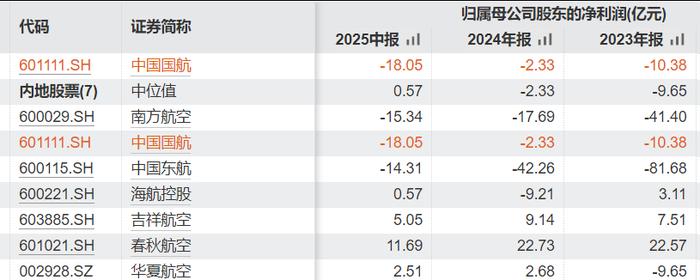
Core Viewpoint - The overall performance of listed airlines in the first half of 2025 shows that state-owned airlines are still in a loss state, while private airlines demonstrate stronger performance recovery due to better operational flexibility [1][2]. Group 1: State-Owned Airlines Performance - In the first half of 2025, three state-owned airlines achieved revenue growth: China International Airlines reported revenue of 80.757 billion yuan, a 1.56% increase, with a net loss of 1.806 billion yuan, a reduction in loss [2] - China Eastern Airlines reported revenue of 66.822 billion yuan, a 4.09% increase, with a net loss of 1.431 billion yuan, also a reduction in loss [2] - China Southern Airlines reported revenue of 86.291 billion yuan, a 1.77% increase, with a net loss of 1.533 billion yuan [2]. Group 2: Private Airlines Performance - Private airlines achieved profitability in the first half of 2025, with Hainan Airlines reporting revenue of 33.083 billion yuan, a 4.22% increase, and a net profit of 56.945 million yuan [3] - Shanghai Juneyao Airlines reported revenue of 11.07 billion yuan, a 1.02% increase, with a net profit of 505 million yuan, a 3.29% increase [3] - Spring Airlines reported revenue of 10.304 billion yuan, a 4.35% increase, with a net profit of 1.169 billion yuan, a 14.11% decrease [3] - Huaxia Airlines reported revenue of 3.610 billion yuan, a 12.41% increase, with a net profit of 251 million yuan, an increase of 858.95% [3]. Group 3: Industry Trends and Insights - The summer transportation season saw a total of 147 million passengers transported, a 3.6% year-on-year increase, with an average seat occupancy rate of 84.8%, up 2.2 percentage points [4] - The market exhibited a trend of increasing volume but decreasing prices, attributed to oversupply and low-price competition [6] - The release of the "Self-Regulation Convention for Air Passenger Transport" aims to combat low-price competition and stabilize market prices [6]. Group 4: Future Outlook - The upcoming "Golden September and Silver October" period is expected to be a crucial window for revenue improvement [7] - Airlines plan to optimize sales strategies and innovate products to enhance efficiency and profitability in the second half of the year [7].






航空机场板块9月2日跌0.63%,华夏航空领跌,主力资金净流出3.22亿元
Zheng Xing Xing Ye Ri Bao· 2025-09-02 08:59
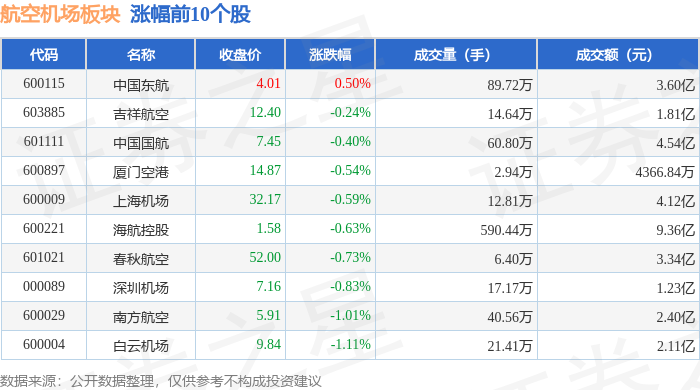
Market Overview - On September 2, the aviation and airport sector declined by 0.63%, with Huaxia Airlines leading the drop [1] - The Shanghai Composite Index closed at 3858.13, down 0.45%, while the Shenzhen Component Index closed at 12553.84, down 2.14% [1] Stock Performance - Key stocks in the aviation sector showed varied performance, with China Eastern Airlines closing at 4.01, up 0.50%, while Huaxia Airlines closed at 8.75, down 2.78% [1][2] - Other notable declines included China Southern Airlines at 5.91, down 1.01%, and Shanghai Airport at 32.17, down 0.59% [1][2] Trading Volume and Capital Flow - The aviation and airport sector experienced a net outflow of 322 million yuan from institutional investors, while retail investors saw a net inflow of 229 million yuan [2] - The trading volume for major stocks included China Eastern Airlines with 897,200 shares traded and a transaction value of 360 million yuan [1] Individual Stock Capital Flow - China National Airlines had a net inflow of 507,500 yuan from institutional investors, while Huaxia Airlines saw a net outflow of 20.93 million yuan [3] - The largest net outflow was recorded for Baiyun Airport at 30.11 million yuan, with retail investors contributing a net inflow of 25.12 million yuan [3]





中国国航(00753) - 2025 Q2 - 电话会议演示
2025-09-02 07:00
Operational Data - Available Seat Kilometers (ASK) reached 17758 billion, a 337% increase[26] - Revenue Passenger Kilometers (RPK) totaled 14334 billion, up by 523%[26] - Passenger Load Factor was 8072%, a 143 percentage point increase[26] - The company's fleet consisted of 934 aircraft, with Airbus series accounting for 430 units, Boeing series 462 units, and COMAC series 39 units[27] - Air China (Parent) had a fleet size of 510 units, with an average aircraft age of 992 years[32] Financial Analysis - Revenue reached RMB 8076 billion, a 156% increase[34] - The company reduced its loss before taxation by RMB 050 billion[34] - Loss attributable to equity shareholders of the group was RMB 181 billion, with a loss reduction of RMB 098 billion[34] - Domestic air passenger revenue accounted for 6711% of total air passenger revenue, while international air passenger revenue accounted for 2505%[38] - Jet fuel costs decreased by 1034% year-over-year[45]
三大航半年亏了47亿
2 1 Shi Ji Jing Ji Bao Dao· 2025-09-02 06:29
Core Viewpoint - The A-share listed airlines have shown steady revenue growth in the first half of 2025, with state-owned airlines reducing losses significantly while private airlines achieved profitability, marking a notable turnaround in the industry [1][4]. Financial Performance of Major Airlines - The three major state-owned airlines (Air China, China Eastern Airlines, and China Southern Airlines) reported a combined loss of 4.77 billion yuan, a reduction of 2.008 billion yuan compared to the previous year [1][5]. - China Eastern Airlines had the least loss among the three, with a net loss of 1.431 billion yuan, a reduction of 1.337 billion yuan year-on-year [5][6]. - Revenue for the three major airlines increased significantly, with Air China reporting 80.757 billion yuan (up 1.6%), China Eastern Airlines at 66.822 billion yuan (up 4.09%), and China Southern Airlines at 86.291 billion yuan (up 1.77%) [4][5]. International Operations and Capacity - China Eastern Airlines expanded its international operations, opening 14 new international routes and restoring flight numbers to over 110% of 2019 levels [5][6]. - The international passenger capacity for China Eastern Airlines increased by 24.38%, while domestic capacity rose by 1.07% [6]. - The three major airlines saw significant growth in international passenger turnover, with China Eastern Airlines at 28.74%, China Southern Airlines at 25.88%, and Air China at 16.99% [6]. Cost Control Measures - China Eastern Airlines implemented a "cost hard battle" plan, focusing on detailed cost management, which resulted in an 8.08% decrease in fuel costs and a 26.89% reduction in financial expenses [9][10]. - Air China also emphasized cost control, reducing major costs such as fuel and operational expenses, leading to a financial expense reduction of 9.36% [9][10]. Performance of Private Airlines - Private airlines such as Spring Airlines, Juneyao Airlines, Huaxia Airlines, and Hainan Airlines achieved profitability, with Spring Airlines leading with a net profit of 1.169 billion yuan [1][10]. - Spring Airlines has maintained its profitability for two consecutive years, with net profits of 2.257 billion yuan in 2023 and 2.273 billion yuan in 2024 [10]. Market Conditions and Challenges - The average domestic economy class ticket price fell by 6.9% year-on-year in the first half of 2025, indicating pressure on pricing [11]. - The recovery of international routes has not yet reached pre-2019 levels, posing challenges for the three major airlines to achieve profitability [11].
三大航半年亏了47亿
21世纪经济报道· 2025-09-02 06:06
Core Viewpoint - The article highlights the financial performance of China's major airlines during the first half of 2025, indicating that while state-owned airlines continue to incur losses, they have significantly reduced their losses, whereas private airlines have achieved profitability, showcasing a contrasting trend in the industry [1][4]. Group 1: Financial Performance of Major Airlines - The three major state-owned airlines (Air China, China Eastern Airlines, and China Southern Airlines) reported a combined loss of 4.77 billion yuan, which is a reduction of 2.008 billion yuan compared to the previous year [1][4]. - China Eastern Airlines had the least loss among the three, with a net loss of 1.431 billion yuan, a reduction of 1.337 billion yuan year-on-year [4]. - In contrast, four private airlines (Spring Airlines, Juneyao Airlines, China United Airlines, and Hainan Airlines) achieved profitability, with Spring Airlines leading with a net profit of 1.169 billion yuan [1]. Group 2: Revenue Growth and Cost Control - All three major airlines experienced revenue growth, with Air China reporting 80.757 billion yuan (up 1.6%), China Eastern Airlines at 66.822 billion yuan (up 4.09%), and China Southern Airlines at 86.291 billion yuan (up 1.77%) [4]. - The international operations of these airlines have been a significant factor in their revenue recovery, with China Eastern Airlines increasing its international passenger capacity by 24.38% and achieving a 28.74% increase in international passenger turnover [6][4]. - Cost control measures have become crucial, with China Eastern Airlines implementing a "cost hard battle" plan, resulting in an 8.08% decrease in fuel costs and a 26.89% reduction in financial expenses [9][10]. Group 3: Market Conditions and Challenges - Despite the improvements, the three major airlines have not yet returned to profitability due to several factors, including the burden of unprofitable routes and the incomplete recovery of the international market [7][11]. - The average ticket price for domestic economy class has decreased by 6.9% year-on-year, indicating ongoing pressure on revenue [11]. - The article suggests that the major airlines face significant challenges in achieving profitability in the near term, as the domestic ticket prices remain under pressure and international routes have not fully recovered to pre-2019 levels [11].

民生证券给予中国国航推荐评级:盈利落于预告上沿,油价回落缓解成本上涨压力
Sou Hu Cai Jing· 2025-09-02 01:12
Group 1 - The core viewpoint of the report is that Minsheng Securities has given a "recommended" rating to China National Airlines (601111.SH) with a latest price of 7.48 yuan [1] - The report highlights that domestic routes continue to exhibit an industry-wide trend of price competition for volume, leading to a year-on-year decline in domestic passenger revenue for the company [1] - The unit fuel cost shows a certain degree of cost rigidity, with a year-on-year increase in the first half of the year, while the recent drop in oil prices alleviates the pressure of rising unit costs [1] - The scale of dollar-denominated debt has decreased, resulting in a steady improvement in financial expenses [1] - The company plans to increase capital in Shenzhen Airlines to address the subsidiary's insolvency issues, while maintaining its shareholding ratio and controlling position in the subsidiary [1]
中国国航(601111):2025年半年报点评:盈利落于预告上沿,油价回落缓解成本上涨压力
Minsheng Securities· 2025-09-02 01:06
Investment Rating - The report maintains a "Recommended" rating for China National Airlines (601111.SH) [4][6] Core Views - The company reported a revenue of 80.8 billion yuan for H1 2025, a year-on-year increase of 1.6%, with a net loss attributable to shareholders of 1.81 billion yuan, an improvement from a loss of 2.78 billion yuan in H1 2024 [1] - The decline in oil prices has alleviated the pressure from rising costs, contributing to a better profit performance despite a challenging pricing environment in domestic routes [1][2] - The company is actively adjusting its pricing strategy in response to market conditions, leading to a year-on-year decrease of 6.2% in domestic passenger kilometer revenue [2] - Financial expenses have improved due to a reduction in dollar-denominated debt and a decrease in interest expenses, with a 27% year-on-year decline in financial costs [3] Financial Forecasts - The projected revenue for 2025 is 179.3 billion yuan, with a growth rate of 7.6% [5][11] - The net profit attributable to shareholders is expected to be 1.04 billion yuan in 2025, a significant increase from a loss of 237 million yuan in 2024 [5][11] - The earnings per share (EPS) is forecasted to be 0.06 yuan for 2025, with a price-to-earnings (PE) ratio of 125 [5][11] Additional Insights - The company plans to increase its investment in Shenzhen Airlines to address its financial difficulties, which is expected to enhance operational capabilities and improve the overall competitiveness of the airline network [3] - The report anticipates a recovery in industry pricing, although it has adjusted the net profit forecast for 2025 to 1.04 billion yuan due to subdued pricing data during the peak summer season [4]
三大航上半年业绩揭晓:东航减亏最多,国际航线助力业绩回暖
Sou Hu Cai Jing· 2025-09-01 18:33
Core Viewpoint - The three major Chinese airlines, Air China, China Eastern Airlines, and China Southern Airlines, reported a significant reduction in losses for the first half of 2025, with a total loss reduction of 2.008 billion yuan compared to the previous year [1][3]. Group 1: Performance Highlights - China Eastern Airlines showed the most notable performance, reducing losses by 1.337 billion yuan, the highest among the three airlines [1]. - Air China followed closely, with a loss reduction of 976 million yuan [1]. - China Southern Airlines experienced a year-on-year increase in net losses by 305 million yuan; however, after excluding non-recurring losses, its losses decreased by 1.431 billion yuan [1][3]. Group 2: Revenue and Cost Management - The strong performance of international routes was a key driver for the improvement in the airlines' results, with double-digit year-on-year growth in passenger revenue, capacity input, and passenger turnover for all three airlines [1]. - Effective cost control and a decline in fuel prices contributed to reduced expenditures, with cost increases for all three airlines not exceeding 5% year-on-year [1]. Group 3: Strategic Initiatives - China Eastern Airlines opened 14 new international routes, becoming the domestic airline with the most international destinations, with capacity input and passenger turnover for international routes increasing by 24.38% and 28.74%, respectively [1]. - China Southern Airlines plans to enhance performance through optimizing sales rhythm, product innovation, and capitalizing on the peak season for cargo [3]. - Air China emphasized the importance of cost control through centralized, collaborative, and refined management, achieving savings in major cost areas such as fuel, landing, catering, and maintenance [3]. Group 4: Challenges and Future Outlook - Despite the positive performance in the first half, the airlines face challenges in achieving profitability for the full year due to intensified market competition, declining ticket prices, and uncertainties in the international environment [3]. - The airlines are focusing on optimizing route networks, enhancing cost control, and innovating products to improve competitiveness and work towards the goal of turning profitable for the year [3].
航司半年报:三大航营收稳步增长 春秋航空蝉联“最赚钱航司”
2 1 Shi Ji Jing Ji Bao Dao· 2025-09-01 11:48
Core Viewpoint - The A-share listed airlines have shown a significant reduction in losses for the first half of 2025, with state-owned airlines still in the red but improving, while private airlines have turned profitable, indicating a contrasting performance in the industry [2][5]. Financial Performance - The three major state-owned airlines (Air China, China Eastern Airlines, and China Southern Airlines) reported a combined loss of 4.77 billion yuan, a reduction of 2.008 billion yuan compared to the previous year [2]. - China Eastern Airlines had the least loss among the three, with a net loss of 1.431 billion yuan, a reduction of 1.337 billion yuan year-on-year [3]. - The revenue for the three major airlines showed growth: Air China at 80.757 billion yuan (up 1.6%), China Eastern at 66.822 billion yuan (up 4.09%), and China Southern at 86.291 billion yuan (up 1.77%) [2]. International Operations - China Eastern Airlines expanded its international operations significantly, opening 14 new international routes and restoring flight numbers to over 110% of 2019 levels [3]. - Air China and China Southern Airlines also increased their international capacity, with Air China's international passenger capacity up 16.7% and China Southern's up 22.5% [4]. Cost Control Measures - Cost control has become a critical focus for the airlines, with China Eastern Airlines implementing a "cost hard battle" plan to manage expenses effectively [6]. - The airlines reported a decrease in fuel costs, with Air China, China Eastern, and China Southern seeing reductions of 10.34%, 8.08%, and 9.15% respectively [7]. Market Conditions - The average ticket price for domestic economy class fell by 6.9% year-on-year in the first half of 2025, indicating ongoing pressure on pricing [8]. - The recovery of international routes remains incomplete, with the overall market still facing challenges in returning to pre-pandemic levels [8].
航司半年报:三大航营收稳步增长,春秋航空蝉联“最赚钱航司”
2 1 Shi Ji Jing Ji Bao Dao· 2025-09-01 11:43
Core Viewpoint - The A-share listed airlines have reported their 2025 semi-annual results, showing steady revenue growth among the three major state-owned airlines, despite still being in a loss position, while private airlines have achieved profitability, indicating a counter-trend breakthrough [1] Group 1: Financial Performance of Major Airlines - The three major airlines (Air China, China Eastern Airlines, and China Southern Airlines) collectively reported a loss of 4.77 billion yuan, with a reduction in losses by 2.008 billion yuan [2] - China Eastern Airlines had the least loss and the most significant reduction in losses among the three, with a net loss of 1.431 billion yuan, a decrease of 1.337 billion yuan year-on-year [3] - Revenue for the three major airlines showed notable growth: Air China reported 80.757 billion yuan (up 1.6%), China Eastern Airlines 66.822 billion yuan (up 4.09%), and China Southern Airlines 86.291 billion yuan (up 1.77%) [3] Group 2: International Operations and Capacity - China Eastern Airlines expanded its international operations significantly, opening 14 new international routes and restoring its international flight numbers to over 110% of 2019 levels [4] - The international passenger capacity for China Eastern Airlines increased by 24.38% year-on-year, while domestic capacity rose by 1.07% [4] - Air China and China Southern Airlines also increased their international capacity, with Air China seeing a 16.7% increase and China Southern Airlines a 22.5% increase [4] Group 3: Cost Control Measures - Cost control has become a crucial focus for the three major airlines, with China Eastern Airlines implementing a "cost hard battle" plan to manage expenses effectively [7] - China Eastern Airlines achieved an 8.08% reduction in fuel costs, while Air China and China Southern Airlines saw reductions of 10.34% and 9.15%, respectively [7] - Financial expenses for China Eastern Airlines decreased by 26.89% year-on-year, while Air China reduced its financial expenses by 9.36 billion yuan [7] Group 4: Performance of Private Airlines - Private airlines such as Spring Airlines, Juneyao Airlines, and others achieved profitability, with Spring Airlines reporting a net profit of 1.169 billion yuan, making it the most profitable airline in the first half of 2025 [2][8] - Spring Airlines' success is attributed to its low-cost model and strong market presence in Shanghai, which aligns well with current market conditions [8] Group 5: Market Challenges - The three major airlines face challenges in turning profitable due to factors such as unprofitable routes and the incomplete recovery of the international market, particularly in long-haul flights [5] - The average domestic economy class ticket price fell by 6.9% year-on-year in the first half of 2025, indicating ongoing pressure on pricing [9] - The recovery of international routes remains below 2019 levels, complicating the path to profitability for the major airlines [9]