
Air China(601111)

Search documents
中国国航(601111) - 中国国航H股公告-月报表
2025-09-01 09:45
FF301 股份發行人及根據《上市規則》第十九B章上市的香港預託證券發行人的證券變動月報表 截至月份: 2025年8月31日 狀態: 新提交 致:香港交易及結算所有限公司 公司名稱: 中國國際航空股份有限公司 呈交日期: 2025年9月1日 FF301 II. 已發行股份及/或庫存股份變動 | 1. 股份分類 | 普通股 | 股份類別 | H | | 於香港聯交所上市 (註1) | 是 | | | --- | --- | --- | --- | --- | --- | --- | --- | | 證券代號 (如上市) | 00753 | 說明 | | | | | | | | | 已發行股份(不包括庫存股份)數目 | | 庫存股份數目 | | 已發行股份總數 | | | 上月底結存 | | | 4,955,610,672 | | 0 | | 4,955,610,672 | | 增加 / 減少 (-) | | | 0 | | 0 | | | | 本月底結存 | | | 4,955,610,672 | | 0 | | 4,955,610,672 | | 2. 股份分類 | 普通股 | 股份類別 | A | | 於香 ...
中国国航(601111):Q2实现扭亏,关注反内卷后续影响
Dongxing Securities· 2025-09-01 09:42
Investment Rating - The report maintains a "Recommended" rating for China National Airlines [5][6]. Core Views - In the first half of 2025, the company achieved revenue of 80.757 billion yuan, a year-on-year increase of 1.56%, and a net profit attributable to shareholders of -1.806 billion yuan, reducing losses by 35.11% compared to the same period last year [2]. - The company turned a profit in Q2 with a net profit of 238 million yuan, following a loss of 2.044 billion yuan in Q1 [2]. - Passenger revenue decreased slightly, but the decline was within expectations, attributed to rising fuel costs and an increase in the proportion of international routes [3]. - The introduction of the "Self-Discipline Agreement for Air Passenger Transport" aims to promote high-quality development in the industry and stabilize ticket prices [4]. Financial Performance - The company’s passenger revenue for the first half of 2025 was 73.196 billion yuan, with a slight increase of 0.59 million yuan year-on-year [3]. - The unit cost of ASK (Available Seat Kilometer) excluding fuel increased to 0.304 yuan, while the unit fuel cost decreased from 0.158 yuan to 0.137 yuan, contributing to the profit recovery in Q2 [3]. - The company plans to introduce 47 aircraft and retire 18 in 2025, indicating cautious growth in fleet size [4]. Profit Forecast - The forecasted net profits for 2025, 2026, and 2027 are 1.88 billion yuan, 6.31 billion yuan, and 7.93 billion yuan, respectively, with corresponding EPS of 0.11, 0.36, and 0.45 yuan [5][11].
航空机场板块9月1日跌0.94%,华夏航空领跌,主力资金净流出2.93亿元
Zheng Xing Xing Ye Ri Bao· 2025-09-01 08:44
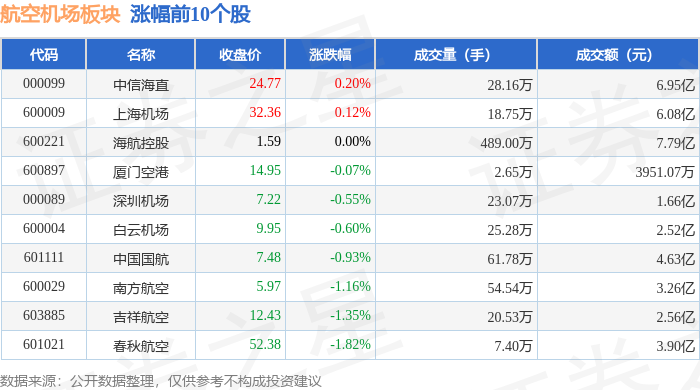
Core Insights - The aviation and airport sector experienced a decline of 0.94% on September 1, with Huaxia Airlines leading the drop [1] - The Shanghai Composite Index closed at 3875.53, up 0.46%, while the Shenzhen Component Index closed at 12828.95, up 1.05% [1] Stock Performance Summary - The following stocks in the aviation and airport sector showed varied performance: - CITIC Haizhi: Closed at 24.77, up 0.20%, with a trading volume of 281,600 shares and a turnover of 695 million yuan [1] - Shanghai Airport: Closed at 32.36, up 0.12%, with a trading volume of 187,500 shares and a turnover of 608 million yuan [1] - HNA Holding: Closed at 1.59, unchanged, with a trading volume of 4.89 million shares and a turnover of 779 million yuan [1] - Xiamen Airport: Closed at 14.95, down 0.07%, with a trading volume of 26,500 shares and a turnover of 39.51 million yuan [1] - Shenzhen Airport: Closed at 7.22, down 0.55%, with a trading volume of 230,700 shares and a turnover of 166 million yuan [1] - Baiyun Airport: Closed at 9.95, down 0.60%, with a trading volume of 252,800 shares and a turnover of 252 million yuan [1] - Air China: Closed at 7.48, down 0.93%, with a trading volume of 617,800 shares and a turnover of 463 million yuan [1] - China Southern Airlines: Closed at 5.97, down 1.16%, with a trading volume of 545,400 shares and a turnover of 326 million yuan [1] - Juneyao Airlines: Closed at 12.43, down 1.35%, with a trading volume of 205,300 shares and a turnover of 256 million yuan [1] - Spring Airlines: Closed at 52.38, down 1.82%, with a trading volume of 74,000 shares and a turnover of 390 million yuan [1] Capital Flow Analysis - The aviation and airport sector saw a net outflow of 293 million yuan from institutional investors, while retail investors contributed a net inflow of 279 million yuan [2] - The following capital flows were noted for specific stocks: - HNA Holding: Net inflow of 45.64 million yuan from institutional investors, but a net outflow of 36.41 million yuan from retail investors [3] - Shenzhen Airport: Net inflow of 13.27 million yuan from institutional investors, with a net outflow of 20.78 million yuan from retail investors [3] - China Southern Airlines: Net outflow of 1.21 million yuan from institutional investors, but a net inflow of 2.78 million yuan from retail investors [3] - Xiamen Airport: Net outflow of 1.79 million yuan from institutional investors, with a net inflow of 178.71 million yuan from retail investors [3] - Huaxia Airlines: Net outflow of 3.68 million yuan from institutional investors, but a net inflow of 542.84 million yuan from retail investors [3] - Air China: Net outflow of 7.48 million yuan from institutional investors, with a net inflow of 38.94 million yuan from retail investors [3] - Juneyao Airlines: Net outflow of 7.64 million yuan from institutional investors, but a net inflow of 682.32 million yuan from retail investors [3] - Spring Airlines: Net outflow of 29.52 million yuan from institutional investors, with a net inflow of 283.88 million yuan from retail investors [3] - Baiyun Airport: Net outflow of 32.34 million yuan from institutional investors, with a net inflow of 239.79 million yuan from retail investors [3]







中国国航(00753) - 截至二零二五年八月三十一日止之股份发行人的证券变动月报表
2025-09-01 08:35
FF301 股份發行人及根據《上市規則》第十九B章上市的香港預託證券發行人的證券變動月報表 截至月份: 2025年8月31日 狀態: 新提交 | 2. 股份分類 | 普通股 | 股份類別 | A | | 於香港聯交所上市 (註1) | | 否 | | | --- | --- | --- | --- | --- | --- | --- | --- | --- | | 證券代號 (如上市) | 601111 | 說明 | | 於上海證券交易所上市 | | | | | | | | 法定/註冊股份數目 | | 面值 | | | 法定/註冊股本 | | | 上月底結存 | | | 12,492,810,328 | RMB | | 1 RMB | | 12,492,810,328 | | 增加 / 減少 (-) | | | 0 | | | RMB | | 0 | | 本月底結存 | | | 12,492,810,328 | RMB | | 1 RMB | | 12,492,810,328 | 本月底法定/註冊股本總額: RMB 17,448,421,000 第 1 頁 共 10 頁 v 1.1.1 致:香港交易及結算所有 ...
三大航司2025年上半年运输规模同步扩大,营收均实现同比增长
Cai Jing Wang· 2025-09-01 07:21
Core Viewpoint - The three major Chinese airlines, Air China, China Eastern Airlines, and China Southern Airlines, have reported significant revenue growth and reduced losses for the first half of 2025, driven by operational scale expansion, cost optimization, fleet upgrades, and digital transformation initiatives [1][2]. Financial Performance - Air China achieved operating revenue of 80.757 billion yuan, a year-on-year increase of 1.6% - China Eastern Airlines reported operating revenue of 66.822 billion yuan, up 4.09% year-on-year - China Southern Airlines continued its growth trend with operating revenue of 86.291 billion yuan - Despite remaining in a loss position, all three airlines showed significant reductions in losses: - China Eastern Airlines' net loss attributable to shareholders was 1.431 billion yuan, a reduction of 1.337 billion yuan from the previous year - Air China's net loss attributable to shareholders was 1.806 billion yuan, down 977 million yuan year-on-year - China Southern Airlines reported a net loss of 1.533 billion yuan, maintaining a low loss scale [1]. Operational Expansion - The three airlines have expanded their transportation scale, which has been a solid support for revenue growth: - China Southern Airlines carried 83.28 million passengers, a year-on-year increase of 4.83% - China Eastern Airlines achieved a total transportation turnover of 135.06 billion ton-kilometers, up 11.89% year-on-year, with passenger volume reaching 73.1696 million, an increase of 8.03% - Air China recorded a capacity input of 177.576 billion seat-kilometers, a 3.37% increase, with passenger transport of 77.114 million, up 2.87% - International routes have become a significant driver of operational recovery, with China Eastern Airlines' international and regional route available seat kilometers (ASK) increasing by 24.38% year-on-year [2]. Fleet Optimization - The airlines are focusing on fleet construction to optimize their core revenue source, the passenger business: - China Eastern Airlines introduced 24 new aircraft and retired 12 old ones, with a current fleet size of 816 aircraft, including 11 C919 domestic aircraft - Air China added 9 aircraft, including 1 A320, 5 B737, 1 C919, and 2 C909, while retiring 5 aircraft, totaling 934 aircraft with an average age of 10.28 years - China Southern Airlines introduced 37 aircraft and retired 11, enhancing operational efficiency and laying the foundation for future energy-saving and service upgrades [3]. Digital Transformation - Digital transformation has become a strategic focus for the three airlines to enhance operational efficiency and optimize service experience: - Air China is promoting AI applications, including smart customer service and intelligent maintenance, with in-flight meal booking services covering all domestic flights - China Eastern Airlines is expanding cross-border e-commerce logistics in the cargo sector to improve operational efficiency through digital means - In addition to internal operational optimization, the airlines are actively expanding their international route networks while consolidating their domestic market positions [4]. Business Layout - The airlines are enhancing their business layout by strengthening domestic market foundations and expanding international route networks: - China Eastern Airlines has seen significant growth in international routes - Air China is increasing coverage of remote area routes to enhance the value of its regional network - China Southern Airlines is optimizing its domestic and international route structure, increasing flights from Xinjiang to Central Asia - The management of China Southern Airlines anticipates a significant increase in passenger volume and seat occupancy during the summer travel season, although ticket prices are expected to decline year-on-year [4].
上市航司半年报业绩分化:三大航上半年整体减亏 四家民营航司均实现盈利
Zheng Quan Shi Bao Wang· 2025-09-01 03:01
Core Viewpoint - The financial performance of major Chinese airlines in the first half of 2025 shows a mixed picture, with state-owned airlines continuing to incur losses but at a reduced rate, while private airlines have achieved profitability. Group 1: State-Owned Airlines Performance - China National Airlines reported operating revenue of 80.757 billion yuan, a year-on-year increase of 1.6%, with a net loss of 1.806 billion yuan, a reduction in losses compared to the previous year [2] - China Eastern Airlines achieved operating revenue of 66.822 billion yuan, a year-on-year increase of 4.09%, with a net loss of 1.431 billion yuan, down from a loss of 2.768 billion yuan in the same period last year [2] - Southern Airlines reported operating revenue of 86.291 billion yuan, a year-on-year increase of 1.77%, with a net loss of 1.533 billion yuan, which is a 24.84% increase in losses compared to the previous year [3] Group 2: Private Airlines Performance - Hainan Airlines, Spring Airlines, Juneyao Airlines, and China Express Airlines all reported profits, with a total net profit of nearly 2 billion yuan [1] - Spring Airlines achieved a net profit of 1.169 billion yuan, although this represents a year-on-year decline of 14.11% [4] - Juneyao Airlines reported a net profit of 505 million yuan, an increase of 3.29% year-on-year [6] - China Express Airlines reported a net profit of 251 million yuan, a significant increase of 858.95% year-on-year [7] Group 3: Market Conditions and Trends - The aviation industry is experiencing a "volume up, price down" trend, with significant pressure on ticket prices leading to reduced revenue per passenger kilometer for major airlines [8] - The Civil Aviation Administration of China has emphasized the need to address "involution" in the aviation sector, which may improve airline profitability in the short term [8] - Airlines are actively expanding their markets and optimizing services, with China National Airlines implementing AI-driven customer service and China Eastern Airlines enhancing its product marketing strategies [9][10]

三大航这半年:国航、东航减亏 国际航线成关键
Bei Jing Shang Bao· 2025-08-31 15:55
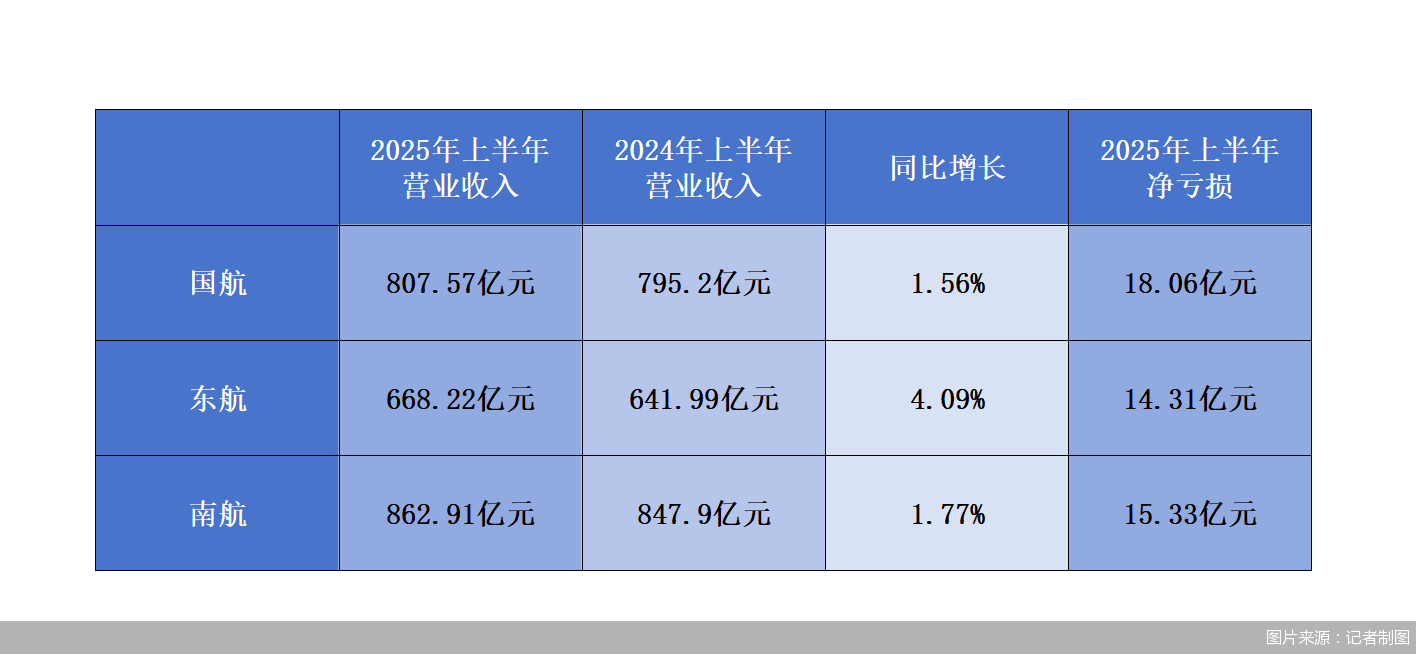
Core Viewpoint - The three major airlines in China have collectively reduced their losses by 2.008 billion yuan in the first half of 2023, with international routes being a key factor for performance improvement [1][3][5]. Financial Performance - The three major airlines reported a total loss of 4.77 billion yuan in the first half of the year, with Eastern Airlines having the least loss and the most significant reduction in losses [3][4]. - Air China reported revenue of 80.757 billion yuan, a year-on-year increase of 1.56%, with a net loss of 1.806 billion yuan, reduced by 976 million yuan [3]. - Eastern Airlines reported revenue of 66.822 billion yuan, a year-on-year increase of 4.09%, with a net loss of 1.431 billion yuan, reduced by 1.337 billion yuan [3]. - Southern Airlines reported revenue of 86.291 billion yuan, a year-on-year increase of 1.77%, with a net loss of 1.533 billion yuan, an increase in loss of 305 million yuan [3][4]. International Route Performance - International passenger revenue for the three major airlines saw double-digit growth, with Air China's international passenger revenue increasing by 16.09%, Eastern Airlines by 20.34%, and Southern Airlines by 15.74% [5][6]. - Eastern Airlines opened 14 new international routes in the first half of the year, becoming the domestic airline with the most international destinations [5][6]. Cost Management - The three major airlines have effectively controlled costs, with operating costs increasing by less than 5% year-on-year [1][8]. - The decline in fuel prices has significantly reduced fuel costs, with Air China, Eastern Airlines, and Southern Airlines seeing reductions of 10.34%, 8.08%, and 9.15% respectively [8][9]. - Financial expenses for Air China decreased by 9.36 billion yuan year-on-year, while Eastern Airlines implemented a cost management committee to enhance cost control [9][10]. Future Strategies - The airlines plan to capitalize on the traditional cargo peak season and explore new routes to South America to further improve profitability [10][11]. - Southern Airlines aims to optimize sales strategies and innovate products to enhance revenue, while Eastern Airlines focuses on expanding its network and reducing costs [11][12].
三大航这半年:国航、东航减亏,国际航线成“关键引擎”
Bei Jing Shang Bao· 2025-08-31 04:54
Core Viewpoint - The three major airlines in China have collectively reduced their losses by 2.008 billion yuan in the first half of 2025, with international routes being a key factor for performance improvement [1][3]. Financial Performance - The total loss for the three major airlines in the first half of 2025 was 4.77 billion yuan, a reduction of 2.008 billion yuan year-on-year [3]. - Air China reported a revenue of 80.757 billion yuan, a year-on-year increase of 1.56%, with a net loss of 1.806 billion yuan, reduced by 976 million yuan [2][3]. - Eastern Airlines achieved a revenue of 66.822 billion yuan, up 4.09% year-on-year, with a net loss of 1.431 billion yuan, reduced by 1.337 billion yuan [2][3]. - Southern Airlines reported a revenue of 86.291 billion yuan, a 1.77% increase, but a net loss of 1.533 billion yuan, which is an increase in loss by 305 million yuan [2][3]. International Route Performance - International passenger revenue for the three airlines saw significant growth, with Air China's international revenue up 16.09%, Eastern Airlines up 20.34%, and Southern Airlines up 15.74% [7]. - Eastern Airlines expanded its international route network by opening 14 new international routes, becoming the domestic airline with the most international destinations [7]. - The capacity and passenger turnover for international routes increased significantly, with Eastern Airlines' international capacity up 24.38% and passenger turnover up 28.74% [7]. Cost Management - The three airlines managed to keep their cost increases below 5% year-on-year, with specific increases of 1.14% for Air China, 3.27% for Eastern Airlines, and 0.17% for Southern Airlines [11]. - The decline in fuel prices contributed to a significant reduction in fuel costs, with Air China, Eastern Airlines, and Southern Airlines seeing decreases of 10.34%, 8.08%, and 9.15% respectively [11]. - Eastern Airlines implemented a cost management committee to enhance control over major costs, achieving a 9.5% reduction in average bridge time at major airports [12]. Future Strategies - The airlines plan to capitalize on the traditional peak season for cargo and explore new routes, including Southern Airlines' focus on the South American market [13][15]. - Eastern Airlines aims to enhance its network layout and increase domestic and international flight offerings, particularly targeting emerging markets in the Middle East, Africa, and South America [15].
中国国航(601111):裸票提升油价下降 Q2实现扭亏为盈
Xin Lang Cai Jing· 2025-08-31 02:36
Core Insights - In H1 2025, the company reported operating revenue of 80.8 billion yuan, a year-on-year increase of 1.6%, and a net profit attributable to shareholders of -1.81 billion yuan, a reduction in losses by 0.98 billion yuan [1] - Q2 2025 saw operating revenue of 40.7 billion yuan, a year-on-year increase of 3.2%, and a net profit of 0.24 billion yuan, marking a return to profitability [1] Business Analysis - Revenue growth was driven by an increase in passenger transport, with revenue reaching 73.2 billion yuan, a slight increase of 0.6 billion yuan year-on-year. This was supported by a rise in capacity and passenger load factor, although offset by a decline in yield [2] - The company’s RPK (Revenue Passenger Kilometers) grew by 5.2% year-on-year, with international RPK increasing by 17%. However, passenger kilometer yield decreased by 4.9% [2] - Cargo revenue increased by 2.5 billion yuan to 3.6 billion yuan, driven by higher capacity and load factor, despite a slight decline in yield [2] Cost and Financial Performance - The decline in oil prices led to an improvement in unit costs, with the unit cost per seat kilometer at 0.44 yuan, down 2.17% year-on-year. The gross margin for H1 2025 was 3%, an increase of 0.4 percentage points [3] - Total expenses related to sales, management, research, and finance decreased by 1.1% year-on-year, with financial expenses dropping significantly due to reduced interest payments and recorded exchange gains [3] - In Q2 2025, the company achieved a net profit of 0.24 billion yuan, an increase of 1.35 billion yuan year-on-year, attributed to improved gross margin and reduced financial expenses [3] Industry Outlook - Recent regulatory measures by the Civil Aviation Administration of China aim to mitigate "involution" competition, which is expected to improve airline revenue levels in the short term [3] - The industry is projected to experience low single-digit growth in supply due to constraints from order shortages and production capacity, while passenger volume is expected to maintain high single-digit growth. A supply-demand turning point is anticipated in 2026, potentially leading to increased ticket prices and profit release for the company [3] Profit Forecast - The company has adjusted its net profit forecasts for 2025-2027 to 0.8 billion, 6 billion, and 9.3 billion yuan, respectively, reflecting slower-than-expected demand recovery [4]
三大航为何仍未扭亏?
Di Yi Cai Jing· 2025-08-30 12:49
Group 1: Airline Performance - All listed airlines in A-shares have reported their 2025 semi-annual results, with private airlines achieving profitability while state-owned airlines continue to incur losses [1] - Spring Airlines has reported the highest net profit among private airlines at 1.169 billion yuan, making it the most profitable listed airline in mainland China for the first half of the year [1] - In contrast, the three major state-owned airlines, Air China, China Eastern Airlines, and China Southern Airlines, reported losses of 1.806 billion yuan, 1.441 billion yuan, and 1.533 billion yuan respectively in the first half of the year [2] Group 2: Market Dynamics - The disparity in performance among airlines is attributed to the slower-than-expected recovery of international routes and ongoing competition in the domestic market [2] - International passenger flights in civil aviation increased by 24.9% year-on-year in the first half of the year, but still fell 12% compared to 2019 levels, indicating that international flight volumes have not fully recovered [2] - Private airlines like Spring Airlines and Juneyao Airlines, which focus on international routes primarily to neighboring countries, are less affected by the slow recovery of international markets compared to state-owned airlines [2][3] Group 3: Revenue and Cost Management - Spring Airlines reported a significant increase in capacity on Japanese routes, with a year-on-year growth of over 116.8%, positively impacting revenue performance [3] - Despite the overall revenue decline in domestic routes, cost control has become crucial for maintaining performance, with private airlines like Spring Airlines having more advantages in this area compared to state-owned airlines [3] Group 4: Airport and Cargo Performance - Among seven listed airport companies, five reported profits in the first half of the year, while only two, Meilan Airport and Capital Airport, continued to incur losses [4] - Capital Airport has faced continuous losses since 2020, with cumulative losses exceeding 10 billion yuan, largely due to competition from Beijing Daxing Airport [4] - Cargo logistics companies also reported profit growth, with China National Aviation and Eastern Air Logistics earning 1.24 billion yuan and 1.289 billion yuan respectively, reflecting a positive trend in global air cargo demand [5] Group 5: Global Cargo Trends - The global air cargo demand is on the rise, with a year-on-year increase of 2.8% in cargo ton-kilometers in the first half of the year, and a significant growth of 8.4% in the Asia-Pacific region [5] - China's air cargo export volume reached 2.67 million tons, a year-on-year increase of 11.6%, with international cargo transport volumes hitting record highs [5] - However, adjustments in U.S. tariff policies and the cancellation of small package exemptions are impacting air carriers, with negative growth observed in exports to North America [5][6]