
BOB(601169)

Search documents
金价飙升后 银行里的“一尺铁柜”成了抢手货
Zhong Guo Zheng Quan Bao· 2026-01-14 21:10
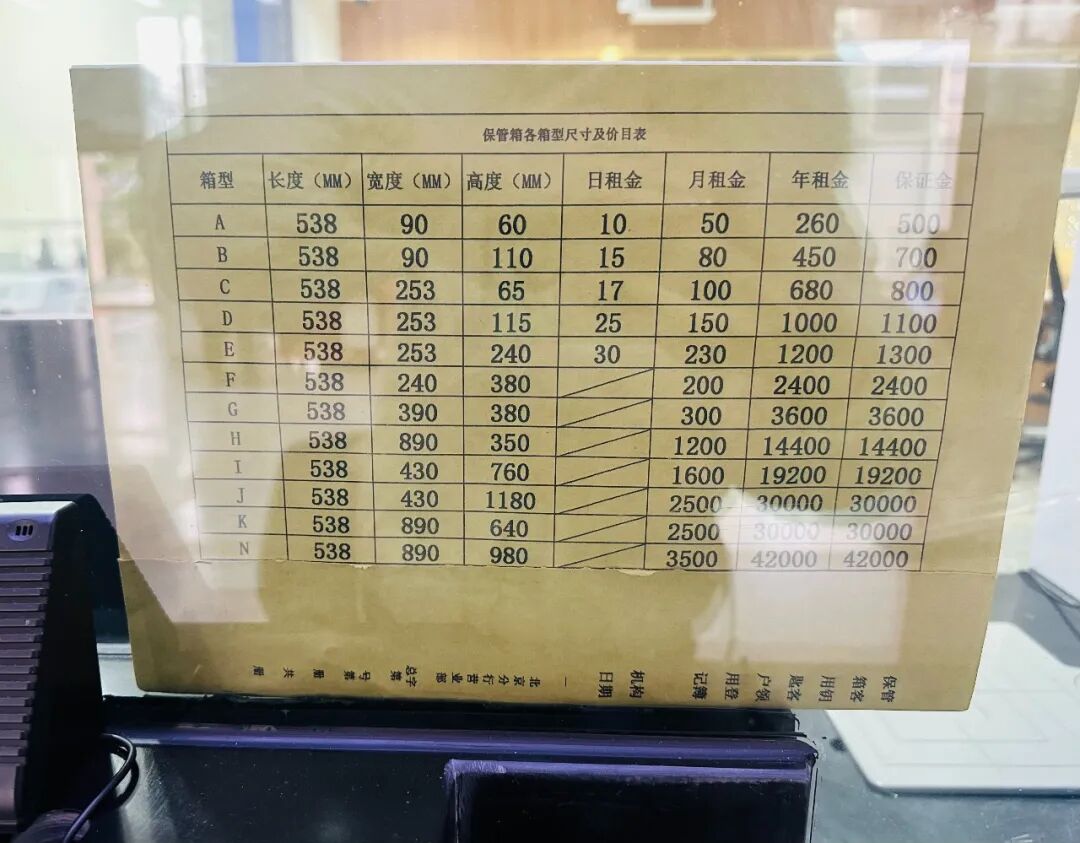
Core Viewpoint - The surge in gold prices has led to a significant increase in demand for bank safe deposit boxes, resulting in a shortage of available boxes in Beijing banks [1][4]. Group 1: Demand for Safe Deposit Boxes - There is a booming demand for safe deposit boxes as residents are increasingly investing in gold, with reports indicating that many banks are fully booked and customers are facing long waiting lists [1][2]. - Some banks have reported waiting lists exceeding 100 people, with estimates suggesting that new customers may not be able to rent boxes until 2026 [2][4]. Group 2: Supply Constraints - The supply of safe deposit boxes has not kept pace with the rising demand, as only larger bank branches typically offer this service, and many smaller branches do not have safe deposit box facilities [1][6]. - Factors such as space limitations and high maintenance costs have prevented banks from expanding their safe deposit box offerings, leading to a decline in the availability of this service [6]. Group 3: Pricing and Variability - Different banks offer various sizes and pricing structures for safe deposit boxes, with significant differences in rental fees based on box dimensions [3][4]. - For example, at China Merchants Bank, the smallest box has a monthly rental fee of 50 yuan, while larger boxes can cost up to 42,000 yuan annually [3]. Group 4: Investor Sentiment and Alternatives - Investors express concerns about the safety of storing physical gold at home, leading many to prefer bank safe deposit boxes for their perceived security [5]. - Some investors are considering alternatives such as home safes due to the high rental costs and long wait times associated with bank safe deposit boxes [7]. Group 5: Innovations and Promotions - To address the supply-demand imbalance, some banks are exploring smart upgrades and promotional offers to attract customers, such as free rental periods for new clients purchasing gold products [7]. - For instance, Qingdao Rural Commercial Bank has offered promotional incentives for customers purchasing gold products, including free usage of safe deposit boxes for a limited time [7].




实探 | “租箱子比买金子难多了!”
Zhong Guo Zheng Quan Bao - Zhong Zheng Wang· 2026-01-14 14:57
Core Insights - The demand for bank safe deposit boxes has surged due to rising gold prices and geopolitical risks, leading to a situation where many banks are fully booked and customers are facing long wait times to rent a box [1][5]. Group 1: Market Demand - Since 2025, the continuous rise in gold prices has fueled investor interest in acquiring gold, resulting in a significant increase in demand for bank safe deposit boxes [5]. - Many investors prefer to store their physical gold in bank safe deposit boxes for security reasons, as they feel safer compared to keeping it at home [6]. Group 2: Supply Constraints - Banks are experiencing a shortage of available safe deposit boxes, with reports indicating that all models are currently rented out and customers are waiting in line, sometimes with over a hundred people ahead [2][5]. - The supply of safe deposit boxes has not kept pace with the growing demand, leading to a situation where potential renters are advised to wait for existing customers to vacate their boxes [6]. Group 3: Pricing Structure - Different banks have varying pricing structures for their safe deposit boxes, with fees based on the size and type of the box. For example, the smallest box at China Merchants Bank has a monthly rental fee of 50 yuan, while the largest can cost up to 42,000 yuan annually [3][4]. - The pricing for safe deposit boxes at Ping An Bank also varies significantly, with the smallest box costing 100 yuan per month and the largest reaching 15,000 yuan annually [4].

银行行业今日净流出资金50.88亿元,招商银行等12股净流出资金超亿元
Zheng Quan Shi Bao Wang· 2026-01-14 09:24
| 代码 | 简称 | 今日涨跌幅(%) | 今日换手率(%) | 主力资金流量(万元) | | --- | --- | --- | --- | --- | | 600036 | 招商银行 | -2.58 | 0.93 | -203476.81 | | 601169 | 北京银行 | -2.71 | 2.18 | -92629.68 | | 601166 | 兴业银行 | -2.38 | 0.61 | -51513.60 | | 600000 | 浦发银行 | -2.85 | 0.41 | -31061.75 | | 600015 | 华夏银行 | -2.81 | 0.99 | -27174.30 | | 601288 | 农业银行 | -1.71 | 0.12 | -24314.35 | | 601658 | 邮储银行 | -1.68 | 0.32 | -19835.95 | | 000001 | 平安银行 | -0.96 | 0.66 | -18038.37 | | 601398 | 工商银行 | -1.54 | 0.14 | -15404.23 | | 601988 | 中国银行 | -1.44 | 0 ...

城商行板块1月14日跌2.11%,北京银行领跌,主力资金净流出7.29亿元
Zheng Xing Xing Ye Ri Bao· 2026-01-14 08:58
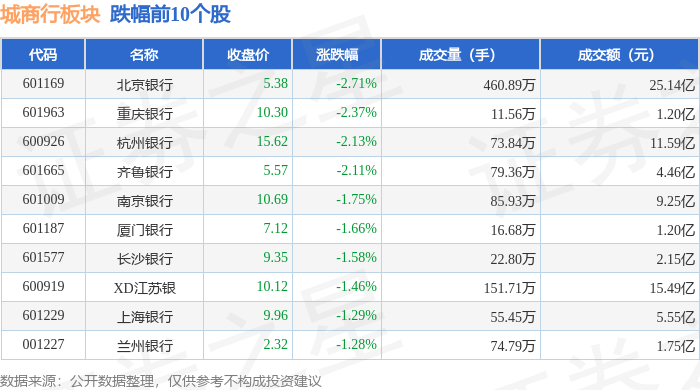
Core Viewpoint - The city commercial bank sector experienced a decline of 2.11% on January 14, with Beijing Bank leading the drop, while the overall market showed mixed results with the Shanghai Composite Index down 0.31% and the Shenzhen Component Index up 0.56% [1] Group 1: Market Performance - The closing price of Beijing Bank was 5.38, down 2.71%, with a trading volume of 4.6089 million shares and a transaction value of 2.514 billion [1] - Other notable declines included Chongqing Bank at 10.30 (-2.37%), Hangzhou Bank at 15.62 (-2.13%), and Qilu Bank at 5.57 (-2.11%) [1] - The city commercial bank sector saw a net outflow of 729 million in main funds, while retail investors contributed a net inflow of 53.1975 million [1] Group 2: Fund Flow Analysis - Hangzhou Bank had a main fund net inflow of 1.20 billion, but a net outflow from retail investors of 92.9469 million [2] - Suzhou Bank recorded a net inflow of 52.503 million from main funds, while retail investors had a net outflow of 54.0558 million [2] - Shanghai Bank experienced a main fund net inflow of 45.3249 million, with a retail net outflow of 46.6735 million [2]



“有流量、无留量”,银行短期营销困局待解
Zhong Guo Zheng Quan Bao· 2026-01-13 12:55
Group 1 - The core activity of banks in early 2023 involves launching asset enhancement marketing campaigns to attract customers by offering rewards for increasing their financial assets [1][2] - Major banks such as Industrial and Commercial Bank of China, Agricultural Bank of China, and Bank of China have initiated these campaigns, which include various incentives for customers to deposit funds [1][4] - The marketing activities are a response to the ongoing pressure on net interest margins, prompting banks to shift focus from traditional deposit assessments to a wealth management competition centered on Assets Under Management (AUM) [1][7] Group 2 - The asset enhancement marketing activities allow customers to earn high points by increasing their average financial assets, which can be redeemed for various gifts and services [2][5] - Agricultural Bank of China's campaign runs until March 31, 2026, offering rewards based on specific asset increase thresholds, ranging from 100,000 to over 600,000 yuan [4] - The trend of banks offering rewards has led to a phenomenon where customers frequently switch banks for better incentives, creating a challenge for banks in retaining these customers long-term [7][8] Group 3 - To address the issue of customer retention, banks are encouraged to develop a layered customer tagging system to differentiate between arbitrage customers and potential long-term clients [8] - The industry is advised to create a comprehensive wealth management system that includes savings, investments, insurance, and trust services to diversify income sources and enhance customer loyalty [8]




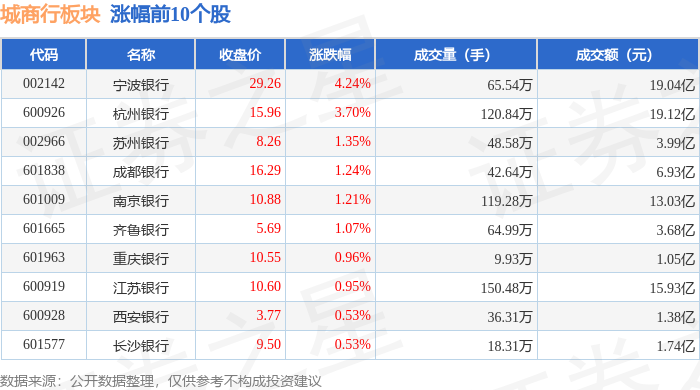
城商行板块1月13日涨1.55%,宁波银行领涨,主力资金净流入2.38亿元
Zheng Xing Xing Ye Ri Bao· 2026-01-13 09:06
Core Insights - The city commercial bank sector experienced a rise of 1.55% on January 13, with Ningbo Bank leading the gains [1] - The Shanghai Composite Index closed at 4138.76, down 0.64%, while the Shenzhen Component Index closed at 14169.4, down 1.37% [1] Stock Performance - Ningbo Bank (002142) closed at 29.26, up 4.24%, with a trading volume of 655,400 shares and a transaction value of 1.904 billion [1] - Hangzhou Bank (600926) closed at 15.96, up 3.70%, with a trading volume of 1,208,400 shares and a transaction value of 1.912 billion [1] - Suzhou Bank (002966) closed at 8.26, up 1.35%, with a trading volume of 485,800 shares [1] - Chengdu Bank (601838) closed at 16.29, up 1.24%, with a trading volume of 426,400 shares and a transaction value of 693 million [1] - Nanjing Bank (600109) closed at 10.88, up 1.21%, with a trading volume of 1,192,800 shares and a transaction value of 1.303 billion [1] - Qilu Bank (601665) closed at 5.69, up 1.07%, with a trading volume of 649,900 shares and a transaction value of 368 million [1] - Chongqing Bank (601963) closed at 10.55, up 0.96%, with a trading volume of 99,300 shares and a transaction value of 10.5 million [1] - Jiangsu Bank (616009) closed at 10.60, up 0.95%, with a trading volume of 1,504,800 shares and a transaction value of 1.593 billion [1] - Xi'an Bank (600928) closed at 3.77, up 0.53%, with a trading volume of 363,100 shares and a transaction value of 13.8 million [1] - Changsha Bank (601577) closed at 9.50, up 0.53%, with a trading volume of 183,100 shares and a transaction value of 174 million [1] Capital Flow - The city commercial bank sector saw a net inflow of 238 million from institutional investors, while retail investors contributed a net inflow of 199 million [2] - The sector experienced a net outflow of 437 million from speculative funds [2] Individual Stock Capital Flow - Hangzhou Bank (600926) had a net inflow of 70.42 million from institutional investors, while it faced a net outflow of 12.4 million from speculative funds [3] - Shanghai Bank (601229) saw a net inflow of 66.71 million from institutional investors, with a net outflow of 33.15 million from speculative funds [3] - Ningbo Bank (002142) had a net inflow of 37.18 million from institutional investors, with a net outflow of 1.4 million from speculative funds [3] - Suzhou Bank (002966) experienced a net inflow of 34.87 million from institutional investors, while facing a net outflow of 24.25 million from speculative funds [3] - Jiangsu Bank (601577) had a net inflow of 20.83 million from institutional investors, with a net outflow of 15.24 million from speculative funds [3]



200万元、叠加补贴最低2%!消费贷利率低位运行
Zhong Guo Jing Ying Bao· 2026-01-13 06:04
Core Viewpoint - In January 2026, consumer loan products are being offered at historically low annual interest rates, with some banks providing rates as low as 2.00% when subsidies are applied, and loan amounts reaching up to 2 million yuan [1][4]. Group 1: Consumer Loan Products - Several banks have introduced promotional policies for consumer loans in January 2026, with one bank announcing a maximum loan amount of 2 million yuan and a minimum annual interest rate of 3.00% [2]. - A city commercial bank has set a minimum interest rate of 3.00% for new customers, with a maximum loan amount of 300,000 yuan, and interest rates ranging from 3.00% to 19.80% based on actual approval results [2][3]. - The minimum annual interest rate for consumer loans is currently at 3.00%, which is the lowest level mandated by regulatory requirements, down from a previous low of 2.60% [2][3]. Group 2: Subsidy Policies - With the addition of consumer loan subsidies, the effective annual interest rate can be reduced to as low as 2.00%, although the subsidy process requires specific conditions such as having a consumption scenario and relevant documentation [4]. - The Chinese government is continuing its consumer loan subsidy policies into 2026, as outlined in a recent State Council meeting aimed at promoting domestic demand through coordinated fiscal and financial policies [4]. - The subsidy policy includes a 1% annual interest rate subsidy for loans under 50,000 yuan and up to 50% of the loan contract interest rate for larger loans in key consumption areas such as home appliances, education, and healthcare [4].

城商行板块1月12日涨0.25%,厦门银行领涨,主力资金净流出6140.56万元
Zheng Xing Xing Ye Ri Bao· 2026-01-12 09:10
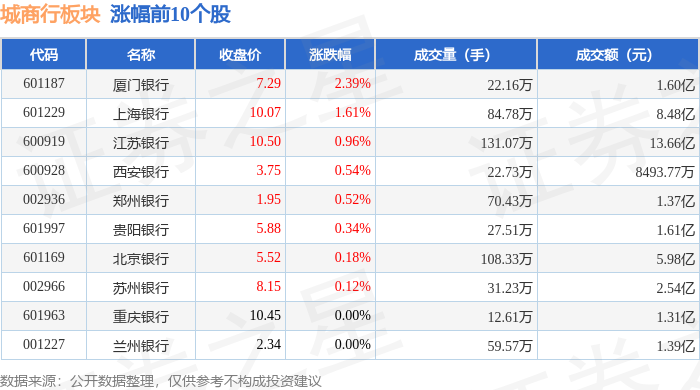
Market Performance - The city commercial bank sector increased by 0.25% compared to the previous trading day, with Xiamen Bank leading the gains [1] - The Shanghai Composite Index closed at 4165.29, up 1.09%, while the Shenzhen Component Index closed at 14366.91, up 1.75% [1] Individual Bank Performance - Xiamen Bank (601187) closed at 7.29, up 2.39% with a trading volume of 221,600 shares and a transaction value of 160 million yuan [1] - Shanghai Bank (601229) closed at 10.07, up 1.61% with a trading volume of 847,800 shares and a transaction value of 848 million yuan [1] - Jiangsu Bank (616009) closed at 10.50, up 0.96% with a trading volume of 1,310,700 shares and a transaction value of 1.366 billion yuan [1] - Other banks such as Xi'an Bank, Zhengzhou Bank, and Beijing Bank also showed minor increases in their stock prices [1] Capital Flow Analysis - The city commercial bank sector experienced a net outflow of 61.41 million yuan from institutional investors, while retail investors saw a net inflow of 66.54 million yuan [2] - The individual capital flow for Jiangsu Bank showed a net inflow of 47.88 million yuan from institutional investors, while retail investors had a net outflow of 51.39 million yuan [3] - Xiamen Bank had a net inflow of 17.18 million yuan from institutional investors, but retail investors experienced a net outflow of 8.30 million yuan [3]

直击绿色融资痛点: 一线金融从业者的创新实践图谱
Zhong Guo Zheng Quan Bao· 2026-01-11 22:15
Core Viewpoint - The green transformation driven by the "dual carbon" goals has become a critical issue for high-quality corporate development, with green finance practitioners innovating products and providing precise services to support traditional and emerging green industries [1] Group 1: Financing Biodiversity and Sustainable Development - There is a noticeable increase in attention towards biodiversity finance, particularly following the implementation of the "Kunming-Montreal Global Biodiversity Framework" and the promotion of the "Biodiversity Finance Directory" by the People's Bank of China [2] - Beijing Rural Commercial Bank, in collaboration with Shou Nong Food Group, launched Beijing's first "Biodiversity + Sustainable Development Linked" loan, targeting ecological protection and sustainable production in agriculture [2] - The loan is designed with quantifiable biodiversity protection performance targets, linking interest rates to performance, thus creating a positive cycle of ecological responsibility and development momentum [2][3] Group 2: Innovation in Green Finance Products - Green credit and transition finance are working together to drive the green transformation of the real economy, with green credit increasing financing costs for high-energy-consuming enterprises, compelling them to transition [4] - Beijing Bank's Suzhou branch has innovated by launching a carbon account certification service, providing 10 million yuan in credit support to a company focused on energy management, thereby reducing the cost of green transformation [4] - The bank also supported Jiangsu Zhonglai Energy Technology Development Group with a transition finance loan of 99.09 million yuan for optimizing production processes and extending product lifespan [5] Group 3: Challenges and Solutions in Green Finance - Despite significant achievements in green finance, challenges remain, such as regional discrepancies in the execution of green finance directories and information asymmetry between enterprises and financial institutions [6] - Experts suggest that by 2026, innovations in green finance products will include more transition financial tools for high-carbon industries, accelerated asset securitization, and digital risk assessment using big data and AI [6] - Policy support is crucial, with recommendations for the government to provide subsidies for enterprises actively pursuing green transitions to further reduce transformation costs [6] Group 4: Future Outlook for Green Finance - The year 2026 is expected to mark a transition from the construction phase to the effectiveness phase of green finance, with a focus on deep value reconstruction of the real economy [7] - Financial resources are anticipated to flow more towards traditional high-carbon industries like steel, cement, and chemicals, addressing the financing difficulties and high costs associated with their transformation [7]
“耐心资本”助力科创企业加速跑
Bei Jing Ri Bao Ke Hu Duan· 2026-01-09 22:17
Group 1 - The core viewpoint of the articles highlights the significant role of patient capital from financial institutions in supporting the growth of technology-driven enterprises in Beijing, with a focus on long-term partnerships and tailored financial solutions [1][2][3] - Beijing Bank has achieved a technology finance loan balance exceeding 440 billion yuan, serving over 30,000 specialized and innovative enterprises, indicating a strong commitment to supporting the local economy [1] - The Chinese government's emphasis on developing technology finance, green finance, inclusive finance, pension finance, and digital finance is reflected in the strategic initiatives of Beijing Bank, which aims to empower the industrial ecosystem [1] Group 2 - The successful IPO of Moer Technology, a domestic GPU manufacturer, was supported by Beijing Bank through initial loans and flexible financing solutions, showcasing the importance of sustained financial backing for long-cycle, capital-intensive enterprises [2] - Beijing Bank has developed a "Science and Technology Radar" evaluation system to identify promising startups and offers a variety of financial products tailored to different stages of enterprise development, including loans for research and development and equity financing [3] - The bank has provided credit funding exceeding 1.45 trillion yuan to nearly 60,000 technology-oriented small and medium-sized enterprises, with a significant percentage of listed companies on various stock exchanges having received financial support from Beijing Bank [3]
