
BOB(601169)

Search documents
城商行板块1月20日涨1.35%,成都银行领涨,主力资金净流入2.66亿元
Zheng Xing Xing Ye Ri Bao· 2026-01-20 08:56
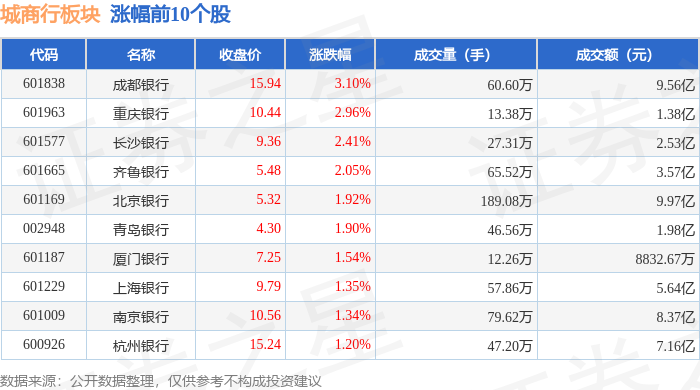
Core Insights - The city commercial bank sector experienced a rise of 1.35% on January 20, with Chengdu Bank leading the gains [1] - The Shanghai Composite Index closed at 4113.65, down 0.01%, while the Shenzhen Component Index closed at 14155.63, down 0.97% [1] Stock Performance - Chengdu Bank (601838) closed at 15.94, up 3.10% with a trading volume of 606,000 shares and a transaction value of 9.56 billion [1] - Chongqing Bank (601963) closed at 10.44, up 2.96% with a trading volume of 133,800 shares and a transaction value of 138 million [1] - Other notable performers include: - Changsha Bank (601577): closed at 9.36, up 2.41% [1] - Qilu Bank (601665): closed at 5.48, up 2.05% [1] - Beijing Bank (601169): closed at 5.32, up 1.92% [1] - Qingdao Bank (002948): closed at 4.30, up 1.90% [1] - Xiamen Bank (601187): closed at 7.25, up 1.54% [1] - Shanghai Bank (601229): closed at 9.79, up 1.35% [1] - Nanjing Bank (601009): closed at 10.56, up 1.34% [1] - Hangzhou Bank (600926): closed at 15.24, up 1.20% [1] Capital Flow - The city commercial bank sector saw a net inflow of 266 million from institutional investors, while retail investors experienced a net outflow of 42.84 million [1] - Detailed capital flow for selected banks includes: - Shanghai Bank (601229): net inflow of 1.051 billion from institutional investors, with net outflows from retail and speculative investors [2] - Hangzhou Bank (600926): net inflow of 90.48 million from institutional investors, with significant outflows from retail and speculative investors [2] - Nanjing Bank (601009): net inflow of 26.57 million from institutional investors, with outflows from retail investors [2] - Other banks also showed varying levels of net inflows and outflows [2]





银行股逆势普涨,齐鲁银行涨近2%
Ge Long Hui· 2026-01-20 03:06
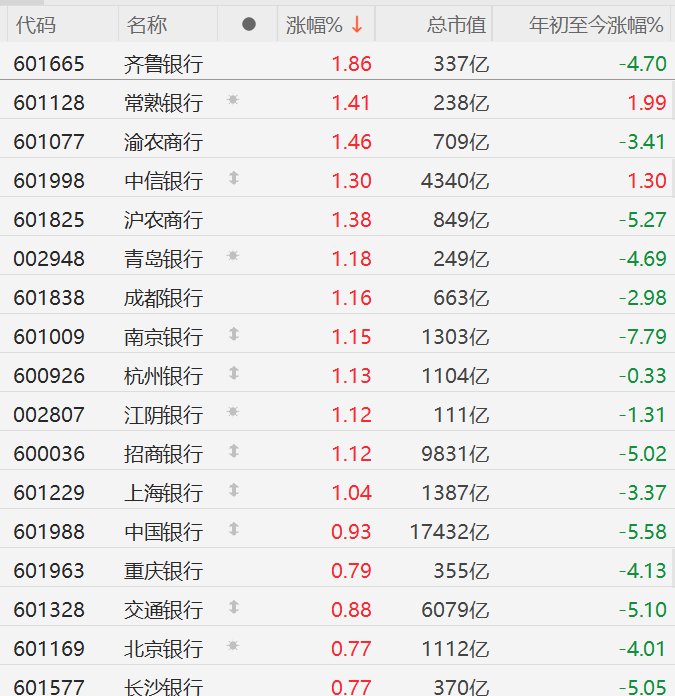
Group 1 - The A-share market saw a significant increase in bank stocks, with Qilu Bank rising nearly 2% and several other banks, including Changshu Bank and Chongqing Rural Commercial Bank, increasing by over 1% [1] - The total market capitalization of Qilu Bank is 33.7 billion, while Changshu Bank has a market cap of 23.8 billion [2] - Year-to-date performance shows that Qilu Bank has decreased by 4.70%, while Changshu Bank has increased by 1.99% [2] Group 2 - Other banks that experienced gains include Yunnan Rural Commercial Bank (1.46%), CITIC Bank (1.30%), and Shanghai Bank (1.04%) [2] - The total market capitalization of CITIC Bank is 434 billion, and it has a year-to-date performance of 1.30% [2] - Despite the gains, many banks still show negative year-to-date performance, such as Shanghai Bank (-3.37%) and China Bank (-5.58%) [2]



银行资负跟踪20260119:降准降息还有空间
GF SECURITIES· 2026-01-19 04:26
Investment Rating - The industry investment rating is "Buy" [3] Core Viewpoints - The report indicates that there is still room for further cuts in reserve requirement ratios and interest rates, with a focus on structural monetary policy support for high-quality economic development [15][19] - The central bank has implemented a reduction of 0.25 percentage points in various structural monetary policy tool rates, signaling a supportive monetary policy stance [15][19] - The report emphasizes the importance of timing for future policy implementations, particularly in relation to government bond issuance peaks and the maturity schedule of high-interest bank deposits [15] Summary by Sections 1. Monetary Policy Adjustments - The report notes a reduction of 0.25 percentage points in structural monetary policy tool rates, with a focus on supporting key areas through increased re-lending [15] - Future attention is directed towards December economic data and January LPR [22] 2. Central Bank Dynamics and Market Rates - The central bank conducted a total of 9,515 billion yuan in 7-day reverse repos at an interest rate of 1.40%, with a net injection of 9,741 billion yuan [16] - The report highlights that the funding rates remained stable, with expectations of slight increases due to tax payments and government bond net repayments [16] 3. Bank Financing Tracking - The report indicates that the total outstanding amount of interbank certificates of deposit (CDs) is 19.09 trillion yuan, with an average issuance rate of 1.65% [20] - The report also notes that there were no commercial bank bond issuances during the period, with a total outstanding commercial bank bond size of 3.38 trillion yuan [20]




负债端稳定,存单提价换量压力不大:存单周报(0112-0118)-20260118
Huachuang Securities· 2026-01-18 14:06
1. Report Industry Investment Rating No information provided in the content. 2. Core View of the Report - The pressure on CDs to "increase prices for volume" is relatively controllable, and there's no need to overly worry about banks' liability - side. Despite a significant increase in CD maturities this week and short - term fluctuations in capital prices, CDs did not "increase prices for volume", indicating a strong continuation of long - term bank deposits after maturity. The current capital frictions are mainly short - term, such as new share subscriptions on the Beijing Stock Exchange and delayed reverse repurchase placements. The central bank actively smoothed out capital fluctuations, and CDs are expected to fluctuate around 1.65% with limited price - increasing pressure [2][46]. 3. Summary According to the Table of Contents Supply: Net financing declines, and the term structure lengthens - This week (January 12 - January 18), CD issuance was 553.58 billion yuan, with a net financing of - 254.88 billion yuan (compared to - 153.30 billion yuan from January 5 - January 11). The issuance proportion of state - owned banks decreased from 19% to 18%, while that of joint - stock banks increased from 11% to 14%, city commercial banks from 44% to 57%, and rural commercial banks from 7% to 9%. The 1M CD issuance proportion dropped from 26% to 8%, while the 3M, 6M, and 9M proportions increased. The weighted issuance term of CDs lengthened to 7.70 months (previously 7.45 months) [2][5]. - Next week (January 19 - January 25), the maturity scale will decline to 681.57 billion yuan, a weekly reduction of 123.80 billion yuan. Maturities are mainly concentrated in state - owned, joint - stock, and city commercial banks. In terms of term, the 3M, 6M, and 1Y CDs have higher maturity amounts, at 163.34 billion yuan, 174.02 billion yuan, and 266.28 billion yuan respectively [2][5]. Demand: Small and medium - sized banks and insurance companies are the main secondary - market allocators, and the primary - market subscription rates vary - In the secondary market, large - scale banks had a net purchase of 26.76 billion yuan this week, small and medium - sized banks had a net purchase of 97.621 billion yuan, wealth management shifted from a net sale of 2.412 billion yuan to a net purchase of 10.777 billion yuan, and money market funds' net sales increased from 57.166 billion yuan to 137.391 billion yuan [2][14]. - In the primary market, the overall market subscription rate (15DMA) decreased from 88% to 87%. Among different institutions, the subscription rate of city commercial banks increased from 81% to 82%, that of joint - stock banks decreased from 89% to 84%, and that of state - owned banks remained at 91% [2][14]. Valuation: The primary - market pricing of CDs shows a divergent trend, and most of the secondary - market pricing declines - In primary - market pricing, the weighted issuance rate of 1Y state - owned bank CDs remained around 1.62%. Specifically, the 1M variety decreased by 9bp, the 3M increased by 3bp, the 6M increased by 1bp, and the 9M and 1Y remained unchanged. The 1Y - 3M term spread of joint - stock banks decreased by 5bp, at the 9% historical quantile. The 1Y credit spread between city commercial banks and joint - stock banks widened from 8.88BP to 9.46BP, at around the 12% quantile, while that between rural commercial banks and joint - stock banks narrowed from 16.17BP to 7.33BP, also around the 12% quantile [2][17]. - In secondary - market yields, most yields of AAA - rated CDs declined. The 1M, 6M, 9M, and 1Y varieties each decreased by 1BP compared to last week, the 3M remained unchanged, and the 1Y remained at the 2% historical quantile since 2019. The 1Y - 3M term spread of AAA - rated CDs remained at the 11% historical quantile [2][29]. Comparison: The spread between CDs and treasury bonds widens - The spread between the 1Y AAA - rated CD yield and the DR007:15DMA capital spread narrowed from 12.32BP to 8.91BP, and the spread with the R007:15DMA capital spread narrowed from 1.56BP to - 0.52BP. The 1Y treasury bond yield decreased by 4.63BP, and the spread between CDs and treasury bonds widened from 34.38BP to 38.26BP, with the quantile rising to around 39%. The spread between CDs and China Development Bank bonds narrowed from 5.46BP to 3.08BP, with the quantile dropping to around 2%. Additionally, the spread between AAA medium - and short - term commercial paper and CDs widened from 6.13BP to 7.36BP, with the quantile rising to around 34% [2][34].

并购市场需求旺盛 贷款投放密集落地
Zhong Guo Jing Ying Bao· 2026-01-16 20:35
Group 1 - The core viewpoint of the article highlights the increasing activity in the domestic merger and acquisition (M&A) market, driven by a series of supportive policies from regulatory authorities, particularly the new guidelines on M&A loans issued by the National Financial Regulatory Administration [1][2][3] - The new M&A loan management regulations allow for a higher proportion of controlling M&A loans in the transaction price, increasing the limit from 60% to 70%, and extending the loan term from seven years to ten years, thereby facilitating financing for M&A transactions [3][4] - The implementation of these regulations has led to a rapid increase in M&A loan projects being approved and disbursed by various commercial banks within a short period, indicating a positive market response to the new policies [2][3][4] Group 2 - The new regulations specifically include minority stake acquisitions in the scope of M&A loans, which aligns with current industrial upgrade needs and is expected to promote industrial integration and high-quality economic development [4][7] - Several banks, including Industrial and Commercial Bank of China and Agricultural Bank of China, have successfully issued the first M&A loans under the new regulations, demonstrating proactive engagement with local enterprises to meet their financing needs [4][5][6] - The regulatory environment is further supported by multiple government departments encouraging industrial mergers and acquisitions, particularly in technology sectors such as electronics and biomedicine, which are seeing increased M&A activity [8][9]



城商行板块1月16日跌1.27%,江苏银行领跌,主力资金净流出2.29亿元
Zheng Xing Xing Ye Ri Bao· 2026-01-16 08:56
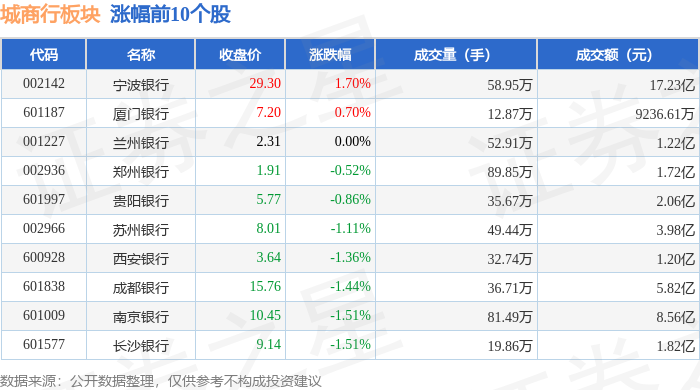
Core Viewpoint - The city commercial bank sector experienced a decline of 1.27% on January 16, with Jiangsu Bank leading the drop. The Shanghai Composite Index closed at 4101.91, down 0.26%, while the Shenzhen Component Index closed at 14281.08, down 0.18% [1]. Group 1: Stock Performance - Ningbo Bank closed at 29.30, up 1.70% with a trading volume of 589,500 shares and a transaction value of 1.723 billion [1]. - Xiamen Bank closed at 7.20, up 0.70% with a trading volume of 128,700 shares and a transaction value of 92.3661 million [1]. - Jiangsu Bank closed at 9.76, down 2.69% with a trading volume of 2,061,300 shares and a transaction value of 2.033 billion [2]. - Shanghai Bank closed at 9.64, down 2.43% with a trading volume of 961,200 shares and a transaction value of 933.3 million [2]. Group 2: Capital Flow - The city commercial bank sector saw a net outflow of 229 million from main funds, while speculative funds had a net inflow of 716 million, and retail investors experienced a net outflow of 487 million [2]. - Hangzhou Bank had a main fund net inflow of 153 million, while retail investors saw a net outflow of 113 million [3]. - Nanjing Bank recorded a main fund net inflow of 70.5 million and a retail net outflow of 131 million [3].
这场变革中,金融力量正发挥重要助力
Xin Lang Cai Jing· 2026-01-15 14:14
Group 1 - China's innovation ecosystem has shown significant results, with many small tech companies receiving support in technology and funding, facilitating their technological breakthroughs [1][10] - Over 600,000 tech and innovative SMEs have been cultivated in China, with more than 140,000 specialized and innovative SMEs and over 17,600 national-level "little giant" enterprises [10] - Private enterprises constitute the majority among specialized and innovative SMEs, which are crucial for the country's technological self-reliance efforts [10] Group 2 - Beijing Bank is a representative pioneer in nurturing industrial innovation through financial support, focusing on technology finance as its primary strategy [2][11] - The bank aims to build a "specialized and innovative first bank" by restructuring service structures and innovating product systems to empower private and tech SMEs [2][12] Group 3 - Beijing Bank has developed a comprehensive financial service system that accompanies tech enterprises throughout their development cycle, providing tailored financial support [4][13] - The bank has established a "1+18+N" technology finance specialized network, serving nearly 60,000 tech SMEs with over 1.45 trillion yuan in credit funding [5][14] Group 4 - The core challenge in serving specialized and innovative enterprises lies in pricing their intangible assets, such as patents and data algorithms, which differ from traditional hard assets [6][15] - Beijing Bank has innovated its risk assessment by integrating various data sources to create dynamic digital profiles of enterprises, enhancing financing efficiency [7][15] Group 5 - The bank's strategy extends beyond individual financing solutions to building a collaborative industrial innovation ecosystem, focusing on key industries like information technology and high-end equipment [18] - By acting as a resource connector, Beijing Bank helps tech companies find market orders and investment partners, transitioning from mere financing to comprehensive intelligence integration [18][19]
北京危旧楼改建融资难题破局!试点银行:个人满足这些条件可申请
Bei Ke Cai Jing· 2026-01-15 13:20
Core Viewpoint - The Beijing Financial Regulatory Bureau has launched a pilot program for financing the renovation of old residential buildings, introducing a specialized "Personal Housing Renovation Loan" product to address residents' financing challenges and improve living conditions in aging neighborhoods [1][6]. Group 1: Pilot Program and Financial Products - The pilot program is the only one in the country supported by the National Financial Supervision Administration, allowing for the creation of a "Personal Housing Renovation Loan" product [1][6]. - Seven banks, including Beijing Bank and China Construction Bank, are participating as pilot banks for the renovation projects [2]. - The first "Personal Housing Renovation Loan" has been successfully issued, marking a significant step in addressing the financing difficulties faced by residents [4][10]. Group 2: Conditions and Process for Borrowers - Borrowers must meet five specific conditions to qualify for the "Personal Housing Renovation Loan," including signing a renovation agreement and demonstrating good creditworthiness [7][8]. - The loan amount is determined based on the renovation costs, and the disbursement aligns with the progress of the renovation project [6][10]. Group 3: Impact on Residents and Urban Development - The initiative aims to alleviate the financial burden on residents during the renovation process, allowing more families to participate and improving living conditions by addressing safety hazards in aging buildings [9][10]. - The program is expected to drive significant fixed asset investment, potentially reaching hundreds of billions in the next five to ten years, thereby stimulating related industries and enhancing overall economic development in Beijing [10].
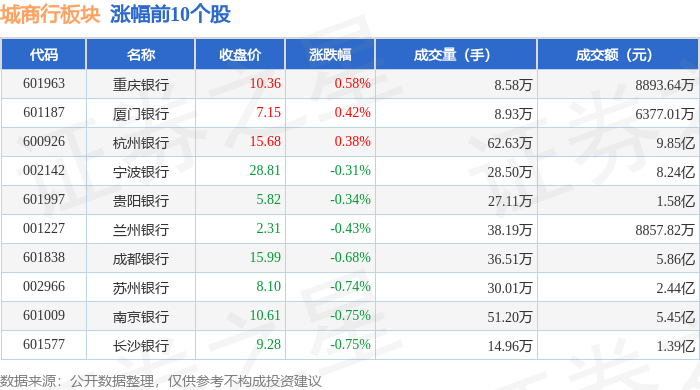
城商行板块1月15日跌0.59%,青岛银行领跌,主力资金净流入2.21亿元
Zheng Xing Xing Ye Ri Bao· 2026-01-15 08:59
Market Performance - The city commercial bank sector declined by 0.59% on January 15, with Qingdao Bank leading the decline [1] - The Shanghai Composite Index closed at 4112.6, down 0.33%, while the Shenzhen Component Index closed at 14306.73, up 0.41% [1] Individual Stock Performance - Chongqing Bank closed at 10.36, up 0.58% with a trading volume of 85,800 shares and a transaction value of 88.94 million [1] - Xiamen Bank closed at 7.15, up 0.42% with a trading volume of 89,300 shares and a transaction value of 63.77 million [1] - Hangzhou Bank closed at 15.68, up 0.38% with a trading volume of 626,300 shares and a transaction value of 9.85 billion [1] - Ningbo Bank closed at 28.81, down 0.31% with a trading volume of 285,000 shares and a transaction value of 824 million [1] - Chengdu Bank closed at 15.99, down 0.68% with a trading volume of 365,100 shares and a transaction value of 586 million [1] Capital Flow Analysis - The city commercial bank sector saw a net inflow of 221 million from institutional investors and a net inflow of 296 million from speculative funds, while retail investors experienced a net outflow of 517 million [2] - Hangzhou Bank had a net inflow of 123 million from institutional investors, accounting for 12.51% of its total [3] - Shanghai Bank had a net inflow of 97.02 million from institutional investors, representing 20.87% of its total [3] - Nanjing Bank had a net inflow of 37.40 million from institutional investors, making up 6.86% of its total [3]
金价飙升后,银行里的“一尺铁柜”成了抢手货
Xin Lang Cai Jing· 2026-01-15 00:02
Core Insights - The rising gold prices have sparked a surge in demand for bank safe deposit boxes, leading to a situation where they are in high demand but low supply [1][4][12] - Many banks in Beijing report that all safe deposit boxes are currently rented out, with waiting lists exceeding 100 customers at some locations [2][10] - The demand for safe deposit boxes is driven by increased interest in gold investments, as geopolitical risks continue to elevate the appeal of gold as a safe-haven asset [4][12] Demand and Supply Dynamics - The demand for safe deposit boxes has significantly increased, with banks reporting a notable rise in inquiries since last year [4][12] - Banks are struggling to keep up with the demand, as the supply of safe deposit boxes has not increased in tandem, leading to a shortage [6][15] - Some banks have ceased offering safe deposit box services altogether due to high maintenance costs and low profitability [15][16] Pricing and Features - Different banks offer various sizes and pricing structures for safe deposit boxes, with significant variations in rental fees [3][11] - For example, at China Merchants Bank, the smallest box has a monthly rental fee of 50 yuan, while larger boxes can cost up to 42,000 yuan annually [11] - Postal Savings Bank offers a fully automated safe deposit box with advanced security features, including 24-hour monitoring and multiple verification methods for access [5][13] Market Trends - The ongoing geopolitical tensions and expectations of continued low interest rates are expected to sustain the demand for gold and, consequently, safe deposit boxes [4][12] - Investors are increasingly looking for secure storage options for their gold investments, as concerns about home security grow [4][12] - Some banks are innovating their services, such as offering promotional deals for customers purchasing gold products, to attract more clients [16]

