BOB(601169)

Search documents
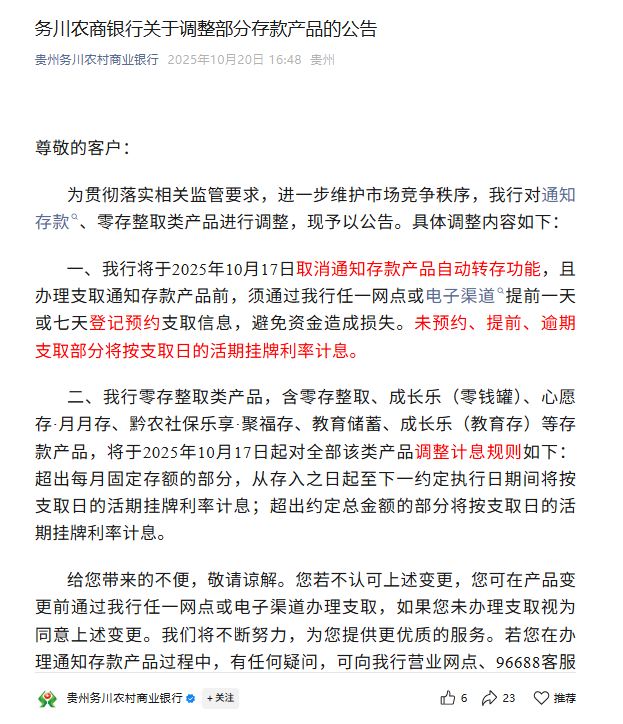
降字当先,多家中小银行取消自动转存,能否助推“存款搬家”?
Feng Huang Wang· 2025-10-21 08:34
Core Viewpoint - Recent adjustments by several small and medium-sized banks in Guizhou Province, including the cancellation of automatic renewal for notice deposits, reflect a response to regulatory requirements aimed at maintaining market order and reducing high-interest deposit products [1][2][5]. Group 1: Regulatory Changes - Guizhou Wuchuan Rural Commercial Bank announced the cancellation of the automatic renewal feature for notice deposits effective October 17, in line with regulatory directives [1][2]. - Over ten banks in Guizhou, including rural credit cooperatives and village banks, have issued similar announcements regarding the adjustment of notice deposit products [5]. - Beijing Bank has also adjusted its notice deposit rates, linking new unit notice deposits to its listed interest rates starting October 1, 2025 [5]. Group 2: Market Impact - The adjustments by local banks are seen as a move to lower notice deposit interest rates and align them more closely with demand deposit rates [5][6]. - Major state-owned banks and most joint-stock banks had already halted automatic renewal of notice deposits in the second half of last year, indicating a broader industry trend [6]. - The disappearance of high-interest deposits and the continuous decline in fixed deposit rates may encourage customers to shift their funds towards bank wealth management products and gold investments [7]. Group 3: Industry Dynamics - The pressure on banks' interest margins has increased, prompting them to reduce high-interest deposit products while seeking alternative methods to attract deposits [6]. - The competitive landscape among banks remains intense, with the potential for some high-interest products to re-emerge in the future [6].


北京银行:北京银行积极践行“All in AI”理念,加快打造“人工智能驱动的商业银行”
Zheng Quan Ri Bao Zhi Sheng· 2025-10-20 14:14
(编辑 任世碧) 证券日报网讯 北京银行10月20日在互动平台回答投资者提问时表示,北京银行积极践行"AllinAI"理 念,加快打造"人工智能驱动的商业银行"。建成"1213"AI体系,就是一体化算力底座、两大模型开发运 营平台、一百余项AI能力、三百余项AI应用场景建设。 ...
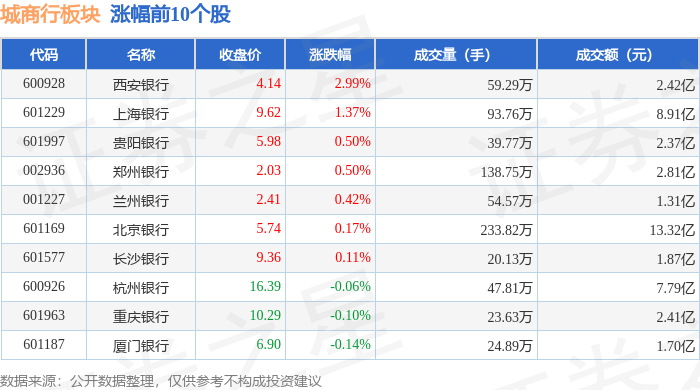
城商行板块10月20日跌0.32%,江苏银行领跌,主力资金净流入2317.93万元
Zheng Xing Xing Ye Ri Bao· 2025-10-20 08:27
Core Insights - The city commercial bank sector experienced a decline of 0.32% on October 20, with Jiangsu Bank leading the drop [1] - The Shanghai Composite Index closed at 3863.89, up 0.63%, while the Shenzhen Component Index closed at 12813.21, up 0.98% [1] Stock Performance - Xi'an Bank (600928) closed at 4.14, up 2.99% with a trading volume of 592,900 shares and a transaction value of 242 million [1] - Shanghai Bank (601229) closed at 9.62, up 1.37% with a trading volume of 937,600 shares and a transaction value of 891 million [1] - Jiangsu Bank (616009) closed at 10.79, down 1.82% with a trading volume of 1,603,000 shares and a transaction value of 173.3 million [2] Capital Flow - The city commercial bank sector saw a net inflow of 23.18 million from institutional investors, while retail investors contributed a net inflow of 52.95 million [2] - The sector experienced a net outflow of 76.12 million from speculative funds [2] Individual Stock Capital Flow - Qilu Bank (601665) had a net inflow of 63.84 million from institutional investors, while it faced a net outflow of 17.01 million from speculative funds [3] - Shanghai Bank (601229) saw a net inflow of 54.98 million from institutional investors, with a net outflow of 18.63 million from speculative funds [3] - Ningbo Bank (002142) recorded a net inflow of 51.83 million from institutional investors, while speculative funds had a net outflow of 45.06 million [3]





北京银行荣获2025年中国版权金奖
Xin Hua Wang· 2025-10-20 07:30
Core Viewpoint - The 10th China International Copyright Expo and 2025 International Copyright Forum was held in Qingdao, co-hosted by the National Copyright Administration and the World Intellectual Property Organization [1] Group 1: Event Participation - Beijing Bank was invited to the event and engaged in in-depth discussions on copyright protection and financial empowerment, being the only financial institution to receive the 2025 China Copyright Gold Award [3] Group 2: Financial Innovation - Beijing Bank recognizes the economic and cultural value of copyrights and has implemented the requirements of the Beijing Regulatory Bureau of the National Financial Supervision Administration and the Beijing Copyright Bureau to support the promotion and application of intellectual property through "mechanism innovation and platform linkage" [5] - The bank launched a specialized product called "Intellectual Property Loan" that allows small and micro enterprises to use core intellectual property such as copyrights as collateral for loans up to ten million yuan, addressing the financing difficulties faced by these enterprises [6] Group 3: Collaborative Platforms - Beijing Bank actively collaborates with professional platforms to integrate financial services with copyright transactions, providing "account + payment" financial services to the Shenzhen Cultural Property Exchange and the National Cultural Big Data Trading Center [7] - The bank is involved in the development of national standards for cultural digital asset valuation and trading, offering professional advice from a financial institution's perspective to promote industry standardization [7] - Future plans include deepening multi-party collaboration, promoting data interaction, expanding application scenarios, and enhancing innovation to build a comprehensive copyright financial service system [7]

区域银行高管互换那些事儿
3 6 Ke· 2025-10-20 02:59
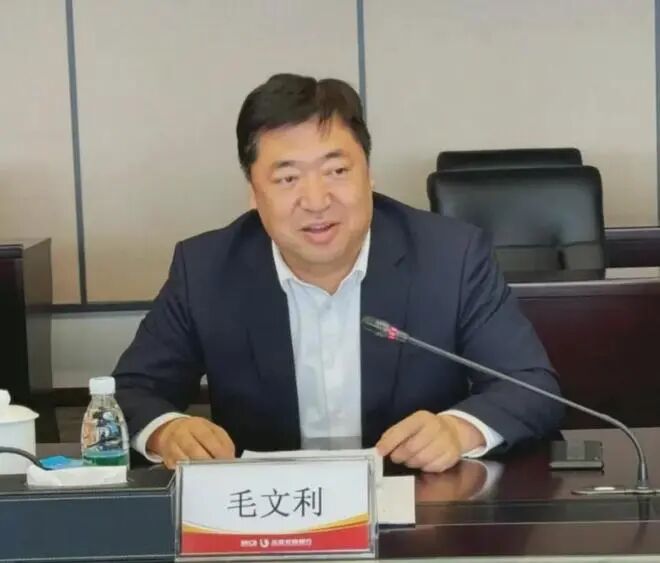
Core Viewpoint - The article discusses the recent trend of leadership exchanges among major banks in China, particularly focusing on the mutual appointments of top executives between Chengdu Bank and Chengdu Rural Commercial Bank, as well as similar movements in Beijing and Shanghai banks, suggesting a potential industry trend towards such leadership rotations [1][15][22]. Group 1: Leadership Changes - Chengdu Bank and Chengdu Rural Commercial Bank announced a mutual exchange of their top executives, with Wang Hui resigning from Chengdu Bank and Huang Jianjun taking over as chairman [15][17]. - In Beijing, multiple executives have shifted roles among major banks, with significant movements including Mao Wenli's appointment as vice president of Beijing Bank from Beijing Rural Commercial Bank [2][7]. - Shanghai banks, including Shanghai Rural Commercial Bank and Shanghai Bank, have also seen leadership changes, with Wang Ming moving from Shanghai Bank to Shanghai Rural Commercial Bank as president [8][10]. Group 2: Executive Backgrounds - Wang Hui, former chairman of Chengdu Bank, has a long history in the banking sector, having joined in 2005 and led the bank to significant growth, including its listing on the stock exchange [18][20]. - Huang Jianjun, the new chairman of Chengdu Bank, has extensive experience within the bank, having held various positions before his recent appointment [20][22]. - In Shanghai, Gu Jianzhong, the new chairman of Shanghai Bank, has a deep understanding of the bank's operations, having worked there for over a decade before moving to Shanghai Rural Commercial Bank [10][12].


多家银行关停旗下App,银行App关闭潮意味着什么?
Sou Hu Cai Jing· 2025-10-18 01:21
Group 1 - Multiple banks have recently announced the shutdown of their mobile apps, with over 10 banks ceasing operations of various apps, including credit card and direct banking apps [3][4] - The trend of shutting down apps is attributed to the inefficiencies and high operational costs associated with maintaining multiple apps, which often leads to resource wastage and management confusion [6][9] - The closure of these apps is also driven by the need for banks to optimize resources and reduce operational costs in a tightening economic environment, as banks face pressure on profitability and must focus on core business areas [10][12] Group 2 - The proliferation of multiple apps within banks has created a "data island" effect, making it difficult for banks to achieve a comprehensive understanding of their customers and provide personalized services [9] - The competitive landscape with internet financial platforms necessitates that banks consolidate their efforts to create a powerful "super app" that can compete effectively against third-party payment platforms [10][12] - The future of banking apps is expected to shift from quantity to quality, with a focus on developing a core app that serves as a comprehensive service platform, integrating financial and lifestyle services [12]

银行研思录23:AH股银行资产质量评估(2025H1):基于“广义不良”和“超额拨备”的分析
CMS· 2025-10-17 09:03
Investment Rating - The report maintains a positive outlook on the banking sector, suggesting that several banks are undervalued based on their asset quality and excess provisioning metrics [4][3]. Core Insights - The valuation premium of banks typically arises from their middle-income and liability advantages, while valuation discounts are often due to concerns over asset quality [2][10]. - The report introduces two key indicators: "broad non-performing asset ratio" and "excess provisioning profit multiple" to objectively assess and compare the current asset quality status of banks [2][10]. - A total of 56 AH-listed banks are analyzed, expanding from the previous report's focus on 42 A-share listed banks, to provide a comprehensive overview of excess provisioning levels and trends [2][10]. Summary by Sections 1. Introduction: Significance of Asset Quality - The report emphasizes the importance of objectively assessing asset quality, as it significantly impacts bank valuations and performance [10]. 2. How to Objectively Assess Bank Non-Performing Assets - Traditional asset quality indicators may not accurately reflect the true provisioning situation due to inconsistent standards and incomplete coverage of assets [14]. - The report proposes a "broad non-performing asset ratio" to better capture the credit risk within banks [14][15]. 3. Construction of Excess Provisioning Profit Multiple Indicator - The excess provisioning profit multiple is constructed to measure the performance elasticity of banks, indicating their potential for future earnings recovery [7][14]. - The report highlights that banks with higher excess provisioning ratios, such as Hangzhou Bank, show strong risk mitigation capabilities [7][14]. 4. Valuation from the Perspective of Broad Excess Provisioning - The long-term correlation between bank valuation levels and ROE is noted, with excess provisioning contributing to performance and valuation improvements [3][4]. - Several banks, including Wuxi Bank and Agricultural Bank (H), are identified as being significantly above the PB-excess provisioning profit multiple regression line, indicating potential investment opportunities [3][4].





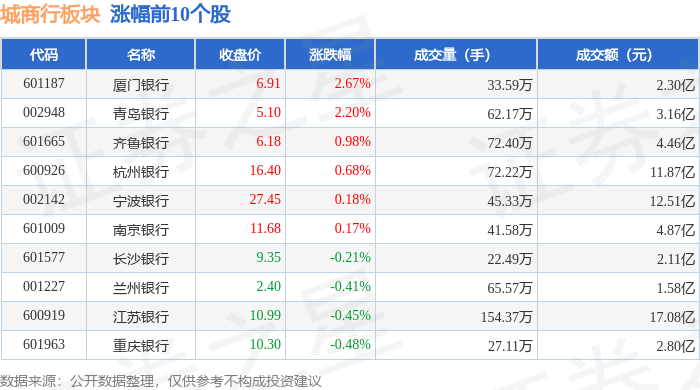
城商行板块10月17日跌0.17%,上海银行领跌,主力资金净流出4.03亿元
Zheng Xing Xing Ye Ri Bao· 2025-10-17 08:35
Market Overview - The city commercial bank sector experienced a decline of 0.17% on October 17, with Shanghai Bank leading the drop [1] - The Shanghai Composite Index closed at 3839.76, down 1.95%, while the Shenzhen Component Index closed at 12688.94, down 3.04% [1] Individual Bank Performance - Xiamen Bank saw a closing price of 6.91, with an increase of 2.67% and a trading volume of 335,900 shares, amounting to a transaction value of 230 million [1] - Qingdao Bank closed at 5.10, up 2.20%, with a trading volume of 621,700 shares and a transaction value of 316 million [1] - In contrast, Shanghai Bank closed at 9.49, down 1.04%, with a trading volume of 768,900 shares and a transaction value of 734 million [2] Capital Flow Analysis - The city commercial bank sector saw a net outflow of 403 million from institutional investors, while retail investors contributed a net inflow of 308 million [2] - The table indicates that Suzhou Bank had a net inflow of 24.27 million from institutional investors, while it faced a net outflow of 14.17 million from speculative funds [3] - Jiangsu Bank experienced a net outflow of 24.10 million from institutional investors but had a net inflow of 1.78 million from retail investors [3]

银行行业点评报告:关注“资金属性”增强过程中的银行经营分化
KAIYUAN SECURITIES· 2025-10-16 02:14
Investment Rating - The industry investment rating is "Positive" (maintained) [1] Core Viewpoints - The banking sector is experiencing a shift towards "wealthization" of deposits, indicating a change in customer behavior and banking operations [9] - The report highlights a divergence in bank operations, with some banks benefiting from enhanced funding attributes while others struggle [8] - The overall sentiment in the banking sector is improving, with dividend yields becoming attractive again after a period of adjustment [9] Summary by Sections Financial Data Analysis - In September, M1 growth was 7.2%, up 1.2 percentage points from the previous month, while M2 growth decreased to 8.4%, down 0.4 percentage points [5] - Social financing (社融) increased by 3.53 trillion yuan in September, with a year-on-year decrease of 229.7 billion yuan, resulting in a stock growth rate of 8.7% [6] - New RMB loans in September amounted to 1.29 trillion yuan, a year-on-year decrease of 300 billion yuan, with a balance growth rate of 6.6% [7] Banking Sector Insights - The report indicates that banks are focusing on a "quantity-price balance" in credit issuance, with a continued trend towards the "wealthization" of deposits [8] - The contribution of funding business to revenue has increased for most state-owned banks, except for Industrial and Commercial Bank of China [23] - The report suggests that banks with a more market-oriented approach and comprehensive licenses will have a competitive advantage in the evolving landscape [8] Investment Recommendations - The report recommends focusing on banks that are well-positioned to benefit from the wealthization of deposits, highlighting specific banks such as China Merchants Bank and Industrial Bank [9] - It emphasizes the attractiveness of H-shares over A-shares in terms of value [9]


成苏宁获选出任绿色动力董事长,曾兼任北京银行董事
Zhong Guo Ji Jin Bao· 2025-10-15 15:10
Group 1 - The core point of the article is the appointment of Cheng Suning as the new chairman of Green Power Environmental Group, which aims to ensure the smooth operation of the company's board and business [2] - Cheng Suning, born in 1984, has extensive management experience in finance and urban functional investment, and has previously served as a director at Beijing Bank [3] - Green Power is a state-owned listed company focused on urban waste incineration power generation and environmental governance, established in March 2000, and is the first A+H share listed company in China's waste incineration power generation industry [4] Group 2 - As of the end of 2024, Green Power operates 37 waste incineration power generation projects across more than 20 provinces and regions in China, with a waste processing capacity of 40,300 tons per day and an installed capacity of 857 MW [4] - For the fiscal year ending June 2025, Green Power reported a revenue of 1.684 billion yuan and a net profit attributable to shareholders of 377 million yuan [4] - As of the market close on October 15, Green Power's stock price was 7.12 yuan per share, with a total market capitalization of 9.921 billion yuan [4]