
Bank Of Shanghai(601229)

Search documents
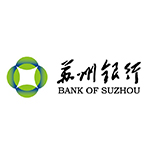
城商行板块1月14日跌2.11%,北京银行领跌,主力资金净流出7.29亿元
Zheng Xing Xing Ye Ri Bao· 2026-01-14 08:58
Core Viewpoint - The city commercial bank sector experienced a decline of 2.11% on January 14, with Beijing Bank leading the drop, while the overall market showed mixed results with the Shanghai Composite Index down 0.31% and the Shenzhen Component Index up 0.56% [1] Group 1: Market Performance - The closing price of Beijing Bank was 5.38, down 2.71%, with a trading volume of 4.6089 million shares and a transaction value of 2.514 billion [1] - Other notable declines included Chongqing Bank at 10.30 (-2.37%), Hangzhou Bank at 15.62 (-2.13%), and Qilu Bank at 5.57 (-2.11%) [1] - The city commercial bank sector saw a net outflow of 729 million in main funds, while retail investors contributed a net inflow of 53.1975 million [1] Group 2: Fund Flow Analysis - Hangzhou Bank had a main fund net inflow of 1.20 billion, but a net outflow from retail investors of 92.9469 million [2] - Suzhou Bank recorded a net inflow of 52.503 million from main funds, while retail investors had a net outflow of 54.0558 million [2] - Shanghai Bank experienced a main fund net inflow of 45.3249 million, with a retail net outflow of 46.6735 million [2]



沪农商行4家支行获评首批“上海银行业老年友好网点”
Zhong Guo Jin Rong Xin Xi Wang· 2026-01-14 07:55
Core Viewpoint - Shanghai Rural Commercial Bank has successfully established several branches as the first batch of "Senior-Friendly Banking Outlets," aiming to enhance financial services for the elderly and fulfill social responsibilities in the context of an aging population [1] Group 1: Senior-Friendly Initiatives - The bank focuses on improving accessibility, convenience, and safety of financial services for the elderly through facility enhancements, process optimization, and extended services [1] - A total of 41 senior service outlets and 3 barrier-free environment construction outlets have been created by the bank [1] Group 2: Specific Branch Initiatives - The Putuo Shiquan branch is the first barrier-free outlet in the city, featuring a "full-process barrier-free" service model and various assistive devices for elderly customers [2] - The Qingpu Liantang branch integrates cultural elements into its design and offers early service hours, health monitoring equipment, and community activities to support elderly clients [3] - The Qingpu Huaxin branch emphasizes a safe and clear environment with a focus on fraud prevention and community outreach, establishing a "15-minute service circle" [4] - The Pudong Caolu branch has implemented a comprehensive approach to elderly service, including home visits and risk prevention education, while enhancing accessibility features [6]

上海农商银行4家支行获评全市首批“上海银行业老年友好网点”
Jin Rong Jie· 2026-01-14 06:36
Core Viewpoint - Shanghai Rural Commercial Bank has successfully established several branches as the first "Senior-Friendly Outlets" in the city, demonstrating leadership in enhancing financial services for the elderly and fulfilling social responsibilities in finance [1] Group 1: Senior-Friendly Initiatives - The bank has created 41 senior service outlets and 3 barrier-free environment outlets to improve accessibility, convenience, and safety for elderly clients [1] - The branches focus on transforming elderly services from mere coverage to quality, emphasizing the importance of tailored financial services for the aging population [1] Group 2: Specific Branch Initiatives - The Putuo Shiquan branch is the first barrier-free outlet in the city, featuring a "full-process barrier-free" service model and various assistive technologies to enhance the experience for elderly clients [2] - The Qingpu Liantang branch integrates cultural elements into its design, offering early service hours and health monitoring facilities to create a comfortable environment for elderly customers [3] - The Qingpu Huaxin branch combines barrier-free construction with elderly-friendly services, establishing a "15-minute service circle" and focusing on fraud prevention for elderly clients [4] - The Pudong Caolu branch emphasizes community engagement by providing financial services and risk prevention education directly to elderly residents in care homes [6]
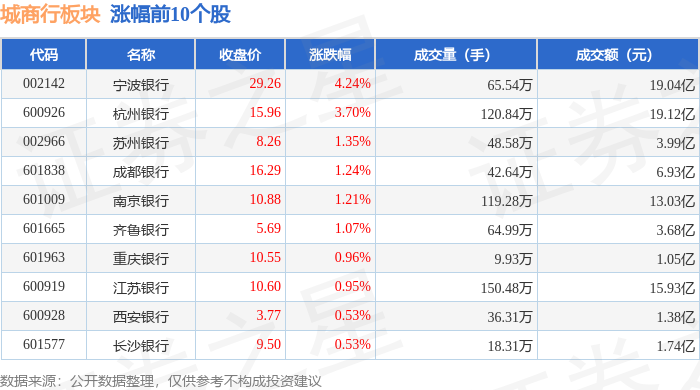
城商行板块1月13日涨1.55%,宁波银行领涨,主力资金净流入2.38亿元
Zheng Xing Xing Ye Ri Bao· 2026-01-13 09:06
Core Insights - The city commercial bank sector experienced a rise of 1.55% on January 13, with Ningbo Bank leading the gains [1] - The Shanghai Composite Index closed at 4138.76, down 0.64%, while the Shenzhen Component Index closed at 14169.4, down 1.37% [1] Stock Performance - Ningbo Bank (002142) closed at 29.26, up 4.24%, with a trading volume of 655,400 shares and a transaction value of 1.904 billion [1] - Hangzhou Bank (600926) closed at 15.96, up 3.70%, with a trading volume of 1,208,400 shares and a transaction value of 1.912 billion [1] - Suzhou Bank (002966) closed at 8.26, up 1.35%, with a trading volume of 485,800 shares [1] - Chengdu Bank (601838) closed at 16.29, up 1.24%, with a trading volume of 426,400 shares and a transaction value of 693 million [1] - Nanjing Bank (600109) closed at 10.88, up 1.21%, with a trading volume of 1,192,800 shares and a transaction value of 1.303 billion [1] - Qilu Bank (601665) closed at 5.69, up 1.07%, with a trading volume of 649,900 shares and a transaction value of 368 million [1] - Chongqing Bank (601963) closed at 10.55, up 0.96%, with a trading volume of 99,300 shares and a transaction value of 10.5 million [1] - Jiangsu Bank (616009) closed at 10.60, up 0.95%, with a trading volume of 1,504,800 shares and a transaction value of 1.593 billion [1] - Xi'an Bank (600928) closed at 3.77, up 0.53%, with a trading volume of 363,100 shares and a transaction value of 13.8 million [1] - Changsha Bank (601577) closed at 9.50, up 0.53%, with a trading volume of 183,100 shares and a transaction value of 174 million [1] Capital Flow - The city commercial bank sector saw a net inflow of 238 million from institutional investors, while retail investors contributed a net inflow of 199 million [2] - The sector experienced a net outflow of 437 million from speculative funds [2] Individual Stock Capital Flow - Hangzhou Bank (600926) had a net inflow of 70.42 million from institutional investors, while it faced a net outflow of 12.4 million from speculative funds [3] - Shanghai Bank (601229) saw a net inflow of 66.71 million from institutional investors, with a net outflow of 33.15 million from speculative funds [3] - Ningbo Bank (002142) had a net inflow of 37.18 million from institutional investors, with a net outflow of 1.4 million from speculative funds [3] - Suzhou Bank (002966) experienced a net inflow of 34.87 million from institutional investors, while facing a net outflow of 24.25 million from speculative funds [3] - Jiangsu Bank (601577) had a net inflow of 20.83 million from institutional investors, with a net outflow of 15.24 million from speculative funds [3]

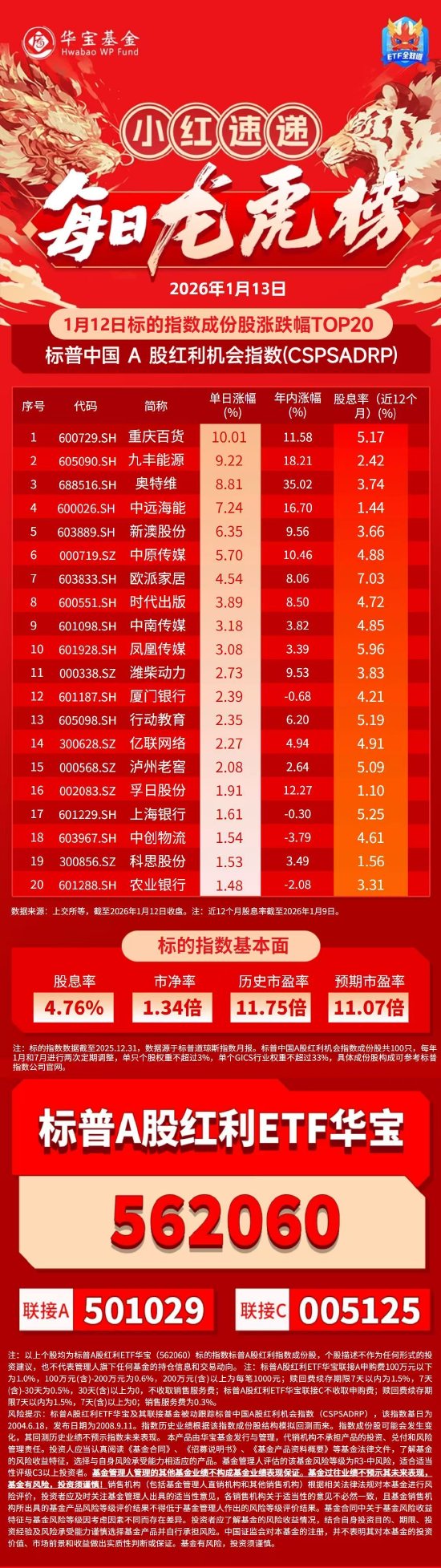
小红日报|重庆百货涨停,标普A股红利ETF华宝(562060)标的指数收涨0.61%
Xin Lang Cai Jing· 2026-01-13 01:09
Core Viewpoint - The article highlights the top-performing stocks in the S&P China A-Share Dividend Opportunity Index as of January 12, 2026, showcasing significant daily and year-to-date gains along with their respective dividend yields. Group 1: Stock Performance - The top stock, Chongqing Department Store (600729.SH), experienced a daily increase of 10.01% and a year-to-date increase of 11.58%, with a dividend yield of 5.17% [1] - Jiufeng Energy (605090.SH) saw a daily rise of 9.22% and a year-to-date rise of 18.21%, with a dividend yield of 2.42% [1] - Aotewei (688516.SH) reported a daily increase of 8.81% and a year-to-date increase of 35.02%, with a dividend yield of 3.74% [1] - Other notable performers include China Merchants Energy (600026.SH) with a daily increase of 7.24% and year-to-date increase of 16.70%, and Xin'ao Co. (603888.SH) with a daily increase of 6.35% and year-to-date increase of 9.56% [1] Group 2: Dividend Yields and Valuation Metrics - The average dividend yield for the index is reported at 4.76%, with a historical price-to-earnings (P/E) ratio of 11.75 times [2] - The expected P/E ratio is noted to be 11.07 times, indicating a stable valuation outlook for the index constituents [2]




城商行板块1月12日涨0.25%,厦门银行领涨,主力资金净流出6140.56万元
Zheng Xing Xing Ye Ri Bao· 2026-01-12 09:10
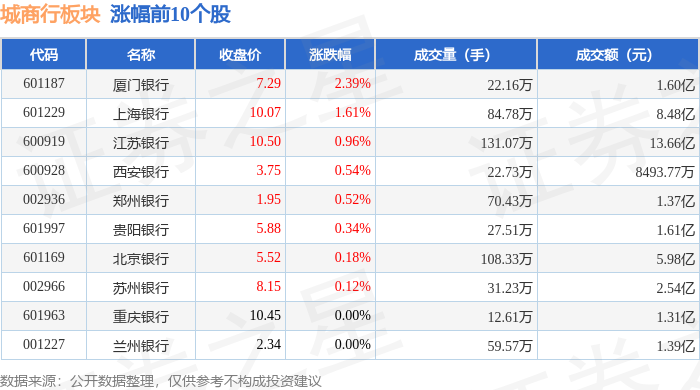
Market Performance - The city commercial bank sector increased by 0.25% compared to the previous trading day, with Xiamen Bank leading the gains [1] - The Shanghai Composite Index closed at 4165.29, up 1.09%, while the Shenzhen Component Index closed at 14366.91, up 1.75% [1] Individual Bank Performance - Xiamen Bank (601187) closed at 7.29, up 2.39% with a trading volume of 221,600 shares and a transaction value of 160 million yuan [1] - Shanghai Bank (601229) closed at 10.07, up 1.61% with a trading volume of 847,800 shares and a transaction value of 848 million yuan [1] - Jiangsu Bank (616009) closed at 10.50, up 0.96% with a trading volume of 1,310,700 shares and a transaction value of 1.366 billion yuan [1] - Other banks such as Xi'an Bank, Zhengzhou Bank, and Beijing Bank also showed minor increases in their stock prices [1] Capital Flow Analysis - The city commercial bank sector experienced a net outflow of 61.41 million yuan from institutional investors, while retail investors saw a net inflow of 66.54 million yuan [2] - The individual capital flow for Jiangsu Bank showed a net inflow of 47.88 million yuan from institutional investors, while retail investors had a net outflow of 51.39 million yuan [3] - Xiamen Bank had a net inflow of 17.18 million yuan from institutional investors, but retail investors experienced a net outflow of 8.30 million yuan [3]

银行业周度追踪2026年第1周:如何理解银行股开年调整?-20260112
Changjiang Securities· 2026-01-12 04:41
Investment Rating - The investment rating for the banking sector is "Positive" and is maintained [12]. Core Insights - In the first week of 2026, the banking sector continued to adjust, with a cumulative decline of 1.9% in the banking index, significantly underperforming the CSI 300 and ChiNext indices by -4.7% and -5.8% respectively. Despite this, the fundamental expectations for the sector remain unchanged, and the market's risk appetite has notably increased [2][6][19]. - The main banks are expected to maintain stable growth in performance throughout 2026. Following recent adjustments, the PB-ROE valuation attractiveness of bank stocks has further increased, suggesting a favorable timing for allocation [2][6][19]. Summary by Sections Market Performance - The banking sector's performance in the first week of 2026 showed a cumulative decline of 1.9%, with significant negative excess returns compared to the CSI 300 and ChiNext indices [6][19]. - Individual stocks such as Chongqing Rural Commercial Bank saw price recovery after management uncertainties were resolved, while stable performers like Hangzhou Bank led the city commercial bank sector [2][6][19]. Fundamental Analysis - The banking sector's performance has been influenced by structural concerns, particularly regarding real estate and retail asset quality. Despite these concerns, overall performance remains stable with steady growth [8][37]. - The LTV (Loan-to-Value) ratios for major banks are stable at 40%-50%, providing a safety margin despite rising asset quality pressures in mortgage loans [8][37]. Trading Dynamics - The increase in market risk appetite has continued to suppress bank stock valuations. Historically, January has seen excess returns for bank stocks, but this year, the rapid recovery in market sentiment has led to underperformance [9][38]. - The report recommends focusing on high-quality city commercial banks such as Hangzhou Bank, Nanjing Bank, and Jiangsu Bank, as well as dividend-oriented assets like Bank of Communications and China Merchants Bank [9][38]. Convertible Bonds - The prices of convertible bonds linked to bank stocks have generally followed the sector's adjustment, with the distance to mandatory conversion prices widening. The report highlights potential trading opportunities in convertible bonds for banks like Changshu Bank and Shanghai Bank, which have stable fundamental performance expectations [7][32].



2026年人工智能金融应用 如何落地
Jin Rong Shi Bao· 2026-01-12 01:55
Core Insights - The integration of artificial intelligence (AI) in the financial sector is seen as a critical opportunity for enhancing operational efficiency and service delivery, with a focus on addressing existing challenges in the industry [2][4][10]. Group 1: Current State of AI in Finance - Financial institutions are recognizing the necessity of adopting digital capabilities across various operational levels to navigate economic fluctuations [2]. - There is a consensus among financial entities regarding the importance of AI applications, although the pace and extent of implementation vary significantly [3]. - AI is primarily being utilized as an auxiliary tool in decision-making processes, with human oversight remaining crucial [3]. Group 2: Key Applications of AI - AI is being applied in several core areas, including digital marketing, risk management, and operational efficiency, with specific use cases such as automated portfolio management and enhanced customer profiling [5]. - The focus is on addressing pain points in financial services, such as improving transparency in technology finance and enhancing the matching of financial products to suitable clients [4][10]. Group 3: Challenges in AI Implementation - The uncertainty associated with AI technologies poses significant challenges, including potential risks in financial services due to computational errors [6]. - There are concerns regarding the clarity of responsibility between business and technical teams, as well as the difficulties in converting expert knowledge into AI training data [7]. - The banking sector faces five core challenges in AI deployment, including the need for optimized management systems and enhanced cross-departmental collaboration [7]. Group 4: Future Trends in AI in Finance - The service model in finance is expected to evolve towards a more seamless, less intrusive experience for customers, with ongoing transformations in physical channels [8]. - The financial sector will likely see a shift in human resource structures and an intensification of competition around data and open ecosystems [8]. - AI is anticipated to play a dual role as both a tool and a catalyst for theoretical innovation, necessitating a balance between technological advancement and ethical considerations [8]. Group 5: Recommendations for AI Development - Financial institutions are encouraged to enhance their technological maturity and create robust organizational frameworks to support AI integration [9]. - There is a call for collaboration between financial entities and external partners, such as academic institutions, to foster innovation in AI applications [9][10]. - Strengthening the infrastructure for AI applications, including improving credit assessment accuracy and establishing a secure data-sharing ecosystem, is essential for the future of finance [10].
在售固收+收益分化:近3月最高超18%,互联网银行未及10%
2 1 Shi Ji Jing Ji Bao Dao· 2026-01-12 01:11
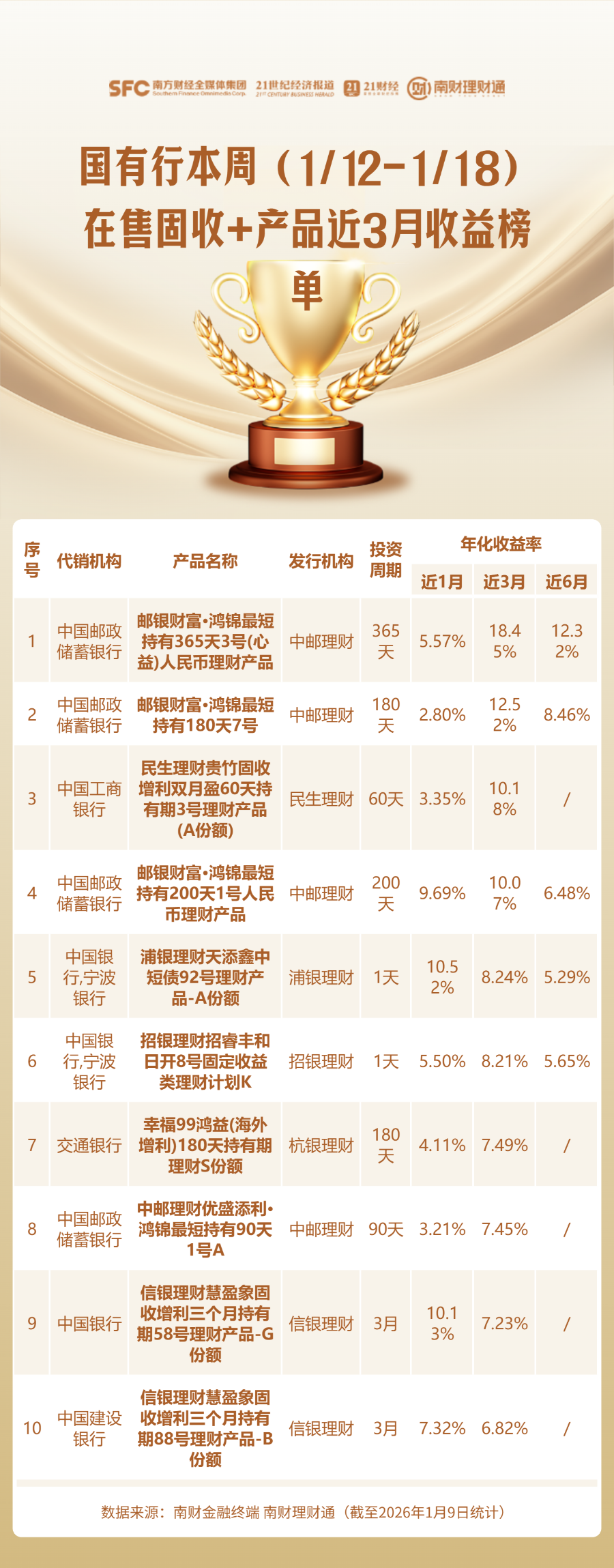
本期,课题组重点关注理财公司发行的"固收+"产品,从代销渠道为投资者筛选出表现较优的在售产品。 为提供有效的选品参考,榜单展示了产品近一月、近三月及近六月的年化业绩,并按照近三月年化收益率进行排序,以此反映 其在近期市场波动中的多维度收益表现。 统计代销机构(28家):工商银行、中国银行、农业银行、邮储银行(601658)、建设银行、交通银行、招商银行、中信银 行、光大银行、民生银行、兴业银行、浦发银行、广发银行、浙商银行(601916)、华夏银行、平安银行、恒丰银行、渤海银 行、北京银行、宁波银行、江苏银行(600919)、上海银行(601229)、南京银行、杭州银行(600926)、徽商银行、微众银 行、网商银行、百信银行。 需要特别提醒的是:本榜单对理财产品"在售"状态的判断基于其投资周期推算。但实际情况中,部分产品可能因额度售罄,或 银行针对不同客户展示的产品清单存在差异而无法购买。因此,建议投资者以代销银行APP的实际展示为准。 | ਲਿ 름 | 代销机构 | 产品名称 | 发行机构 | Harris 周期 | | 年化收益率 | | | --- | --- | --- | --- | --- | ...


银行行业2025年度业绩前瞻:利息收入有望回正
ZHESHANG SECURITIES· 2026-01-11 15:27
Investment Rating - The industry investment rating is "Positive" [3][17] Core Insights - Interest income is expected to return to positive growth, supported by an improvement in net interest margins in Q4 2025, which will offset other non-interest impacts [1] - For the full year 2025, listed banks are projected to see a net profit growth rate of 1.8% and revenue growth of 1.2%, both showing a quarter-on-quarter improvement [1] - Quality city commercial banks are expected to lead the sector, with revenue and profit growth rates projected between 5-10% for 2025 [1] Summary by Relevant Sections Industry Outlook - The overall outlook for 2025 indicates an improvement in net profit and revenue growth for listed banks, primarily due to the alleviation of margin pressures and increased provisions [1] - The asset scale of listed banks is expected to grow by 9.0% year-on-year, reflecting a slowdown compared to previous quarters due to weak credit demand [1] Key Drivers - **Margin Stabilization**: Q4 2025 is expected to see a 2 basis point improvement in net interest margin to 1.32%, driven by a larger decline in funding costs compared to asset yields [1] - **Non-Interest Income**: Non-interest income is projected to grow by 3.2% year-on-year, a decrease from earlier quarters, with a slight positive trend in commission income [1] - **Credit Quality**: The credit cost ratio is expected to decline to 0.67%, indicating a stable improvement in non-performing loans, particularly in retail lending [1] Investment Recommendations - The report suggests that banks with new growth drivers are likely to see significant value recovery, recommending major state-owned banks and select city commercial banks as key investment targets [1][2]

