Bank Of Shanghai(601229)

Search documents
上海银行:“上银转债”将于1月26日支付年度利息
Xin Lang Cai Jing· 2026-01-19 11:59
Core Viewpoint - Shanghai Bank announced that the 200 billion RMB A-share convertible bonds issued on January 25, 2021, will start paying interest on January 26, 2026, for the period from January 25, 2025, to January 24, 2026, with a coupon rate of 3.50% [1][14][18] Summary by Sections Bond Issuance Overview - The convertible bonds, referred to as "Shangyin Convertible Bonds," have a total issuance size of 200 billion RMB, with 20 million bonds issued at a par value of 100 RMB each [6][21] - The bonds were issued from January 25 to January 29, 2021, and listed on February 10, 2021, with a maturity period of six years [21][22] - The coupon rates are structured as follows: 0.30% for the first year, 0.80% for the second year, 1.50% for the third year, 2.80% for the fourth year, 3.50% for the fifth year, and 4.00% for the sixth year [21][22] Interest Payment Details - The interest payment for the current period will be 3.50 RMB per bond (including tax), with the interest payment record date set for January 23, 2026, and the interest payment date on January 26, 2026 [9][10][24] - The interest payment date was postponed from January 25, 2026, due to it being a non-trading day [10][19] Taxation Information - According to the latest tax policy, from January 1, 2026, to December 31, 2027, interest income from bonds held by foreign institutions will be temporarily exempt from corporate income tax and value-added tax [3][18][28] - Individual investors are subject to a 20% personal income tax on interest income, resulting in a net interest payment of 2.80 RMB per bond after tax [12][27] Payment Method - The company has signed an agreement with China Securities Depository and Clearing Corporation Limited Shanghai Branch for bond payment and interest distribution [11][26] - If the company fails to transfer the interest payment funds on time, the responsibility for subsequent payments will revert to the company [11][26]


上海银行(601229) - 上海银行关于“上银转债”2026年付息的进展公告
2026-01-19 11:31
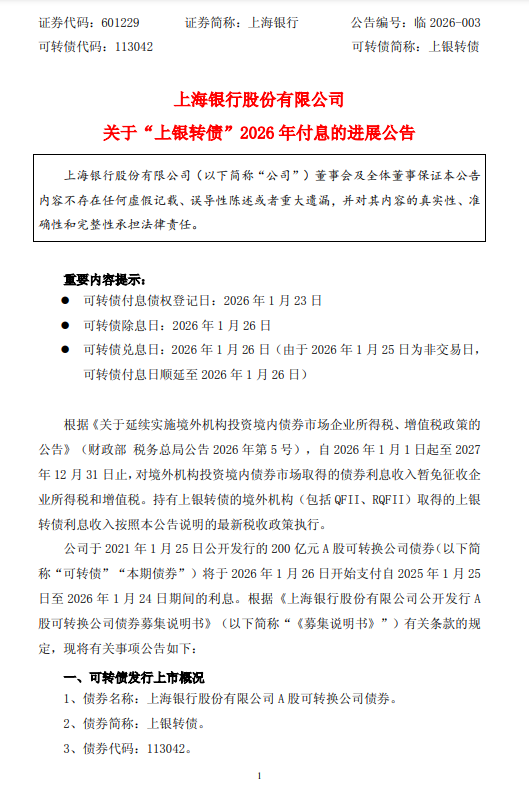
上海银行股份有限公司(以下简称"公司")董事会及全体董事保证本公告 内容不存在任何虚假记载、误导性陈述或者重大遗漏,并对其内容的真实性、准 确性和完整性承担法律责任。 重要内容提示: 根据《关于延续实施境外机构投资境内债券市场企业所得税、增值税政策的 公告》(财政部 税务总局公告 2026 年第 5 号),自 2026 年 1 月 1 日起至 2027 年 12 月 31 日止,对境外机构投资境内债券市场取得的债券利息收入暂免征收企 业所得税和增值税。持有上银转债的境外机构(包括 QFII、RQFII)取得的上银 转债利息收入按照本公告说明的最新税收政策执行。 公司于 2021 年 1 月 25 日公开发行的 200 亿元 A 股可转换公司债券(以下简 称"可转债""本期债券")将于 2026 年 1 月 26 日开始支付自 2025 年 1 月 25 日至 2026 年 1 月 24 日期间的利息。根据《上海银行股份有限公司公开发行 A 股可转换公司债券募集说明书》(以下简称"《募集说明书》")有关条款的规 定,现将有关事项公告如下: 证券代码:601229 证券简称:上海银行 公告编号:临 2026-00 ...
华泰研究:结构性降息落地,融资逆周期调节
HTSC· 2026-01-19 03:10
Investment Rating - The report maintains an "Overweight" rating for the securities and banking sectors, while also suggesting a positive outlook for the insurance sector [10][40]. Core Insights - The report highlights a structural monetary policy shift with a focus on "increasing quantity and reducing price," indicating potential for further interest rate cuts and reserve requirement ratio reductions [12][41]. - The A-share market remains active, with an average daily trading volume of 3.47 trillion yuan and a financing balance exceeding 2.7 trillion yuan, marking a new high [12][28]. - The report emphasizes the importance of the recent increase in the minimum margin requirement for financing from 80% to 100%, which aims to stabilize market conditions and reduce leverage [14][18]. Securities Sector Summary - The securities sector is expected to benefit from improved market conditions, with a focus on high-quality brokerage firms such as CITIC Securities and Guotai Junan [3][27]. - The report notes that the recent increase in financing margin requirements is a regulatory measure to control leverage and stabilize market sentiment [14][15]. - CITIC Securities reported a 38% year-on-year increase in net profit for 2025, reflecting strong performance in brokerage and investment banking [27]. Insurance Sector Summary - The insurance sector is advised to focus on high-quality leading companies, as the market has recognized the strong performance of life insurance sales [39]. - The report indicates that the main drivers for insurance stock prices are currently on the asset side rather than the liability side, leading to some price corrections [12][39]. Banking Sector Summary - The banking sector is characterized by a stable performance, with major banks like Shanghai Bank and Nanjing Bank recommended for investment due to their solid fundamentals [3][40]. - The report highlights a decrease in social financing growth, primarily due to high government debt base effects, but notes an increase in corporate loans [42][43]. - The Central Bank's recent policies suggest room for further interest rate cuts, which could enhance the banking sector's profitability [41][40].




企业端发力支撑信贷
HTSC· 2026-01-16 12:01
Investment Rating - The report maintains a "Buy" rating for several banks, including Chengdu Bank, Chongqing Rural Commercial Bank, Nanjing Bank, Industrial and Commercial Bank of China, Shanghai Bank, and China Construction Bank, while recommending "Hold" for Chongqing Rural Commercial Bank [8][35]. Core Insights - The report highlights that corporate lending has become the main driver of credit growth, with December's new loans reaching 910 billion yuan, exceeding expectations, while household loans contracted significantly [2][5]. - The total social financing for 2025 is projected to be 35.6 trillion yuan, an increase of 3.34 trillion yuan year-on-year, supported mainly by government bonds [5][12]. - The report indicates a recovery in corporate bond financing, with December seeing an increase of 1.54 billion yuan, while government bond financing decreased significantly due to a high base effect from the previous year [3][5]. Summary by Sections Credit Growth - December's new loans amounted to 910 billion yuan, with corporate loans increasing by 1.07 trillion yuan, while household loans decreased by 916 billion yuan [2][5]. - The overall loan growth rate for December was 6.4%, remaining stable compared to November [2][12]. Social Financing - The total social financing in December was 2.21 trillion yuan, with a year-on-year decrease of 646.2 billion yuan, primarily due to fluctuations in government bonds [1][5]. - For the entire year of 2025, social financing is expected to grow significantly, driven by government support [5][12]. Monetary Supply - M1 and M2 growth rates for December were 3.8% and 8.5%, respectively, with M1 showing a decline due to limited demand for corporate current funds [4][12]. - New deposits in December reached 1.68 trillion yuan, with a year-on-year increase of 3.08 trillion yuan [4][12]. Investment Recommendations - The report recommends specific stocks for investment, including Chengdu Bank (target price 23.25 yuan), Nanjing Bank (target price 14.78 yuan), and Industrial and Commercial Bank of China (target price 8.31 yuan) [11][35].
城商行板块1月16日跌1.27%,江苏银行领跌,主力资金净流出2.29亿元
Zheng Xing Xing Ye Ri Bao· 2026-01-16 08:56
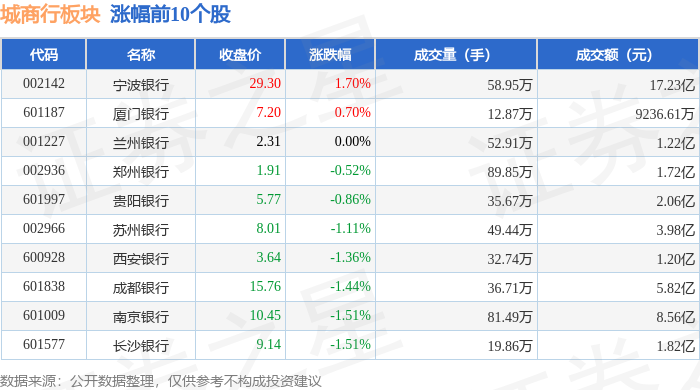
Core Viewpoint - The city commercial bank sector experienced a decline of 1.27% on January 16, with Jiangsu Bank leading the drop. The Shanghai Composite Index closed at 4101.91, down 0.26%, while the Shenzhen Component Index closed at 14281.08, down 0.18% [1]. Group 1: Stock Performance - Ningbo Bank closed at 29.30, up 1.70% with a trading volume of 589,500 shares and a transaction value of 1.723 billion [1]. - Xiamen Bank closed at 7.20, up 0.70% with a trading volume of 128,700 shares and a transaction value of 92.3661 million [1]. - Jiangsu Bank closed at 9.76, down 2.69% with a trading volume of 2,061,300 shares and a transaction value of 2.033 billion [2]. - Shanghai Bank closed at 9.64, down 2.43% with a trading volume of 961,200 shares and a transaction value of 933.3 million [2]. Group 2: Capital Flow - The city commercial bank sector saw a net outflow of 229 million from main funds, while speculative funds had a net inflow of 716 million, and retail investors experienced a net outflow of 487 million [2]. - Hangzhou Bank had a main fund net inflow of 153 million, while retail investors saw a net outflow of 113 million [3]. - Nanjing Bank recorded a main fund net inflow of 70.5 million and a retail net outflow of 131 million [3].


上海银行股份有限公司关于“上银转债”2026年付息公告
Shang Hai Zheng Quan Bao· 2026-01-15 19:28
Core Viewpoint - Shanghai Bank will begin paying interest on its convertible bonds, "Shangyin Convertible Bonds," starting January 26, 2026, for the period from January 25, 2025, to January 24, 2026 [2][11]. Group 1: Convertible Bond Overview - The company issued 20 billion RMB worth of convertible bonds on January 25, 2021, with a total of 20 million bonds issued at a face value of 100 RMB each [5]. - The bonds have a maturity period of six years, from January 25, 2021, to January 24, 2027 [5]. - The bonds are convertible into the company's A-shares [2]. Group 2: Interest Payment Details - The interest rates for the bonds are structured as follows: 0.30% for the first year, 0.80% for the second year, 1.50% for the third year, 2.80% for the fourth year, 3.50% for the fifth year, and 4.00% for the sixth year [3]. - The interest for the current period is set at 3.50% (including tax), amounting to 3.50 RMB per bond [11]. - The interest payment record date is January 23, 2026, with the interest payment date and ex-dividend date both on January 26, 2026 [4][12]. Group 3: Tax Implications - Individual investors are subject to a 20% tax on interest income, resulting in a net payment of 2.80 RMB per bond after tax [14]. - For corporate investors, the interest income is subject to self-payment of taxes, with the gross amount remaining at 3.50 RMB per bond [14]. - Foreign institutional investors are temporarily exempt from corporate income tax and value-added tax until December 31, 2025 [15]. Group 4: Contact Information - The issuer is Shanghai Bank, located at 688 Zhongshan South Road, Huangpu District, Shanghai [15]. - The underwriter and trustee for the convertible bonds is Guotai Junan Securities Co., Ltd. [15].
上海银行(601229) - 上海银行关于“上银转债”2026年付息公告
2026-01-15 10:32
关于"上银转债"2026 年付息公告 上海银行股份有限公司(以下简称"公司")董事会及全体董事保证本公告 内容不存在任何虚假记载、误导性陈述或者重大遗漏,并对其内容的真实性、准 确性和完整性承担法律责任。 1 可转债付息债权登记日:2026 年 1 月 23 日 可转债除息日:2026 年 1 月 26 日 可转债兑息日:2026 年 1 月 26 日(由于 2026 年 1 月 25 日为非交易日, 可转债付息日顺延至 2026 年 1 月 26 日) 证券代码:601229 证券简称:上海银行 公告编号:临 2026-002 可转债代码:113042 可转债简称:上银转债 上海银行股份有限公司 重要内容提示: 公司于 2021 年 1 月 25 日公开发行的 200 亿元 A 股可转换公司债券(以下简 称"可转债""本期债券""上银转债")将于 2026 年 1 月 26 日开始支付自 2025 年 1 月 25 日至 2026 年 1 月 24 日期间的利息。根据《上海银行股份有限公 司公开发行 A 股可转换公司债券募集说明书》(以下简称"《募集说明书》") 有关条款的规定,现将有关事项公告如下: 一、 ...
城商行板块1月15日跌0.59%,青岛银行领跌,主力资金净流入2.21亿元
Zheng Xing Xing Ye Ri Bao· 2026-01-15 08:59
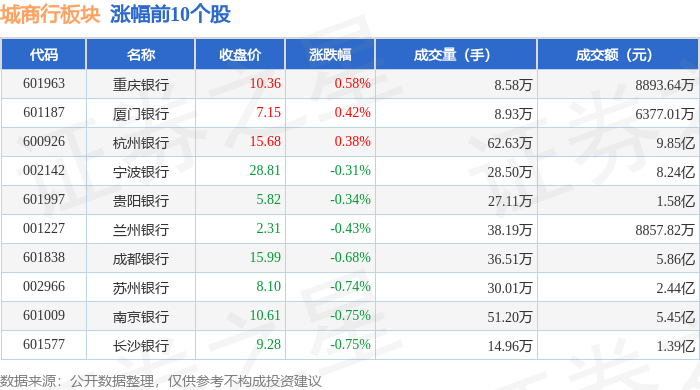
Market Performance - The city commercial bank sector declined by 0.59% on January 15, with Qingdao Bank leading the decline [1] - The Shanghai Composite Index closed at 4112.6, down 0.33%, while the Shenzhen Component Index closed at 14306.73, up 0.41% [1] Individual Stock Performance - Chongqing Bank closed at 10.36, up 0.58% with a trading volume of 85,800 shares and a transaction value of 88.94 million [1] - Xiamen Bank closed at 7.15, up 0.42% with a trading volume of 89,300 shares and a transaction value of 63.77 million [1] - Hangzhou Bank closed at 15.68, up 0.38% with a trading volume of 626,300 shares and a transaction value of 9.85 billion [1] - Ningbo Bank closed at 28.81, down 0.31% with a trading volume of 285,000 shares and a transaction value of 824 million [1] - Chengdu Bank closed at 15.99, down 0.68% with a trading volume of 365,100 shares and a transaction value of 586 million [1] Capital Flow Analysis - The city commercial bank sector saw a net inflow of 221 million from institutional investors and a net inflow of 296 million from speculative funds, while retail investors experienced a net outflow of 517 million [2] - Hangzhou Bank had a net inflow of 123 million from institutional investors, accounting for 12.51% of its total [3] - Shanghai Bank had a net inflow of 97.02 million from institutional investors, representing 20.87% of its total [3] - Nanjing Bank had a net inflow of 37.40 million from institutional investors, making up 6.86% of its total [3]

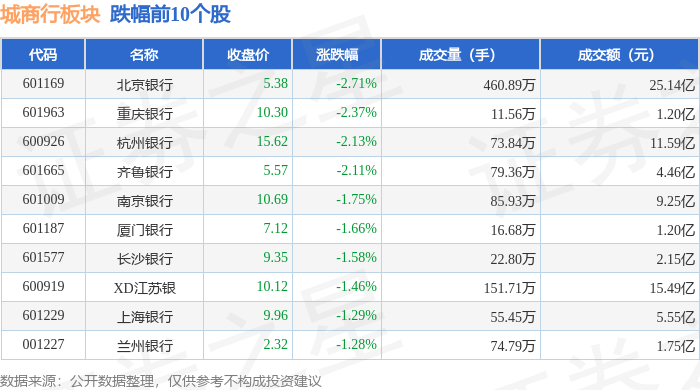
城商行板块1月14日跌2.11%,北京银行领跌,主力资金净流出7.29亿元
Zheng Xing Xing Ye Ri Bao· 2026-01-14 08:58
Core Viewpoint - The city commercial bank sector experienced a decline of 2.11% on January 14, with Beijing Bank leading the drop, while the overall market showed mixed results with the Shanghai Composite Index down 0.31% and the Shenzhen Component Index up 0.56% [1] Group 1: Market Performance - The closing price of Beijing Bank was 5.38, down 2.71%, with a trading volume of 4.6089 million shares and a transaction value of 2.514 billion [1] - Other notable declines included Chongqing Bank at 10.30 (-2.37%), Hangzhou Bank at 15.62 (-2.13%), and Qilu Bank at 5.57 (-2.11%) [1] - The city commercial bank sector saw a net outflow of 729 million in main funds, while retail investors contributed a net inflow of 53.1975 million [1] Group 2: Fund Flow Analysis - Hangzhou Bank had a main fund net inflow of 1.20 billion, but a net outflow from retail investors of 92.9469 million [2] - Suzhou Bank recorded a net inflow of 52.503 million from main funds, while retail investors had a net outflow of 54.0558 million [2] - Shanghai Bank experienced a main fund net inflow of 45.3249 million, with a retail net outflow of 46.6735 million [2]
沪农商行4家支行获评首批“上海银行业老年友好网点”
Zhong Guo Jin Rong Xin Xi Wang· 2026-01-14 07:55
Core Viewpoint - Shanghai Rural Commercial Bank has successfully established several branches as the first batch of "Senior-Friendly Banking Outlets," aiming to enhance financial services for the elderly and fulfill social responsibilities in the context of an aging population [1] Group 1: Senior-Friendly Initiatives - The bank focuses on improving accessibility, convenience, and safety of financial services for the elderly through facility enhancements, process optimization, and extended services [1] - A total of 41 senior service outlets and 3 barrier-free environment construction outlets have been created by the bank [1] Group 2: Specific Branch Initiatives - The Putuo Shiquan branch is the first barrier-free outlet in the city, featuring a "full-process barrier-free" service model and various assistive devices for elderly customers [2] - The Qingpu Liantang branch integrates cultural elements into its design and offers early service hours, health monitoring equipment, and community activities to support elderly clients [3] - The Qingpu Huaxin branch emphasizes a safe and clear environment with a focus on fraud prevention and community outreach, establishing a "15-minute service circle" [4] - The Pudong Caolu branch has implemented a comprehensive approach to elderly service, including home visits and risk prevention education, while enhancing accessibility features [6]